
Global Opioid Use Disorder Market Size, Share, Growth Trends, and Forecasts 2032

Opioid Use Disorder Market By Drug (Buprenorphine, Methadone, and Naltrexone), By Route Of Administration (Oral Administration, Injectable Administration, and Others), By Distribution Channel (Hospital & Pharmacies, Retail Pharmacies, and Others), and By Region - Global and Regional Industry Overview, Market Intelligence, Comprehensive Analysis, Historical Data, and Forecasts 2024 - 2032
| Market Size in 2023 | Market Forecast in 2032 | CAGR (in %) | Base Year |
|---|---|---|---|
| USD 3.10 Billion | USD 7.65 Billion | 10.58% | 2023 |
Opioid Use Disorder Industry Perspective
What will be the global opioid use disorder market size during the forecast period?
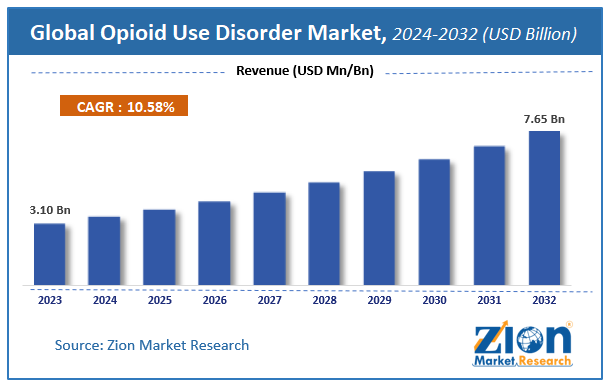
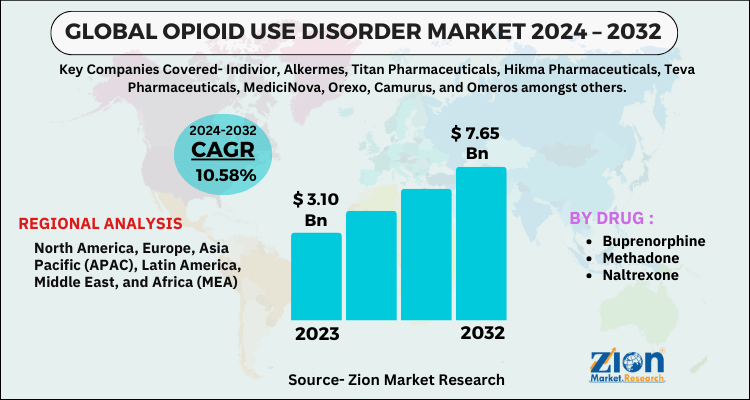
The global opioid use disorder market size was worth around USD 3.10 billion in 2023 and is predicted to grow to around USD 7.65 billion by 2032 with a compound annual growth rate (CAGR) of roughly 10.58% between 2024 and 2032.
This report provides a comprehensive analysis of the growth drivers, restraints, and challenges shaping demand across the global opioid use disorder market throughout the forecast period, while highlighting high-potential emerging opportunities within the industry.
Key Insights
- As per the analysis shared by our research analyst, the global opioid use disorder market is estimated to grow annually at a CAGR of around 10.58% over the forecast period (2025-2030).
- In terms of revenue, the global opioid use disorder market size was valued at around USD 3.10 billion in 2023 and is projected to reach USD 7.65 billion by 2030.
- The opioid use disorder market is projected to grow at a significant rate due to the rising opioid epidemic, growing government initiatives to combat the crisis, and increasing commercialization of novel medication-assisted treatment products.
- Based on the drug, the buprenorphine segment led the market and accounted for 59.58% of global revenue in 2023 due to its effective dual action as a partial opioid agonist that helps alleviate withdrawal symptoms and cravings while minimizing euphoria and misuse risk.
- Based on the route of administration, the injectable segment dominated and accounted for 59.26% of global revenue in 2023, as extended-release injectables such as Vivitrol (naltrexone) and Sublocade (buprenorphine) offer prolonged, steady drug delivery that improves adherence and reduces relapse risk.
- Based on the distribution channel, the hospital & pharmacies segment dominated with a market share of 47.90% in 2023 due to their integral role in managing complex and severe cases of opioid use disorder.
- Based on region, North America accounted for a 68.98% share in 2023 due to the highest prevalence of opioid use disorder in the region, which drives significant demand for treatment solutions.
Opioid Use Disorder Market: Overview
Opioids, used for pain relief medicinally, have depressing effects on the analgesic and central nervous system as well as the potential for euphoria. Opioid use disorder (OUD) may include misuse of prescribed opioid drugs, use of diverted opioid drugs, or use of unlawfully obtained heroin. Opioid use disorder is typically a chronic, recurrent disease associated with significantly higher morbidity and mortality rates.
Opioid Use Disorder Market: Growth Factors
What factors are propelling the expansion of the opioid use disorder market?
The growing number of patients suffering from opioid-related addiction, rising government initiatives, and increasing support from NGOs and agencies are key factors driving the market for disorder treatment for opioid use.
With the help of government agencies and many others, NGOs coordinate various programs and campaigns to increase awareness of the clinical ill effects of Opioid abuse. These programs are aimed at eradicating illicit drug use in federal workplaces and contributing to drug-free workplaces.
Opioid Use Disorder Market: Restraints
What factors are limiting the growth of the opioid use disorder market?
However, individuals ' reluctance to access treatment modalities and the discontinuation of behavioral therapies that lead to relapse are the factors that restrict this market's growth.
Treatment access gaps in rural and underserved areas, along with challenges related to adherence and retention in care, also moderate market expansion. Cost and reimbursement considerations for newer formulations can further influence adoption rates.
Opioid Use Disorder Market: Report Scope
| Report Attributes | Report Details |
|---|---|
| Report Name | Opioid Use Disorder Market |
| Market Size in 2023 | USD 3.10 Billion |
| Market Forecast in 2032 | USD 7.65 Billion |
| Growth Rate | CAGR of 10.58% |
| Number of Pages | 230 |
| Key Companies Covered | Indivior PLC, Teva Pharmaceutical Industries, Ltd., Pfizer, Inc., Collegium Pharmaceutical (BioDelivery Sciences International, Inc.), Alkermes, Inc., Orexo US, Inc. (a part of Orexo AB), Titan Pharmaceuticals, Inc., Omeros Corporation, Camurus AB, Hikma Pharmaceuticals PLC, and Others. |
| Segments Covered | By Drug, By Route Of Administration, By Distribution Channel, and By Region |
| Regions Covered | North America, Europe, Asia Pacific (APAC), Latin America, Middle East, and Africa (MEA) |
| Base Year | 2023 |
| Historical Year | 2018 - 2022 |
| Forecast Year | 2024 - 2032 |
| Customization Scope | Avail customized purchase options to meet your exact research needs. Request For Customization |
Opioid Use Disorder Market: Segmentation
The opioid use disorder market is segmented by drug, route of administration, distribution channel, and region. All the segments of the opioid use disorder market have been analyzed based on present and future trends and the market is estimated from 2024 to 2032.
Based on Drugs, the market is segmented into buprenorphine, methadone, and naltrexone. Buprenorphine is further classified into Bunavail, Sublocade, Suboxone, Zubsolv, and Others. The largest revenue-generating segment in 2023 was buprenorphine. The most widely prescribed drugs for opioid use disorder include buprenorphine/naloxone sublingual tablets, branded suboxone, and buprenorphine sublingual tablets. Because of its excellent clinical profile, Suboxone Film is the most prescribed drug on the opioid use disorder market. High effectiveness in addiction treatment, low potential for abuse & relatively slight adverse effects, and favorable type exposure are factors that can contribute to this drug's high acceptance.
Based on Route of Administration, the opioid use disorder market is divided into oral administration, injectable administration, and others. The injectable segment dominated and accounted for 59.26% of global revenue in 2023. Extended-release injectables such as Sublocade (buprenorphine) and Vivitrol (naltrexone) provide prolonged, steady drug delivery that improves treatment adherence and reduces the risk of relapse compared with daily oral dosing. These formulations also help address concerns about diversion and daily compliance. Strong uptake of long-acting injectables supports market expansion by offering clinicians and patients more reliable options for sustained recovery. Oral formulations continue to play a substantial role for induction, flexible dosing, and settings where injectables are less practical.
Based on Distribution Channel, the opioid use disorder market is divided into hospital pharmacies, retail pharmacies, and others. Hospital pharmacies dominated with a market share of 47.90% in 2023. Their leading position reflects their central role in managing complex and severe cases of opioid use disorder, particularly during initiation of treatment, management of comorbidities, and administration of injectable formulations. Hospital settings often serve as critical entry points for patients seeking care. Retail pharmacies and other channels support ongoing outpatient treatment and community-based access. The strength of hospital pharmacies helps drive market volume for both oral and injectable products while supporting the continuum of care from acute to maintenance treatment.
Opioid Use Disorder Market: Regional Analysis
Why will North America continue to dominate the global market during the projection period?
North America accounted for the largest share of the opioid use disorder market in 2023 and is expected to remain the leading region. The region has the highest prevalence of opioid use disorder, which generates substantial and sustained demand for medication-assisted treatment. Strong government initiatives, expanded access to buprenorphine and other approved medications, and a relatively mature treatment infrastructure further reinforce regional leadership. The United States, in particular, drives innovation, clinical guidelines, and commercialization of novel formulations. This dominance supports overall market growth by concentrating the majority of global revenue, accelerating product development, and shaping treatment standards that influence adoption in other regions.
Europe maintains an important presence through established addiction treatment systems and ongoing efforts to expand access to evidence-based care. Asia Pacific is expected to register notable growth, with countries such as India projected to show relatively higher growth rates as awareness and treatment infrastructure develop. Latin America and the Middle East and Africa currently represent smaller shares but may see gradual expansion as public health responses to substance use disorders strengthen.
Opioid Use Disorder Market: Competitive Landscape
Key players within the global Opioid Use Disorder market include
- Indivior PLC
- Teva Pharmaceutical Industries, Ltd.
- Pfizer, Inc.
- Collegium Pharmaceutical (BioDelivery Sciences International, Inc.)
- Alkermes, Inc.
- Orexo US, Inc. (a part of Orexo AB)
- Titan Pharmaceuticals, Inc.
- Omeros Corporation
- Camurus AB
- Hikma Pharmaceuticals PLC
The global opioid use disorder market is segmented as follows
By Drug
- Buprenorphine
- Bunavail
- Sublocade
- Suboxone
- Zubsolv
- Others
- Methadone
- Naltrexone
By Route of Administration
- Oral Administration
- Injectable Administration
- Others
By Distribution Channel
- Hospital & Pharmacies
- Retail Pharmacies
- Others
By Region
- North America
- The U.S.
- Canada
- Mexico
- Europe
- France
- The UK
- Spain
- Germany
- Italy
- Rest of Europe
- Asia Pacific
- China
- Japan
- India
- Australia
- South Korea
- Rest of Asia Pacific
- The Middle East & Africa
- Saudi Arabia
- UAE
- Egypt
- Kuwait
- South Africa
- Rest of the Middle East & Africa
- Latin America
- Brazil
- Argentina
- Rest of Latin America
Table Of Content
Methodology
FrequentlyAsked Questions
Opioid use disorder is a medical illness that is characterized by a problematic habit of taking opioid medicines. These drugs include painkillers that are prescribed as well as illicit opioids such as heroin. It entails a loss of control over opioid usage, cravings, and negative repercussions such as concerns with one's health and social life.
The rising number of patients with opioid-related addiction, increased government efforts and increased support from NGOs and agencies are key factors driving the market for opioid use disorder care.
According to the report, the global opioid use disorder market size was valued at approximately USD 3.10 billion in 2023 and is projected to reach around USD 7.65 billion by 2032.
The global opioid use disorder market is expected to grow at a compound annual growth rate (CAGR) of around 10.58% during the forecast period from 2024 to 2032.
North America is expected to continue dominating the opioid use disorder market, accounting for the largest share due to high prevalence and established treatment infrastructure.
Key players in the global opioid use disorder market include Indivior PLC, Teva Pharmaceutical Industries, Ltd., Pfizer, Inc., Collegium Pharmaceutical (BioDelivery Sciences International, Inc.), Alkermes, Inc., Orexo US, Inc. (a part of Orexo AB), Titan Pharmaceuticals, Inc., Omeros Corporation, Camurus AB, and Hikma Pharmaceuticals PLC, among others.

HappyClients

