
Drug Testing Market Size, Share, Trends, Value 2032

Drug Testing Market By Product (Consumables and Rapid Testing Devices), By Sample Type (Urine Sample, Oral Fluid Samples, and Hair Samples), By End-Use (Drug Testing Laboratories, Workplace, and Hospitals), And By Region: Global Industry Perspective, Comprehensive Analysis, and Forecast, 2024-2032
| Market Size in 2023 | Market Forecast in 2032 | CAGR (in %) | Base Year |
|---|---|---|---|
| USD 3.07 Billion | USD 5.94 Billion | 7.6% | 2023 |
Drug Testing Industry Perspective
What will be the global Drug Testing market size during the forecast period?
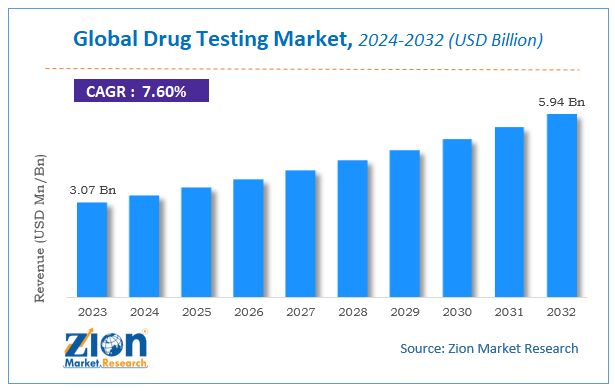
The global Drug Testing market size was worth around USD 3.07 billion in 2023 and is predicted to reach around USD 5.94 billion by 2032, with a compound annual growth rate (CAGR) of roughly 7.6% between 2024 and 2032. The Drug Testing Market is driven by strict government enforcement of drug and alcohol testing laws, rising workplace screening programs, and the need to monitor and combat substance abuse.
Drug Testing Market: Overview
Drug testing is a procedure of making use of a biological sample for determining the presence as well as absence of metabolites or medicine. This procedure can be completed in various settings through the use of myriad kinds of techniques. With the human body metabolizing different medicines at different rates, the time span for determining the effect of a particular medicine on the human body can be specific and can vary extensively from one drug to another.
In spite of these hitches, drug testing plays a pivotal role in clinical settings, as medical examination, collateral reporting, and patient self-reporting can understate the incidence of medicine utilization. Moreover, according to NIH researchers, drug testing should be performed along with physical or psychological assessment.
Furthermore, drug testing is utilized for validating current use of any drug. It also plays a key role in diagnosis, treatment, and identification of drug addiction in individuals. Moreover, the urine drug testing method is one of the most accurate methods for drug identification in the human body system, as it is based on the immunoassay technique.
Key Insights
- As per the analysis shared by our research analyst, the global Drug Testing market is estimated to grow at a CAGR of 7.60% during the forecast period 2024-2032.
- In terms of revenue, the global Drug Testing market size was valued at around USD 3.07 billion in 2023 and is projected to reach USD 5.94 billion by 2032.
- The market is driven by strict government laws mandating drug and alcohol testing, rising workplace screening programs, and increased efforts to monitor and combat substance abuse.
- Based on the Product segment, the Rapid Testing Devices segment is growing at a high rate and is projected to dominate the global market.
- Based on the Sample Type segment, the Urine Sample segment is projected to capture the largest market share.
- Based on the End-User segment, the Drug Testing Laboratories segment held the largest market share in 2023 and is expected to grow at a significant rate over the forecast period
- Based on the Region, North America is expected to dominate the global market during the forecast period.
Drug Testing Market: Growth Dynamics
Strict enforcement of laws by government authorities mandating drug testing as well as alcohol testing for security purpose as well as combating drug abuse in respective countries will drive market trends. Massive demand for workplace drug testing, such as pre-employment drug testing, incident-driven as well as for-cause drug testing for staff, and post-employment drug testing or random drug testing for targeted staff has proliferated market scope in recent years. Moreover, drug testing is a harm reduction technique and has been used in many European countries and in the U.S. Rise in roadside drug testing for ensuring road safety as well as reducing incidents of road collisions, will culminate in massive growth of drug testing market in years to come. Need for monitoring as well as combating drug abuse has raised the requirement for drug testing activities, thereby driving market trends.
Furthermore, COVID-19 has resulted in closure of many manufacturing units due to lockdown and this has resulted in a large number of layoffs in factories. In addition to this, many other industries including tourism, hotel, and travel industries, have been severely affected due to COVID pandemic. This, in turn, has resulted in rise in stress, depression, and deteriorating mental condition/health among the working population, giving rise to intake of drugs. This has made drug testing a necessary tool for government to curb drug consumption among persons affected due to job loss or under stress of losing their jobs during the COVID-19 pandemic, thereby opening new vistas of growth for drug testing business.
Drug Testing Market: Segmentation
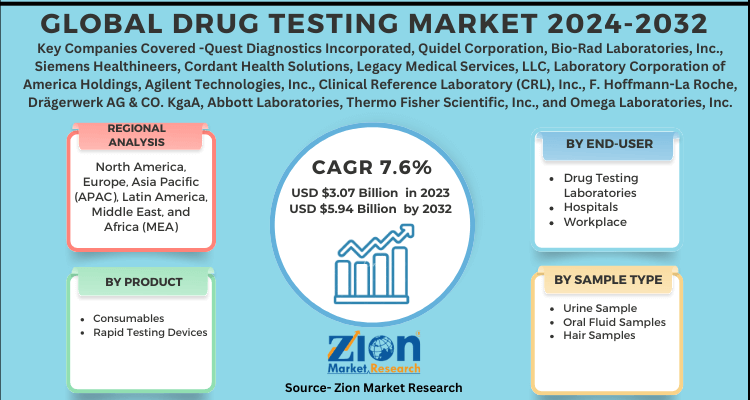
The Drug Testing market is segmented by Product, End-User, Sample Type, and Region.
Based on Product Segment, the Drug Testing market is divided into Consumables and Rapid Testing Devices. Rapid Testing Devices represent a high-growth area because they deliver quick results at the point of care or workplace, reducing turnaround times and enabling immediate decision-making. Consumables form the foundational volume driver, supporting both laboratory-based and rapid testing workflows through reagents, kits, and related materials. The combination of reliable consumables and convenient rapid devices helps expand testing accessibility and supports higher overall testing volumes across clinical and occupational settings.
Based on End-User Segment, the Drug Testing market is divided into Drug Testing Laboratories, Workplace, and Hospitals. Drug Testing Laboratories lead demand because of the high volume of compliance, pre-employment, random, and for-cause testing required by regulations and organizational policies. Hospitals contribute through clinical diagnostic and treatment-monitoring applications. Leadership of laboratory and workplace segments drives market growth by generating consistent, large-scale testing volumes and encouraging continuous innovation in both laboratory instrumentation and rapid on-site devices.
Based on Sample Type Segment, the Drug Testing market is divided into Urine Sample, Oral Fluid Samples, and Hair Samples. Urine Sample is the most dominant method due to its established accuracy, reliance on proven immunoassay techniques, and wide acceptance for detecting a broad range of substances. Oral Fluid Samples rank as an important secondary option, valued for non-invasive collection and suitability in roadside or workplace screening. Dominance of urine testing anchors high-volume laboratory and workplace programs, while complementary sample types enable more flexible and context-specific testing strategies that broaden market reach.
Drug Testing Market: Report Scope
| Report Attributes | Report Details |
|---|---|
| Report Name | Drug Testing Market |
| Market Size in 2023 | USD 3.07 Billion |
| Market Forecast in 2032 | USD 5.94 Billion |
| Growth Rate | CAGR of 7.6% |
| Number of Pages | 166 |
| Key Companies Covered | Quest Diagnostics Incorporated, Quidel Corporation, Bio-Rad Laboratories, Inc., Siemens Healthineers, Cordant Health Solutions, Legacy Medical Services, LLC, Laboratory Corporation of America Holdings, Agilent Technologies, Inc., Clinical Reference Laboratory (CRL), Inc., F. Hoffmann-La Roche, Drägerwerk AG & CO. KgaA, Abbott Laboratories, Thermo Fisher Scientific, Inc., and Omega Laboratories, Inc |
| Segments Covered | By Product, By End-User, By Sample Type and By Region |
| Regions Covered | North America, Europe, Asia Pacific (APAC), Latin America, Middle East, and Africa (MEA) |
| Base Year | 2023 |
| Historical Year | 2018 - 2022 |
| Forecast Year | 2024 - 2032 |
| Customization Scope | Avail customized purchase options to meet your exact research needs. Request For Customization |
Drug Testing Market: Regional Landscape
Why will North America continue to dominate the global market during the projection period?
Growth of the drug testing market in North America over forecast timespan can be ascribed to the large-scale presence of giant participants in countries such as the U.S. Apart from this, favorable compensation policies along with high acceptance of new drug testing tools will drive regional market trends.
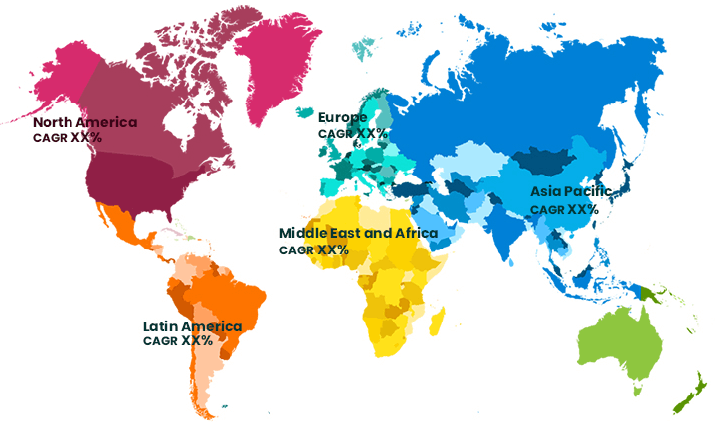
With regional governments enforcing strict laws pertaining to drug abuse, the market for drug testing in North America is set to witness exponential growth over years to come. Legalization of cannabis in countries such as Canada and U.S. through passing of acts in parliament is likely to enlarge scope of drug testing market in North America over coming decade.
Europe maintains solid demand supported by established harm-reduction approaches and workplace and roadside testing programs across multiple countries. Asia Pacific is positioned for growth driven by rising awareness of substance abuse issues, expanding workplace safety initiatives, and improving diagnostic infrastructure in key markets.
Drug Testing Market: Competitive Landscape
The global Drug Testing market profiles key players such as:
- Quest Diagnostics Incorporated
- Quidel Corporation
- Bio-Rad Laboratories, Inc
- Siemens Healthineers
- Cordant Health Solutions
- Legacy Medical Services, LLC
- Laboratory Corporation of America Holdings
- Agilent Technologies, Inc
- Clinical Reference Laboratory (CRL), Inc
- F. Hoffmann-La Roche
- Drägerwerk AG & CO. KgaA
- Abbott Laboratories
- Thermo Fisher Scientific, Inc
- Omega Laboratories, Inc
The global Drug Testing Market is segmented as follows:
By Product
- Consumables
- Rapid Testing Devices
By End-User
- Drug Testing Laboratories
- Hospitals
- Workplace
By Sample Type
- Urine Sample
- Oral Fluid Samples
- Hair Samples
By Region
- North America
- The U.S.
- Canada
- Europe
- France
- The UK
- Spain
- Germany
- Italy
- Rest of Europe
- Asia Pacific
- China
- Japan
- India
- South Korea
- Southeast Asia
- Rest of Asia Pacific
- Latin America
- Brazil
- Mexico
- Rest of Latin America
- Middle East & Africa
- GCC
- South Africa
- Rest of Middle East & Africa
Table Of Content
Methodology
FrequentlyAsked Questions
Drug testing analyzes samples to detect substances. It is used in healthcare, sports, and workplaces
The global Drug Testing market is expected to be driven by the workplace safety programs and healthcare screening. Expansion of diagnostic laboratories and regulatory compliance supports adoption.
According to study, the global Drug Testing market size was worth around USD 3.07 Billion in 2023 and is predicted to grow to around USD 5.94 Billion By 2032.
The global Drug Testing market is expected to grow at a Compound Annual Growth Rate (CAGR) of around CAGR 7.6% during the forecast period from 2024-2032.
The global Drug Testing industry is projected to be challenged by Challenges include privacy concerns, regulatory compliance, and accuracy requirements.
The Opportunities include workplace safety programs, sports testing, law enforcement demand, and rapid testing technologies will offer significant growth opportunities in the Drug Testing market.
Rapid and point-of-care testing kits; multiplex and digital result reporting; growth in workplace and clinical testing are the emerging trends and innovations impacting the Drug Testing market.
The global Drug Testing market is expected to be led by North America during the forecast period.
Some of the prominent players operating in the global Drug Testing market are; Quest Diagnostics Incorporated, Quidel Corporation, Bio-Rad Laboratories, Inc., Siemens Healthineers, Cordant Health Solutions, Legacy Medical Services, LLC, Laboratory Corporation of America Holdings, Agilent Technologies, Inc., Clinical Reference Laboratory (CRL), Inc., F. Hoffmann-La Roche, Drägerwerk AG & CO. KgaA, Abbott Laboratories, Thermo Fisher Scientific, Inc., and Omega Laboratories, Inc and others.
The report explores crucial aspects of the Drug Testing market, including a detailed discussion of existing growth factors and restraints, while also browsing future growth opportunities and challenges that impact the market.

HappyClients

