
Global Oilfield Drilling Fluid Additives Market Size, Growth, Trends, and Forecasts, 2034

Oilfield Drilling Fluid Additives Market By Type (Oil-Based Additives and Water-Based Additives), By Fluid Formation (Oil-Based Mud [OBM] and Water-Based Mud [WBM]), By Application (Well Completion Fluids and Drilling Fluids), and By Region - Global and Regional Industry Overview, Market Intelligence, Comprehensive Analysis, Historical Data, and Forecasts 2025 - 2034
| Market Size in 2024 | Market Forecast in 2034 | CAGR (in %) | Base Year |
|---|---|---|---|
| USD 1891.55 Million | USD 2339.07 Million | 2.69% | 2024 |
Oilfield Drilling Fluid Additives Market: Industry Perspective
What will be the size of the global oilfield drilling fluid additives market during the forecast period?
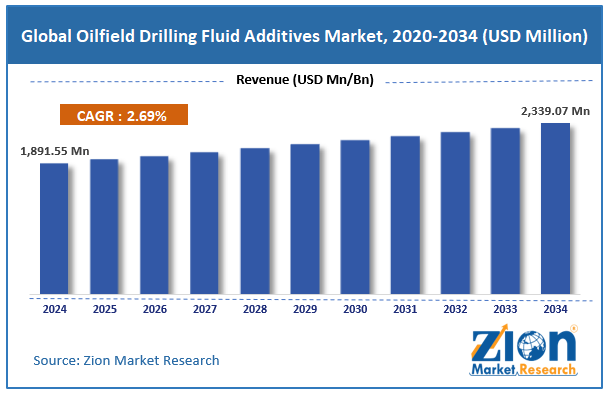
The global oilfield drilling fluid additives market size was around USD 1891.55 million in 2024 and is projected to reach USD 2339.07 million by 2034, with a compound annual growth rate (CAGR) of roughly 2.69% between 2025 and 2034.
Key Insights:
- As per the analysis shared by our research analyst, the global oilfield drilling fluid additives market is estimated to grow annually at a CAGR of around 2.69% over the forecast period (2025-2034)
- In terms of revenue, the global oilfield drilling fluid additives market size was valued at around USD 1891.55 million in 2024 and is projected to reach USD 2339.07 million by 2034.
- The oilfield drilling fluid additives market is projected to grow significantly owing to increasing exploration & production (E&P) activities, the expansion of shale oil and gas operations, and demand for high-performance, eco-friendly additives.
- Based on type, the water-based additives segment is expected to lead the market, while the oil-based additives segment is expected to grow considerably.
- Based on fluid type, the Water-Based Mud (WBM) segment is the largest, while the Oil-Based Mud (OBM) segment is projected to record sizeable revenue over the forecast period.
- Based on application, the drilling fluids segment is expected to lead the market, followed by the well completion fluids segment.
- By region, North America is projected to dominate the global market during the forecast period, followed by the Asia Pacific.
Oilfield Drilling Fluid Additives Market: Overview
Oilfield drilling fluid additives are specialized chemicals added to drilling mud to enhance performance during well-drilling operations. They control properties such as density, viscosity, stability, and filtration loss, while helping cool the drill bit and carry cuttings to the surface. Commonly used additives are tailored to specific operational and geological conditions. The global oilfield drilling fluid additives market is poised to expand rapidly, driven by rising global energy demand, growth in unconventional resource exploration, and the expansion of deepwater and offshore drilling. Growing energy consumption worldwide continues to fuel oil and gas exploration and surging demand for drilling fluids. The expanding transportation sector and industrialization further augment hydrocarbon needs. This sustained demand supports the continued use of advanced drilling fluid systems.
Moreover, the development of tight oil, shale gas, and other unconventional resources needs specialized drilling additives and fluids. These formations demand precise control over lubrication, pressure, and wellbore stability. As unconventional drilling expands, additive consumption is growing rapidly. Furthermore, as offshore and deepwater exploration projects increase, they require high-performance additives capable of withstanding extreme conditions. These environments demand superior thermal stability and corrosion resistance. This trend fuels innovation and demand for advanced additive formulations.
Despite growth, the global market is constrained by factors such as strict environmental norms and volatility in crude oil prices. Strict regulations on drilling fluid toxicity and disposal hamper the use of conventional additives. Compliance raises operational costs and limits some chemical formulations. This creates barriers for service providers and manufacturers. Similarly, fluctuating oil prices significantly affect exploration and drilling budgets. During price downturns, drilling activities decline, lowering additive demand. This cyclical nature creates instability in the industry's growth. Nonetheless, the global oilfield drilling fluid additives industry stands to benefit from several key opportunities, such as the development of eco-friendly additives and the integration of nanotechnology.
Growing environmental awareness is driving demand for non-toxic, biodegradable drilling fluid additives. Companies are actively investing in sustainable product development. This shift offers fresh avenues for advancement and market growth. Additionally, nanotechnology allows the development of advanced additives with superior thermal efficiency and stability. These materials enhance lubrication and reduce formation damage. Their adoption is projected to expand notably.
Impact of the USA-Israel war on Iran on the Oilfield Drilling Fluid Additives Market
The Israel-USA war, including Iran, has increased geopolitical tensions, leading to oil price volatility and short-term increases in drilling activity, thereby escalating demand for oilfield drilling fluid additives. Yet, prolonged instability discourages long-term exploration investments and creates uncertainty in continuous market demand. Moreover, supply chain disruptions and rising raw material costs adversely affect profitability and production for additive manufacturers.
Oilfield Drilling Fluid Additives Market: Dynamics
Growth Drivers
How are escalating global energy demand and the need for hydrocarbon recovery driving the oilfield drilling fluid additives market?
Strong energy demand, fueled by industrialization, population growth, and transport, promises continued exploration of new reserves and redevelopment of existing fields. Operators are using improved recovery techniques that need tailored drilling fluid systems and additive blends to access tight oil/gas unconventional reservoirs. As conventional reserves decline, lengthy drilling campaigns into harder formations increase additive consumption. This macro energy demand growth strengthens the long-term outlook for the oilfield drilling fluid additives market.
How are environmental regulations and demand for eco‑friendly additives fueling the oilfield drilling fluid additives market development?
Tighter ecological standards and emissions requirements worldwide are driving operators to adopt biodegradable, eco-friendly additive solutions that reduce toxicity and the environmental footprint. Regulatory compliance across diverse regions is prompting formulators to innovate toward safer chemistries. The shift toward biodegradable, water-based additives that retain performance is transforming product portfolios and investment priorities. This shift not only maintains industry demand but also accelerates the development of green additive technologies.
Restraints
Substitution and the use of alternative drilling technologies negatively impact the market progress
Growing adoption of drilling practices that reduce reliance on conventional drilling fluids, such as air drilling or dry drilling, may decrease additive use. Operators experimenting with alternative drilling media may opt out of traditional additive-intensive fluids. This shift, though geographically restricted, poses a limitation on conventional additive demand. Market-share pressures arise from non-fluid drilling technologies.
Opportunities
How is digitalization and real‑time drilling optimization presenting favorable prospects for the oilfield drilling fluid additives market expansion?
Integration of real-time monitoring, AI-driven optimization platforms, and drilling analytics creates opportunities for smart drilling fluid systems. Additives formulated to be compatible with predictive models and digital sensors improve drilling performance. This allows fluid management programs to adjust chemistry vigorously during operations. These innovation fosters high value offerings and service contracts, thus offering opportunities in the oilfield drilling fluid additives industry.
Challenges
Market fragmentation and supplier consolidation present a challenge for market growth
The presence of several global and regional suppliers creates a fragmented competitive landscape. Buyers may receive inconsistent service levels or product quality across suppliers. Consolidation trends may lead to pricing pressures and reduced competition, especially in commoditized markets. Managing associations and procurement in fragments markets is a major challenge for the operators.

Oilfield Drilling Fluid Additives Market: Report Scope
| Report Attributes | Report Details |
|---|---|
| Report Name | Oilfield Drilling Fluid Additives Market |
| Market Size in 2024 | USD 1891.55 Million |
| Market Forecast in 2034 | USD 2339.07 Mllion |
| Growth Rate | CAGR of 2.69% |
| Number of Pages | 228 |
| Key Companies Covered | BASF SE, Schlumberger Limited, Halliburton Company, Baker Hughes Company, Chevron Phillips Chemical Company LLC, Clariant AG, Croda International Plc, Newpark Resources Inc., Tetra Technologies Inc., AkzoNobel N.V., Stepan Company, Solvay S.A., Dow Inc., Albemarle Corporation, Lubrizol Corporation., and others. |
| Segments Covered | By Type, By Fluid Formation, By Application, and By Region |
| Regions Covered | North America, Europe, Asia Pacific (APAC), Latin America, Middle East, and Africa (MEA) |
| Base Year | 2024 |
| Historical Year | 2019 - 2023 |
| Forecast Year | 2025 - 2034 |
| Customization Scope | Avail customized purchase options to meet your exact research needs. Request For Customization |
Oilfield Drilling Fluid Additives Market: Segmentation
The global oilfield drilling fluid additives market is segmented based on type, fluid formation, application, and region.
Why is the Water-based Additives segment projected to dominate the oilfield drilling fluid additives market?
Based on type, the global oilfield drilling fluid additives industry is divided into oil-based additives and water-based additives. Water-based additives dominate the market with a 60% share due to their environmental compliance, cost-effectiveness, and adaptability across different formations. Their ease of disposal and handling make them the ideal choice for most drilling operations. Regulatory limitations on oil-based fluids further drive their adoption.
Nonetheless, the oil-based additives segment ranks second in the market with 40% share. They are valued primarily for their lubrication, high thermal stability, and performance in HPHT wells. They are crucial for complex drilling operations and deepwater where water-based fluids underperform. Despite the high cost, their efficiency in challenging conditions sustains robust demand.
What factors help the Water-based Mud (WBM) segment lead the oilfield drilling fluid additives market?
Based on fluid formation, the global oilfield drilling fluid additives market is segmented into Oil-Based Mud (OBM) and Water-Based Mud (WBM). The water-based mud (WBM) segment leads the market with a 60% share, driven by its low cost, eco-friendly nature, and adaptability to diverse geopolitical formations. WBM is chosen for most shallow and onshore drilling operations due to its ease of disposal and handling.
However, the oil-based mud (OBM) segment is the second-largest market, with a 35% share, due to its optimal performance in high-temperature, deepwater, and high-pressure wells. OBM offers complex drilling environments. Despite strict environmental regulations and high costs, it is crucial for complex operations.
What are the key reasons for the leadership of the Drilling Fluids segment in the oilfield drilling fluid additives market?
Based on application, the global market is segmented into well completion fluids and drilling fluids. The drilling fluids segment leads the market, holding nearly 70% market share. Their primary role in cooling the drill bit, maintaining wellbore stability, and cuttings to the surface fuels continuous demand. Drilling operations in offshore and onshore sites largely rely on these fluids, making them the leading segment.
Conversely, well completion fluids account for the second-largest market share at 30%. These fluids prepare wells for production, promising efficient hydrocarbon flow and controlling formation damage. Despite having a lower volume than drilling fluids, their dedicated function in improving well productivity sustains major demand.
Oilfield Drilling Fluid Additives Market: Regional Analysis
Why is North America outperforming other regions in the global Oilfield Drilling Fluid Additives market?
North America is anticipated to retain its leading role in the global oilfield drilling fluid additives market, with a 4.3-6.5% CAGR, driven by abundant oil and gas exploration, advanced drilling technologies, and a favorable regulatory and investment environment. North America leads the market due to oil and gas exploration, particularly in shale formations across Canada and the United States. High drilling activity raises demand for efficient drilling fluid additives. North America’s rich unconventional reserves sustain constant industry growth. The adoption of directional, horizontal, and deepwater drilling technologies in the region fuels the need for dedicated additives.
Advanced fluids enhance wellbore stability, efficiency, and lubrication. Technological advancements support greater consumption of high-performance additives. Furthermore, supportive government policies and major private investment in oilfield services drive production and exploration. This motivates the deployment of advanced drilling fluids and additives. Regulatory frameworks also promote the use of environmentally compliant and safer additives.
Why does Asia Pacific rank second in the global Oilfield Drilling Fluid Additives Market?
Asia Pacific ranks as the second-largest region in the global oilfield drilling fluid additives industry, with a 5-9.2% CAGR, driven by escalating energy demand growth, expansion of onshore and offshore drilling, and investment in oilfield infrastructure and services. APAC leads in energy consumption growth, driven by urbanization, industrialization, and population growth. Elevated oil and gas exploration in countries such as India and China drives demand for drilling fluid additives. Growing energy needs sustain continuous industry growth. The region is also experiencing onshore and offshore exploration projects, especially in shale reserves and deepwater.
Complex drilling operations require high-performance additives to enhance wellbore stability and fluid efficiency. This fuels high consumption of advanced fluid formulations. Additionally, increasing investments by local and global oilfield service companies increases exploration and production capabilities. The development of supportive infrastructure, including chemical distribution and manufacturing, promises ready access to additives. This reinforces the region's market ranking.
Oilfield Drilling Fluid Additives Market: Competitive Analysis
The leading players in the global oilfield drilling fluid additives market are:
- BASF SE
- Schlumberger Limited
- Halliburton Company
- Baker Hughes Company
- Chevron Phillips Chemical Company LLC
- Clariant AG
- Croda International Plc
- Newpark Resources Inc.
- Tetra Technologies Inc.
- AkzoNobel N.V.
- Stepan Company
- Solvay S.A.
- Dow Inc.
- Albemarle Corporation
- Lubrizol Corporation
What are the key trends in the global Oilfield Drilling Fluid Additives Market?
Integration of digital and smart drilling systems:
The use of real-time monitoring, automated fluid management systems, and sensors is surging. Smart drilling allows precise control of fluid properties, enhancing efficiency and reducing waste. This trend motivates the development of data-driven and customizable additive solutions.
Growth in unconventional resource exploration:
Exploration of tight oil, shale, and other unconventional resources is growing worldwide. Complex formations need specialized additives to manage pressure, maintain wellbore integrity, and reduce fluid loss. This trend is increasing the demand for modified drilling fluid formulations.
The global oilfield drilling fluid additives market is segmented as follows:
By Type
- Oil-Based Additives
- Water-Based Additives
By Fluid Formation
- Oil-Based Mud (OBM)
- Water-Based Mud (WBM)
By Application
- Well Completion Fluids
- Drilling Fluids
By Region
- North America
- The U.S.
- Canada
- Mexico
- Europe
- France
- The UK
- Spain
- Germany
- Italy
- Rest of Europe
- Asia Pacific
- China
- Japan
- India
- Australia
- South Korea
- Rest of Asia Pacific
- The Middle East & Africa
- Saudi Arabia
- UAE
- Egypt
- Kuwait
- South Africa
- Rest of the Middle East & Africa
- Latin America
- Brazil
- Argentina
- Rest of Latin America
Table Of Content
Methodology
FrequentlyAsked Questions
Oilfield drilling fluid additives are specialized chemicals added to drilling mud to enhance performance during well-drilling operations. They control properties such as density, viscosity, stability, and filtration loss, while helping cool the drill bit and carry cuttings to the surface. Commonly used additives are tailored to specific operational and geological conditions.
Which key factors will influence the oilfield drilling fluid additives market growth over 2025-2034?
The global oilfield drilling fluid additives market is projected to grow, driven by rising global energy demand, increased offshore drilling projects, and technological advancements in drilling fluids.
According to study, the global oilfield drilling fluid additives market size was around USD 1891.55 million in 2024 and is projected to reach USD 2339.07 million by 2034.
The CAGR value of the oilfield drilling fluid additives market is expected to be around 2.69% during 2025-2034.
Major opportunities include rising unconventional resource and deepwater exploration, growing demand for eco-friendly additives, and improvements in high-performance drilling fluid technologies.
North America is expected to lead the global oilfield drilling fluid additives market during the forecast period.
The key players profiled in the global oilfield drilling fluid additives market include BASF SE, Schlumberger Limited, Halliburton Company, Baker Hughes Company, Chevron Phillips Chemical Company LLC, Clariant AG, Croda International Plc, Newpark Resources Inc., Tetra Technologies, Inc., AkzoNobel N.V., Stepan Company, Solvay S.A., Dow Inc., Albemarle Corporation, and Lubrizol Corporation.
Leading players are adopting acquisitions & mergers, product innovations, partnerships, and regional expansions to strengthen their market presence.
The value chain includes sourcing of raw material, additive manufacturing, quality testing, distribution, application in drilling, and after-sales support.
The report examines key aspects of the oilfield drilling fluid additives market, including a detailed analysis of current growth factors and restraints, as well as future growth opportunities and challenges that will affect the market.

HappyClients

