
Global mTOR Inhibitors Market Size, Share, Trends, Growth and Forecast 2034

mTOR Inhibitors Market By Drug Type (Rapamycin and Analogs, Everolimus, Temsirolimus, Sirolimus), By Application (Oncology, Organ Transplantation, Cardiovascular Disease, Tuberous Sclerosis Complex), By Route of Administration (Oral, Injectable), By End-User (Hospitals, Specialty Clinics, Transplant Centers, Research Institutes), and By Region - Global and Regional Industry Overview, Market Intelligence, Comprehensive Analysis, Historical Data, and Forecasts 2026 - 2034
| Market Size in 2025 | Market Forecast in 2034 | CAGR (in %) | Base Year |
|---|---|---|---|
| USD 7.74 Billion | USD 13.23 Billion | 6.23% | 2025 |
mTOR Inhibitors Industry Perspective:
What will be the size of the mTOR inhibitors market during the forecast period?
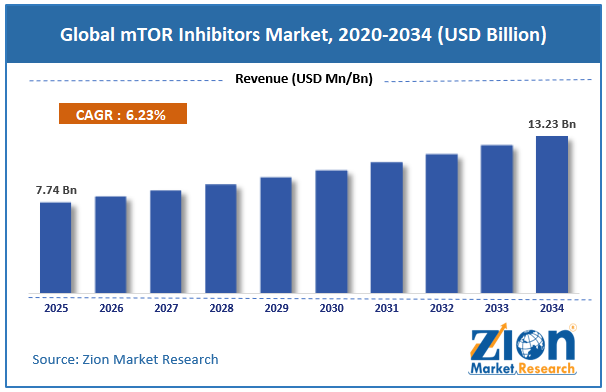
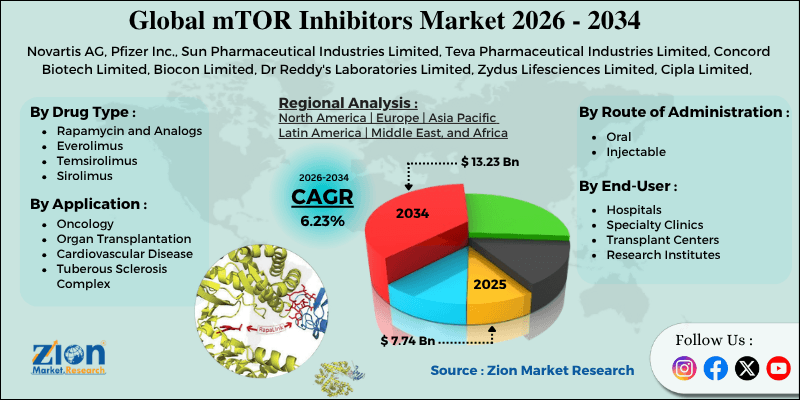
The global mTOR inhibitors market size was approximately USD 7.74 billion in 2025 and is projected to reach around USD 13.23 billion by 2034, with a compound annual growth rate of roughly 6.23% between 2026 and 2034.
Key Insights
- As per the analysis shared by our research analyst, the global mTOR inhibitors market is estimated to grow annually at a compound annual growth rate of around 6.23% over the forecast period from 2026 to 2034.
- In terms of revenue, the global mTOR inhibitors market size was valued at approximately USD 7.74 billion in 2025 and is projected to reach USD 13.23 billion by 2034.
- The mTOR inhibitors market is expected to grow steadily, driven by rising organ transplant volumes, growing cancer treatment applications, expanding research into rare disease indications, and continuous improvements in drug formulation.
- Based on drug type, everolimus is expected to lead the market, while sirolimus is anticipated to grow rapidly as new generic formulations become more widely available.
- Based on application, oncology is expected to lead the mTOR inhibitors market, while tuberous sclerosis complex treatment is anticipated to grow quickly, supported by rising awareness and improved diagnosis of the condition.
- Based on route of administration, oral formulations are the largest current segment, while injectable formulations are expected to grow steadily during the forecast period as more hospital-based cancer treatments adopt this drug class.
- Based on end-user, hospitals are expected to lead the market, while transplant centers are anticipated to grow steadily as organ transplantation procedures continue to rise worldwide.
- Based on region, North America is projected to dominate the global mTOR inhibitors market during the estimated period, followed by Europe.
mTOR Inhibitors Market: Overview
mTOR inhibitors are a class of medicines that block a protein called the mammalian target of rapamycin (mTOR), which controls cell growth, cell division, metabolism, and immune system activity. By blocking this protein, these drugs help slow the growth of certain cancer cells, prevent organ transplant rejection, and treat rare genetic disorders such as tuberous sclerosis complex. Common mTOR inhibitors include everolimus, sirolimus, and temsirolimus, with treatment depending on the patient's condition and medical needs. These medicines are widely used in hospitals, transplant centers, and cancer treatment facilities because they improve treatment outcomes and reduce the risk of disease progression or organ rejection. The mTOR inhibitors market is growing due to increasing organ transplant procedures, rising cancer cases, and greater awareness of targeted therapies. Pharmaceutical companies are also developing improved formulations that offer better safety, fewer side effects, and easier long-term treatment. In addition, ongoing research is exploring the use of mTOR inhibitors for age-related diseases and other chronic conditions, creating new growth opportunities. Advances in personalized medicine and improved patient monitoring are expected to further support growth in the global mTOR inhibitors market during the forecast period.
The mTOR inhibitors industry is growing due to rising organ transplantation procedures, expanding use in cancer treatment protocols, and increasing research into new therapeutic applications beyond transplantation and oncology.
Impact of the USA-Israel War on Iran on the mTOR Inhibitors Market
Ongoing tensions among the United States, Israel, and Iran may temporarily disrupt the supply of active pharmaceutical ingredients and specialty chemicals used to manufacture mTOR inhibitor drugs. Pharmaceutical companies relying on imported raw materials could face temporary delays and rising production costs. However, steady demand from hospitals, transplant centers, and oncology clinics is expected to keep the mTOR inhibitors market on a stable growth path despite short-term regional disruptions.
mTOR Inhibitors Market: Technology Roadmap 2026–2034
What is the projected development roadmap for the mTOR inhibitors market over the forecast period?
The mTOR inhibitor market is advancing through improved drug formulations, smarter patient monitoring, and fully personalized treatment ecosystems. The market is expected to grow at a compound annual growth rate of around 6.23% over the forecast period, supported by rising global demand for effective transplant and cancer therapies and continuous advancements in drug delivery technology.
The following roadmap outlines key development phases expected through 2034.
2026-2028: Formulation Improvement and Access Expansion Phase
- Pharmaceutical companies are expected to expand production of generic versions of established mTOR inhibitor drugs, making treatment more affordable for a wider patient population.
- Improved oral formulations are expected to grow in adoption, allowing patients to manage long-term therapy more comfortably without frequent hospital visits.
- Better dosing guidelines and monitoring tools are expected to simplify treatment management, making it easier for doctors to adjust therapy based on individual patient response.
2029-2031: Precision Dosing and Expanded Application Phase
- Companies are expected to combine genetic and biomarker testing with mTOR inhibitor therapy to identify which patients will respond best to treatment.
- Integration between electronic health records and drug monitoring systems is expected to grow, helping doctors track patient response and adjust dosing more accurately.
- Research into new applications, including age-related conditions and rare metabolic disorders, is expected to gain wider acceptance, expanding the overall use of this drug class.
2032-2034: Fully Personalized and Integrated Therapy Phase
- mTOR inhibitor treatment programs are expected to become part of larger, connected healthcare systems that integrate diagnosis, dosing, and long-term monitoring into a single, coordinated approach.
- Next-generation formulations with fewer side effects are expected to reduce the need for frequent dose adjustments, making long-term therapy more manageable for patients.
- Fully integrated data-sharing systems are expected to enable seamless collaboration among transplant centers, oncologists, and researchers, thereby supporting the faster development of new treatment protocols.
mTOR Inhibitors Market: Dynamics
Growth Drivers
How is rising organ transplantation activity driving growth in the mTOR inhibitor market?
The mTOR inhibitors industry is growing steadily as hospitals and transplant centers increasingly rely on these medicines to prevent organ rejection after transplant surgery. Rising numbers of kidney, liver, heart, and lung transplants worldwide are driving demand for effective immunosuppressive therapies that help the body accept transplanted organs. mTOR inhibitors are widely used because they help regulate the immune system while offering long-term treatment benefits for many patients. The increasing number of people living with chronic kidney disease, liver disorders, and heart failure is also supporting the demand for reliable post-transplant medications. Pharmaceutical and biotechnology companies are developing improved formulations that offer greater safety, more convenient dosing, and fewer drug interactions. Advances in drug delivery systems, manufacturing processes, and patient monitoring are making long-term treatment safer and easier to manage. Growing awareness of transplant care, rising healthcare investments, and continuous innovation in immunosuppressive therapies are expected to strengthen the mTOR inhibitors market and create long-term growth opportunities throughout the forecast period.
The rising adoption of targeted cancer therapies is driving growth in the mTOR inhibitors market.
The mTOR inhibitors industry is expanding as pharmaceutical companies, oncologists, and research organizations develop more effective, targeted cancer treatments. Unlike traditional chemotherapy, which often affects both healthy and cancer cells, mTOR inhibitors block specific cell-signaling pathways that enable cancer cells to grow and proliferate. This targeted approach can slow tumor growth while offering a different side effect profile, improving treatment tolerance for many patients. The increasing demand for personalized cancer care is also driving the use of biomarker testing and genetic profiling to identify patients who are most likely to benefit from mTOR inhibitor therapy. Healthcare providers are using advanced diagnostic technologies to create more accurate and individualized treatment plans.
In addition, hospitals and cancer centers are increasingly combining mTOR inhibitors with other targeted therapies and immunotherapies to improve treatment effectiveness and patient outcomes. Continuous research into new cancer applications, growing investments in precision medicine, and advances in molecular diagnostics are creating significant opportunities for the mTOR inhibitors market. These developments are expected to support steady market growth and improve long-term treatment options for cancer patients worldwide.
Restraints
Side effects and drug-interaction concerns are key challenges in the mTOR inhibitors market.
The mTOR inhibitors market faces several challenges that could limit its growth. Long-term use of these medicines may cause side effects such as mouth sores, high cholesterol levels, and an increased risk of infections, which can affect patient comfort and adherence to treatment. These drugs also require regular blood monitoring to ensure the correct dosage, as improper dosing may reduce effectiveness or increase the risk of side effects. Smaller hospitals and healthcare facilities may lack the specialized equipment needed for proper patient monitoring, particularly in developing regions. Drug interactions with other medications can further complicate treatment, especially for patients with multiple health conditions.
In addition, the high cost of mTOR inhibitors and limited insurance coverage in some countries make treatment less affordable for many patients. Pharmaceutical companies also invest heavily in research and development to improve drug safety and effectiveness, increasing overall costs. However, ongoing medical advancements and the growing demand for targeted therapies are expected to support the market's long-term growth.
Opportunities
How are precision dosing and expanding rare disease applications driving the mTOR inhibitors market?
The mTOR inhibitors industry offers significant growth opportunities as healthcare providers increasingly adopt personalized, biomarker-based treatment approaches. Rising numbers of organ transplants and cancer cases across North America, Europe, and Asia Pacific are driving demand for effective, targeted therapies with better long-term safety. Patients are seeking treatments that reduce side effects, improve quality of life, and offer simpler dosing schedules. Pharmaceutical companies, biotechnology firms, and research institutes are investing in new formulations, combination therapies, and expanded clinical studies to improve treatment outcomes. The growing use of genetic testing and biomarker analysis is helping doctors identify patients most likely to benefit from mTOR inhibitor therapy, thereby supporting more precise treatment decisions. Advances in drug delivery technologies are also improving the effectiveness and safety of these medicines.
In addition, ongoing research into rare diseases such as tuberous sclerosis complex, along with studies exploring the potential role of mTOR inhibitors in metabolic and age-related conditions, is expanding their clinical applications. Continuous innovation, rising healthcare investments, and increasing adoption of precision medicine are expected to create strong long-term growth opportunities for the market throughout the forecast period.
Challenges
What challenges does the mTOR inhibitors market face in patient adherence and treatment monitoring amid rising competition?
The mTOR inhibitors market faces several challenges, particularly in ensuring safe and effective long-term treatment for patients. Maintaining proper dosing is one of the biggest concerns, as missed or incorrect doses can reduce treatment effectiveness and increase the risk of organ rejection or cancer progression. Regular blood monitoring is also essential, but access to testing facilities may be limited for some patients. Managing long-term therapy can be difficult because side effects and frequent medical visits may reduce patient adherence. Healthcare providers also need experienced specialists who understand the use of mTOR inhibitors in both transplant medicine and cancer treatment.
In addition, growing competition from generic and branded products is creating pricing pressure, encouraging companies to invest continuously in product innovation and improved formulations. Different regulatory requirements across countries can further delay drug approvals and market expansion. Despite these challenges, ongoing advances in patient care, drug development, and precision medicine are expected to support the long-term growth of the market.
mTOR Inhibitors Market: Report Scope
| Report Attributes | Report Details |
|---|---|
| Report Name | mTOR Inhibitors Market |
| Market Size in 2025 | USD 7.74 Billion |
| Market Forecast in 2034 | USD 13.23 Billion |
| Growth Rate | CAGR of 6.23% |
| Number of Pages | 230 |
| Key Companies Covered | Novartis AG, Pfizer Inc., Sun Pharmaceutical Industries Limited, Teva Pharmaceutical Industries Limited, Concord Biotech Limited, Biocon Limited, Dr Reddy's Laboratories Limited, Zydus Lifesciences Limited, Cipla Limited, Sandoz Group AG, and others. |
| Segments Covered | By Drug Type, By Application, By Route of Administration, By End-User, and By Region |
| Regions Covered | North America, Europe, Asia Pacific (APAC), Latin America, Middle East, and Africa (MEA) |
| Base Year | 2025 |
| Historical Year | 2020 - 2024 |
| Forecast Year | 2026 - 2034 |
| Customization Scope | Avail customized purchase options to meet your exact research needs. Request For Customization |
mTOR Inhibitors Market: Segmentation
The global mTOR inhibitors market is segmented by drug type, application, route of administration, end-user, and region.
Why is everolimus the preferred drug type in the mTOR inhibitors market?
Based on drug type, the global mTOR inhibitors market is segregated into rapamycin and analogs, everolimus, temsirolimus, and sirolimus. Everolimus holds about 39% market share, leading due to its widespread approval and use across organ transplantation and multiple cancer treatment indications. Sirolimus holds around 24% of the market share. It is one of the fastest-growing segments, driven by increasing availability of affordable generic versions and expanding use in transplant medicine.
How does the oncology application segment maintain its leading position in the mTOR inhibitors market?
Based on application, the mTOR inhibitors industry is categorized into oncology, organ transplantation, cardiovascular disease, and tuberous sclerosis complex. The oncology segment accounts for about 36% of the global mTOR inhibitors market, driven by rising demand for targeted cancer therapies that inhibit cell-signaling pathways. The organ transplantation segment holds around 31% of the market share. It is growing steadily as the number of kidney, liver, and heart transplant procedures continues to increase worldwide.
Which route-of-administration segment dominates the mTOR inhibitors market?
Based on route of administration, the market is divided into oral and injectable formulations. Oral formulations lead with about a 68% share, driven by patient preference for convenient at-home dosing without hospital visits. Injectable formulations hold around 32% of the market share. They remain important for certain hospital-based cancer treatment protocols that require controlled dosing.
How do hospitals dominate the end-user landscape in the mTOR inhibitors market?
Based on end-user, the mTOR inhibitors industry is segmented into hospitals, specialty clinics, transplant centers, and research institutes. Hospitals account for about 41% of the market, due to their comprehensive facilities for managing both transplant and cancer patients requiring this medication class. Transplant centers hold around a 27% share. They are growing steadily as specialized facilities expand to handle rising transplant volumes worldwide.
mTOR Inhibitors Market: Regional Analysis
What is driving North America's leadership in the mTOR inhibitors market?
The North America mTOR inhibitors market accounts for around 38% of the global market, making it the largest regional market. A strong organ transplant infrastructure, advanced cancer care, and broad access to specialty medicines drive growth. The United States holds the largest market share due to its high volume of organ transplant procedures, well-established pharmaceutical industry, and continuous investment in targeted therapy research. Hospitals and transplant centers increasingly use mTOR inhibitors to reduce the risk of organ rejection and improve long-term transplant outcomes. Rising adoption of personalized cancer treatment and precision medicine is also boosting demand across oncology centers. Canada is another important market, supported by expanding transplant programs, government-funded healthcare, and increasing use of biomarker-guided therapies.
Research institutions and academic centers are conducting clinical studies using advanced genetic testing to improve treatment effectiveness. Strong collaboration among healthcare providers, pharmaceutical companies, and regulatory agencies continues to improve patient care, drug safety, and treatment standards. In addition, ongoing investments in drug delivery technologies, combination therapies, and patient monitoring systems are expected to strengthen the North America mTOR inhibitors market and support its steady growth throughout the forecast period.
What factors are supporting the expansion of the mTOR inhibitors market across Europe?
The Europe mTOR inhibitors market accounts for around 29% of the global market, making it the second-largest regional market. Advanced healthcare infrastructure, strong organ transplant programs, supportive regulatory policies, and rising demand for targeted cancer therapies drive growth. Germany holds the largest market share due to its well-established pharmaceutical industry, leading transplant centers, and continuous investment in oncology and immunology research. Hospitals and research institutions across the country increasingly use mTOR inhibitors to improve transplant success rates and treat specific cancers. The United Kingdom is another major contributor, supported by the growing adoption of precision medicine and biomarker testing, as well as government initiatives that promote organ donation and transplantation. France is also experiencing steady market growth through increased healthcare spending, expanding cancer research, and greater access to innovative therapies.
Across Europe, governments continue investing in medical research, advanced treatment technologies, and patient access programs to improve healthcare outcomes. Strong collaboration among pharmaceutical companies, hospitals, academic institutions, and regulatory authorities is accelerating the development of safer, more effective mTOR inhibitor therapies. These factors are expected to support the long-term growth of the Europe mTOR inhibitors market throughout the forecast period.
Recent Market Developments
- In July 2026, Novartis AG announced its acquisition of Myricx Bio to strengthen its oncology pipeline with next-generation targeted therapies, supporting continued innovation in precision cancer treatment alongside established targeted drug platforms such as mTOR inhibitors.
mTOR Inhibitors Market: Competitive Analysis
The leading players in the global mTOR inhibitors market are:
- Novartis AG
- Pfizer Inc.
- Sun Pharmaceutical Industries Limited
- Teva Pharmaceutical Industries Limited
- Concord Biotech Limited
- Biocon Limited
- Dr Reddy's Laboratories Limited
- Zydus Lifesciences Limited
- Cipla Limited
- Sandoz Group AG
The global mTOR inhibitors market is segmented as follows:
By Drug Type
- Rapamycin and Analogs
- Everolimus
- Temsirolimus
- Sirolimus
By Application
- Oncology
- Organ Transplantation
- Cardiovascular Disease
- Tuberous Sclerosis Complex
By Route of Administration
- Oral
- Injectable
By End-User
- Hospitals
- Specialty Clinics
- Transplant Centers
- Research Institutes
By Region
- North America
- The U.S.
- Canada
- Mexico
- Europe
- France
- The UK
- Spain
- Germany
- Italy
- Rest of Europe
- Asia Pacific
- China
- Japan
- India
- Australia
- South Korea
- Rest of Asia Pacific
- The Middle East & Africa
- Saudi Arabia
- UAE
- Egypt
- Kuwait
- South Africa
- Rest of the Middle East & Africa
- Latin America
- Brazil
- Argentina
- Rest of Latin America
Table Of Content
Methodology
FrequentlyAsked Questions
mTOR inhibitors are a class of medicines that block a protein called the mammalian target of rapamycin (mTOR), which controls cell growth, cell division, metabolism, and immune system activity. By blocking this protein, these drugs help slow the growth of certain cancer cells, prevent organ transplant rejection, and treat rare genetic disorders such as tuberous sclerosis complex.
The global mTOR inhibitors market is expected to grow, driven by rising organ transplantation procedures, expanding cancer treatment applications, increasing adoption of biomarker testing, and ongoing improvements in drug formulation and delivery.
According to research, the global mTOR inhibitors market size was approximately USD 7.74 billion in 2025 and is projected to reach approximately USD 13.23 billion by 2034.
The compound annual growth rate value of the mTOR inhibitors market is expected to be around 6.23% from 2026 to 2034.
North America is expected to lead the global mTOR inhibitors market during the forecast period, driven by a strong transplant medicine infrastructure, advanced cancer research capabilities, and broad insurance coverage.
The major players in the global mTOR inhibitors market include Novartis AG, Pfizer Inc., Sun Pharmaceutical Industries Limited, Teva Pharmaceutical Industries Limited, Concord Biotech Limited, Biocon Limited, Dr Reddy's Laboratories Limited, Zydus Lifesciences Limited, Cipla Limited, and Sandoz Group AG.
The report examines key aspects of the mTOR inhibitors market, including growth drivers, restraints, emerging opportunities, challenges, a competitive landscape analysis, regional breakdowns, and a detailed future outlook across all major drug types, applications, routes of administration, end users, and geographies.
The mTOR inhibitors market is shifting toward personalized medicine, with growing demand for targeted therapies that provide better treatment outcomes and fewer side effects. Healthcare providers and patients are increasingly preferring biomarker-guided treatments, convenient dosing schedules, and medicines that improve long-term quality of life.
The mTOR inhibitors market will see strong growth opportunities in organ transplantation, oncology, and rare genetic disorders such as tuberous sclerosis complex. Expanding research into age-related diseases, metabolic disorders, and combination therapies is also creating new clinical applications for these medicines.
Innovations in precision medicine, biomarker testing, advanced drug delivery systems, and combination therapies combining immunotherapy and targeted drugs are shaping the mTOR inhibitors market. Ongoing research, improved formulations, and genetic profiling technologies are helping deliver safer, more effective, and personalized treatment options.

HappyClients

