
Mobile Workforce Management Market Size, Share, Trends, Growth and Forecast 2034

Mobile Workforce Management Market By Type (Cloud-Based and On-Premise), By Component (Solutions and Services), By Application (Telecommunications, Manufacturing, Logistics & Transportation, Banking, Financial Services & Insurance (BFSI), Healthcare, and Others), and By Region - Global and Regional Industry Overview, Market Intelligence, Comprehensive Analysis, Historical Data, and Forecasts 2025 - 2034
| Market Size in 2024 | Market Forecast in 2034 | CAGR (in %) | Base Year |
|---|---|---|---|
| USD 499.11 Million | USD 769.18 Million | 4.95% | 2024 |
Mobile Workforce Management Industry Perspective:
What is the anticipated CAGR for the mobile workforce management market during the projection period?
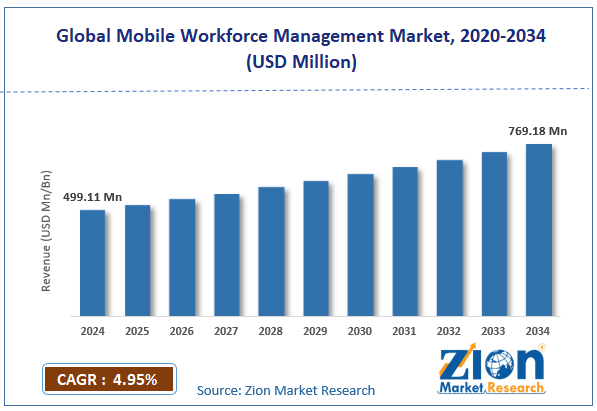
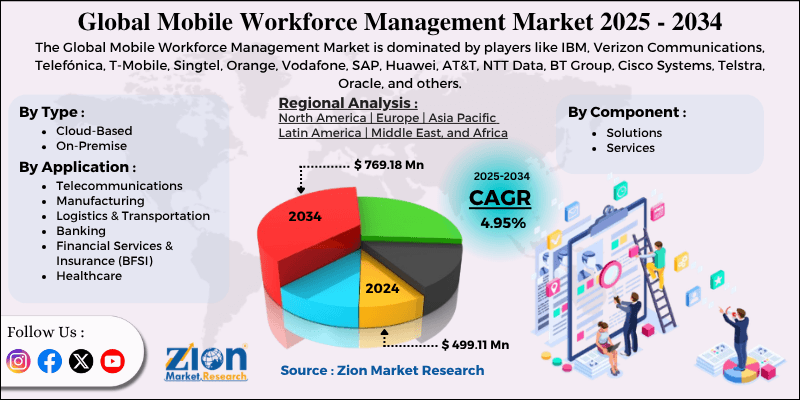
The global mobile workforce management market size was worth around USD 499.11 million in 2024 and is predicted to grow to around USD 769.18 million by 2034 with a compound annual growth rate (CAGR) of roughly 4.95% between 2025 and 2034.
Key Insights:
- As per the analysis shared by our research analyst, the global mobile workforce management market is estimated to grow annually at a CAGR of around 4.95% over the forecast period (2025-2034)
- In terms of revenue, the global mobile workforce management market size was valued at around USD 499.11 million in 2024 and is projected to reach USD 769.18 million by 2034.
- The market is projected to grow at a significant rate due to the rising number of remote workers around the globe.
- Based on the type, the cloud-based segment is growing at a high rate and will continue to dominate the global market, as per industry projections
- Based on the component, the services segment is anticipated to command the largest market share
- Based on the application, the logistics & transportation segment is expected to lead the market growth trends
- Based on region, the Asia-Pacific is projected to dominate the global market during the forecast period
Mobile Workforce Management Market: Overview
Mobile workforce management (MWM) refers to the tools and processes used by an organization to manage, support, and coordinate employees who work outside of traditional work premises. For instance, field agents and remote workers are prime examples of the mobile workforce. MWM technologies are essential to allow employees to stay connected with their teams and perform their job responsibilities without any limitations. The growing number of Mobile workforce worldwide will influence higher demand for MWM tools and technologies that allow seamless coordination between employees irrespective of their location. During the forecast period, demand for mobile workforce management is expected to grow due to the rising number of remote workers worldwide and increasing hiring as field agents, especially in the sales field.
In addition, Artificial Intelligence (AI) integration in MWM applications will prove beneficial for the industry players in the long run. However, the high cost of mobile workforce management tools, data security concerns, and loophole exploitation by employees may impact business revenue during the forecast period.
Mobile Workforce Management Market: Dynamics
Growth Drivers
How will the growing number of remote workers influence the mobile workforce management market?
The global mobile workforce management market is expected to be influenced by the rising number of remote workers around the globe. According to official projections, more than 25.5% of the global workforce is expected to be employed in a remote or hybrid work culture by 2030. During COVID-19, several companies offered remote work to their employees to prevent shutting down completely.
Since then, most companies have switched to a hybrid work environment, allowing employees to work certain days from home and specific days from office premises. A hybrid and remote work culture is associated with several benefits for organizations as well as employees. Studies indicate an increase of 15% to 20% in work productivity among employees working partly or completely from home. Organizations, on the other hand, can reduce utility expenses by allowing a certain segment of workers to work from a preferred location.
Expansion of service-based industries to aid in accelerated market revenue in the long run
Service-based industries such as logistics and telemedicine rely significantly on a mobile workforce, especially field agents. For instance, as per industry projections, the global logistics industry employs over 20 million workers worldwide. Furthermore, service industries drive demand for telecom operations offering customer service. The rapid expansion of service-based industries will aid in elevated demand for field workers, creating revenue in the global mobile workforce management market.
Restraints
What will be the impact of cost barriers on the mobile workforce management industry?
The global mobile workforce management industry will be restricted due to the high cost of technology implementation and application. For instance, MWM requires extensive investments in hardware and software solutions such as collaboration-enabling applications. In addition, companies have to invest resources in training employees, further adding to the overall cost of technology ownership. High licensing fees or subscription charges may further impact business revenue in the long run.
Opportunities
Artificial Intelligence (AI) integration in MWM to generate growth opportunities for the industry leaders
The global mobile workforce management market is expected to generate growth opportunities due to growing investments in AI integration. Mobile workforce management solution providers are increasingly investing in integrating AI systems to enhance tool performance. In March 2026, Leverage, an enterprise AI platform for organizations, announced the launch of an AI-powered workforce productivity platform. The tool is designed to help companies improve employee performance by connecting information across tools used by workers and turning the information into actionable insights.
In November 2025, UKG, another leading AI platform for Human Resources and workforce management, launched UKG® Beacon. The solution aims to assist small and medium-sized enterprises in recognizing and retaining their best employees by offering predictive engagement nudges, real-time achievement recognition, and personalized, preference-based acknowledgement.
Challenges
How will concerns over data privacy and loophole exploitation challenge the mobile workforce management market?
The global mobile workforce management industry is expected to be challenged by concerns over data privacy as MWM tools are susceptible to data breaches and cybercrimes. In addition, organizations have raised doubts over the efficiency of mobile workforce management tools in detecting and flagging loophole exploitation by workers, leading to reduced confidence in the system.
Mobile Workforce Management Market: Report Scope
| Report Attributes | Report Details |
|---|---|
| Report Name | Mobile Workforce Management Market |
| Market Size in 2024 | USD 499.11 Million |
| Market Forecast in 2034 | USD 769.18 Million |
| Growth Rate | CAGR of 4.95% |
| Number of Pages | 228 |
| Key Companies Covered | IBM, Verizon Communications, Telefónica, T-Mobile, Singtel, Orange, Vodafone, SAP, Huawei, AT&T, NTT Data, BT Group, Cisco Systems, Telstra, Oracle, and others. |
| Segments Covered | By Type, By Component, By Application, and By Region |
| Regions Covered | North America, Europe, Asia Pacific (APAC), Latin America, Middle East, and Africa (MEA) |
| Base Year | 2024 |
| Historical Year | 2019 to 2023 |
| Forecast Year | 2025 - 2034 |
| Customization Scope | Avail customized purchase options to meet your exact research needs. Request For Customization |
Mobile Workforce Management Market: Segmentation
The global mobile workforce management market is segmented based on type, component, application, and region.
Why will the cloud-based segment lead the mobile workforce management industry revenue during the forecast period?
Based on type, the global market segments are cloud-based and on-premise. In 2024, the highest growth was listed in the cloud-based segment, accounting for 59% of the global revenue. It is expected to continue leading the industry growth trends with a CAGR of 13.5% during the forecast period due to the expansion of the Software-as-a-Service (SaaS) industry and technical advantages offered by cloud solutions, such as scalability.
Which will be the fastest-growing component type during the forecast period in the mobile workforce management market?
Based on components, the global mobile workforce management industry is divided into solutions and services. The highest growth rate in 2024 was listed in the services segment, contributing up to 71% of the global revenue. It is projected to offer a CAGR of 12.07% during the forecast period, driven by higher demand for third-party work-from-home scheduling and monitoring tools.
Why will the logistics & transportation industry lead the mobile workforce management industry in the coming years?
Based on application, the global market is fragmented into telecommunications, manufacturing, logistics & transportation, banking, financial services & insurance (BFSI), healthcare, and others. In 2024, the logistics & transportation sector led the market revenue, accounting for 31% of the global market share. It is expected to grow at a CAGR of 12.9% during the forecast period due to the globalization of e-commerce companies and the emergence of quick commerce and grocery delivery applications.
Mobile Workforce Management Market: Regional Analysis
Why does North America lead the mobile workforce management market?
The global mobile workforce management market is currently led by North America. In 2024, it accounted for 40.02% of the global revenue and is expected to grow at a CAGR of 13.09% in the coming years. The regional market will be driven by a high volume of remote or hybrid workers across the US and Canada. In addition, early technology adoption, the presence of key players, and higher demand for work-life balance among regional workers will promote regional expansion in the coming years.
What is the expected CAGR for Asia-Pacific during the forecast period in the mobile workforce management market?
Asia-Pacific is expected to emerge as the fastest-growing region in the mobile workforce management market with a CAGR of 15%. In 2024, it contributed around 25% of the global revenue. Rapid expansion of the regional workforce, industrialization, and digitalization will influence regional growth trends. Moreover, the proliferation of the regional e-commerce industry, along with a growing number of regional providers of SaaS solutions, will allow improved revenue across the Asia-Pacific.
Mobile Workforce Management Market: Competitive Analysis
The global mobile workforce management market is led by players like:
- IBM
- Verizon Communications
- Telefónica
- T-Mobile
- Singtel
- Orange
- Vodafone
- SAP
- Huawei
- AT&T
- NTT Data
- BT Group
- Cisco Systems
- Telstra
- Oracle
What are the latest key trends in the mobile workforce management market?
Demand for employee tracking tools
The mobile workforce management industry is witnessing growing demand for employee tracking tools to enhance visibility and transparency. Additionally, these tools are designed to reduce loophole exploitation by employees.
Data security
Growing focus on ensuring data security will encourage MWM service providers to use next-generation encryption and secure cloud environments, thus propelling industry growth trends to new heights.
The global mobile workforce management market is segmented as follows:
By Type
- Cloud-Based
- On-Premise
By Component
- Solutions
- Services
By Application
- Telecommunications
- Manufacturing
- Logistics & Transportation
- Banking
- Financial Services & Insurance (BFSI)
- Healthcare
- Others
By Region
- North America
- The U.S.
- Canada
- Mexico
- Europe
- France
- The UK
- Spain
- Germany
- Italy
- Rest of Europe
- Asia Pacific
- China
- Japan
- India
- Australia
- South Korea
- Rest of Asia Pacific
- The Middle East & Africa
- Saudi Arabia
- UAE
- Egypt
- Kuwait
- South Africa
- Rest of the Middle East & Africa
- Latin America
- Brazil
- Argentina
- Rest of Latin America
Table Of Content
Methodology
FrequentlyAsked Questions
Mobile workforce management (MWM) refers to the tools and processes used by an organization to manage, support, and coordinate employees who work outside of traditional work premises.
The global mobile workforce management market is expected to be influenced by the rising number of remote workers around the globe.
According to study, the global mobile workforce management market size was worth around USD 499.11 million in 2024 and is predicted to grow to around USD 769.18 million by 2034.
The CAGR value of the mobile workforce management market is expected to be around 4.95% during 2025-2034.
The global mobile workforce management industry is expected to be challenged by concerns over data privacy as MWM tools are susceptible to data breaches and cybercrimes.
The global mobile workforce management market has performed well so far and will offer similar trends in the coming years.
Asia-Pacific is expected to emerge as the fastest-growing region in the mobile workforce management market with a CAGR of 15%.
The global mobile workforce management market is led by players like IBM, Verizon Communications, Telefónica, T-Mobile, Singtel, Orange, Vodafone, SAP, Huawei, AT&T, NTT Data, BT Group, Cisco Systems, Telstra, and Oracle.
The report explores crucial aspects of the mobile workforce management market including detailed discussion of existing growth factors and restraints while also browsing future growth opportunities and challenges that impact the market.

HappyClients

