
Global Microplate Reader Market Size, Share, Growth Analysis Report - Forecast 2034

Microplate Readers Market By Application (Nucleic Acid Quantification, Protein Colorimetric Assays, Enzyme Kinetics, Enzyme-Linked Immunosorbent Assays, and Other), By Mode-Type (Multi-Mode, and Single-Mode), By End-User (Education, Computer & Electronics, Healthcare, Manufacturing, Pharmaceuticals, Energy & Utility, Biotechnology, and Other), By Enterprise Size (SMEs, and Large Enterprise), and By Region - Global and Regional Industry Overview, Market Intelligence, Comprehensive Analysis, Historical Data, and Forecasts 2025 - 2034
| Market Size in 2024 | Market Forecast in 2034 | CAGR (in %) | Base Year |
|---|---|---|---|
| USD 97.28 Billion | USD 1499.05 Billion | 31.6% | 2024 |
Microplate Reader Market: Industry Perspective
What will be the global microplate readers market size during the forecast period?
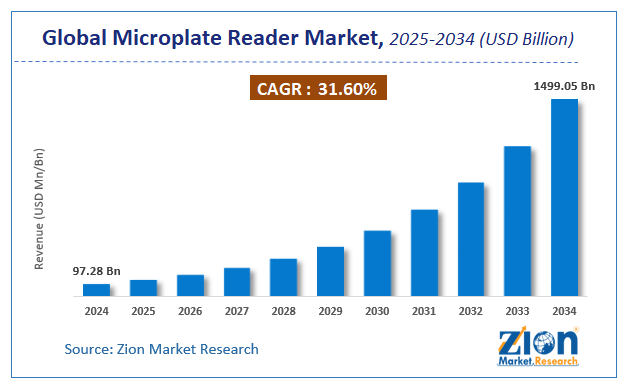
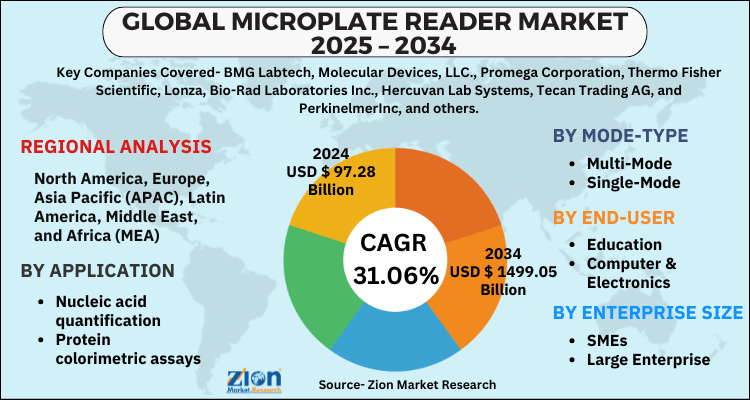
The global microplate readers market size was worth around USD 97.28 billion in 2024 and is predicted to reach around USD 1499.05 billion by 2034, with a compound annual growth rate (CAGR) of roughly 31.6% between 2025 and 2034.
This report provides a comprehensive analysis of the growth drivers, restraints, and challenges shaping demand across the global microplate readers market throughout the forecast period, while highlighting high-potential emerging opportunities within the industry.
Key Insights
- As per the analysis shared by our research analyst, the global microplate reader market is estimated to grow annually at a CAGR of around 31.6% over the forecast period (2025-2034).
- Regarding revenue, the global microplate reader market size was valued at around USD 97.28 Billion in 2024 and is projected to reach USD 1499.05 Billion by 2034.
- The microplate reader market is projected to grow at a significant rate due to increasing applications in pharmaceutical research, diagnostics, and biotechnology for high-throughput screening.
- Based on Application, the Nucleic Acid Quantification segment is expected to lead the global market.
- Based on Mode-Type, the Multi-Mode segment is growing at a high rate and will continue to dominate the global market.
- Based on the End-User, the Education segment is projected to swipe the largest market share.
- Based on Enterprise Size, the SMEs segment is expected to dominate the global market.
- Based on region, North America is predicted to dominate the global market during the forecast period.
Microplate Reader Market: Overview
Microplate readers are also known as microplate photometers or simply plate readers, and are medical instruments used to detect chemical, biological, or physical activities of samples that are placed on microtiter plates. Fields such as research, bioassay validation, drug discovery & development, quality control, and other manufacturing processes in academic organizations, the biotechnology industry, or the pharmaceutical industry use microplate readers extensively.
The microplate format most commonly used in diagnostic clinics or research centers is 96-well, an 8×12 matrix with a reaction volume of 100 to 200 µL per well. Microplates with higher densities are mostly used when cost per sample and the number of samples processed in a day become important. Luminescence, fluorescence intensity, fluorescence polarization, time-resolved fluorescence, and absorbance are the most common form of detection modes.
Microplate readers allow for simultaneous performance and measurement of various experiments. Whatever the assay type, experiments conducted with the aid of plate readers follow a standard curve to derive the experimental results. Samples of known concentration generate a line that best fits the standard curve, and experimental values are extrapolated to the curve or calculated using a linear regression equation.
Microplate Reader Market: Growth Drivers
What factors are primarily accelerating demand in the microplate readers market?
The global microplate readers market stands to benefit from the research-oriented and future-forward benefits offered by microplate readers in comparison to the traditional spectrometer, which works on a small sample size but microplate readers offer a higher throughput, such as measuring a 96-well microplate within a few seconds or 1536-well plates in a matter of minutes. The global market expansion may also be pushed forward by the growing number of medical cases, coupled with already existing diseases that do not have any cure as of 2022 as well. COVID-19 added to the immense pressure on the healthcare and pharmaceutical sector to meet growing demand for medical care, resulting in intensified research supported by increased funding from governments, international healthcare organizations, and private institutes. The pharmaceutical sector is focusing heavily on drug development processes, creating more demand for microplate readers.
Infectious diseases are growing at an alarming rate. As per the World Health Organization, around 390 million dengue infections are reported every year, of which 97 million are fatal. The rapidly increasing number of infectious and contagious diseases threatens the global population, and market players are working to control and eradicate them, which will support global market expansion during the forecast period.
Microplate Reader Market: Restraints
What factors are limiting the expansion of the microplate readers market?
Although microplate readers are easy to use and deliver excellent results, their storage conditions are extremely sensitive, and even minor changes can permanently damage the plate readers. For example, for fluorescence, only plates with black walls and transparent bottoms are recommended, since nonspecific reflections may impair sensitivity. Owing to the strict rules for the use of microplate readers, the global market may not reach its true potential, as there is no room for human error, since damage to the highly sensitive reader plates may end up increasing the overall cost of the establishment.
Another factor that may restrict the global market growth is the unlabeled technology associated with microplate readers, since the data recovered cannot be tagged.
Microplate Reader Market: Opportunities
Where do significant growth opportunities lie for the microplate readers market?
As the population grows and diseases rise, government support for research is increasing, creating multiple growth opportunities. Many governments have opened lucrative and attractive channels for foreign investments, thus allowing for key players to expand their global footprint. Multiple large-scale manufacturers or research units are tying up with local producers to utilize the true potential of the global microplate reader market.
Microplate Reader Market: Challenges
What key challenges confront participants in the microplate readers market?
There is a significant rise in the price of multi-mode microplate readers. Even though they may be more beneficial than their counterparts, their high price makes them unaffordable for many research institutes because there is an added cost of maintenance and installation as well. Because the investments required to set up manufacturing units for new products are high, few market players can enter the global market, which may challenge its growth.
Small-scale manufacturers lack the funds to operate in such a competitive environment, making survival difficult and potentially hindering global market growth.
Microplate Reader Market: Report Scope
| Report Attributes | Report Details |
|---|---|
| Report Name | Microplate Reader Market |
| Market Size in 2024 | USD 97.28 Billion |
| Market Forecast in 2034 | USD 1499.05 Billion |
| Growth Rate | CAGR of 31.6% |
| Number of Pages | 250 |
| Key Companies Covered | BMG Labtech, Molecular Devices, LLC, Promega Corporation, Thermo Fisher Scientific, Lonza, Bio-Rad Laboratories Inc., Hercuvan Lab Systems, Tecan Trading AG, PerkinElmer Inc., and others. |
| Segments Covered | By Application, By Mode-Type, By End-User, By Enterprise Size, and By Region |
| Regions Covered | North America, Europe, Asia Pacific (APAC), Latin America, The Middle East and Africa (MEA) |
| Base Year | 2024 |
| Historical Year | 2020 - 2023 |
| Forecast Year | 2025 - 2034 |
| Customization Scope | Avail customized purchase options to meet your exact research needs. Request For Customization |
Microplate Reader Market: Segmentation
The microplate readers market is segmented by application, mode-type, end-user, enterprise size, and region. All the segments of the microplate readers market have been analyzed based on present and future trends and the market is estimated from 2025 to 2034.
Based on Application Segment, the microplate readers market is divided into nucleic acid quantification, protein colorimetric assays, enzyme kinetics, enzyme-linked immunosorbent assays, and other. The nucleic acid quantification segment is expected to lead the global market and offers high growth potential, including use in ultrasensitive protein detection. This leadership drives overall market expansion by anchoring demand in molecular biology, diagnostics, and research workflows that require precise quantification, while protein assays, enzyme kinetics, and ELISA applications sustain broad laboratory and pharmaceutical use.
Based on Mode-Type Segment, the microplate readers market is divided into multi-mode and single-mode. The multi-mode segment is growing rapidly and will continue to dominate the global market as laboratories seek to study various samples and detection modes simultaneously. This dominance supports market growth by enabling flexible assay menus on a single platform, although the higher cost of multi-mode systems remains an important consideration for budget-constrained users.
Based on End-User Segment, the microplate readers market is divided into education, computer and electronics, healthcare, manufacturing, pharmaceuticals, energy and utility, biotechnology, and other. The education segment is projected to hold the largest market share, reflecting extensive use in academic teaching and research laboratories. This focus drives demand for accessible plate-reading capacity across institutions, while pharmaceuticals, biotechnology, and healthcare continue to expand high-throughput screening and diagnostic applications.
Based on Enterprise Size Segment, the microplate readers market is divided into SMEs and large enterprises. The SMEs segment is expected to dominate the global market as smaller organizations adopt plate readers for research and quality applications. Large enterprises retain strong capacity to fund installation and manufacturing-scale use, supporting overall equipment and service demand across both enterprise tiers.
Microplate Reader Market: Regional Analysis
Why will North America continue to dominate the global market during the projection period?
An increase in FDA approvals, along with rising government funding for research activities, is expected to help North America dominate global microplate reader market growth. The biopharma sector in the region has shown strong growth, driven by the entry of key players and strategic decisions such as mergers & acquisitions and tie-ups to reach a larger customer base. Genome and proteomic research, coupled with extensive drug-development research, may also support regional growth.
Europe is expected to generate high revenue due to strong government policies for healthcare infrastructure development. Molecular device companies are witnessing steady growth in Europe, which may aid regional expansion.
The Middle East and Africa may also register considerable growth because of the rising pharmaceutical sector along with an increasing number of biotech labs.
Recent Development:
- In April 2021, the world leader in service science, Thermo Fisher Scientific Inc., announced approval to acquire PPD for $47.50 per share, for a total cash purchase price of $17.4 billion. The company will assume around USD 3 billion debts of PPD. The deal opened up the clinical trial management segment, worth USD 50 billion, for Thermo Fisher.
- In January 2019, BioTek Instruments launched the next-gen Epoch 2 Microplate Spectrometer. This rebooted version is a compact product that combines up-to-the-minute technology with excellent performance for UV-Vis measurements and will enable better absorbance measurements than its original counterpart.
Microplate Reader Market: Competitive Analysis
The global microplate reader market is dominated by players like:
- BMG Labtech
- Molecular Devices. LLC.
- Promega Corporation
- Thermo Fisher Scientific
- Lonza
- Bio-Rad Laboratories Inc.
- Hercuvan Lab Systems
- Tecan Trading AG
- Perkinelmer. Inc.
Segments Covered
The global microplate reader market is segmented as follows:
By Application
- Nucleic Acid Quantification
- Protein Colorimetric Assays
- Enzyme Kinetics
- Enzyme-linked Immunosorbent Assays
- Other
By Mode-Type
- Multi-Mode
- Single-Mode
By End-User
- Education
- Computer & Electronics
- Healthcare
- Manufacturing
- Pharmaceuticals
- Energy & Utility
- Biotechnology
- Other
By Enterprise Size
- SMEs
- Large Enterprises
By Region
- North America
- The U.S.
- Canada
- Mexico
- Europe
- France
- The UK
- Spain
- Germany
- Italy
- Rest of Europe
- Asia Pacific
- China
- Japan
- India
- Australia
- South Korea
- Rest of Asia Pacific
- The Middle East & Africa
- Saudi Arabia
- UAE
- Egypt
- Kuwait
- South Africa
- Rest of the Middle East & Africa
- Latin America
- Brazil
- Argentina
- Rest of Latin America
Table Of Content
Methodology
FrequentlyAsked Questions
Microplate readers are also known as microplate photometers or simply plate readers, and are medical instruments used to detect chemical, biological, or physical activities of samples that are placed on microtiter plates.
The global microplate reader market is expected to grow due to increasing applications in drug discovery, clinical diagnostics, and life science research.
According to a study, the global microplate reader market size was worth around USD 97.28 Billion in 2024 and is expected to reach USD 1499.05 Billion by 2034.
The global microplate reader market is expected to grow at a CAGR of 31.6% during the forecast period.
North America is expected to dominate the microplate reader market over the forecast period.
Leading players in the global microplate reader market include BMG Labtech, Molecular Devices, LLC., Promega Corporation, Thermo Fisher Scientific, Lonza, Bio-Rad Laboratories Inc., Hercuvan Lab Systems, Tecan Trading AG, and PerkinelmerInc, among others.
The report explores crucial aspects of the microplate reader market, including a detailed discussion of existing growth factors and restraints, while also examining future growth opportunities and challenges that impact the market.

List of Contents
Microplate Reader Industry PerspectiveKey InsightsMicroplate Reader OverviewMicroplate Reader Growth DriversMicroplate Reader RestraintsMicroplate Reader OpportunitiesMicroplate Reader ChallengesMicroplate Reader Report ScopeMicroplate Reader SegmentationMicroplate Reader Regional AnalysisRecent Development:Microplate Reader Competitive AnalysisSegments CoveredHappyClients

