
Luxury Watches Market Size, Share, Growth, Opportunities 2034

Luxury Watches Market By Mechanism (Electronics, Quartz, and Mechanical), By Price Range (Below USD 10,000, USD 10,000 to USD 25,000, and Above 25,000), By Purchase Type (Pre-Owned and New), By Distribution Channel (Online, Multi-Brand Stores, and Single-Brand Stores), and By Region - Global and Regional Industry Overview, Market Intelligence, Comprehensive Analysis, Historical Data, and Forecasts 2026 - 2034
| Market Size in 2025 | Market Forecast in 2034 | CAGR (in %) | Base Year |
|---|---|---|---|
| USD 53.81 Billion | USD 82.74 Billion | 4.82% | 2025 |
Luxury Watches Industry Perspective:
What is the anticipated size of the luxury watches market during the projection period?
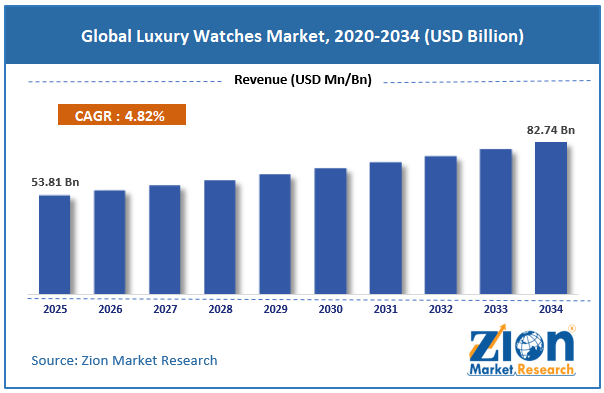
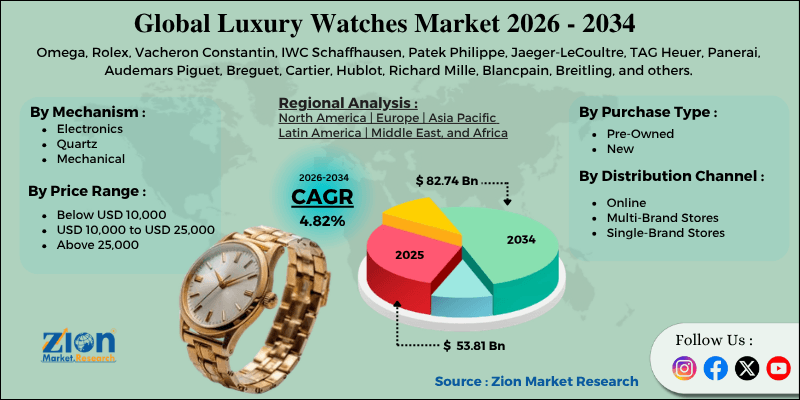
The global luxury watches market size was worth around USD 53.81 billion in 2025 and is predicted to grow to around USD 82.74 billion by 2034, with a compound annual growth rate (CAGR) of roughly 4.82% between 2026 and 2034.
Key Insights:
- As per the analysis shared by our research analyst, the global luxury watches market is estimated to grow annually at a CAGR of around 4.82% over the forecast period (2026-2034)
- In terms of revenue, the global luxury watches market size was valued at around USD 53.81 billion in 2025 and is projected to reach USD 82.74 billion by 2034.
- The luxury watches market is projected to grow at a significant rate due to the surge in the number of affluent consumers.
- Based on the mechanism, the mechanical segment is growing at a high rate and will continue to dominate the global market as per industry projections.
- Based on the price range, the below USD 10,000 segment is anticipated to command the largest market share.
- Based on the purchase type, the new segment is expected to lead the market growth trends.
- Based on the distribution channel, the single-brand stores segment is projected to influence revenue in the market.
- Based on region, Europe is projected to dominate the global market during the forecast period.
Luxury Watches Market: Overview
Luxury watches are specially designed, premium timepieces. They are developed using precious metals such as platinum and gold. Furthermore, luxury watches are powered by next-generation technologies, adding to the overall monetary and perceived value of the end products. Some of the crucial aspects of luxury watches that distinguish them from affordable ones include craftsmanship, caliber, weight balance, and the final price. The global luxury watches market is expected to be driven by a surge in the number of high-net-worth individuals worldwide and the evolving consumer lifestyles.
In addition, easier access to luxury watches through online channels and higher demand for pre-owned watches may further aid market expansion in the coming years. However, the high cost of the watches, the limited number of buyers, and concerns over counterfeit products may affect the total revenue generated by the market players.
Luxury Watches Market: Dynamics
Growth Drivers
How will the surge in the number of high-net-worth individuals influence the luxury watches market?
The global luxury watches market is expected to be driven by the surge in the number of affluent consumers. According to official reports, more than 60.1 million people worldwide hold a net worth of over USD 1 million. In addition, over 3000 billionaires exist across the globe. Improving job opportunities has further amplified the number of people who can afford luxury products such as watches. Premium timepieces are considered a form of status symbol and are widely preferred among wealthy consumers. For instance, at a recent event, billionaire and Amazon owner Jeff Bezos wore a USD 2.4 million Richard Mille RM 27-05 Flying Tourbillon. The watch has an ultra-lightweight carbon skeleton.
Luxury watches as investment opportunities to drive industry growth trends
Luxury watches are considered investment opportunities, as the prices of unique and rare watches are generally appreciated over time. Moreover, luxury watches can be easily liquidated, providing access to cash in urgent situations. Limited production models from brands such as Patek Philippe and Rolex have outpaced inflation in several instances.
In July 2026, a leading provider of luxury goods and fine arts launched Materiality. It is a new online luxury auction consisting of 30 collector pieces, one of which is a Richard Mille RM35-03 Rafael Nadal skeletonized wristwatch with an adjustable rotor. Such investment opportunities offer new avenues for growth to players in the global luxury watch market.
Restraints
Why will limited buyers and cost barriers affect the luxury watches market revenue?
The global luxury watch industry is projected to be constrained by high product costs and a limited pool of buyers. Luxury watches are expensive to procure and maintain. The average cost of high-end luxury watches can range between USD 15,000 and USD 50,000. Rare and limited-edition pieces may cost millions of dollars, depending on the brand and uniqueness. Luxury watches are bought by a select segment of the global population and cater to the needs of a limited consumer group, thereby restricting revenue streams.
Opportunities
Growing popularity of pre-owned watches offers growth opportunities during the forecast period
The global luxury watches market is projected to generate growth opportunities in the form of growing demand for pre-owned pieces. Growing public awareness is one of the primary boosters for pre-owned luxury goods. This form of transaction allows consumers access to rare models. In addition, they offer better monetary value, and younger audiences prefer spending on pre-loved luxury before they invest in brand-new options. Most luxury watches have long waiting times because buying from premium brands requires customers to first build up a history, which may take years. Conversely, buying a pre-owned watch reduces wait time and also promotes sustainability. As more channels to access used luxury watches open up, demand for rare timepieces is expected to accelerate.
Challenges
Why will concerns over counterfeit goods challenge the luxury watches market during the forecast period?
The global luxury watches industry is likely to be challenged by rising cases of counterfeit products. According to market analysis, counterfeiters are increasingly using advanced technology to produce counterfeits known as superfakes. They are extremely similar to original products, including serial numbers. Brand value is severely compromised by counterfeit products. More than 35 million fake luxury watches are currently circulating in the current ecosystem.
Luxury Watches Market: Report Scope
| Report Attributes | Report Details |
|---|---|
| Report Name | Luxury Watches Market |
| Market Size in 2025 | USD 53.81 Billion |
| Market Forecast in 2034 | USD 82.74 Billion |
| Growth Rate | CAGR of 4.82% |
| Number of Pages | 228 |
| Key Companies Covered | Omega, Rolex, Vacheron Constantin, IWC Schaffhausen, Patek Philippe, Jaeger-LeCoultre, TAG Heuer, Panerai, Audemars Piguet, Breguet, Cartier, Hublot, Richard Mille, Blancpain, Breitling, and others. |
| Segments Covered | By Mechanism, By Price Range, By Purchase Type, By Distribution Channel, and By Region |
| Regions Covered | North America, Europe, Asia Pacific (APAC), Latin America, Middle East, and Africa (MEA) |
| Base Year | 2025 |
| Historical Year | 2020 - 2024 |
| Forecast Year | 2026 - 2034 |
| Customization Scope | Avail customized purchase options to meet your exact research needs. Request For Customization |
Luxury Watches Market: Segmentation
The global luxury watches market is segmented based on mechanism, price range, purchase type, distribution channel, and region.
Why will the mechanical segment lead the luxury watches industry revenue during the forecast period?
Based on mechanism, the global market segments are electronics, quartz, and mechanical. In 2025, the highest growth was listed in the mechanical segment. It contributed nearly 63% of the total revenue. During the forecast period, the electronics segment is anticipated to witness the highest CAGR of 10.01% as demand for hybrid watches is on the rise. Premium smartwatches are projected to further help the segment thrive.
Which will be the fastest-growing price range during the forecast period in the luxury watches market?
Based on price range, the global luxury watches industry is divided into below USD 10,000, USD 10,000 to USD 25,000, and above USD 25,000. The highest growth rate in 2025 was reported in the below USD 10,000 segment. It generated over 55% of the total market share. Above USD 25,000 is projected to deliver the highest CAGR, at 8.89%, as rare and high-end watches gain greater popularity.
Which factors drive demand in the pre-owned segment in the luxury watches industry?
Based on purchase type, the global market divisions are pre-owned and new. According to market analysis, the new segment held prominence over 83% of global revenue. However, the pre-owned segment is expected to be the fastest-growing, with a CAGR of 9.52%. The pre-owned luxury watches segment is steadily becoming more organized as the number of players continues to grow, thereby aiding its dominance.
What will be the influence of online on the luxury watches market?
Based on distribution channel, the global market is fragmented into online, multi-brand stores, and single-brand stores. Industry trends suggest that were the leading segment in 2025, accounting for 46.5% of the global revenue. The online segment is projected to grow at a CAGR of 9.51% during the projection period with the expansion of e-commerce channels, social media platforms, and certified sellers.
Luxury Watches Market: Regional Analysis
Why will Europe lead the luxury watches market in the coming years?
The global luxury watches market is currently led by Europe. In 2025, it accounted for 41% of global revenue and is projected to grow at a CAGR of 6.56% during the forecast period. Europe is home to some of the largest and oldest luxury watch producers, including brands such as Omega, Rolex, Jaeger-LeCoultre, and Breguet, among others. In addition, the region has mature consumer groups that frequently invest in premium watches. Growing luxury tourism across European countries will further aid regional expansion.
Why will Asia-Pacific generate the fastest CAGR in the luxury watches market during the forecast period?
Asia-Pacific is expected to emerge as the fastest-growing region in the luxury watches market with a CAGR of 8.52% during the forecast period. In 2025, it accounted for 35% of the global revenue. The number of affluent consumers across Asian countries such as South Korea, India, and China is growing steadily, driving demand for luxury goods. In addition, manufacturing plants for most luxury brands are located across the Asia-Pacific region, which supports regional growth trends.
Luxury Watches Market: Competitive Analysis
The global luxury watches market is led by players like:
- Omega
- Rolex
- Vacheron Constantin
- IWC Schaffhausen
- Patek Philippe
- Jaeger-LeCoultre
- TAG Heuer
- Panerai
- Audemars Piguet
- Breguet
- Cartier
- Hublot
- Richard Mille
- Blancpain
- Breitling
Which are the latest key trends in the luxury watches market?
Customization
Customized luxury watches are a growing trend. Buyers can personalize watches, including elements such as design, materials, engravings, movements, dial colors, and other parameters. Customized luxury timepieces have higher retail prices, thus contributing to market revenue.
Celebrity partnerships
Celebrity partnerships are a popular form of marketing technique used by luxury watchmakers to appeal to a wider consumer segment. Most brands partner with athletes and actors, enhancing brand visibility.
The global luxury watches market is segmented as follows:
By Mechanism
- Electronics
- Quartz
- Mechanical
By Price Range
- Below USD 10,000
- USD 10,000 to USD 25,000
- Above 25,000
By Purchase Type
- Pre-Owned
- New
By Distribution Channel
- Online
- Multi-Brand Stores
- Single-Brand Stores
By Region
- North America
- The U.S.
- Canada
- Mexico
- Europe
- France
- The UK
- Spain
- Germany
- Italy
- Rest of Europe
- Asia Pacific
- China
- Japan
- India
- Australia
- South Korea
- Rest of Asia Pacific
- The Middle East & Africa
- Saudi Arabia
- UAE
- Egypt
- Kuwait
- South Africa
- Rest of the Middle East & Africa
- Latin America
- Brazil
- Argentina
- Rest of Latin America
Table Of Content
Methodology
FrequentlyAsked Questions
Luxury watches are specially designed, premium timepieces.
The global luxury watches market is expected to be driven by the surge in the number of affluent consumers.
According to study, the global luxury watches market size was worth around USD 53.81 billion in 2025 and is predicted to grow to around USD 82.74 billion by 2034.
The CAGR value of the luxury watches market is expected to be around 4.82% during 2026-2034.
The global luxury watches industry is likely to be challenged by rising cases of counterfeit products.
Market trends and consumer preferences are moving toward pre-owned luxury watches.
The global luxury watches market has performed well so far and will offer similar trends in the coming years.
Europe will contribute notably towards the luxury watches market value.
The global luxury watches market is led by players like Omega, Rolex, Vacheron Constantin, IWC Schaffhausen, Patek Philippe, Jaeger-LeCoultre, TAG Heuer, Panerai, Audemars Piguet, Breguet, Cartier, Hublot, Richard Mille, Blancpain, and Breitling.
The report explores crucial aspects of the luxury watches market, including a detailed discussion of existing growth factors and restraints, while also browsing future growth opportunities and challenges that impact the market.

HappyClients

