
Industrial Energy Management System (IEMS) Market Size and Forecast 2034

Industrial Energy Management System (IEMS) Market By Component (Metering & Field Equipment, Software, Hardware, Networking Device, Control Systems, Sensors, and Others), By Application (Power & Energy, Healthcare, Manufacturing, Enterprise, IT, and Others), and By Region - Global and Regional Industry Overview, Market Intelligence, Comprehensive Analysis, Historical Data, and Forecasts 2025 - 2034
| Market Size in 2024 | Market Forecast in 2034 | CAGR (in %) | Base Year |
|---|---|---|---|
| USD 20.8 Billion | USD 33.2 Billion | 4.8% | 2024 |
Industrial Energy Management System (IEMS) Industry Perspective:
What will be the size of the global industrial energy management system (IEMS) market during the forecast period?
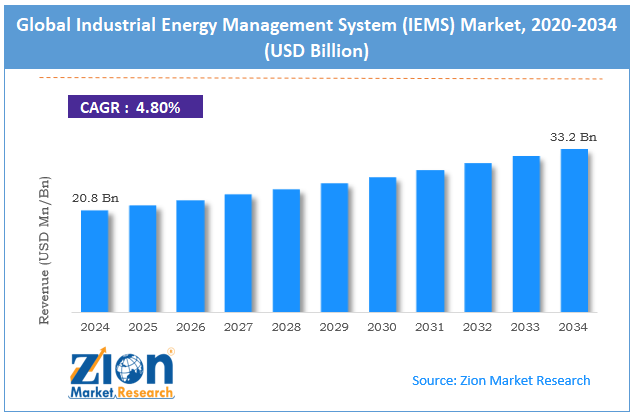
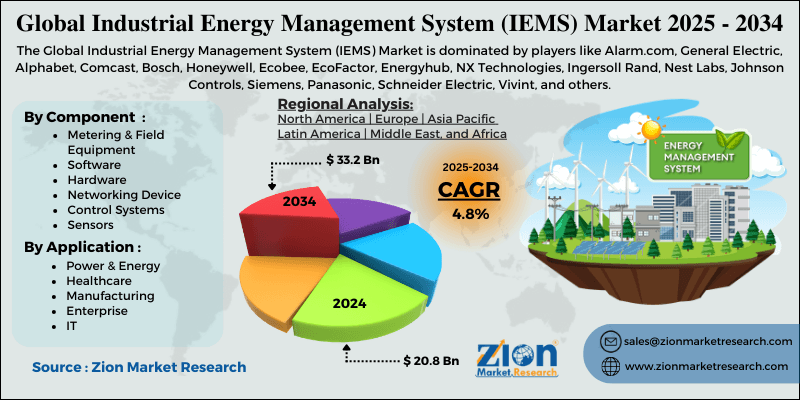
The global industrial energy management system (IEMS) market size was worth around USD 20.8 billion in 2024 and is predicted to grow to around USD 33.2 billion by 2034, with a compound annual growth rate (CAGR) of roughly 4.8% between 2025 and 2034.
Key Insights
- As per the analysis shared by our research analyst, the global Industrial Energy Management System (IEMS) market is estimated to grow annually at a CAGR of around 4.8% over the forecast period (2025-2034).
- In terms of revenue, the global Industrial Energy Management System (IEMS) market size was valued at around USD 20.8 billion in 2024 and is projected to reach USD 33.2 billion by 2034.
- Increased focus on sustainability and decarbonization is expected to drive the Industrial Energy Management System (IEMS) market.
- Based on the component, the metering & field equipment captures the largest revenue share in 2024.
- Based on the application, power & energy dominate the industry growth.
- Based on region, North America captures the largest revenue share of over 38% in 2024.
Industrial Energy Management System (IEMS) Market: Overview
An Industry Energy Management System (IEMS) is a set of data-based management software and hardware tools that allow for the administration of energy consumption in industrial environments, such as manufacturing, chemical, electrical, and heavy industries; refineries; power stations; and process plants. An IEMS monitors plant sources of energy (electricity, natural gas, fuel oil) and equipment (motors, turbines, generators), real-time usage and consumption data from various plant processes (through sensors, intelligent meters, and control systems), and utilizes the data to prevent wastage, improve machine performance, and identify areas of potential plant-wide efficiency gains. IEMS solutions that use IoT technology and smart meters can be set up in the cloud, automate processes, and use artificial intelligence, like predictive analytics, to significantly improve an industrial plant's ability to make smart choices about energy use.
Industrial Energy Management System (IEMS) Market: Dynamics
Growth Drivers
Why do rising energy costs drive the growth of the industrial energy management system market?
One of the major factors for Industrial Energy Management System (IEMS) market growth is the ‘rising energy prices,' as they form a major part of consumption in the industrial processes. Energy consumed (electricity, natural gas, and other fuels) in the industrial segment accounts for a significant share of the overall energy consumption in the business. Continuous changes and rising prices of energy would positively affect the margins of manufacturers and process industries. IEMS applications help businesses by providing solutions that monitor real-time energy consumption of equipment and identify inefficiencies, improve load management, and enable peak demand control. Such improvement is achieved through better load management, participation in demand response programs, and predictive maintenance, leading to a reduction of utility bills and predictive cost estimation. With energy prices remaining volatile, the global market for structured and data-driven energy optimization solutions is set to surge.
According to the European Commission, Industrial energy costs have stabilized above pre-2021 levels following the energy crisis, with European and Asian industrial gas/electricity prices remaining 2–4 times higher than key competitors, severely impacting manufacturing competitiveness. In India, industrial consumption grew from 242,418 KToE (2014-15) to 311,822 KToE (2023-24).
Restraints
High initial implementation cost is hindering the industry's growth
A primary factor limiting the growth of the IEMS market is the high cost of initial installation—local automation systems, hardware components (smart meters, sensors, and controllers), communication infrastructure, and system integration—which has a significant impact on small and medium-sized industries. Another notable factor is the cost of hardware (location awareness hardware, such as smart meters, sensors, and controllers), installation and startup, as well as workforce training, cybersecurity, and maintenance. The high start-up costs, which can be amortized over several years, not only raise barriers to the current deployment of IEMS but also inhibit the penetration of the industry in cost-sensitive regions with tight budget limitations.
Opportunities
Does the combination of AI in IEMS offer a potential opportunity for the industrial energy management system market growth?
The adoption of Artificial Intelligence (AI) in Industrial Energy Management Systems (IEMS) is expected to be transformative, driving market proliferation. The AI-integrated IEMS enables it to go beyond simple energy monitoring to predictive, autonomous, and optimized energy management. AI-enabled algorithms can constantly process large amounts of real-time as well as historical energy data to identify trends, predict demand, recognize unsustainable conditions, and give recommendations for correction autonomously.
For instance, in June 2024, ABB launched its new version (6.4) of the ABB Ability (TM) OPTIMAX(R) digital energy management and optimization system. Developed to enable coordinated control of multiple industrial assets and processes, it aims to improve energy efficiency, lower emissions, and aid decarbonization. The upgrades and improvements to OPTIMAX include an AI module that improves forecasting of load demand, energy generation, and energy pricing without involvement from operators. This minimizes day-ahead and intraday nomination errors when supplying energy to the grid, which in turn prevents an increase in penalty payments owed by operators.
Challenges
Why is the shortage of skilled workforce hampering the industrial energy management system industry expansion?
Lack of skilled workforce is also one of the factors responsible for the restrained growth of the Industrial Energy Management System (IEMS) market, as these systems require a high level of technical skill to be installed, commissioned, and operated efficiently. IEMS involve the deployment of multiple high-end technologies such as industrial automation, the internet of things, data analytics, cloud computing, and even, in some cases, artificial intelligence, which require talented labor skilled in energy management concepts and practices, IT, and industrial knowledge. Skilled human resources capable of system configuration and operation, data interpretation and analysis, security management, and performance enhancement are globally in short supply, especially in emerging economies. This situation adds time and cost, thereby affecting the perceived return on investment in IEMS.
Industrial Energy Management System (IEMS) Market: Report Scope
| Report Attributes | Report Details |
|---|---|
| Report Name | Industrial Energy Management System (IEMS) Market |
| Market Size in 2024 | USD 20.8 Billion |
| Market Forecast in 2034 | USD 33.2 Bllion |
| Growth Rate | CAGR of 4.8% |
| Number of Pages | 222 |
| Key Companies Covered | Alarm.com, General Electric, Alphabet, Comcast, Bosch, Honeywell, Ecobee, EcoFactor, Energyhub, NX Technologies, Ingersoll Rand, Nest Labs, Johnson Controls, Siemens, Panasonic, Schneider Electric, Vivint, and others. |
| Segments Covered | By Component, By Application, and By Region |
| Regions Covered | North America, Europe, Asia Pacific (APAC), Latin America, Middle East, and Africa (MEA) |
| Base Year | 2024 |
| Historical Year | 2019 to 2023 |
| Forecast Year | 2025 - 2034 |
| Customization Scope | Avail customized purchase options to meet your exact research needs. Request For Customization |
Industrial Energy Management System (IEMS) Market: Segmentation
Component Insights
Why does metering & field equipment hold the dominant position in the industrial energy management system market?
The metering & field equipment captures the largest revenue share in 2024. These growths are driven by the rise in the need of precise real-time evaluation of energy consumption at the machinery and plant level. Industries are adopting sophisticated meters, power quality analyzers, sensors, equipment, and other communication devices to analyze energy consumption down to the level of production lines and utility systems. This extensive granularity of data effectively forms the basis for an improved energy-saving concept.
Application Insights
Why does power & energy hold the largest share in the industrial energy management system industry?
The power & energy dominate the industry growth. As more smart grids are being installed, the need to perform real-time data processing, automation, and energy usage and energy distribution optimization is ever-expanding. The fast-growing demand for energy storage technologies, such as batteries, drives the demand for a management system that can seamlessly manage and optimize storage and reduce wastage.
Regional Insights
Why does North America lead the Industrial Energy Management System (IEMS) market?
North America captures the largest revenue share of over 38% in 2024. Increasing energy prices, a tough regulatory environment for emission control, and rapid industrial digitalization are expanding the regional market. North America has the highest industry energy consumption globally, across manufacturing, petroleum & gas, chemicals, food & beverage, automotive, and other sectors. Industries are investing in advanced energy-monitoring and management frameworks and optimization solutions to reduce operating costs. The strict regulatory landscape governing energy efficiency, GHG reduction, and sustainability reporting—especially in the U.S.—is forcing industries to build robust energy management frameworks. North America shows a high adoption of modern manufacturing practices, industrial IoT, and AI-powered analytics, which results in larger installations of smart manufacturing systems and broader adoption of advanced IEMS systems.
Additionally, government support in the form of energy efficiency incentives, decarbonization plans, and corporate ESG commitments is driving market growth. Several big technology players and well-established traditional industry infrastructure are already laying the groundwork for innovation and larger system integration, leading to steady North American IEMS revenues.
Industrial Energy Management System (IEMS) Market: Competitive Analysis
The global Industrial Energy Management System (IEMS) market is dominated by players like:
- Alarm.com
- General Electric
- Alphabet
- Comcast
- Bosch
- Honeywell
- Ecobee
- EcoFactor
- Energyhub
- NX Technologies
- Ingersoll Rand
- Nest Labs
- Johnson Controls
- Siemens
- Panasonic
- Schneider Electric
- Vivint
The global Industrial Energy Management System (IEMS) market is segmented as follows:
By Component
- Metering & Field Equipment
- Software
- Hardware
- Networking Device
- Control Systems
- Sensors
- Others
By Application
- Power & Energy
- Healthcare
- Manufacturing
- Enterprise
- IT
- Others
By Region
- North America
- The U.S.
- Canada
- Mexico
- Europe
- France
- The UK
- Spain
- Germany
- Italy
- Rest of Europe
- Asia Pacific
- China
- Japan
- India
- Australia
- South Korea
- Rest of Asia Pacific
- The Middle East & Africa
- Saudi Arabia
- UAE
- Egypt
- Kuwait
- South Africa
- Rest of the Middle East & Africa
- Latin America
- Brazil
- Argentina
- Rest of Latin America
Table Of Content
Methodology
FrequentlyAsked Questions
Which are the major players leveraging the Industrial Energy Management System (IEMS) market growth?

HappyClients

