
Compressed Natural Gas (CNG) Market Size, Share, Trends, Growth and Forecast 2034

Compressed Natural Gas (CNG) Market By Source (Refinery, Associated Gas, and Non-Associated), By Application (Residential/Commercial, Chemical, Industrial, Auto Gas, Refinery, and Others), By End Use (Light Duty Vehicles, Medium/Heavy Duty Trucks, Medium/Heavy Duty Buses, and Others), and By Region - Global and Regional Industry Overview, Market Intelligence, Comprehensive Analysis, Historical Data, and Forecasts 2025 - 2034
| Market Size in 2024 | Market Forecast in 2034 | CAGR (in %) | Base Year |
|---|---|---|---|
| USD 178.72 Billion | USD 436.23 Billion | 11.80% | 2024 |
Compressed Natural Gas (CNG) Industry Perspective:
What will be the size of the global compressed natural gas CNG market during the forecast period?
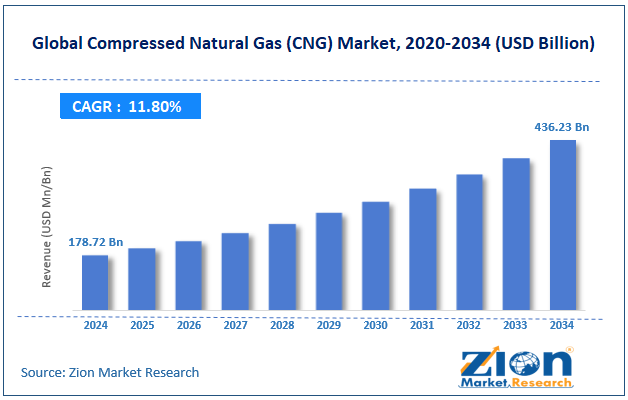
The global compressed natural gas CNG market size was worth around USD 178.72 billion in 2024 and is predicted to grow to around USD 436.23 billion by 2034, with a compound annual growth rate (CAGR) of roughly 11.80% between 2025 and 2034.
Key Insights:
- As per the analysis shared by our research analyst, the global compressed natural gas CNG market is estimated to grow annually at a CAGR of around 11.80% over the forecast period (2025-2034)
- In terms of revenue, the global compressed natural gas CNG market size was valued at around USD 178.72 billion in 2024 and is projected to reach USD 436.23 billion by 2034.
- The compressed natural gas CNG market is projected to grow significantly owing to government policies and incentives promoting CNG adoption, expansion of CNG refueling infrastructure, and urban air pollution concerns.
- Based on the source, the non-associated segment is expected to lead the market, while the associated gas segment is expected to grow considerably.
- Based on application, the refinery segment is the dominant segment, while the residential/commercial segment is projected to witness sizeable revenue over the forecast period.
- Based on end use, the light duty vehicles segment is expected to lead the market, followed by the medium/heavy duty trucks and medium/heavy duty buses segments.
- By region, North America is projected to dominate the global market during the forecast period, followed by Europe.
Compressed Natural Gas (CNG) Market: Overview
Compressed natural gas is a clean-burning fuel made by compressing natural gas, especially methane, to under 1% of its volume for effective transport and storage. It is widely used in vehicles as a cleaner, eco-friendlier alternative to diesel and petrol, producing lower emissions of harmful gases. It is safer because of its lighter-than-air properties and high ignition temperature, which allow it to dissipate quickly in case of leaks. The global compressed natural gas CNG market is likely to expand rapidly, fueled by the growing demand for cleaner fuels, government incentives and policies, and cost-effectiveness compared to conventional fuels. Increasing worldwide concern over carbon emissions and air pollution is driving the adoption of low-emission fuels like CNG. It produces notably less greenhouse gas than diesel and petrol. This environmental advantage remarkably fuels the market growth.
Moreover, governments around the world are promoting CNG through tax benefits, subsidies, and emissions regulations. Policies targeting clean transportation are accelerating adoption across private and public fleets. Regulatory push remains a major industry catalyst. Furthermore, CNG is usually cheaper than diesel and petrol, lowering operational costs for users. Fleet operators and public transport systems benefit significantly from fuel savings. This economic benefit drives broader adoption.
Nevertheless, the global market faces limitations, including limited refueling infrastructure and high initial investment costs. CNG stations are unequally distributed, mainly in semi-urban and rural areas. Limited access discourages vehicle adoption and limits long-distance travel. Infrastructure gaps is still a key constraint. Likewise, setting up CNG stations and converting vehicles needs major upfront investment. Small operators often find these costs prohibitive, thus slowing industry penetration in cost-sensitive regions. Still, the global compressed natural gas CNG industry benefits from several favorable factors, such as growth in public transportation systems and integration with renewable natural gas (RNG).
Cities are actively converting taxis and buses to CNG to reduce emissions. Large-scale fleet conversions create consistent fuel demand. This segment offers high growth potential. Additionally, blending CNG with renewable sources improves sustainability and reduces the carbon footprint, aligning with global decarbonization goals. This creates fresh market segments.
Impact of the USA-Israel war on Iran on the Compressed Natural Gas CNG market
A war involving Israel, the USA, and Iran could disrupt natural gas supply chains, leading to uncertainty and price volatility in global energy markets. Growing gas prices may temporarily reduce the cost benefit of CNG, slowing its adoption in price-sensitive regions. Nonetheless, long-term energy security concerns may encourage diversification and elevated investment in CNG infrastructure outside conflict-impacted regions.
Compressed Natural Gas (CNG) Market: Dynamics
Growth Drivers
How is the compressed natural gas CNG market driven by the rapid growth of refueling infrastructure?
Investment in CNG refueling stations is expanding speedily in emerging and major markets, enhancing accessibility for long-distance and urban travel. Denser networks reduce range anxiety and operational restrictions for commercial fleets and private users. Private-public partnerships are accelerating station deployment, mainly along major transport corridors and logistics hubs. Advanced technologies and high throughput capacity further improve reliability, making infrastructure growth a key propeller of the global compressed natural gas CNG market.
How is cost competitiveness against conventional fuels creating a positive impact on the compressed natural gas CNG market growth?
CNG offers a lower cost per unit of energy than diesel and petrol, resulting in major fuel savings for users. Stable natural gas pricing in several regions lowers exposure to volatile crude oil markets. High-mileage operators like trucking companies and public fleets eventually benefit from the low total energy cost of ownership. This strong cost benefit makes CNG a sustainable and appealing choice, strengthening its role as a major market driver.
Restraints
Variability in natural gas pricing unfavorably impacts the market progress
Natural gas prices can vary due to worldwide supply dynamics, infrastructure restraints, and seasonal demand. In markets where gas should be imported or transported over long distances, costs may rise dramatically. When gas prices rise relative to diesel and petrol, the economic benefit of CNG shrinks. This erodes the operational cost incentive for private owners and fleet operators. Price instability, hence, hampers some buyers from committing to CNG vehicles. Cost variability remains a major limitation on demand.
Opportunities
How are corporate fleet sustainability programs creating promising avenues for the growth of the compressed natural gas CNG industry?
Large service and logistics companies are adopting cleaner fuels to meet decarbonization targets and sustainability objectives. CNG offers a low-emission, reliable alternative, particularly where full electrification has not yet been implemented for heavy-duty fleets. High-mileage operations benefit from cost savings and improved emissions performance. Ongoing procurement cycles and fleet renewals continue to create strong and recurring demand for CNG solutions, thus offering prospects in the worldwide compressed natural gas CNG industry.
Challenges
Competition for investment funding challenges the growth pace of the market
Investment is increasingly shifting towards hydrogen, electric mobility, and other emerging technologies, creating tough competition for capital. This creates complications for CNG projects to secure funding for innovation and infrastructure. Investors usually prioritize zero-emission solutions over low-emission fossil fuel substitutes like CNG. Hence, limited access to capital can slow R&D, station growth, and overall industry growth.
Compressed Natural Gas (CNG) Market: Report Scope
| Report Attributes | Report Details |
|---|---|
| Report Name | Compressed Natural Gas CNG Market |
| Market Size in 2024 | USD 178.72 Billion |
| Market Forecast in 2034 | USD 436.23 Bllion |
| Growth Rate | CAGR of 11.80% |
| Number of Pages | 228 |
| Key Companies Covered | ExxonMobil Corporation, BP plc, Shell plc, Chevron Corporation, TotalEnergies SE, ConocoPhillips Company, Gazprom PJSC, Clean Energy Fuels Corp., ENN Energy Holdings Limited, Trillium Energy Solutions, China National Petroleum Corporation, GAIL (India) Limited, Snam S.p.A., Naturgy Energy Group S.A., Enbridge Inc., and others. |
| Segments Covered | By Source, By Application, By End Use, and By Region |
| Regions Covered | North America, Europe, Asia Pacific (APAC), Latin America, Middle East, and Africa (MEA) |
| Base Year | 2024 |
| Historical Year | 2019 - 2023 |
| Forecast Year | 2025 - 2034 |
| Customization Scope | Avail customized purchase options to meet your exact research needs. Request For Customization |
Compressed Natural Gas (CNG) Market: Segmentation
The global compressed natural gas CNG market is segmented based on source, application, end use, and region.
Why is the Non-Associated segment projected to dominate the compressed natural gas CNG market?
Based on the source, the global compressed natural gas CNG industry is divided into refinery, associated gas, and non-associated. The non-associated segment accounts for nearly 55% of the total market. This growth is backed by broader dedicated dry gas production from gas fields with high methane quality and consistent supply.
Conversely, the associated gas segment ranks second in the market with 45% share. This share is supported by its capture capacity during crude oil extraction and is increasingly used to reduce flaring and improve resource efficiency.
What factors help the Refinery segment lead the compressed natural gas CNG market?
Based on application, the global compressed natural gas CNG market is segmented into residential/commercial, chemical, industrial, auto gas, refinery, and others. The refinery segment captured nearly 33.1% of the total market. Refineries increasingly capture and utilize gas that would otherwise be wasted or flared, thereby fueling the segment's dominance and driving CNG supply and revenue.
However, the residential/commercial segment holds second place in the market with a 19% share. This is supported by the city-gas network expansion and the growing distributed energy demand in urban centers.
What are the key reasons for the leadership of the Light Duty Vehicles segment in the compressed natural gas CNG market?
Based on end use, the global market is segmented into light duty vehicles, medium/heavy duty trucks, medium/heavy duty buses, and others. The light duty vehicles segment dominates the market with a 55% share. These vehicles benefit from lower fuel costs, broad OEM availability, and urban use, thus driving segmental dominance.
Nonetheless, the medium/heavy duty trucks and medium/heavy duty buses segment, together, hold leadership, holding up to 45% of the market. This growth is fueled by the adoption of public and commercial transport in regions with established CNG infrastructure.
Compressed Natural Gas (CNG) Market: Regional Analysis
What gives Asia Pacific a competitive edge in the global Compressed Natural Gas CNG Market?
Asia Pacific is projected to maintain its dominant position in the global compressed natural gas CNG market, with a 7-9% CAGR, owing to speedy urbanization, growing middle-class mobility, and infrastructure development. APAC is experiencing rapid urban growth, driving increased demand for energy and transportation. Dense cities need cost-efficient, cleaner fuels for both private and public vehicles. CNG is an ideal choice for urban mobility due to its low emissions. This growing urban population fuels large-scale adoption of CNG solutions. Moreover, growing incomes and vehicle ownership in APAC increase fuel demand.
CNG offers a cheaper alternative to diesel and petrol, increasing its appeal for urban commuters. Fleet operators also adopt CNG to lower operational costs. This demographic trend promises an expanding and consistent market base. Furthermore, investment in refueling stations and pipeline networks promises reliable access to CNG. Expanding infrastructure supports both commercial fleets and light-duty vehicles. This long-term network growth strengthens the industry’s stability.
Why does Europe rank second in the global Compressed Natural Gas CNG Market?
Europe maintains its position as the second-largest region, with a 5-7% CAGR in the global compressed natural gas CNG industry, driven by the established infrastructure, government subsidies and incentives, and fleet adoption and public transport. Europe has an extensive network of CNG refueling stations in major economies such as Sweden, Italy, and Germany. Easy access to refueling encourages fleet operators and vehicle owners to switch confidently to CNG. A mature infrastructure lowers obstacles to broader industry adoption.
Moreover, European governments offer incentives, including tax breaks, reduced road tolls, and purchase subsidies for CNG stations and vehicles. Financial support reduces the ownership and operation costs. These measures make CNG more competitive against petrol and diesel alternatives. Additionally, several European cities have converted taxis, buses, and delivery fleets to CNG to meet emission goals. Large-scale fleet transitions create predictable and steady CNG demand. Public transport adoption strengthens industry visibility and volume.
Compressed Natural Gas (CNG) Market: Competitive Analysis
The leading players in the global compressed natural gas CNG market are;
- ExxonMobil Corporation
- BP plc
- Shell plc
- Chevron Corporation
- TotalEnergies SE
- ConocoPhillips Company
- Gazprom PJSC
- Clean Energy Fuels Corp.
- ENN Energy Holdings Limited
- Trillium Energy Solutions
- China National Petroleum Corporation
- GAIL (India) Limited
- Snam S.p.A.
- Naturgy Energy Group S.A.
- Enbridge Inc.
What are the key trends in the global Compressed natural gas CNG market?
Shift toward Dual‑Fuel and Bi‑Fuel vehicles:
Automakers are developing vehicles that can operate on conventional fuels like diesel, petrol, and CNG. Dual-fuel systems offer flexibility, easing consumer transition to cleaner fuels without range compromises. This raises CNG’s appeal in more segments. It also supports fleet operators in lowering emissions while maintaining operational versatility.
Integration with Renewable Natural Gas (RNG):
CNG markets are actively incorporating renewable sources such as biomethane and biogas into their compressed gas supplies. RNG has a lower carbon footprint than fossil natural gas, helping meet sustainability goals. Adoption of RNG improves CNG's environmental credentials, appealing to green policy support. This trend ranks CNG as a more renewable transport fuel option.
The global compressed natural gas CNG market is segmented as follows:
By Source
- Refinery
- Associated Gas
- Non-Associated
By Application
- Residential/Commercial
- Chemical
- Industrial
- Auto Gas
- Refinery
- Others
By End Use
- Light Duty Vehicles
- Medium/Heavy Duty Trucks
- Medium/Heavy Duty Buses
- Others
By Region
- North America
- The U.S.
- Canada
- Mexico
- Europe
- France
- The UK
- Spain
- Germany
- Italy
- Rest of Europe
- Asia Pacific
- China
- Japan
- India
- Australia
- South Korea
- Rest of Asia Pacific
- The Middle East & Africa
- Saudi Arabia
- UAE
- Egypt
- Kuwait
- South Africa
- Rest of the Middle East & Africa
- Latin America
- Brazil
- Argentina
- Rest of Latin America
Table Of Content
Methodology
FrequentlyAsked Questions
Compressed natural gas is a clean-burning fuel made by compressing natural gas, especially methane, to under 1% of its volume for effective transport and storage. It is widely used in vehicles as a cleaner, eco-friendlier alternative to diesel and petrol, producing lower emissions of harmful gases. It is safer because of its lighter-than-air properties and high ignition temperature, which allow it to dissipate quickly in case of leaks.
The global compressed natural gas CNG market is projected to grow due to increasing demand for cleaner fuels to reduce emissions, rising prices of petrol and diesel, and growth in natural gas availability and supply.
According to study, the global compressed natural gas CNG market size was worth around USD 178.72 billion in 2024 and is predicted to grow to around USD 436.23 billion by 2034.
The CAGR value of the compressed natural gas CNG market is expected to be around 11.80% during 2025-2034.
Emerging trends and innovations in the CNG market include integration with renewable natural gas (RNG), smart/digital refueling systems, advancements in high-pressure storage technologies, and the rise of hybrid CNG fuel vehicles, all of which enhance efficiency and sustainability.
Asia Pacific is expected to lead the global compressed natural gas CNG market during the forecast period.
China is a significant contributor to the global Compressed Natural Gas (CNG) market due to its strong government support, large vehicle base, and extensive refueling infrastructure.
The key players profiled in the global compressed natural gas CNG market include ExxonMobil Corporation, BP plc, Shell plc, Chevron Corporation, TotalEnergies SE, ConocoPhillips Company, Gazprom PJSC, Clean Energy Fuels Corp., ENN Energy Holdings Limited, Trillium Energy Solutions, China National Petroleum Corporation, GAIL (India) Limited, Snam S.p.A., Naturgy Energy Group S.A., and Enbridge Inc.
Stakeholders should adopt advanced compression and storage technologies, invest in infrastructure expansion, form strategic partnerships to enhance supply chain efficiency and market reach, and integrate renewable natural gas (RNG).
The report examines key aspects of the compressed natural gas CNG market, including a detailed analysis of existing growth factors and restraints, as well as an examination of future growth opportunities and challenges that will impact the market.

HappyClients

