Indoor 5G Market Size, Trend, Growth, Industry Analysis 2034

Indoor 5G Market By Component (Hardware and Services), By Frequency Band (Sub-6 GHz, mmWave, and Others), By Building (Residential, Industrial, and Commercial), By Deployment Mode (Private 5G Networks, Carrier-provided Indoor Solutions, Neutral Host Networks, Hybrid Networks, and Network-as-a-Service), By End-Use (Enterprises, Hospitality and Retail, Telecom Operators, Healthcare Providers, Government, Manufacturers, and Others), and By Region - Global and Regional Industry Overview, Market Intelligence, Comprehensive Analysis, Historical Data, and Forecasts 2026 - 2034
| Market Size in 2025 | Market Forecast in 2034 | CAGR (in %) | Base Year |
|---|---|---|---|
| USD 17.2 Billion | USD 106.8 Billion | 22.5% | 2025 |
Indoor 5G Industry Perspective:
What will be the size of the global indoor 5G market during the forecast period?
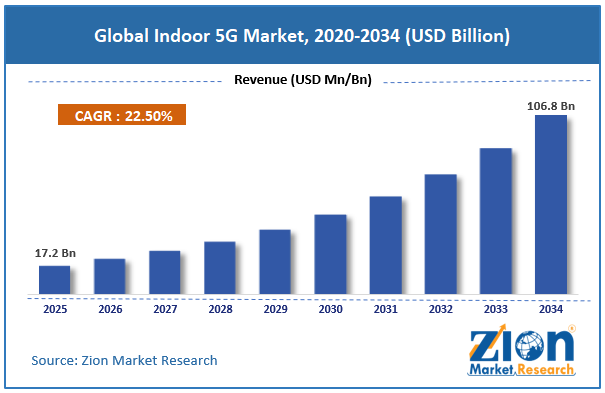
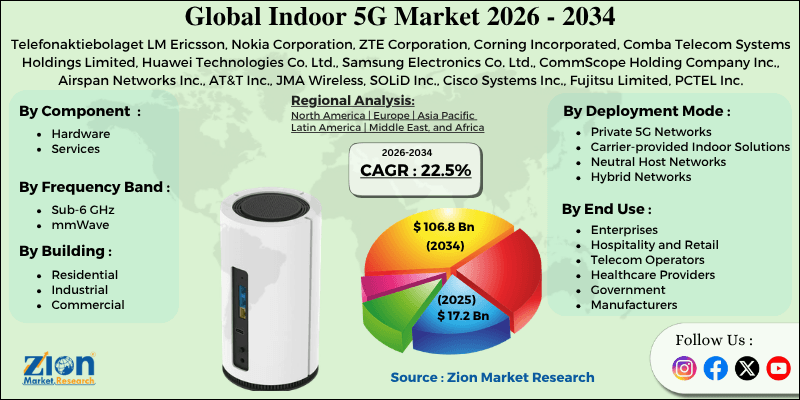
The global indoor 5G market size was worth around USD 17.2 billion in 2025 and is predicted to grow to around USD 106.8 billion by 2034, with a compound annual growth rate (CAGR) of roughly 22.5% between 2026 and 2034.
Key Insights
- As per the analysis shared by our research analyst, the global indoor 5G market is estimated to grow annually at a CAGR of around 22.5% over the forecast period (2026-2034).
- In terms of revenue, the global Indoor 5G market size was valued at around USD 17.2 billion in 2025 and is projected to reach USD 106.8 billion by 2034.
- Rising adoption of Industry 4.0 and private 5G networks is expected to propel the Indoor 5G market over the projected period.
- Based on the component, the hardware segment held the largest revenue share in 2025.
- Based on the frequency band, the Sub-6 GHz segment held the largest revenue share in 2025 of 55%.
- Based on the building, the commercial segment captured a prominent revenue share of 56% in 2025.
- Based on the deployment mode, the private 5G networks segment held the largest revenue share in 2025 of 41%.
- Based on the end use, the telecom operators are growing at a significant rate over the projected period.
- Based on region, North America dominates the Indoor 5G market with a revenue share of 36% in 2025.
Indoor 5G Market: Overview
Indoor 5G is the term for the fifth-generation wireless network implemented in enclosed spaces such as offices, factories, hospitals, malls, airports, schools, hotels, and houses. The 5G network requires proper installation of small cells to penetrate walls and other constructions to provide a robust signal for smartphones, IoT devices, video streaming, and cloud platforms. In other words, 5G indoor solutions address the need for ultra-fast, low-latency networks to enable smart technologies like AR and VR and support massive data exchange in industrial sites, enterprises, and organizations. Moreover, with enhanced mobile broadband, indoor networks support the rising demand for cloud services and IoT devices.
Impact of the USA-Israel War on Iran on the Indoor 5G Market
The USA-Israel conflict with Iran has a negative impact on the indoor 5G market in the short term. The region’s telecom infrastructure development, expensive supply chains, and enterprise investment in the Middle East have been severely disrupted by the geopolitical tensions.
Moreover, increased cybersecurity threats and network development delays have significantly reduced the growth rate of the indoor 5G market in the region. Nevertheless, security concerns among governments, healthcare institutions, and other critical facilities about the vulnerability of outdoor networks to attacks and surveillance drive demand for private indoor 5G networks.
Indoor 5G Market: Dynamics
Growth Drivers
How does the rapid growth of smart buildings and digital workspaces drive the indoor 5G market?
The rise in the adoption of smart buildings and digital workspaces is one of the key factors driving demand in the indoor 5G market. Increasing government investments in digital infrastructure and the need to build next-gen networks are contributing to market growth for indoor 5G. The European Commission has approved a €865 million (approximately USD 935 million) budget under the Connecting Europe Facility (CEF Digital) Work Program 2024–2027 for the development of 5G networks, edge cloud, and high-performance digital infrastructure.
In the previous year, the European Commission allocated €420 million (approximately USD 454 million) to fund digital projects, including the development of smart 5G communities. Government-led initiatives in the region will drive the development of smart offices, commercial buildings, healthcare infrastructure, and campuses. All these aspects involve the need for enhanced indoor 5G networks for improved performance and seamless operations.
Restraints
High initial deployment costs hamper the growth of the indoor 5G industry
High initial investment is a major hindrance to the growth of the indoor 5G market. Indoor networks require huge capital expenditures (CapEx) for small cells, distributed antenna systems (DAS), fiber, indoor radio heads, power, and other network management solutions.
Moreover, enterprises need to consider the costs of network design and integration with other systems, network security, and maintenance and support. These expenditures are high in comparison with other wireless communication technologies. Consequently, many firms, especially small and medium-sized enterprises (SMEs), are unable or reluctant to adopt expensive 5G solutions in their operations. As a result, growth in the indoor 5G market is hindered, as firms opt for more affordable solutions like Wi-Fi 6/6E.
Opportunities
How does increasing collaboration among key players create a lucrative opportunity for the indoor 5G market?
Increasing collaboration among key market players offers a potential opportunity for the indoor 5G market over the projected period. For instance, in June 2025, Nokia and Andorix, a provider of digital infrastructure and smart building solutions for real estate properties, announced a partnership to accelerate the adoption of private 5G networks and Neutral Host Networks in the real estate market across the United States and Canada. Real estate owners are looking for a 5G private cellular platform to connect their Operational Technology (OT) use cases, including energy management and efficiency, building operations and optimization, as well as physical and cybersecurity on a resilient infrastructure.
Additionally, real estate companies want a converged and future-proof smart 5G platform that can expand indoor cellular coverage to improve their tenant’s experience with connectivity and value-added edge applications.
Challenges
How does the spectrum availability and regulatory constraints pose a significant challenge to the growth of the indoor 5G industry?
Spectrum availability and regulatory restrictions hinder the development of the indoor 5G industry because distributing indoor networks requires a certain amount of licensed or shared spectrum for use by local authorities, which is not always available in all countries. The number of countries offering enough mid-band spectrum is limited, while the provision of millimeter-wave communications requires significant regulatory relaxations or even changes to laws concerning telecommunications networks. In addition, in most countries, creating private indoor 5G networks requires substantial time, approval, and resources to release spectrum for exploitation.
Moreover, the differences between countries influence the power levels and technical regulations to which network equipment must comply, making installations costly and time-consuming for authorized organizations. All these factors make 5G implementation challenging and are more significant for countries that do not have an established regulatory framework for private and corporate 5G networks.
Indoor 5G Market: Report Scope
| Report Attributes | Report Details |
|---|---|
| Report Name | Indoor 5G Market |
| Market Size in 2025 | USD 17.2 Billion |
| Market Forecast in 2034 | USD 106.8 Billion |
| Growth Rate | CAGR of 22.5% |
| Number of Pages | 228 |
| Key Companies Covered | Telefonaktiebolaget LM Ericsson, Nokia Corporation, ZTE Corporation, Corning Incorporated, Comba Telecom Systems Holdings Limited, Huawei Technologies Co. Ltd., Samsung Electronics Co. Ltd., CommScope Holding Company Inc., Airspan Networks Inc., AT&T Inc., JMA Wireless, SOLiD Inc., Cisco Systems Inc., Fujitsu Limited, PCTEL Inc., Huber+Suhner AG, Nextivity Inc., Proptivity AB, LiteOn Technology Corporation, Boingo Wireless Inc., and others. |
| Segments Covered | By Component, By Frequency Band, By Building, By Deployment Mode, By End Use, and By Region |
| Regions Covered | North America, Europe, Asia Pacific (APAC), Latin America, Middle East, and Africa (MEA) |
| Base Year | 2025 |
| Historical Year | 2020 - 2024 |
| Forecast Year | 2026 - 2034 |
| Customization Scope | Avail customized purchase options to meet your exact research needs. Request For Customization |
Indoor 5G Market: Segmentation
Component Insights
Why does the hardware segment hold a prominent position in the indoor 5G market?
The hardware segment held the largest revenue share of the DevOps platform industry in 2025. Market growth is driven by rising installations of small cells, distributed antenna systems (DAS), indoor radio units (RUs), antennas, baseband units, routers, and edge servers. The rising need for enhanced network infrastructure is fueled by enterprises, hospitals, and airports that leverage indoor 5G technology to offer improved ultra-broadband connectivity, support IoT devices, AI, and automated building functions. Moreover, the emerging adoption of private 5G in industrial enterprises is driving investments in network infrastructure to enable enhanced control and optimization of connected devices in time-critical Industry 4.0 operations.
Frequency Band Insights
Does the Sub-6 GHz segment capture the largest share in the indoor 5G market?
The Sub-6 GHz segment held the largest revenue share of the DevOps platform market in 2025, at 55%. The main reason for its growth is that it provides coverage, capacity, and cost-efficiency for indoor use compared to mmWave frequencies. Moreover, compared to the higher frequencies of 5G networks (such as mmWave), Sub-6 GHz radio waves penetrate walls, floors, and other structures better, allowing the creation of reliable cellular coverage indoors with a lower density of base stations. Telecommunication companies and enterprises are interested in Sub-6 GHz solutions for 5G networks because they help ensure broader coverage, reduce network deployment costs, and enable higher capacity for mobile broadband, IoT devices, cloud services, and enterprise applications.
Building Insights
How does the commercial segment capture the largest share in the indoor 5G market?
The commercial segment captures a prominent revenue share of the DevOps platform market of 56% in 2025. The growth is driven by the digitization of office buildings, malls, hotels, airports, convention centers, educational institutions, and healthcare facilities. These facilities need reliable, high-speed, low-latency wireless networks and services that support cloud-based business applications, smart building technologies, hybrid workstyles, video conferencing, IoT, AI analytics, digital signage, and customer experience technologies. Businesses are capitalizing on the deployment of indoor 5G to increase productivity and ensure secure connectivity for their employees and customers.
Deployment Mode Insights
What factors drive the private 5G networks segment in the indoor 5G market?
The private 5G networks segment held the largest revenue share of the DevOps platform industry in 2025 of 41%. Segment growth is driven by the need for high-quality wireless communications in industrial sites, warehouses, hospitals, airports, corporate campuses, and other locations where enterprises are looking to create private indoor 5G networks. Such networks are seen as enablers for a range of mission-critical applications, from industrial automation and autonomous mobile robots to real-time object location, AI analytics, computer vision, and large-scale IoT implementations, with greater control over network performance, security, and data privacy.
End-Use Insights
Does the telecom operators segment capture the largest share in the indoor 5G market?
Telecom operators are growing at a significant rate in the DevOps platform market over the projected period. A growing number of investments are being made to improve indoor networks and provide better services to enterprise and consumer clients. Moreover, telecom operators are adopting indoor 5G solutions such as small cells, distributed antenna systems, and indoor radio units, among others, to meet the need for reliable, high-quality high-speed internet in enterprise and consumer locations while complementing the limited access provided by outdoor signals. Further, rising demand for mobile data, cloud services, video streams, IoT, and hybrid workstyles is driving operators to densify their networks and improve indoor coverage.
Regional Insights
What factors drive the North America region in the indoor 5G market?
North America dominates the indoor 5G market with a revenue share of 36% in 2025. The development of the Indoor 5G Market can be attributed to the early adoption of 5G technology and the extensive digitization taking place in the enterprise sector. Further, significant investments by major telecom operators and network equipment manufacturers are also contributing to the growth of this market. The region is witnessing a rapid rise in the adoption of enterprise-grade indoor solutions in commercial buildings, manufacturing units, hospitals, airports, stadiums, smart campuses, and other commercial infrastructure to enable ultra-reliable connectivity, private 5G, Internet of Things (IoT), and artificial intelligence-driven applications. Leading market participants in the region are investing significantly in accelerating the growth of the Indoor 5G Market.
For instance, recently, Ericsson launched the Indoor Fusion 8828 solution in Canada in collaboration with telecom operator Bell Canada to address the need for indoor 5G solutions in commercial buildings. The solution offers enhanced performance and is designed to empower retailers, restaurants, and enterprise offices to transform their operations with seamless connectivity. Moreover, Nokia announced that around 25% of its total 960 private wireless customers are present in North America and continues to invest significantly in 5G R&D, private wireless, and network infrastructure in the U.S. Such factors are fueling the growth of the Indoor 5G Market in the region at a robust pace.
Indoor 5G Market: Competitive Analysis
The global indoor 5G market is dominated by players like:
- Telefonaktiebolaget LM Ericsson
- Nokia Corporation
- ZTE Corporation
- Corning Incorporated
- Comba Telecom Systems Holdings Limited
- Huawei Technologies Co. Ltd.
- Samsung Electronics Co. Ltd.
- CommScope Holding Company Inc.
- Airspan Networks Inc.
- AT&T Inc.
- JMA Wireless
- SOLiD Inc.
- Cisco Systems Inc.
- Fujitsu Limited
- PCTEL Inc.
- Huber+Suhner AG
- Nextivity Inc.
- Proptivity AB
- LiteOn Technology Corporation
- Boingo Wireless Inc.
The global indoor 5G market is segmented as follows:
By Component
- Hardware
- Services
By Frequency Band
- Sub-6 GHz
- mmWave
- Others
By Building
- Residential
- Industrial
- Commercial
By Deployment Mode
- Private 5G Networks
- Carrier-provided Indoor Solutions
- Neutral Host Networks
- Hybrid Networks
- Network-as-a-Service
By End Use
- Enterprises
- Hospitality and Retail
- Telecom Operators
- Healthcare Providers
- Government
- Manufacturers
- Others
By Region
- North America
- The U.S.
- Canada
- Mexico
- Europe
- France
- The UK
- Spain
- Germany
- Italy
- Rest of Europe
- Asia Pacific
- China
- Japan
- India
- Australia
- South Korea
- Rest of Asia Pacific
- The Middle East & Africa
- Saudi Arabia
- UAE
- Egypt
- Kuwait
- South Africa
- Rest of the Middle East & Africa
- Latin America
- Brazil
- Argentina
- Rest of Latin America
Table Of Content
Methodology
FrequentlyAsked Questions
Indoor 5G is the term for the fifth-generation wireless network implemented in enclosed spaces such as offices, factories, hospitals, malls, airports, schools, hotels, and houses. The 5G network requires proper installation of small cells to penetrate walls and other constructions to provide a robust signal for smartphones, IoT devices, video streaming, and cloud platforms.
The key growth drivers for the Indoor 5G market include the increasing demand for high-speed and low-latency indoor connectivity, rapid adoption of smart buildings and digital workplaces, expansion of private 5G networks for Industry 4.0, growing deployment of IoT devices, and rising investments in edge computing and enterprise digital transformation.
The major challenges restraining the growth of the Indoor 5G market include high initial deployment and infrastructure costs, complex installation and integration with existing networks, limited spectrum availability and regulatory constraints, signal propagation challenges in dense indoor environments, and cybersecurity concerns associated with connected enterprise networks.
Based on the end use, the telecom operators segment is expected to dominate the Indoor 5G market growth during the projected period.
Emerging trends and innovations impacting the Indoor 5G market include the rapid adoption of private 5G networks, AI-powered network automation, Open RAN (O-RAN) architectures, edge computing integration, and network slicing for customized enterprise services. The growing deployment of small cells, distributed antenna systems (DAS), and indoor radio units to improve coverage, along with increasing demand for smart buildings, Industry 4.0, IoT, and AR/VR applications, is further driving innovation and accelerating the evolution of the indoor 5G market.
According to the report, the global indoor 5G market size was worth around USD 17.2 billion in 2025 and is predicted to grow to around USD 106.8 billion by 2034.
The global indoor 5G market is expected to grow at a CAGR of 22.5% during the forecast period.
The global indoor 5G industry growth is expected to be led by North America over the forecast period.
The global indoor 5G market is dominated by players like Telefonaktiebolaget LM Ericsson, Nokia Corporation, ZTE Corporation, Corning Incorporated, Comba Telecom Systems Holdings Limited, Huawei Technologies Co. Ltd., Samsung Electronics Co. Ltd., CommScope Holding Company Inc., Airspan Networks Inc., AT&T Inc., JMA Wireless, SOLiD Inc., Cisco Systems Inc., Fujitsu Limited, PCTEL Inc., Huber+Suhner AG, Nextivity Inc., Proptivity AB, LiteOn Technology Corporation, and Boingo Wireless Inc., among others.
The DevOps platform market report covers the geographical market along with a comprehensive competitive landscape analysis. It also includes cash flow analysis, profit ratio analysis, market basket analysis, market attractiveness analysis, sentiment analysis, PESTLE analysis, trend analysis, SWOT analysis, trade area analysis, demand & supply analysis, Porter’s five forces analysis, and value chain analysis.

HappyClients