
Global Herbal Beverages Market Size, Share, Trends, Growth and Forecast 2034

Herbal Beverages Market By Product Type (Tea, Coffee, Juices, Functional Drinks, and Others), By Ingredient (Chamomile, Peppermint, Ginger, Hibiscus, and Others), By Packaging Type (Bottles, Cans, Sachets, and Others), By Distribution Channel (Online Stores, Supermarkets/Hypermarkets, Specialty Stores, and Others), and By Region - Global and Regional Industry Overview, Market Intelligence, Comprehensive Analysis, Historical Data, and Forecasts 2026 - 2034
| Market Size in 2025 | Market Forecast in 2034 | CAGR (in %) | Base Year |
|---|---|---|---|
| USD 3.6 Billion | USD 6.7 Billion | 7.1% | 2025 |
Herbal Beverages Market: Industry Perspective
What will be the size of the global herbal beverages market during the forecast period?
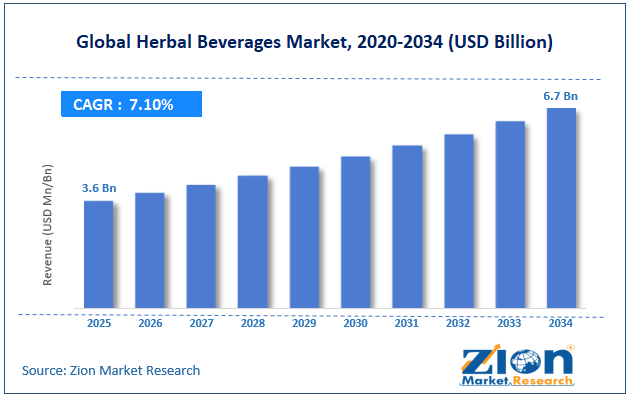
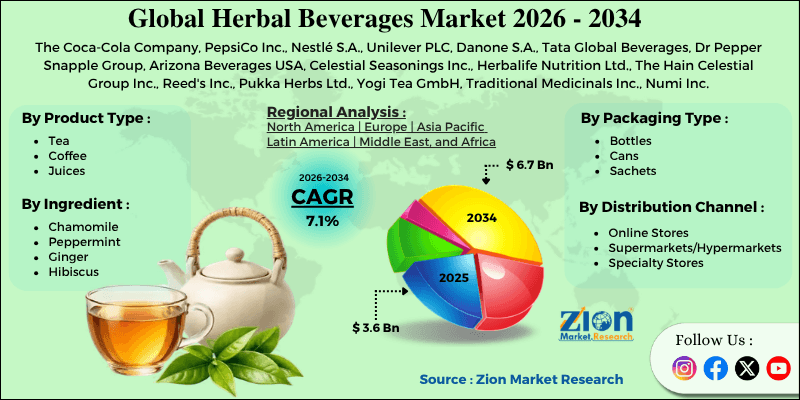
The global herbal beverages market size was worth around USD 3.6 billion in 2025 and is predicted to grow to around USD 6.7 billion by 2034, with a compound annual growth rate (CAGR) of roughly 7.1% between 2026 and 2034.
 Request Free SampleRequest Free Sample
Key Insights
- As per the analysis shared by our research analyst, the global herbal beverages market is estimated to grow annually at a CAGR of around 7.1% over the forecast period (2026-2034).
- In terms of revenue, the global herbal beverages market size was valued at around USD 3.6 billion in 2025 and is projected to reach USD 6.7 billion by 2034.
- Increasing interest in plant-based and sustainable lifestyles is expected to propel the herbal beverages market over the projected period.
- Based on the product type, the tea segment held the largest revenue share in 2025 of 43%.
- Based on the ingredient, the chamomile segment held the largest revenue share in 2025 of 20%.
- Based on the packaging type, the bottles segment captured a prominent revenue share in 2025 of 35%.
- Based on the distribution channel, supermarkets/hypermarkets hold a prominent revenue share of 38% in 2025.
- Based on region, the Asia Pacific dominates the herbal beverages market with a revenue share of 39% in 2025.
Herbal Beverages Market: Overview
Herbal beverages are non-alcoholic drinks made by extracting or infusing herbs, spices, flowers, roots, seeds, leaves, or other botanicals in water or other liquids. Herbal beverages, also called herbal teas, are usually caffeine-free (unless made with caffeinated botanicals such as yerba mate or guayusa) and are consumed for their hydrating, flavorful properties, relaxation, and health benefits, including digestive aid, immune support, and stress reduction, among others. Herbal beverages can be in the form of herbal teas, tisanes, botanical infusions, functional herbal drinks, ready-to-drink (RTD) herbal beverages, herbal wellness tonics, and plant-based herbal blends. Some of the most popular herbal ingredients are chamomile, peppermint, ginger, hibiscus, lemongrass, Tulsi (holy basil), rooibos, fennel, licorice root, turmeric, and lavender. Herbal beverages are available in supermarket chains, specialty stores, pharmacies, health food stores, cafes, and online.
Impact of the USA-Israel War on Iran on the Herbal Beverages Market
The USA-Israel conflict over Iran has had a relatively limited impact on the herbal beverages market. On the one hand, the tension between the countries increases geostrategic uncertainty, which affects international transportation and causes instability in the price of various ingredients. Additionally, shipping costs are rising since major suppliers are located in the affected region. Thus, the production and supply of herbal drinks are now more expensive, and inflationary pressures limit the market’s development. However, the growing demand for healthy and functional drinks supports the market, outweighing the unfavorable effects of geopolitical issues.
Herbal Beverages Market: Dynamics
Growth Drivers
How does the rising consumer preference for natural and functional drinks drive the herbal beverages market?
A growing demand for healthier options is a major trend within the herbal beverage market. An expanding emphasis on preventive healthcare and immunity, along with the functional attributes of herbal beverages, has led to a shift in consumer preferences. Consumers are trading sugar-sweetened and artificially flavored drinks for herbal beverages that feature botanical extracts such as ginger, turmeric, chamomile, hibiscus, peppermint, Tulsi, and other natural extracts. Moreover, consumers want fewer processed options and more natural beverages with additional health benefits; therefore, companies are developing new innovative herbal beverage products to meet these demands. In addition, herbal beverages are gaining popularity among millennial and Gen Z consumers due to their convenience and health benefits.
One of the significant product launches in this regard was in August 2025 when the company Twinings launched a new line of cold herbal teas called Refreshers. This product is available in two flavors: Strawberry Raspberry and Peach Mango, and is in the form of an instant beverage. Refreshers are a twinings’ response to the growing demand for more interesting and fruity-tasting herbal beverages among young people. Thus, the product launch met the industry trend of using herbal ingredients and convenient packaging.
Restraints
High production and raw material costs pose a restraint to the herbal beverages industry's growth
Herbal beverage manufacturers face high production and raw material costs as a major restraint. This is because such products as chamomile, hibiscus, turmeric, ginger, Tulsi, and other herbal and medicinal plants have become expensive. Moreover, manufacturers spend significantly on organic processing, testing, extracting, and sustainable packaging. Consequently, high production costs challenge manufacturers to raise the retail price of their products. On the other hand, the high cost of these herbal substances and other production costs discourage investors and make the production process unprofitable for some firms. Additionally, supply chains and environmental factors also play an essential role in the soaring prices of herbal drinks.
Opportunities
How does the launch of functional drinks offer a lucrative opportunity for the herbal beverages market?
The introduction of functional drinks creates substantial opportunities for the herbal beverages market by diversifying the range of herbal tea beyond traditional products and meeting the growing demand for value-added drinks. Manufacturers offer functional herbal beverages containing botanical extracts, such as turmeric, ginger, ashwagandha, chamomile, hibiscus, ginseng, and Tulsi, combined with vitamins, probiotics, adaptogens, electrolytes, and antioxidants for immune support, digestion support, and stress relief, among others. This strategy meets consumer demand for healthier options and positions the company to sell premium products with a healthy positioning, targeting those who want to replace sugar-sweetened beverages with functional drinks.
Moreover, the opportunity is presented by the growing trend for personalized nutrition and ready-to-drink (RTD) functional beverages. Companies develop herbal sparkling drinks, botanical shots, cold-brew herbal beverages, and functional drinks for active women and men. With growing demand for personalized and preventive care, botanical extracts for wellness, and RTD drinks, manufacturers can design products with targeted functionality, gain more shelf space in traditional and digital retailers, and identify new distribution channels, profoundly impacting the growth of the herbal beverages market.
For instance, in September 2025, Israeli food-tech start-up Solveat announced that it has entered an investment-based joint development and commercial agreement with multinational beverages company The Central Bottling Company (CBC Group). The two firms intend to cooperate closely to develop functional drinks that will include Solveat’s proprietary natural herbal ingredients. As part of the deal, Solveat and CBC’s juice concentrates and fruit-based solutions provider Gat Foods will launch a new line of beverages made with the start-up’s botanical ingredients. The products’ areas of application would include metabolic and blood sugar function and other wellness categories.
Challenges
Why does the competition from other healthy beverage categories pose a significant challenge to the growth of the herbal beverages industry?
The herbal beverages market is highly competitive, with many alternative healthy drink options such as green tea, kombucha, probiotic drinks, functional waters, cold-pressed juices, plant-based beverages, sports drinks, and vitamin-enriched beverages. Similar in terms of health and wellness properties like hydration, immune support, digestion, and energy, these alternatives have strong brand presence and extensive distribution networks, making it difficult for herbal beverage producers to compete. Moreover, customers have more choices when buying functional drinks and beverages with wellness properties, which means herbal beverage producers need to differentiate their production through various botanical ingredients, unique flavors, and other means to attract customers’ attention.
In addition, beverage companies with extensive experience producing RTD functional drinks and personalized products are also entering the market, targeting the same customers through promotional activities. Finally, in some emerging markets, such as Asia-Pacific, consumers may prefer cheaper healthy alternatives to expensive herbal beverages, which limits their appeal and makes them uncompetitive against other functional beverages. Therefore, fierce competition with numerous alternatives to herbal drinks presents challenges for market participants and threatens to limit the growth of the herbal beverages market.
 Request Free SampleRequest Free Sample
Herbal Beverages Market: Report Scope
| Report Attributes | Report Details |
|---|---|
| Report Name | Herbal Beverages Market |
| Market Size in 2025 | USD 3.6 Billion |
| Market Forecast in 2034 | USD 6.7 Billion |
| Growth Rate | CAGR of 7.1% |
| Number of Pages | 228 |
| Key Companies Covered | The Coca-Cola Company, PepsiCo Inc., Nestlé S.A., Unilever PLC, Danone S.A., Tata Global Beverages, Dr Pepper Snapple Group, Arizona Beverages USA, Celestial Seasonings Inc., Herbalife Nutrition Ltd., The Hain Celestial Group Inc., Reed's Inc., Pukka Herbs Ltd., Yogi Tea GmbH, Traditional Medicinals Inc., Numi Inc., Bigelow Tea Company, Twinings North America Inc., Organic India Pvt. Ltd., Tazo Tea Company, and others. |
| Segments Covered | By Product Type, By Ingredient, By Packaging Type, By Distribution Channel, and By Region |
| Regions Covered | North America, Europe, Asia Pacific (APAC), Latin America, Middle East, and Africa (MEA) |
| Base Year | 2025 |
| Historical Year | 2020 to 2024 |
| Forecast Year | 2026 - 2034 |
| Customization Scope | Avail customized purchase options to meet your exact research needs. Request For Customization |
Herbal Beverages Market: Segmentation
Product Type Insights
Why does the tea segment hold a prominent position in the herbal beverages market?
The tea segment held the largest revenue share of the herbal beverages market in 2025 of 43%. Its growth is attributed to rising consumer preference for herbal teas as an alternative to traditional teas and coffee because they are caffeine-free. The potential health benefits of herbal teas are driving their demand in both developed and emerging markets. For instance, chamomile is used for relaxation, peppermint for digestion, ginger and turmeric for immunity, hibiscus for cardiovascular health, and Tulsi for stress management, among others.
Ingredient Insights
Does the chamomile segment capture the largest share in the Herbal Beverages market?
The chamomile segment held the largest revenue share of the herbal beverages industry in 2025 of 20%. The growth is attributed to the demand for natural beverages that provide relaxation, reduce stress, and improve sleep. Chamomile is a herb that is naturally caffeine-free and has been associated with promoting digestion and relaxation for centuries. Therefore, as consumers turn to more natural remedies and put more emphasis on mental health care and wellness, herbal teas and drinks are gaining popularity in both emerging and mature markets.
Packaging Type Insights
How does the bottles segment capture the largest share in the herbal beverages market?
The bottles segment captures a prominent revenue share in 2025 of 35%. Growth is primarily driven by demand for ready-to-drink (RTD) herbal and on-the-go consumption, as bottles offer convenience with a durable, resealable package, making them suitable for herbal drinks, botanicals, teas, tonics, and flavored herbal drinks. A rising need for convenience in healthy drinks is driving the sales of bottled herbal drinks worldwide.
Distribution Channel Insights
Why does the supermarkets/hypermarkets segment capture the largest share in the herbal beverages market?
The supermarkets/hypermarkets hold a prominent revenue share of 38% in 2025. This growth is explained by the wide variety of products, competitive prices, and the number of consumers who visit these retail chains. They offer customers a great selection of herbal teas, ready-to-drink (RTD) herbal teas, botanicals, and wellness drinks. The wide variety includes many popular and unique brands.
Regional Insights
What factors drive the Asia Pacific region in the herbal beverages market?
The Asia Pacific dominates the herbal beverages market with a revenue share of 39% in 2025. The growth of the herbal beverages market is attributed to rising consumer awareness of traditional herbal treatments, rising disposable income, urbanization, and demand for natural and functional drinks. Herbal teas and botanical infusions, as well as herbal ready-to-drink beverages, are gaining popularity in countries such as China, India, Japan, South Korea, and Australia. These regions report a rising demand for healthy and functional drinks with immunity-boosting properties.
Moreover, the availability of herbal teas, flavored with medicinal plants and having beneficial effects on health, is supported by the rich local biodiversity and ongoing research activities. This includes the development of innovative organic products derived from herbal active ingredients. Asia Pacific was the biggest regional market for herbal beverages in 2025, with increased consumption levels and a strong retail network.
India, for instance, has over 1,178 species of medicinal plants reported by the National Medicinal Plants Board (NMPB). Out of these, 242 species have an annual demand of more than 100 tonnes of raw material. This includes the most common herbal ingredients for making herbal teas, such as Tulsi, ginger, licorice, fennel, and many others.
Herbal Beverages Market: Competitive Analysis
The global herbal beverages market is dominated by players like:
- The Coca-Cola Company
- PepsiCo Inc.
- Nestlé S.A.
- Unilever PLC
- Danone S.A.
- Tata Global Beverages
- Dr Pepper Snapple Group
- Arizona Beverages USA
- Celestial Seasonings Inc.
- Herbalife Nutrition Ltd.
- The Hain Celestial Group Inc.
- Reed's Inc.
- Pukka Herbs Ltd.
- Yogi Tea GmbH
- Traditional Medicinals Inc.
- Numi Inc.
- Bigelow Tea Company
- Twinings North America Inc.
- Organic India Pvt. Ltd.
- Tazo Tea Company
The global herbal beverages market is segmented as follows:
By Product Type
- Tea
- Coffee
- Juices
- Functional Drinks
- Others
By Ingredient
- Chamomile
- Peppermint
- Ginger
- Hibiscus
- Others
By Packaging Type
- Bottles
- Cans
- Sachets
- Others
By Distribution Channel
- Online Stores
- Supermarkets/Hypermarkets
- Specialty Stores
- Others
By Region
- North America
- The U.S.
- Canada
- Mexico
- Europe
- France
- The UK
- Spain
- Germany
- Italy
- Rest of Europe
- Asia Pacific
- China
- Japan
- India
- Australia
- South Korea
- Rest of Asia Pacific
- The Middle East & Africa
- Saudi Arabia
- UAE
- Egypt
- Kuwait
- South Africa
- Rest of the Middle East & Africa
- Latin America
- Brazil
- Argentina
- Rest of Latin America
Table Of Content
Methodology
FrequentlyAsked Questions
Herbal beverages are non-alcoholic drinks made by extracting or infusing herbs, spices, flowers, roots, seeds, leaves, or other botanicals in water or other liquids. Herbal beverages, also called herbal teas, are usually caffeine-free (unless made with caffeinated botanicals such as yerba mate or guayusa) and are consumed for their hydrating, flavorful properties, relaxation, and health benefits, including digestive aid, immune support, and stress reduction, among others.
The herbal beverages market is primarily driven by rising consumer preference for natural, clean-label, and functional drinks, increasing health and wellness awareness, and growing demand for beverages that support immunity, digestion, stress relief, and overall well-being. The expanding popularity of caffeine-free alternatives, herbal teas, and ready-to-drink (RTD) botanical beverages, coupled with product innovation using ingredients such as chamomile, ginger, turmeric, hibiscus, and Tulsi, is further accelerating market growth.
The major challenges restraining the growth of the herbal beverages market include high production and raw material costs, seasonal fluctuations in the availability of herbal ingredients, and stringent regulatory requirements for health claims and product labeling. The market also faces intense competition from other healthy beverage categories such as kombucha, functional waters, green tea, and probiotic drinks.
Based on the product type, the tea segment is expected to dominate the herbal beverages market growth during the projected period.
Emerging trends and innovations in the herbal beverages market include the growing popularity of functional and ready-to-drink (RTD) herbal beverages, clean-label and organic formulations, and products enriched with adaptogens, probiotics, vitamins, and antioxidants. Manufacturers are introducing innovative botanical blends featuring ingredients such as ashwagandha, chamomile, turmeric, ginger, hibiscus, and Tulsi to address consumer demand for immunity, stress relief, digestive health, and hydration.
According to the report, the global herbal beverages market size was worth around USD 3.6 billion in 2025 and is predicted to grow to around USD 6.7 billion by 2034.
The global herbal beverages market is expected to grow at a CAGR of 7.1% during the forecast period.
The global herbal beverages industry growth is expected to be led by the Asia Pacific over the forecast period.
The global herbal beverages market is dominated by players like The Coca-Cola Company, PepsiCo Inc., Nestlé S.A., Unilever PLC, Danone S.A., Tata Global Beverages, Dr Pepper Snapple Group, Arizona Beverages USA, Celestial Seasonings Inc., Herbalife Nutrition Ltd., The Hain Celestial Group Inc., Reed's Inc., Pukka Herbs Ltd., Yogi Tea GmbH, Traditional Medicinals Inc., Numi Inc., Bigelow Tea Company, Twinings North America Inc., Organic India Pvt. Ltd., and Tazo Tea Company, among others.
The herbal beverages market report covers the geographical market along with a comprehensive competitive landscape analysis. It also includes cash flow analysis, profit ratio analysis, market basket analysis, market attractiveness analysis, sentiment analysis, PESTLE analysis, trend analysis, SWOT analysis, trade area analysis, demand & supply analysis, Porter’s five forces analysis, and value chain analysis.

HappyClients

