
Hand Grip Strengthener Market Size, Share, Trends, Growth and Forecast 2034

Hand Grip Strengthener Market By Product Type (Adjustable Hand Grip Strengtheners, Fixed Hand Grip Strengtheners, Digital Hand Grip Strengtheners), By Material (Plastic, Metal, Rubber, Foam), By Distribution Channel (Online Retail, Offline Retail, Specialty Stores, Supermarkets/Hypermarkets), and By Region - Global and Regional Industry Overview, Market Intelligence, Comprehensive Analysis, Historical Data, and Forecasts 2025 - 2034
| Market Size in 2024 | Market Forecast in 2034 | CAGR (in %) | Base Year |
|---|---|---|---|
| USD 1,100 Million | USD 1,660 Million | 5.30% | 2024 |
Hand Grip Strengthener Industry Perspective:
What will be the size of the global hand grip strengthener market during the forecast period?
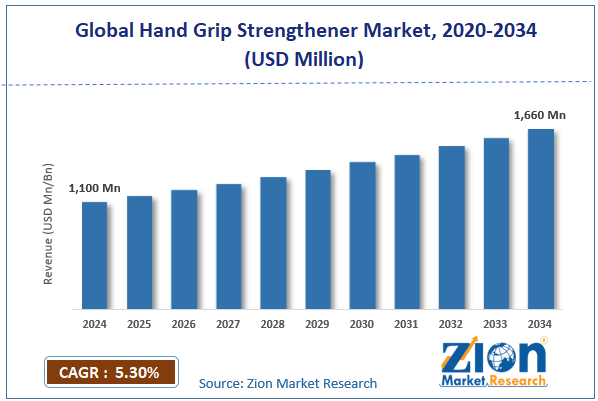
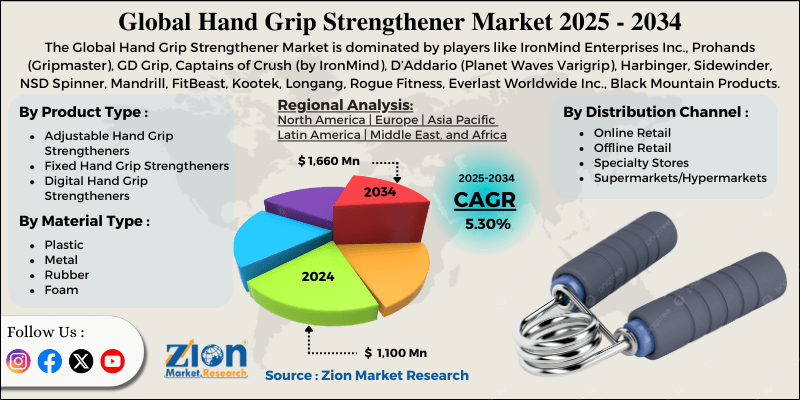
The global hand grip strengthener market size was worth around USD 1,100 million in 2024 and is predicted to grow to around USD 1,660 million by 2034, with a compound annual growth rate (CAGR) of roughly 5.30% between 2025 and 2034.
Key Insights:
- As per the analysis shared by our research analyst, the global hand grip strengthener market is estimated to grow annually at a CAGR of around 5.30% over the forecast period (2025-2034)
- In terms of revenue, the global hand grip strengthener market size was valued at around USD 1,100 million in 2024 and is projected to reach USD 1,660 million by 2034.
- The hand grip strengthener market is projected to grow significantly owing to increasing home workout trends, an aging population requiring hand strength maintenance, and the rise of e-commerce and online fitness equipment sales.
- Based on product type, the adjustable hand grip strengtheners segment is expected to lead the market, while the fixed hand grip strengtheners segment is expected to grow considerably.
- Based on material, the plastic segment is the dominating segment, while the metal segment is projected to witness sizeable revenue over the forecast period.
- Based on the distribution channel, the Online Retail segment is expected to lead the market compared to the Specialty Stores segment.
- Based on region, North America is projected to dominate the global market during the estimated period, followed by the Asia Pacific.
Hand Grip Strengthener Market: Overview
A hand grip strengthener is an exercise device that helps improve hand, forearm, and wrist strength by providing adjustable resistance for squeezing motions. It improves dexterity, grip endurance, and rehabilitation for injuries, increasing its significance for musicians, athletes, and daily hand function. The global hand grip strengthener market is likely to expand rapidly, fueled by the growing fitness awareness, rise in sports participation, and rehabilitation and physiotherapy. Worldwide health consciousness has motivated people to include forearm and hand exercises in their daily routines. Hand grip strengtheners offer an effective and simple way to improve grip strength and total hand function. Growing preventive fitness trends have steadily elevated the demand for these devices.
Moreover, participation in sports like weightlifting, tennis, and climbing requires strong hand and forearm strength. Athletes use grip strengtheners to prevent injuries and improve performance. This broad adoption in sports has augmented the market demand remarkably. Furthermore, grip strengtheners are extensively used in recovery programs for hand, wrist, and forearm injuries. Physiotherapists incorporate them to restore strength and enhance mobility safely. Their use in clinical care has augmented the market in the rehabilitation and healthcare industries.
Nevertheless, the global market faces limitations due to factors such as perceived low utility and competition from multifunctional equipment. Some consumers do not quickly realize the benefits of grip exercise. The perception of limited usefulness may lower regular use and hamper adoption education and awareness are required to boost market acceptance. Likewise, users usually prefer dumbbells or resistance bands that target multiple muscle groups. Standalone grip devices may be overlooked in favor of versatile tools. This competition limits industry share growth.
Still, the global hand grip strengthener industry benefits from several favorable factors, such as product innovation, customization, and ergonomic designs. IoT-enabled devices with gamification, tracking, and personalized programs appeal to tech-savvy users. Advanced features differentiate products in a competitive market. Advancement drives engagement and premium sales prospects. Tailored devices for climbers, seniors, or musicians improve usability and comfort. Ergonomic designs lower strain and enhance training efficiency. Customization enables brands to attract niche consumer segments.
Hand Grip Strengthener Market: Dynamics
Growth Drivers
How is the hand grip strengthener market augmented by the increased sports participation & functional training trends?
Grip strength is vital for sports like tennis, baseball, golf, climbing, and weightlifting, fueling enthusiasts and athletes to use dedicated grip trainers. Functional fitness routines that focus on real-world strength and injury prevention have increased grip exercises for different age groups. Many gyms now let their clients use hand grip strengtheners as a part of regular training programs. This sport-driven demand augments unit sales and motivates the creation of performance-oriented and premium products. Overall, ongoing participation in different sports backs sustained worldwide industry growth.
How are product improvement and technological advancements considerably fueling the hand grip strengthener market?
Manufacturers are introducing smart grip strengtheners offering app connectivity, digital tracking, and ergonomic designs to attract tech-savvy populations. These advancements allow consumers to monitor performance, personalize training, and set goals, creating differentiation in an open market. Adjustable resistance models cater to a wide audience, from beginners to professional athletes, expanding the user base. Digital feedback and sensor integration improve engagement and promote consistent usage. The growth of smart and multifunctional devices majorly reinforces the hand grip strengthener market’s overall value proposition.
Restraints
Regulatory & quality standard issues adversely impact the market progress
Low-class or poorly designed grip strengtheners flood the industry, risking user injuries and negative reviews. Regulatory standards for fitness devices vary broadly between economies, challenging international sales. Institutional buyers, like rehabilitation centers or gyms, are careful with unverified products. Safety concerns restrict mainstream adoption in professional sports and healthcare sectors. Maintaining consistent quality worldwide is still a major constraint.
Opportunities
How do rehabilitation & healthcare partnerships create promising avenues for the growth of the hand grip strengthener industry?
Hospitals, rehabilitation centers, and physiotherapy clinics increasingly include grip strengtheners in treatment plans. These devices help patients recover from wrist injuries, conditions like tendonitis or arthritis, and surgeries. Associations with healthcare institutions can formalize device usage in therapy programs. An aging population also augments the demand for rehabilitative and preventive solutions. This segment offers high-value and stable growth prospects in the hand grip strengthener industry.
Challenges
Seasonal & trend-driven demand fluctuations restrict the market growth
Sales of hand grip strengtheners usually spike at the start of the year (new year resolutions), sports seasons, and fitness trends. Outside these peaks, demand falls, creating revenue and inventory challenges. Overstocking during off-peak periods elevates financial risks, while understocking during peak demand leads to lost sales. Brands should foresee accurately and adapt marketing to stabilize sales. This cyclicality adds to the operational burden.
Hand Grip Strengthener Market: Report Scope
| Report Attributes | Report Details |
|---|---|
| Report Name | Hand Grip Strengthener Market |
| Market Size in 2024 | USD 1,100 Million |
| Market Forecast in 2034 | USD 1,660 Mllion |
| Growth Rate | CAGR of 5.30% |
| Number of Pages | 224 |
| Key Companies Covered | IronMind Enterprises Inc., Prohands (Gripmaster), GD Grip, Captains of Crush (by IronMind), D’Addario (Planet Waves Varigrip), Harbinger, Sidewinder, NSD Spinner, Mandrill, FitBeast, Kootek, Longang, Rogue Fitness, Everlast Worldwide Inc., Black Mountain Products, and others. |
| Segments Covered | By Product Type, By Material Type, By Distribution Channel, and By Region |
| Regions Covered | North America, Europe, Asia Pacific (APAC), Latin America, Middle East, and Africa (MEA) |
| Base Year | 2024 |
| Historical Year | 2019 to 2023 |
| Forecast Year | 2025 - 2034 |
| Customization Scope | Avail customized purchase options to meet your exact research needs. Request For Customization |
Hand Grip Strengthener Market: Segmentation
The global hand grip strengthener market is segmented based on product type, material, distribution channel, and region.
Why is the Adjustable Hand Grip Strengtheners segment projected to dominate the hand grip strengthener market?
Based on product type, the global hand grip strengthener industry is divided into adjustable hand grip strengtheners, fixed hand grip strengtheners, and digital hand grip strengtheners. The adjustable hand grip strengtheners lead the market with 55% of the overall market revenue because of their versatility and resistance. They appeal to a broad range of users, from rehabilitation patients to serious fitness lovers, backing progressive training goals. Integration with ergonomic designs and digital features has strengthened their leading position worldwide.
Conversely, the fixed hand grip strengtheners rank second, holding 30% of the total market, fueled by their cost-effectiveness, durability, and simplicity. These non-adjustable devices are popular among traditional users, budget-conscious buyers, and athletes. While less versatile than adjustable types, their strong sales and reliability secure their number-two position worldwide.
What factors help the Plastic segment lead the hand grip strengthener market?
Based on material, the global hand grip strengthener market is segmented into plastic, metal, rubber, and foam. The plastic hand grip strengtheners segment dominates the market with 42% market share, due to their lightweight build, cost-effectiveness, and versatility. They support ergonomic designs that attract casual fitness users and beginners. Plastic’s compatibility with smart and digital models further strengthens its leadership in mass-market devices.
Nevertheless, the metal hand grip strengtheners segment registers a second-leading position with 30% market share due to their high-tension performance and durability. Made from aluminum or steel alloys, they attract powerlifters, athletes, and professionals seeking long-lasting resistance. Their reliability and superior strength sustain strong sales in developed markets like Europe and North America.
What are the key reasons for the leadership of the Online Retail segment in the hand grip strengthener market?
Based on distribution channel, the global market is segmented into online retail, offline retail, specialty stores, and supermarkets/hypermarkets. The online retail segment captures a leading share with 50% of the total market due to wide product selection, doorstep delivery, and convenience. E-commerce platforms attract both beginners and regular fitness users with easy returns and competitive pricing. Surging mobile shopping and internet access continue to fuel its speedy growth over traditional stores.
However, the specialty stores segment ranks second, holding nearly 25% of the total market by offering hands-on product experience and expert guidance. They cater to trainers, athletes, and healthcare customers who value personalized advice and high-class products. While smaller than online sales, specialty retail is strong where in-person evaluation is crucial.
Hand Grip Strengthener Market: Regional Analysis
What gives North America a competitive edge in the global Hand Grip Strengthener Market?
North America is projected to maintain its dominant position in the global hand grip strengthener market, with a 5.1% CAGR, owing to high health and fitness awareness, advanced healthcare and rehabilitation infrastructure, and high disposable income and e-commerce penetration. North America holds a strong culture of fitness, health, and wellness, with a broad awareness of strength training and preventive care. Consumers actively seek tools like hand grip strengtheners to enhance forearm strength, grip, and overall physical fitness. This high level of fitness consciousness fuels demand in age groups.
Moreover, the region holds well-developed physiotherapy and rehabilitation centers that integrate grip training devices for hand therapy and injury recovery. Clinics and hospitals actively use these tools for patient care, driving adoption in wellness and medical industries. The availability of professional guidance backs effective and safe usage.
Furthermore, North American consumers have comparatively high disposable income, allowing higher spending on premium products and fitness accessories. The strong presence of online retail platforms makes grip strengtheners easily accessible, offering convenience, competitive pricing, and variety. These factors together strengthen the regional dominance.
Why does Asia Pacific rank second in the global Hand Grip Strengthener Market?
Asia Pacific maintains its position as the second-largest region, with a 5.3% CAGR in the global hand grip strengthener industry, driven by speedy fitness awareness and health trends, expanding sports and recreational activities, and a focus on rehabilitation and elderly fitness. Growing health consciousness and rising adoption of fitness routines have surged the demand for hand grip strengtheners in APAC. Consumers are integrating rehabilitation exercises and strength training into daily life to enhance overall wellness. This move toward preventive health supports steady industry growth in the region. The prominence of sports like climbing, badminton, and weightlifting is growing remarkably, creating a strong need for grip enhancement devices. Enthusiasts and athletes are adopting hand grip strengtheners to prevent injuries and improve performance. The growth of both recreational and professional sports adds significantly to industry demand.
Additionally, a growing senior population and higher awareness of physiotherapy have elevated the demand for grip training devices. Hand grip strengtheners are used for maintaining hand strength in senior adults and in rehabilitation. This demographic and medical focus strengthens industry adoption in APAC.
Hand Grip Strengthener Market: Competitive Analysis
The leading players in the global hand grip strengthener market are:
- IronMind Enterprises Inc.
- Prohands (Gripmaster)
- GD Grip
- Captains of Crush (by IronMind)
- D’Addario (Planet Waves Varigrip)
- Harbinger
- Sidewinder
- NSD Spinner
- Mandrill
- FitBeast
- Kootek
- Longang
- Rogue Fitness
- Everlast Worldwide Inc.
- Black Mountain Products
What are the key trends in the global Hand Grip Strengthener Market?
Compact wellness & home fitness tools:
The growth of home fitness routines has augmented the demand for portable and small exercise tools like hand grip strengtheners that need minimal space. Customers are seeking convenient equipment that can be used anytime without the need to visit gyms. This trend backs steady adoption in remote and urban areas where workouts are common.
Customization & ergonomic design focus:
Manufacturers are developing products with ergonomic shapes, comfort-centric materials, and adjustable resistance to improve usability. tailored designs target specific user groups like athletes, seniors, and rehabilitation patients. This focus on personalization and comfort widens market attraction and boosts user experience.
The global hand grip strengthener market is segmented as follows:
By Product Type
- Adjustable Hand Grip Strengtheners
- Fixed Hand Grip Strengtheners
- Digital Hand Grip Strengtheners
By Material Type
- Plastic
- Metal
- Rubber
- Foam
By Distribution Channel
- Online Retail
- Offline Retail
- Specialty Stores
- Supermarkets/Hypermarkets
By Region
- North America
- The U.S.
- Canada
- Mexico
- Europe
- France
- The UK
- Spain
- Germany
- Italy
- Rest of Europe
- Asia Pacific
- China
- Japan
- India
- Australia
- South Korea
- Rest of Asia Pacific
- The Middle East & Africa
- Saudi Arabia
- UAE
- Egypt
- Kuwait
- South Africa
- Rest of the Middle East & Africa
- Latin America
- Brazil
- Argentina
- Rest of Latin America
Table Of Content
Methodology
FrequentlyAsked Questions

HappyClients

