
GRNA Market Size, Trend, Growth, Industry Analysis 2034

GRNA Market By Product Type (Synthetic gRNA, Plasmid-Encoded gRNA Constructs, RNP Complexes (gRNA + Cas), In-vitro Transcribed (IVT) gRNA, and Multiplex gRNA Libraries), By Application (Genome Editing, Diagnostics, Cell & Gene Therapy, Functional Genomics Screens, and Agricultural Biotechnology), By End-User (Academic & Research Institutes, Agro-industrial Firms, Contract Research Organizations (CROs), Biotechnology & Pharmaceutical Companies, and Hospitals & Diagnostic Laboratories), and By Region - Global and Regional Industry Overview, Market Intelligence, Comprehensive Analysis, Historical Data, and Forecasts 2026 - 2034
| Market Size in 2025 | Market Forecast in 2034 | CAGR (in %) | Base Year |
|---|---|---|---|
| USD 718 Billion | USD 3,308 Million | 18.5% | 2025 |
GRNA Industry Perspective:
What will be the size of the global GRNA market during the forecast period?
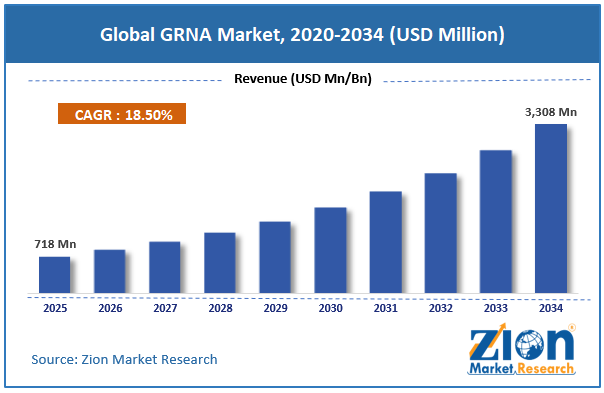
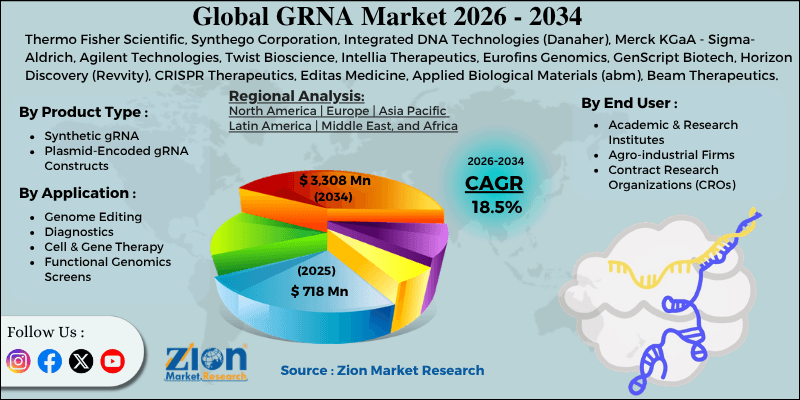
The global GRNA market size was worth around USD 718 million in 2025 and is predicted to grow to around USD 3,308 million by 2034, with a compound annual growth rate (CAGR) of roughly 18.5% between 2026 and 2034.
Key Insights
- As per the analysis shared by our research analyst, the global GRNA market is estimated to grow annually at a CAGR of around 18.5% over the forecast period (2026-2034).
- In terms of revenue, the global GRNA market size was valued at around USD 718 million in 2025 and is projected to reach USD 3,308 million by 2034.
- Growing investment in cell and gene therapy development is expected to propel the GRNA market over the projected period.
- Based on the product type, the synthetic gRNA segment dominates the GRNA market with a revenue share of 45% in 2025.
- Based on the application, the genome editing segment held the largest revenue share in 2025 of 53%.
- Based on the end-user, the academic & research institutes segment held a prominent share of 41% in 2025.
- Based on region, North America dominates the GRNA market with a revenue share of 49% in 2025.
GRNA Market: Overview
gRNA (guide RNA) is a synthetic RNA molecule used in CRISPR gene-editing technology to direct the CRISPR-associated protein (Cas), mostly Cas9, to the desired location in the genome. It consists of crRNA, which contains the sequence complementary to the target DNA strand, and tracrRNA, which binds to the Cas enzyme; both RNAs are commonly joined together to form a single-guide RNA. The gRNA guides Cas9 to the desired DNA section, which can then be cut out and replaced or regulated to alter gene expression. The gRNA technology is widely used in biomedical research, the pharmaceutical industry, agriculture, and gene therapy to manipulate genes for studying their functions, discovering new medicines, engineering crops, and treating genetic disorders.
Impact of the USA-Israel War on Iran on the GRNA Market
The U.S.-Israel conflict with Iran has negatively affected the gRNA market, as the geopolitical uncertainty may disrupt international pharmaceutical and biotechnology supply chains and increase transportation costs. As guide RNA production requires specialized nucleic acid synthesis reagents and laboratory consumables, global supply chain disruptions and higher freight costs may significantly impact the market, especially as some essential shipments of laboratory equipment and reagents are transported via commercial shipping routes. Moreover, delays in clinical studies and reduced investor confidence in biomedical technologies may slow the pace of initial public offerings and lower demand for gRNA. Still, the market for CRISPR-based gene editing approaches and therapeutics will continue to grow on both a global and national scale regardless of the geopolitical situation.
GRNA Market: Dynamics
Growth Drivers
How does the rising adoption of CRISPR-based gene editing technologies drive the GRNA market?
The rising adoption of CRISPR gene-editing techniques is estimated to propel growth in the global GRNA market. Guide RNAs are critical components of CRISPR-Cas technology that allow targeting of specific regions of genomes. The growing interest from biotech and pharmaceutical companies to develop gene-editing therapeutics for diverse applications, such as oncology, rare diseases, cardiology, and autoimmune disorders, is driving the need for precisely designed synthetic gRNAs. In 2023, for instance, CRISPR Therapeutics reported expanded investment in its pipeline of clinical-stage programs backed by a substantial cash reserve of around $1.9 billion. In addition, the company advanced its innovative gene-editing therapies. It launched the first CRISPR-based therapy, CASGEVY(R), while also advancing next-generation technologies to discover and develop an extensive range of gene-editing therapeutics.
Similarly, Vertex Pharmaceuticals has invested significantly in the CRISPR ecosystem through its January 2023 collaboration with Orna Therapeutics to develop novel in vivo gene-editing therapeutics, including innovative lipid nanoparticle (LNP) technology to edit genes inside the body, with a deal worth up to $635 million. These developments are anticipated to augment the demand for guide RNAs with a rise in clinical-stage research and the adoption of CRISPR-based therapeutics.
Restraints
High development and manufacturing costs hamper the growth of the GRNA industry
High development and manufacturing costs are a limiting factor for the GRNA market. The production of research- and clinical-grade RNA oligonucleotides requires sophisticated and expensive synthesis methods. In addition, there are costs associated with chemical modifications, purification, analytical tests, cold chain distribution, and regulatory documentation that make the technology inaccessible to smaller biotech companies and academic institutions. Furthermore, manufacturing gRNA requires specialized equipment and highly qualified personnel, adding to production costs and limiting the commercialization of gene-editing technologies. As a result, despite high demand for gene-edited therapeutics, the high cost of CRISPR-Cas9 production reduces the rate at which these products can be deployed and brought to market, negatively impacting the industry’s growth.
Opportunities
How does increasing technological innovation offer a lucrative opportunity for the GRNA market?
Increasing technological innovations will propel growth in the GRNA market by creating greater potential for genome engineering applications. The development of advanced AI-based gRNA design platforms, high-throughput oligo synthesis, novel chemically modified gRNAs, and high-fidelity CRISPR systems will help reduce off-target effects and increase the accuracy and efficacy of modifying target genes. Furthermore, the evolution of innovative lipid nanoparticle (LNP) technologies and other non-viral delivery systems will enable the effective in vivo delivery of gRNA therapeutics to develop gene-modified therapeutics for treating various diseases, including cancer, rare genetic disorders, and cardiovascular diseases.
Moreover, the introduction of automated technologies, cloud-based bioinformatics, and next-generation genome editing approaches, such as base editing, prime editing, and multiplex gene editing, will provide more significant commercialization opportunities by supporting and accelerating drug discovery, functional genomics, and research activities in the life sciences industry. These emerging technologies will also reduce the time and costs of research and development and increase the chances for clinical success in developing therapeutics to treat and manage a wide range of diseases and genetic disorders. Therefore, the aforesaid factors will contribute to the growth of the global GRNA market.
For instance, in February 2025, Illumina, Inc. unveiled a series of roadmap innovations, establishing the industry's largest portfolio of omics solutions and sequencing applications. The solutions – spanning genomics, spatial transcriptomics, single-cell analysis, CRISPR technologies, epigenetics, and data analytics software – will enable researchers to derive breakthrough insights around the drivers of disease. The new omics solutions surpass industry standards for scale, accuracy, and reliability because they are built on Illumina's powerful sequencers, known for unmatched quality, consistency, and accuracy. The expanded multiomics portfolio will be presented today at the Advances in Genome Biology and Technology (AGBT) General Meeting.
Challenges
How does the limited clinical validation for several applications pose a significant challenge to the growth of the GRNA industry?
Limited clinical validation for several applications is a major threat to the GRNA industry. This is primarily because most therapies using guide RNA are in early-stage clinical trials, and only a few products have received regulatory approval. Additionally, preclinical data may show promising results and genome-editing capabilities; however, clinical validation of large-scale therapies is required for long-term safety, efficacy, and persistence of the effects induced. Therapies need to clear various hurdles of clinical validation to prove safety, immunogenicity, optimal delivery mechanisms, and long-term genetic effects. Such extensive validation of genome-editing therapies may lead to high costs, time delays, and risks for manufacturers.
Moreover, such factors discourage pharmaceutical companies and other organizations from investing significantly in gRNA-based research and development. A delayed approval process and lack of trust in the technology by pharmaceutical companies and healthcare providers will limit the commercialization of various products that involve guide RNA. These factors, in turn, threaten the growth of the overall GRNA market.
GRNA Market: Report Scope
| Report Attributes | Report Details |
|---|---|
| Report Name | GRNA Market |
| Market Size in 2025 | USD 718 Million |
| Market Forecast in 2034 | USD 3,308 Million |
| Growth Rate | CAGR of 18.5% |
| Number of Pages | 229 |
| Key Companies Covered | Thermo Fisher Scientific, Synthego Corporation, Integrated DNA Technologies (Danaher), Merck KGaA - Sigma-Aldrich, Agilent Technologies, Twist Bioscience, Intellia Therapeutics, Eurofins Genomics, GenScript Biotech, Horizon Discovery (Revvity), CRISPR Therapeutics, Editas Medicine, Applied Biological Materials (abm), Beam Therapeutics, OriGene Technologies, Lonza Group, Dharmacon (Horizon), Takara Bio Inc., Bioneer Corporation, Sangamo Therapeutics, and others. |
| Segments Covered | By Product Type, By Application, By End User, and By Region |
| Regions Covered | North America, Europe, Asia Pacific (APAC), Latin America, Middle East, and Africa (MEA) |
| Base Year | 2025 |
| Historical Year | 2020 - 2024 |
| Forecast Year | 2026 - 2034 |
| Customization Scope | Avail customized purchase options to meet your exact research needs. Request For Customization |
GRNA Market: Segmentation
Product Type Insights
Why does the synthetic gRNA segment hold a prominent position in the GRNA market?
The synthetic gRNA segment dominates the GRNA market with a revenue share of 45% in 2025. The growth is attributed to its high precision, consistency, and compatibility with CRISPR-based genome-editing technologies. Compared to the use of guide RNAs expressed from a vector, synthetic guide RNAs are synthetically produced and offer faster design, higher editing efficiency, reduced integration risk, and decreased off-target effects. Increasing applications of CRISPR-based technologies in cell and gene therapies, functional genomics, drug discovery, and food/agriculture are driving the demand for synthetic guide RNAs.
Application Insights
Does the genome editing segment capture the largest share in the GRNA market?
The genome editing segment held the largest revenue share of the GRNA industry in 2025, at 53%. This is driven by the rising adoption of CRISPR-Cas gene-editing technologies in biomedical research, therapeutics, and drug discovery. Guide RNAs are critical components of the genome editing machinery that direct the target-specific action of CRISPR-associated nucleases such as Cas9 and Cas12. The demand for guide RNAs is being driven by increasing investment in cell and gene therapeutic approaches, growing research activities related to monogenic, oncology, and rare diseases, and a rise in CRISPR-based clinical trials worldwide.
End-User Insights
How does the academic & research institutes segment capture the largest share in the GRNA market?
The academic & research institutes segment held a prominent share of the GRNA market of 41% in 2025. The growth is attributed to the rising investments in genome editing, functional genomics, and CRISPR-based life sciences research. Academic and government research institutes and universities are the key adopters of gRNAs for gene function analysis, disease model generation, target identification and validation, and high-throughput CRISPR screening. Extensive grant funding for genomic and precision medicine research, as well as collaboration between academic and biotech organizations, will propel adoption of innovative gene-editing technologies.
Regional Insights
What factors drive the North America region in the GRNA market?
North America dominates the GRNA market with a revenue share of 49% in 2025. The growth of this region is attributed to a robust biotechnology ecosystem, substantial research into CRISPR-based technologies, and generous government funding for genomic and precision medicine research. North America is home to premier biotechnology and pharmaceutical companies, world-class academic institutions, and a regulatory environment conducive to advancing gene-editing therapeutics.
Moreover, the region is seeing a surge in government spending on gene-editing research. The NIH has an annual research budget of about $48.5 billion in FY 2025, with around 82% of its funding awarded through extramural research grants to universities, medical schools, and research institutions. In FY 2025, the NIH invested approximately $35.3 billion, covering thousands of studies and clinical trials on biomedicine and genomics, including genome-editing therapies.
In addition, the NIH funds several Somatic Cell Genome Editing programs that promote the development and clinical translation of CRISPR technologies. As a result, the region’s genomic medicine market for gRNA is projected to grow steadily due to an increase in clinical trials, cell and gene therapy pipelines, and the use of synthetic gRNAs in research and therapeutics.
GRNA Market: Competitive Analysis
The global GRNA market is dominated by players like:
- Thermo Fisher Scientific
- Synthego Corporation
- Integrated DNA Technologies (Danaher)
- Merck KGaA - Sigma-Aldrich
- Agilent Technologies
- Twist Bioscience
- Intellia Therapeutics
- Eurofins Genomics
- GenScript Biotech
- Horizon Discovery (Revvity)
- CRISPR Therapeutics
- Editas Medicine
- Applied Biological Materials (abm)
- Beam Therapeutics
- OriGene Technologies
- Lonza Group
- Dharmacon (Horizon)
- Takara Bio Inc.
- Bioneer Corporation
- Sangamo Therapeutics
The global GRNA market is segmented as follows:
By Product Type
- Synthetic gRNA
- Plasmid-Encoded gRNA Constructs
- RNP Complexes (gRNA + Cas)
- In-vitro Transcribed (IVT) gRNA
- Multiplex gRNA Libraries
By Application
- Genome Editing
- Diagnostics
- Cell & Gene Therapy
- Functional Genomics Screens
- Agricultural Biotechnology
By End User
- Academic & Research Institutes
- Agro-industrial Firms
- Contract Research Organizations (CROs)
- Biotechnology & Pharmaceutical Companies
- Hospitals & Diagnostic Laboratories
By Region
- North America
- The U.S.
- Canada
- Mexico
- Europe
- France
- The UK
- Spain
- Germany
- Italy
- Rest of Europe
- Asia Pacific
- China
- Japan
- India
- Australia
- South Korea
- Rest of Asia Pacific
- The Middle East & Africa
- Saudi Arabia
- UAE
- Egypt
- Kuwait
- South Africa
- Rest of the Middle East & Africa
- Latin America
- Brazil
- Argentina
- Rest of Latin America
Table Of Content
Methodology
FrequentlyAsked Questions
gRNA (guide RNA) is a synthetic RNA molecule used in CRISPR gene-editing technology to direct the CRISPR-associated protein (Cas), mostly Cas9, to the desired location in the genome.
The gRNA (guide RNA) market is primarily driven by the rapid adoption of CRISPR-based gene-editing technologies across biomedical research, drug discovery, and gene therapy development. Increasing investments in cell and gene therapies, expanding genomics and functional genomics research, and growing demand for precision medicine are accelerating the use of synthetic and custom-designed gRNAs.
The gRNA (guide RNA) market faces several challenges, including high development and manufacturing costs, stringent regulatory requirements for gene-editing therapies, and limited clinical validation for many CRISPR-based applications. Concerns regarding off-target gene editing, delivery efficiency, and long-term safety continue to slow clinical adoption and regulatory approvals.
Based on the application, the genome editing segment is expected to dominate the GRNA market growth during the projected period.
The gRNA (guide RNA) market is being transformed by innovations in AI-powered gRNA design, which improve target selection and minimize off-target effects, enhancing the efficiency of CRISPR-based genome editing. The development of chemically modified synthetic gRNAs with greater stability and nuclease resistance is expanding their use in both research and clinical applications. Advances in base editing, prime editing, multiplex genome editing, and CRISPR-Cas12/Cas13 platforms are broadening the scope of genome engineering beyond conventional CRISPR-Cas9 systems.
According to the report, the global GRNA market size was worth around USD 718 million in 2025 and is predicted to grow to around USD 3,308 million by 2034.
The global GRNA market is expected to grow at a CAGR of 18.5% during the forecast period.
The global GRNA industry growth is expected to be led by North America over the forecast period.
The global GRNA market is dominated by players like Thermo Fisher Scientific, Synthego Corporation, Integrated DNA Technologies (Danaher), Merck KGaA - Sigma-Aldrich, Agilent Technologies, Twist Bioscience, Intellia Therapeutics, Eurofins Genomics, GenScript Biotech, Horizon Discovery (Revvity), CRISPR Therapeutics, Editas Medicine, Applied Biological Materials (abm), Beam Therapeutics, OriGene Technologies, Lonza Group, Dharmacon (Horizon), Takara Bio Inc., Bioneer Corporation, and Sangamo Therapeutics, among others.
The GRNA market report covers the geographical market along with a comprehensive competitive landscape analysis. It also includes cash flow analysis, profit ratio analysis, market basket analysis, market attractiveness analysis, sentiment analysis, PESTLE analysis, trend analysis, SWOT analysis, trade area analysis, demand & supply analysis, Porter’s five forces analysis, and value chain analysis.

HappyClients

