
Global Fluid Bed Systems Market Size, Share, Industry Analysis, Trends, Growth, and Forecasts 2030

Fluid Bed Systems Market - By Flow Type (Vertical And Horizontal Fluid Bed Systems), By Product Type (Customized And Standard Products), By Production Capacity (Large Scale Production, Medium Scale Production, Plot Scale Production, And Lab Scale Production), By End-use Industry (Cosmetics, Food And Beverage, Chemical, Nutraceutical, And Pharmaceutical Industries), By Application (Pelletizing, Coating, Granulation, And Drying), And By Region - Global And Regional Industry Overview, Market Intelligence, Comprehensive Analysis, Historical Data, And Forecasts 2023 - 2030
| Market Size in 2022 | Market Forecast in 2030 | CAGR (in %) | Base Year |
|---|---|---|---|
| USD 830.77 Million | USD 2,341.72 Million | 13.83% | 2022 |
Description
What is Market Size of Fluid Bed Systems Industry?
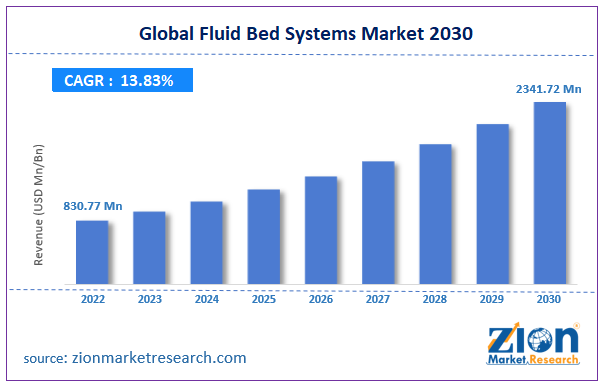
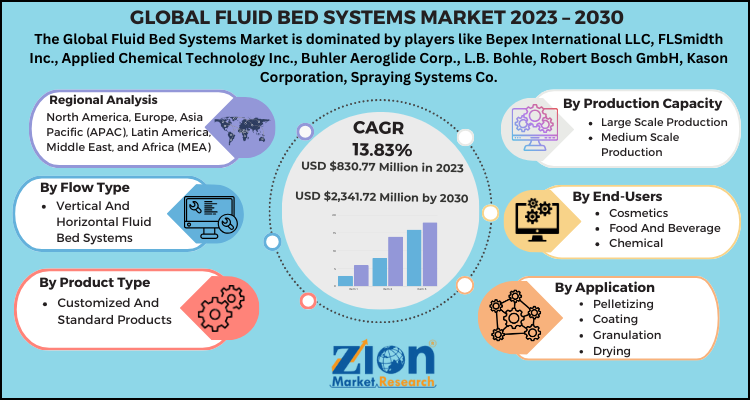
The global fluid bed systems market size was worth around USD 830.77 Million in 2022 and is predicted to grow to around USD 2,341.72 Million by 2030 with a compound annual growth rate (CAGR) of roughly 13.83% between 2023 and 2030. The report analyzes the global fluid bed systems market drivers, restraints/challenges, and the effect they have on the demands during the projection period. In addition, the report explores emerging opportunities in the fluid bed systems industry.
Global Fluid Bed Systems Market: Overview
Fluid bed systems are designed for the thermal treatment of heat-sensitive materials and fragile feed. They are used in dryers, reactors, and coolers and can be used for numerous processes such as batch granulation, agglomeration of the products that are in powder form, coating of pellets, and batch drying of the granulates.
Global Fluid Bed Systems Market: Growth Factors
There is rapid growth in the pharmaceutical industry due to the increasing efficiency visible in the granulation, drying, and coating processes. This has led to an increased demand for fluid bed systems in the market across the globe. Macroeconomic factors influencing market growth include developments seen in emerging economies, rapid rate of urbanization, increasing disposable income, and changing lifestyles of individuals. Growth in the food and beverage industry due to the increasing demand by consumers for processed food is also boosting the fluid bed systems market. However, the stringent certifications that are required to be cleared for the manufacturing of fluid bed systems may restrain the market.
Fluid Bed Systems Market: Restraints
The market for fluid bed systems is confronted with a number of constraints that have the potential to hamper its growth trajectory. The substantial initial capital investment that is required for the acquisition and installation of fluid bed processing equipment is a significant drawback that should be taken into consideration. Smaller businesses or those with limited financial resources face a big obstacle in the form of these systems because of the high expenses that are associated with the complex technology and engineering that are involved in their development.
In addition, the costs of operation and maintenance that are connected with fluid bed systems can be rather expensive, which might have an impact on the total cost of ownership. The complexity of modifying these systems to handle a wide variety of materials and processes is another limitation. This may provide difficulties for companies that have manufacturing requirements that are distinctive or unique.
Regulatory compliance and high quality control standards in particular industries, such as the pharmaceutical industry, can also be a restraint. These standards require ongoing adherence to rules, which may limit the amount of flexibility available for system alterations or upgrades. In order to ensure the continued expansion and widespread use of fluid bed systems in a variety of industrial applications, it will be essential to address these problems.
Global Fluid Bed Systems Market: Report Scope
| Report Attributes | Report Details |
|---|---|
| Report Name | Fluid Bed Systems Market Research Report |
| Market Size in 2022 | USD 830.77 Million |
| Market Forecast in 2030 | USD 2,341.72 Million |
| Growth Rate | CAGR of 13.83% |
| Number of Pages | 255 |
| Forecast Units | Value (USD Billion), and Volume (Units) |
| Key Companies Covered | Bepex International LLC, FLSmidth Inc., Applied Chemical Technology Inc., Buhler Aeroglide Corp., L.B. Bohle, Robert Bosch GmbH, Kason Corporation, Spraying Systems Co., Glatt GmbH, Binzen, and Kevin Process Technologies Pvt. Ltd. |
| Segments Covered | By Flow Type, By Product Type, By Production Capacity, By End-use Industry, By Application, And By Region |
| Regions Covered | North America, Europe, Asia Pacific (APAC), Latin America, Middle East and Africa (MEA) |
| Base Year | 2022 |
| Historical Year | 2017 - 2021 |
| Forecast Year | 2023 - 2030 |
| Customization Scope | Avail customized purchase options to meet your exact research needs. Request For Customization |
Global Fluid Bed Systems Market: Segmentation
The global fluid bed systems market is segmented into its flow type, product type, production capacity, end-use industry, application, and geography.
Based on product flow type, the market is divided into vertical and horizontal fluid bed systems.
Based on product type, the market is segregated into customized and standard products.
Based on production capacity, the market is categorized into large-scale production, medium-scale production, plot-scale production, and lab-scale production.
Based on the end-use industry, the market is segregated into cosmetics, food and beverage, chemical, nutraceutical, and pharmaceutical industries.
Based on application, the market is classified into pelletizing, coating, granulation, and drying. Diversification of the fluid bed systems market is seen in regions such as North America, Asia Pacific, Europe, Latin America, and the Middle East and Africa.
Global Fluid Bed Systems Market: Regional Analysis
North America dominates the fluid bed systems market. Growth in this region can be attributed to the growing demand from the chemical and pharmaceutical industries for various processes such as drying, granulation, and coating. Countries such as Canada and the U.S. are the major centers of growth in the North American region. Following North America in its growth in Europe. Europe is expected to be among the largest exporters and manufacturers of fluid bed systems across the globe. Rapid developments in countries such as India, China, Kenya, and the Philippines will be influencing the fluid bed systems market growth in the Asia Pacific and the Middle East and African regions. Japan and Brazil also anticipate to grow tremendously owing to the very large pharmaceutical market in these economies.
Global Fluid Bed Systems Market: Competitive Players
Some of the major companies in the fluid bed systems market include
- Bepex International LLC
- FLSmidth Inc.
- Applied Chemical Technology Inc.
- Buhler Aeroglide Corp.
- L.B. Bohle
- Robert Bosch GmbH
- Kason Corporation
- Spraying Systems Co.
- Glatt GmbH
- Binzen
- Kevin Process Technologies Pvt. Ltd.
The Global Fluid Bed Systems Market is segmented as follows:
By Flow Type
- Vertical And Horizontal Fluid Bed Systems
By Product Type
- Customized And Standard Products
By Production Capacity
- Large Scale Production
- Medium Scale Production
- Plot Scale Production
- Lab Scale Production
By End-use Industry
- Cosmetics
- Food And Beverage
- Chemical
- Nutraceutical
- Pharmaceutical Industries
By Application
- Pelletizing
- Coating
- Granulation
- Drying
By Region
- North America
- The U.S.
- Canada
- Mexico
- Europe
- France
- The UK
- Spain
- Germany
- Italy
- Rest of Europe
- Asia Pacific
- China
- Japan
- India
- Australia
- South Korea
- Rest of Asia Pacific
- The Middle East & Africa
- Saudi Arabia
- UAE
- Egypt
- Kuwait
- South Africa
- Rest of the Middle East & Africa
- Latin America
- Brazil
- Argentina
- Rest of Latin America
What Reports Provide
- Full in-depth analysis of the parent market
- Important changes in market dynamics
- Segmentation details of the market
- Former, ongoing, and projected market analysis in terms of volume and value
- Assessment of niche industry developments
- Market share analysis
- Key strategies of major players
- Emerging segments and regional markets
- Testimonials to companies in order to fortify their foothold in the market
Table Of Content

FrequentlyAsked Questions
Fluid bed systems suspend particles in fluid flow. They are used in drying, coating, and granulation
The global Fluid Bed Systems market is expected to be driven by the pharmaceutical and chemical processing needs. Demand for efficient drying and granulation supports expansion.
According to study, the global Fluid Bed Systems market size was worth around USD 830.77 Million in 2022 and is predicted to grow to around USD 2,341.72 Million by 2030.
The global Fluid Bed Systems market is expected to grow at a Compound Annual Growth Rate (CAGR) of around CAGR 13.83% during the forecast period from 2023-2030.
The global Fluid Bed Systems industry is projected to be challenged by Challenges include high equipment costs and operational complexity.
Which application areas will offer significant growth opportunities in the Fluid Bed Systems market?
The Opportunities include pharmaceutical processing, chemical manufacturing, granulation, and coating applications will offer significant growth opportunities in the Fluid Bed Systems market.
Process efficiency and uniform particle handling; use in pharma and chemicals; automation and scale-up innovation are the emerging trends and innovations impacting the Fluid Bed Systems market.
The global Fluid Bed Systems market is expected to be led by Europe during the forecast period.
Some of the prominent players operating in the global Fluid Bed Systems market are; Bepex International LLC, FLSmidth Inc., Applied Chemical Technology Inc., Buhler Aeroglide Corp., L.B. Bohle, Robert Bosch GmbH, Kason Corporation, Spraying Systems Co., Glatt GmbH, Binzen, and Kevin Process Technologies Pvt. Ltd. and others.
The report explores crucial aspects of the Fluid Bed Systems market, including a detailed discussion of existing growth factors and restraints, while also browsing future growth opportunities and challenges that impact the market.
HappyClients

