Eye Tracking Equipment Market Size, Share, Value and Forecast 2034

Eye Tracking Equipment Market By Product Type (Screen-Based Eye Trackers, Remote Eye Trackers, Wearable Eye Trackers, Mobile Eye Trackers), By Technology (Infrared Eye Tracking, Electrooculography, Video-Based Eye Tracking), By Application (Clinical and Medical Research, Human-Computer Interaction, Retail and Consumer Behavior Research, Automotive and Driver Monitoring, Gaming and Virtual Reality, Academic Research), By End-User (Healthcare Institutions, Research Organizations, Automotive Manufacturers, Retail and Marketing Companies, Gaming and Entertainment), By Distribution Channel (Direct Sales, Online Retail, Specialized Distributors), and By Region – Global and Regional Industry Overview, Market Intelligence, Comprehensive Analysis, Historical Data, and Forecasts 2025 - 2034-
| Market Size in 2024 | Market Forecast in 2034 | CAGR (in %) | Base Year |
|---|---|---|---|
| USD 648.27 Million | USD 2,186.53 Million | 14.44% | 2024 |
Eye Tracking Equipment Industry Perspective:
What will be the size of the eye tracking equipment market during the forecast period?
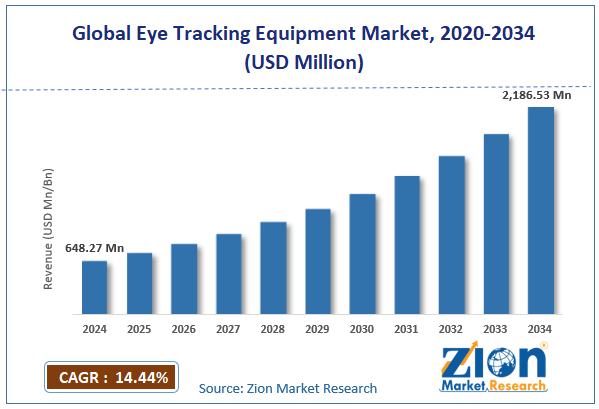
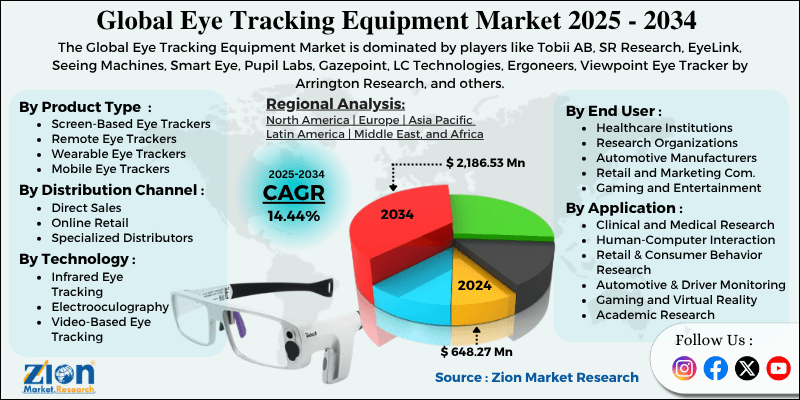
The global eye tracking equipment market size was worth approximately USD 648.27 million in 2024 and is projected to grow to around USD 2,186.53 million by 2034, with a compound annual growth rate (CAGR) of roughly 14.44% between 2025 and 2034.
 Request Free SampleRequest Free Sample
Key Insights
- As per the analysis shared by our research analyst, the global eye tracking equipment market is estimated to grow annually at a CAGR of around 14.44% over the forecast period (2025–2034).
- In terms of revenue, the global eye tracking equipment market size was valued at approximately USD 648.27 million in 2024 and is projected to reach USD 2,186.53 million by 2034.
- The eye tracking equipment market is projected to grow significantly due to the rapid integration of eye tracking into virtual reality and augmented reality headsets, growing automotive driver monitoring system adoption driven by safety regulations, increasing use of eye tracking in clinical neurology and assistive technology applications, rising investment in retail consumer behavior research, and expanding accessibility technology applications for individuals with severe motor disabilities.
- Based on product type, the screen-based eye trackers segment is expected to lead the eye tracking equipment market, while the wearable eye trackers segment is anticipated to grow significantly.
- Based on technology, the infrared eye tracking segment is expected to lead the eye tracking equipment market, while the video-based eye tracking segment is anticipated to grow at a notable pace.
- Based on application, the human-computer interaction segment is expected to lead the eye tracking equipment market, while the automotive and driver monitoring segment is anticipated to grow at the fastest rate.
- Based on end-user, the research organizations segment is the largest current end-user group, while the automotive manufacturers segment is anticipated to grow most rapidly.
- Based on distribution channel, the direct sales segment is expected to lead the eye tracking equipment market, while the online retail segment is anticipated to grow steadily.
- Based on region, North America is projected to dominate the global eye tracking equipment market during the estimated period, followed by Europe.
Eye Tracking Equipment Market: Overview
Eye tracking equipment is technology that tracks where a person is looking and how their eyes move in real time. It uses infrared light and cameras to detect eye position, focus point, and movement on a screen or in an environment. The data collected helps to understand attention, thinking patterns, emotions, and behavior in ways that are not otherwise easy to observe. Eye tracking was first used in medical and research fields to study reading habits, eye movement disorders, and brain-related conditions. Over time, it has become smaller, more accurate, and more affordable, enabling its use across many industries.
In healthcare, it helps diagnose conditions like autism, ADHD, Parkinson’s disease, and brain injuries. In technology and design, it improves user experience by showing how people interact with apps and websites. In retail, it helps brands understand what attracts customer attention, while in the automotive industry, it is used to detect driver fatigue and distraction. Along with the rise of virtual and augmented reality, eye tracking is now widely used to create more realistic and efficient digital experiences.
The accelerating integration of eye-tracking technology into consumer electronics, medical diagnostics, automotive safety systems, and enterprise human-computer interaction applications is expected to drive exceptional growth in the eye tracking equipment market over the forecast period.
Eye Tracking Equipment Market: Technology Roadmap 2025–2034
What is the projected development roadmap of the eye tracking equipment market over the forecast period?
The eye tracking equipment market is evolving due to smaller sensors, AI-based gaze analysis, integration into consumer devices, driver-monitoring regulations, and growing clinical applications. The market is expected to grow at a CAGR of around 14.44% over the forecast period, driven by strong demand across medical, automotive, consumer technology, and research segments.
The following roadmap outlines key development phases expected through 2034.
2025–2027: Consumer Devices and Smarter Cars Phase
- Eye tracking technology is becoming smaller, cheaper, and easier to add to everyday devices like VR headsets, laptops, and tablets, making it a common feature for regular consumers rather than a premium add-on.
- Car manufacturers are installing eye tracking systems to monitor driver attention and comply with safety regulations.
- AI-based gaze analysis is getting much smarter. It will not just track where you look, but also understand intent, attention, and behavior patterns in real time.
2028–2031: Healthcare and Accessibility Breakthrough Phase
- Eye tracking will play a larger role in healthcare, helping doctors detect brain conditions such as Alzheimer’s and multiple sclerosis earlier through subtle changes in eye movements.
- Eye-controlled devices will help people with severe disabilities communicate and control technology.
- Retail stores will increasingly use eye tracking insights to understand what customers notice on shelves, helping brands improve product placement and shopping experiences.
2032–2034: Invisible and Everywhere Eye Tracking Phase
- Eye tracking will become a standard feature in advanced smart glasses and extended reality devices.
- Systems will be able to estimate emotions and mental effort using eye data, transforming training, education, and user experience design.
- Large-scale cloud platforms will collect and analyze eye movement data from millions of users, unlocking deep behavioral insights and enabling a new era of data-driven human understanding.
Eye Tracking Equipment Market: Dynamics
Growth Drivers
What is driving eye tracking adoption in the VR and AR segment of the eye tracking equipment market?
The eye tracking equipment market is growing rapidly as virtual and augmented reality devices expand worldwide. These technologies are becoming more affordable, displays are improving, and content is expanding across gaming, training, entertainment, and business applications. A key factor driving this growth is eye-tracking technology, which is becoming essential in modern headsets.
One of its biggest advantages is foveated rendering, which delivers high-quality visuals only where the user is looking while reducing detail in other areas. This reduces processing power requirements, allowing companies to either improve visual quality or lower device costs, thereby increasing adoption. Eye tracking also enables more natural interactions, as users can control and select with just their gaze rather than physical controllers. It improves comfort by adjusting visuals based on eye position and enhances realism in virtual environments. As global demand for VR and AR devices rises and companies continue investing heavily, eye tracking is becoming a core feature supporting this growth.
Automotive safety rules requiring driver monitoring are driving strong demand for eye tracking equipment.
The eye tracking equipment industry is also expanding rapidly due to rising demand from the automotive sector, driven by safety regulations and accident-prevention needs. Road accidents caused by driver fatigue and distraction remain a major global issue, pushing governments to enforce stricter safety standards. Regions such as Europe, the United States, and China are introducing rules requiring driver-monitoring systems in new vehicles.
For example, European safety regulations mandate systems that detect driver drowsiness and inattention. Eye tracking plays a key role because it can directly monitor where a driver is looking, how often they blink, and whether their eye movements indicate fatigue or distraction. This makes it one of the most effective technologies for improving road safety. As a result, car manufacturers are rapidly integrating eye tracking systems into new models. This regulatory push is creating steady and long-term demand, making automotive a highly reliable growth segment for the market.
Restraints
How do high equipment costs and technical complexity limit adoption in the eye tracking equipment market?
The eye tracking equipment market faces a major challenge due to the high cost of advanced systems used in medical and research applications. While basic eye tracking features are becoming more affordable in consumer devices, high-precision systems used for clinical diagnosis and detailed research can cost tens of thousands of dollars, making them difficult to afford for smaller institutions, universities with limited budgets, and healthcare providers in developing regions. Such limitations restrict widespread adoption despite growing interest. They require skilled professionals for setup, calibration, and operation, which adds to overall cost and complexity. The data generated also requires specialized software and expert knowledge to be interpreted correctly, creating another barrier for new users. Increased training time and operational expenses further add to the challenge.
As a result, many potential users are unable to fully benefit from eye tracking technology, slowing adoption and acting as a key restraint on overall market growth.
Opportunities
The rising demand for eye tracking-based assistive communication is creating new opportunities in the eye tracking equipment market.
The eye tracking equipment market is experiencing strong growth opportunities, driven by rising demand for assistive communication technologies among people with severe physical disabilities. For individuals with conditions such as ALS, cerebral palsy, paralysis, or serious spinal injuries, eye tracking devices allow them to communicate, use computers, browse the internet, and even control smart home devices using only their eye movements. This creates a life-changing impact by giving them independence and the ability to interact with the world around them. As awareness about assistive technologies increases globally, more families, healthcare providers, and organizations are adopting these solutions. Governments and insurance providers in several countries are also starting to support and cover these devices, making them more accessible to a wider population.
In addition, the growing aging population is leading to more people affected by conditions that limit physical movement, further increasing demand. These factors together are creating a strong, long-term opportunity for eye tracking technologies in healthcare and assistive applications worldwide.
Challenges
What impact do data privacy regulations and ethical concerns have on the adoption of eye tracking technology in the eye tracking equipment market?
The eye tracking equipment industry faces a serious challenge regarding privacy and data security. Eye tracking technology collects highly sensitive information, as a person’s gaze can reveal interests, emotions, attention levels, and even decision-making patterns. When used in retail stores, public areas, workplaces, or personal devices, concerns arise about who controls the data, how it is stored, and how it is used. Many users may not fully understand or agree to such detailed tracking, which can create trust issues.
Regulators and privacy experts, especially in regions such as Europe, have raised concerns about the misuse of gaze data for targeted advertising, behavioral monitoring, or employee tracking. Strict laws, such as the GDPR, require companies to follow strong data protection rules when handling such information. Meeting these requirements increases compliance costs and slows down implementation. Companies must invest heavily in secure systems and transparent policies to avoid legal risks. Managing innovation while protecting user privacy remains a difficult balance, making data ethics a major challenge for market growth.
 Request Free SampleRequest Free Sample
Eye Tracking Equipment Market: Report Scope
| Report Attributes | Report Details |
|---|---|
| Report Name | Eye Tracking Equipment Market |
| Market Size in 2024 | USD 648.27 Million |
| Market Forecast in 2034 | USD 2,186.53 Mllion |
| Growth Rate | CAGR of 14.44% |
| Number of Pages | 229 |
| Key Companies Covered | Tobii AB, SR Research, EyeLink, Seeing Machines, Smart Eye, Pupil Labs, Gazepoint, LC Technologies, Ergoneers, Viewpoint Eye Tracker by Arrington Research, and others. |
| Segments Covered | By Product Type, By Technology, By Application, By End-User, By Distribution Channel, and By Region |
| Regions Covered | North America, Europe, Asia Pacific (APAC), Latin America, Middle East, and Africa (MEA) |
| Base Year | 2024 |
| Historical Year | 2019 - 2023 |
| Forecast Year | 2025 - 2034 |
| Customization Scope | Avail customized purchase options to meet your exact research needs. Request For Customization |
Eye Tracking Equipment Market: Segmentation
The global eye tracking equipment market is segmented by product type, technology, application, end-user, distribution channel, and region.
What makes the screen-based eye trackers segment the expected leader in the eye tracking equipment market?
Based on product type, the global eye tracking equipment market is categorized into screen-based, remote, wearable, and mobile eye trackers. Screen-based eye trackers hold about 38% of the market share and are expected to remain dominant, driven by strong use in research, diagnostics, usability testing, and consumer studies.
The wearable eye trackers segment holds around 32% share and is growing at the fastest rate, driven by expanding use in sports science, real-world research, and integration into consumer extended reality devices.
How does the infrared eye tracking segment maintain its leading position in the eye tracking equipment market?
Based on technology, the eye tracking equipment market is divided into infrared and video-based eye tracking systems. The infrared segment accounts for approximately 63% of the global market share, driven by its high accuracy, reliability, and widespread use in research, healthcare, and commercial applications. The video-based segment holds around 37% share and is growing steadily, supported by lower cost, ease of use, and increasing adoption in consumer and mobile-based applications.
Why does the automotive and driver monitoring application segment grow the fastest in the eye tracking equipment market?
Based on application, the eye tracking equipment market is segregated into clinical and medical research, human-computer interaction, retail and consumer behavior research, automotive and driver monitoring, gaming and virtual reality, and academic research. The human-computer interaction segment leads the market with approximately 28% global market share, driven by increased adoption in usability testing, interface design, and consumer experience optimization. The automotive and driver monitoring segment holds around 22% share and is the second-largest segment, supported by rising vehicle safety regulations and the growing adoption of driver monitoring systems.
Why does the research organization end-user segment lead the eye tracking equipment market?
Based on end user, the eye tracking equipment industry is categorized into healthcare institutions, research organizations, automotive manufacturers, retail and marketing companies, and gaming and entertainment companies. The research organizations segment accounts for approximately 34% of the global market share and continues to lead the market, driven by strong adoption across academic and research institutions. The automotive manufacturers segment holds around 26% of the market share and is the second-largest, driven by the growing adoption of driver monitoring systems.
How does the direct sales channel dominate the distribution landscape of the eye tracking equipment market?
Based on distribution channel, the eye tracking equipment market is classified into direct sales, online retail, and specialized distributors. The direct sales segment accounts for approximately 49% of the global market share and is expected to remain dominant throughout the forecast period, as most high-value, technically advanced systems are sold directly to research institutions, healthcare providers, and enterprise clients that require customization, training, and after-sales support. The specialized distributors segment holds around 29% of the market share, supported by their role in supplying niche markets and providing localized technical expertise.
Eye Tracking Equipment Market: Regional Analysis
How does North America's ecosystem of technology, healthcare, and research institutions drive its dominance in the eye tracking equipment market?
The eye tracking equipment market is led by North America, which accounts for around 36.8% of global demand and continues to dominate due to a strong combination of technological leadership, research activity, and early adoption. The region benefits from a high concentration of top universities and research institutions that actively use eye-tracking in psychology, neuroscience, and human-computer interaction, creating consistent demand for advanced systems. The United States is a major growth driver, with large technology companies investing heavily in virtual, augmented, and artificial intelligence. Eye tracking is becoming a key feature in these next-generation devices, increasing its commercial importance.
In addition, North America has a well-developed automotive sector, where companies are integrating eye tracking into driver monitoring systems to improve safety and comply with regulations. Healthcare is another important factor, as hospitals and research centers are adopting eye tracking for diagnostic and treatment support, especially in neurological conditions. The region also hosts leading eye tracking manufacturers, software developers, and system integrators, creating a strong, connected ecosystem.
Access to funding, advanced infrastructure, and faster adoption of new technologies further support market growth. Strong collaboration between industry and research institutions accelerates innovation. Government support for research and innovation also plays a key role in sustaining growth. High consumer awareness and willingness to adopt advanced technologies further boost demand. Continuous product development and frequent technology upgrades keep the region ahead of global competition. All these factors together make North America the most established and leading region in the eye tracking equipment market.
What combination of innovation and research activity positions Europe as the second-largest market for eye tracking equipment globally?
Europe is expected to account for about 28.4% of the global eye tracking equipment market. The region is growing strongly due to several key factors working together. One of the biggest drivers is the European Union's strict vehicle safety regulations, which require new cars to be equipped with driver monitoring systems. These systems often use eye tracking to detect driver fatigue and distraction, creating strong demand among automotive companies across Europe and even among global manufacturers selling in the region. Europe also benefits from having strong technology providers.
For example, Sweden is home to Tobii, one of the world’s leading eye tracking companies, which supports innovation and supply in the region. In addition, European universities and research institutions in countries such as Germany, the United Kingdom, the Netherlands, and Switzerland actively use eye tracking across fields such as psychology, neuroscience, and human-computer interaction. This creates a steady demand for advanced systems. Healthcare is another important growth area, as hospitals and research centers are increasingly using eye tracking to diagnose neurological conditions and support patients with communication difficulties. Strong research support, strict safety rules, and rising healthcare utilization collectively make Europe an important and steadily expanding market for eye-tracking equipment.
Recent Market Developments
- In January 2026, Samsung introduced a next-generation 6K glasses-free 3D gaming monitor integrated with real-time eye tracking technology, aimed at enhancing immersive gaming experiences and accelerating the adoption of eye tracking in consumer display systems.
- In October 2025, Tobii AB partnered with STMicroelectronics to begin mass production of an advanced interior sensing system combining eye tracking and imaging technologies for driver and occupant monitoring in premium European vehicles.
Eye Tracking Equipment Market: Competitive Analysis
The leading players in the global eye tracking equipment market are:
- Tobii AB
- SR Research
- EyeLink
- Seeing Machines
- Smart Eye
- Pupil Labs
- Gazepoint
- LC Technologies
- Ergoneers
- Viewpoint Eye Tracker by Arrington Research
The global eye tracking equipment market is segmented as follows:
By Product Type
- Screen-Based Eye Trackers
- Remote Eye Trackers
- Wearable Eye Trackers
- Mobile Eye Trackers
By Technology
- Infrared Eye Tracking
- Electrooculography
- Video-Based Eye Tracking
By Application
- Clinical and Medical Research
- Human-Computer Interaction
- Retail and Consumer Behavior Research
- Automotive and Driver Monitoring
- Gaming and Virtual Reality
- Academic Research
By End-User
- Healthcare Institutions
- Research Organizations
- Automotive Manufacturers
- Retail and Marketing Companies
- Gaming and Entertainment
By Distribution Channel
- Direct Sales
- Online Retail
- Specialized Distributors
By Region
- North America
- The U.S.
- Canada
- Mexico
- Europe
- France
- The UK
- Spain
- Germany
- Italy
- Rest of Europe
- Asia Pacific
- China
- Japan
- India
- Australia
- South Korea
- Rest of Asia Pacific
- The Middle East & Africa
- Saudi Arabia
- UAE
- Egypt
- Kuwait
- South Africa
- Rest of the Middle East & Africa
- Latin America
- Brazil
- Argentina
- Rest of Latin America
Table Of Content
Methodology
FrequentlyAsked Questions
The eye tracking equipment market encompasses all commercially manufactured devices, systems, and software platforms that measure, record, and analyze the movement and focus point of human eyes, used across applications including medical diagnostics, human-computer interaction research, automotive safety, retail analytics, and assistive communication technology.
The global eye tracking equipment market is projected to grow due to rapid integration of eye tracking into virtual reality and augmented reality headsets, growing regulatory requirements for automotive driver monitoring systems, expanding clinical and assistive technology applications, rising investment in retail and consumer behavior research, and the growing incorporation of gaze-aware computing into mainstream consumer devices.
According to a study, the global eye tracking equipment market size was worth around USD 648.27 million in 2024 and is predicted to grow to around USD 2,186.53 million by 2034.
The CAGR value of the eye tracking equipment market is expected to be around 14.44% during 2025–2034.
North America is expected to lead the global eye tracking equipment market during the forecast period.
The major players in the global eye tracking equipment market include Tobii AB, SR Research, EyeLink, Seeing Machines, Smart Eye, Pupil Labs, Gazepoint, LC Technologies, Ergoneers, and Viewpoint Eye Tracker by Arrington Research.
The report examines key aspects of the eye tracking equipment market, including a detailed analysis of current growth drivers and constraints, as well as future growth opportunities and challenges.
The eye tracking equipment market value chain includes component manufacturing, sensor and hardware integration, software development, distribution, and end-user applications such as healthcare, research, automotive, and consumer electronics.
The eye tracking equipment market is shifting toward compact, affordable, AI-enabled solutions, driven by rising demand for integration into VR/AR devices, driver monitoring systems, and assistive technologies.
The eye tracking equipment market is driven by expanding VR and AR adoption, increasing automotive safety regulations, growing use in healthcare and research, and rising demand for assistive communication technologies for individuals with physical disabilities.

HappyClients