
Global EV Battery Heating System Market Size, Share, Value and Forecast 2034

EV Battery Heating System Market By Propulsion Type (Battery Electric Vehicles and Hybrid Electric Vehicles), By Vehicle Type (Electric Passenger Vehicle and Electric Commercial Vehicle), By Technology (Liquid Cooling and Heating, Air Cooling and Heating, and Others), and Region - Global and Regional Industry Overview, Market Intelligence, Comprehensive Analysis, Historical Data, and Forecasts 2026 - 2034
| Market Size in 2025 | Market Forecast in 2034 | CAGR (in %) | Base Year |
|---|---|---|---|
| USD 4.4 Billion | USD 14.9 Billion | 14.5% | 2025 |
EV Battery Heating System Industry Perspective:
What will be the size of the global EV battery heating system market during the forecast period?
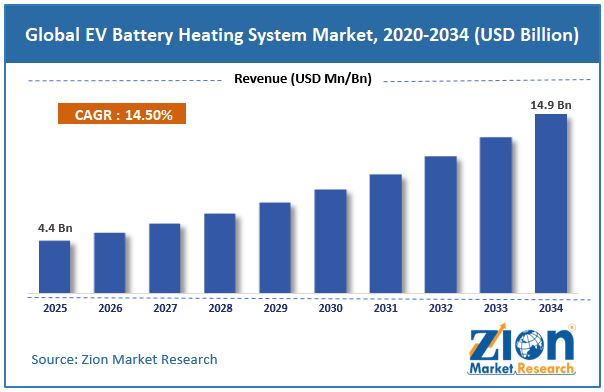
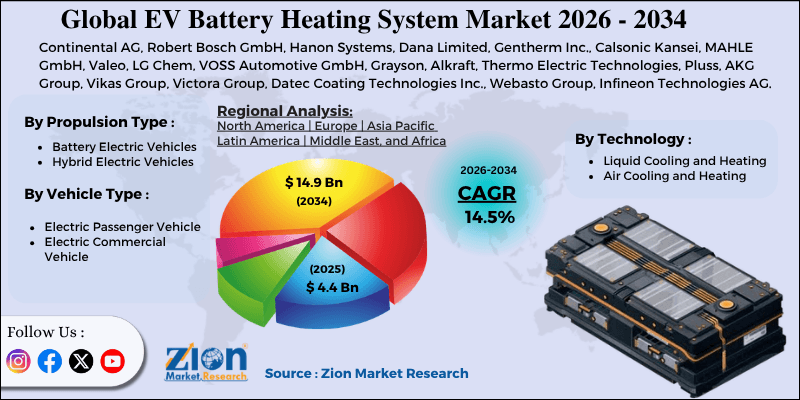
The global EV battery heating system market size was worth around USD 4.4 billion in 2025 and is predicted to grow to around USD 14.9 billion by 2034, with a compound annual growth rate (CAGR) of roughly 14.5% between 2026 and 2034.
Key Insights
- As per the analysis shared by our research analyst, the global EV battery heating system market is estimated to grow annually at a CAGR of around 14.5% over the forecast period (2026-2034).
- In terms of revenue, the global EV battery heating system market size was valued at around USD 4.4 billion in 2025 and is projected to reach USD 14.9 billion by 2034.
- Growing demand for fast charging is expected to propel the EV battery heating system market over the projected period.
- Based on the propulsion type, the battery electric vehicles segment dominates the market with a revenue share of 68% in 2025.
- Based on the vehicle type, the electric passenger vehicle segment holds a majority of market share of 71% in 2025.
- Based on the technology, the liquid cooling and heating segment holds a majority of market share in 2025 of 35.5%.
- Based on region, North America dominates the EV battery heating system market with a revenue share of 33.7% in 2025.
EV Battery Heating System Market: Overview
The EV battery heating system is a thermal management system that heats the electric vehicle (EV) battery to maintain it at an optimal operating temperature during cold weather and low ambient temperatures. The system employs various methods such as electric heating, coolant heating, heat pumps, or battery-integrated heating to provide sufficient warmth to the battery’s cells. Battery heating improves EV battery performance by ensuring efficient charging, satisfactory power and range, and long-term health while minimizing damage. Lithium battery heating systems are critical to preventing adverse impacts from low-temperature operation and improving charging acceptance in cold weather. EV battery heating systems are increasingly used in electric cars, commercial vehicles, and buses as the adoption of electric vehicles rises globally and manufacturers seek to enhance performance.
Impact of the USA-Israel War on Iran on the EV Battery Heating System Market
The USA-Israel war against Iran is expected to have a negative and positive impact on the EV battery heating system market. Unrest in the Strait of Hormuz leads to higher energy and transportation prices, as well as general supply chain disruptions that increase the production and logistics costs of electric vehicles (EVs) and their components. Higher and more volatile oil prices are also likely to drive the adoption of EVs and, consequently, the need for battery thermal-management solutions. Nonetheless, the war also disrupts car production due to higher component, energy, and logistics costs. Overall, the situation in the Middle East is likely to result in higher costs in the short term and higher adoption rates of battery heating systems in the long term.
EV Battery Heating System Market: Dynamics
Growth Drivers
How does rapid growth in EV adoption drive the EV battery heating system market?
The rising demand for electric vehicles (EVs) is a significant factor fueling the growth of the EV battery heating system market because the growing number of electric cars increases the potential buyer base for all kinds of battery thermal-management technologies. According to the International Energy Agency (IEA), EV sales worldwide hit over 20 million units in 2025, growing by around 20% from the previous year, making up 25% of total car sales globally.
Moreover, according to the International Energy Agency, global electric car production hit 22 million units in 2025, up over 25% compared to 2024, with about a fifth of vehicles produced being electric. Thus, electric car production is set to continue to grow, which will in turn drive demand for related technologies. Battery heating systems are necessary to ensure that batteries are heated to optimal temperatures during cold weather to maximize power, charge speed, range, and battery lifespan. IEA estimates that global electric car sales will hit 23 million units during 2026, with EVs accounting for almost 30% of overall car sales, implying further demand for battery heating systems.
Restraints
Why does the high energy consumption act as a major restraint to the EV battery heating system industry's growth?
High energy consumption is a significant restraint on the growth of the EV Battery Heating System Market, especially in cold conditions, where extra energy is needed to warm the battery to an adequate operating temperature. As EVs depend on the battery pack to power the vehicle’s heating systems, the energy used in the process reduces the amount available to propel the vehicle, limiting driving range. According to a real-world 2025 study, the energy consumption of the vehicle was almost 50% higher at -10°C than at 30°C.
Moreover, a study on the impact of the thermal-management system stated that the range loss due to thermal management could be highly significant in cases of extreme cold. In addition, conventional electric-resistance/PTC heating can sometimes be incredibly energy-intensive; for example, heat-pump-based battery preheating can provide 38.4% better battery power performance than conventional electric heater preheating. Thus, concerns about additional power consumption, limited driving ranges, and the search for more efficient technologies can complicate the design of the EV Battery Heating System and limit the development of conventional EV battery heating solutions.
Opportunities
How do growing product launches offer a lucrative opportunity for the EV battery heating system market?
Rising product launches and technological advancements in the EV battery heating system sector are expected to propel market growth by enhancing battery performance, energy efficiency, and charging capacity, and improving the integration of thermal-management systems. For instance, in June 2025, ZF introduced the ready-to-series TherMaS thermal-management system, which offers more than 10 kW of heating and cooling performance from -25°C to +35°C and can help improve the driving range of electric vehicles by up to 10% by smartly utilizing the available heat.
Moreover, in December 2025, Webasto introduced the Heated Chiller, which enables a 3-in-1 function of battery thermal management, cooling, and cabin heating by integrating all three functionalities into one compact system, cutting down weight, reducing complexity, and saving installation space. In 2025, Calatherm launched a Battery Thermal Management System that helps simultaneously heat and cool while recovering waste heat from the battery and the drivetrain. The growing focus on advanced technology and product innovation has encouraged automakers to incorporate such innovative thermal management solutions to enhance battery performance, improve overall efficiency and safety, and drive market growth.
Challenges
Limited demand in mild climates poses a significant challenge to the growth of the EV battery heating system industry
Limited demand in mild and warm climates is a major restraining force for the growth of the EV battery heating system market, as heating systems are generally not required for low- to moderate-ambient temperatures. Studies have shown that battery thermal management is mostly needed in cold climates, where lithium batteries have been proven to perform significantly worse than in warm climates, with a significant reduction in capacity, power, and charge speed. Therefore, in a region that features only mild and hot temperatures, there is limited need for EV battery heating systems, as thermal management in such conditions would be mostly provided by active cooling mechanisms.
According to one study conducted in 2025, energy consumption for thermal management in cold Tabriz was almost double that in both temperate Tehran and hot Bandar Abbas. Thus, it can be asserted that in warm climates, the demand for battery heating systems will be mostly nonexistent, and, as a result, EV battery heating system manufacturers will struggle to penetrate such markets.
EV Battery Heating System Market: Report Scope
| Report Attributes | Report Details |
|---|---|
| Report Name | EV Battery Heating System Market |
| Market Size in 2025 | USD 4.4 Billion |
| Market Forecast in 2034 | USD 14.9 Billion |
| Growth Rate | CAGR of 14.5% |
| Number of Pages | 230 |
| Key Companies Covered | Continental AG, Robert Bosch GmbH, Hanon Systems, Dana Limited, Gentherm Inc., Calsonic Kansei, MAHLE GmbH, Valeo, LG Chem, VOSS Automotive GmbH, Grayson, Alkraft, Thermo Electric Technologies, Pluss, AKG Group, Vikas Group, Victora Group, Datec Coating Technologies Inc., Webasto Group, Infineon Technologies AG, and others. |
| Segments Covered | By Propulsion Type, By Vehicle Type, By Technology, and By Region |
| Regions Covered | North America, Europe, Asia Pacific (APAC), Latin America, Middle East, and Africa (MEA) |
| Base Year | 2025 |
| Historical Year | 2020 - 2024 |
| Forecast Year | 2026 - 2034 |
| Customization Scope | Avail customized purchase options to meet your exact research needs. Request For Customization |
EV Battery Heating System Market: Segmentation
Propulsion Type Insights
Why does the battery electric vehicles segment hold a prominent position in the EV battery heating system market?
The battery electric vehicles segment dominates the EV battery heating system market with a revenue share of 68% in 2025. The battery needs to be heated because BEVs are battery-powered, and their performance is highly dependent on battery function, especially battery temperature. Low-temperature conditions may decrease battery power, reduce battery charge capacity by limiting charge acceptance, and lower the vehicle’s range. Battery heating systems can warm the battery to an optimum temperature, enabling it to deliver maximum performance; this, in turn, improves the vehicle's power performance and charge capacity. The growing demand for BEVs is expected to drive battery producers to incorporate more thermal-management technologies to enhance performance, increase range, and improve battery lifespan. Consequently, the rising need for advanced BEVs has created an enormous opportunity for battery heating systems and components, which, in turn, will propel the growth of the global EV battery heating system market.
Vehicle Type Insights
How does the electric passenger vehicle segment capture the largest share in the EV battery heating system market?
The electric passenger vehicle segment holds a majority of EV battery heating system industry share of 71% in 2025. Because passenger EV manufacturers are focusing on improving battery performance, driving range, charging speed, and reliability in diverse climates. Battery heating helps regulate battery temperature, particularly when the battery is exposed to cold conditions that can negatively affect its performance and accelerate charging. The trend towards more sophisticated thermal-management systems in passenger cars, which include heat pumps, makes it more likely that automakers will use battery heating in their EVs. Such systems have the potential to increase revenues for manufacturers of battery-heating systems and components.
Technology Insights
Does the liquid cooling and heating segment capture the largest share in the EV battery heating system market?
The liquid cooling and heating segment holds a majority of EV battery heating system market share in 2025 of 35.5% because it offers a means of controlling the temperature of the battery both in hot and cold conditions. The liquid can be used to cool the battery down when it is too hot by passing it through the channels in proximity to the battery cells. It can be used to heat the battery in the cold by transferring the heat from the liquid to the battery itself, offering greater versatility and control compared to the simple air-cooling system.
Regional Insights
What factors drive the North America region in the EV battery heating system market?
North America dominates the EV battery heating system market with a revenue share of 33.7% in 2025. This is mainly because of the rising need for battery thermal management systems due to the increasing adoption of electric vehicles. According to Statista, a government agency that researches and compiles economic data, Canada registered 487,618 battery electric vehicles (BEVs) in 2024, which is an increase of 48.8% compared to 2023.
In fact, BEV registrations in Canada rose 12.9% year over year in the first quarter of 2026, while zero-emission vehicle registrations climbed 15.8% year over year in the same period. This was mainly attributed to the launch of the Electric Vehicle Affordability Program by the Federal Government. The rising adoption of electric vehicles in North America, especially in cold climates, will necessitate battery heating systems that help regulate battery temperatures, ensure optimal charging, maintain vehicle range, and enhance overall battery performance. Hence, increasing demand for electric vehicles and government initiatives to promote their adoption will drive the North American EV battery heating system market revenue.
EV Battery Heating System Market: Competitive Analysis
The global EV battery heating system market is dominated by players like:
- Continental AG
- Robert Bosch GmbH
- Hanon Systems
- Dana Limited
- Gentherm Inc.
- Calsonic Kansei
- MAHLE GmbH
- Valeo
- LG Chem
- VOSS Automotive GmbH
- Grayson
- Alkraft
- Thermo Electric Technologies
- Pluss
- AKG Group
- Vikas Group
- Victora Group
- Datec Coating Technologies Inc.
- Webasto Group
- Infineon Technologies AG
The global EV battery heating system market is segmented as follows:
By Propulsion Type
- Battery Electric Vehicles
- Hybrid Electric Vehicles
By Vehicle Type
- Electric Passenger Vehicle
- Electric Commercial Vehicle
By Technology
- Liquid Cooling and Heating
- Air Cooling and Heating
- Others
By Region
- North America
- The U.S.
- Canada
- Mexico
- Europe
- France
- The UK
- Spain
- Germany
- Italy
- Rest of Europe
- Asia Pacific
- China
- Japan
- India
- Australia
- South Korea
- Rest of Asia Pacific
- The Middle East & Africa
- Saudi Arabia
- UAE
- Egypt
- Kuwait
- South Africa
- Rest of the Middle East & Africa
- Latin America
- Brazil
- Argentina
- Rest of Latin America
Table Of Content
Methodology
FrequentlyAsked Questions
The EV battery heating system is a thermal management system that heats the electric vehicle (EV) battery to maintain it at an optimal operating temperature during cold weather and low ambient temperatures. The system employs various methods such as electric heating, coolant heating, heat pumps, or battery-integrated heating to provide sufficient warmth to the battery’s cells.
The key growth drivers for the EV battery heating system market include the rapid adoption of electric vehicles, increasing demand for fast charging, growing EV use in cold climates, and the need to improve battery performance and driving range. Low temperatures can reduce battery efficiency and charging capability, making heating systems important for maintaining optimal battery temperature.
The major challenges restraining the EV Battery Heating System Market include high energy consumption, reduced driving range in cold conditions, high system and integration costs, technological complexity, and uneven demand across different climates. Battery heating consumes additional energy that could otherwise be used for propulsion, potentially reducing EV range, particularly in extremely cold weather.
Based on the propulsion type, the battery electric vehicles segment is expected to dominate the EV battery heating system market growth during the projected period.
Emerging trends and innovations in the EV battery heating system market include the adoption of heat-pump-based heating, intelligent battery preconditioning, integrated liquid cooling and heating systems, phase-change materials, and AI-based thermal-management controls. Manufacturers are increasingly developing systems that can recover waste heat from the battery, motor, and power electronics and redistribute it where needed, improving overall energy efficiency. Advanced control technologies are also being developed to predict battery temperature and optimize heating according to driving, charging, and weather conditions. These innovations are helping reduce energy consumption, improve fast-charging performance, extend driving range, and maintain battery life, supporting continued market growth.
According to the report, the global EV battery heating system market size was worth around USD 4.4 billion in 2025 and is predicted to grow to around USD 14.9 billion by 2034.
The global EV battery heating system market is expected to grow at a CAGR of 14.5% during the forecast period.
The global EV battery heating system industry growth is expected to be led by North America over the forecast period.
The global EV battery heating system market is dominated by players like Continental AG, Robert Bosch GmbH, Hanon Systems, Dana Limited, Gentherm Inc., Calsonic Kansei, MAHLE GmbH, Valeo, LG Chem, VOSS Automotive GmbH, Grayson, Alkraft, Thermo Electric Technologies, Pluss, AKG Group, Vikas Group, Victora Group, Datec Coating Technologies Inc., Webasto Group, and Infineon Technologies AG, among others.
The EV battery heating system market report covers the geographical market along with a comprehensive competitive landscape analysis. It also includes cash flow analysis, profit ratio analysis, market basket analysis, market attractiveness analysis, sentiment analysis, PESTLE analysis, trend analysis, SWOT analysis, trade area analysis, demand & supply analysis, Porter’s five forces analysis, and value chain analysis.

HappyClients

