
Electric Commercial Vehicle Market Size, Share, Trends, Growth 2034

Electric Commercial Vehicle Market By Vehicle Type (Light Commercial Vehicles, Medium Commercial Vehicles, Heavy Commercial Vehicles, and Buses and Coaches), By Propulsion Type (Battery Electric Vehicles, Plug in Hybrid Electric Vehicles, and Fuel Cell Electric Vehicles), By Application (Goods Transportation and Logistics, Public Transportation, Municipal and Waste Management Services, and Construction and Mining Operations), By End User (Logistics and Fleet Operators, Public Transit Authorities, E-commerce and Retail Companies, Construction Companies, and Municipal and Government Bodies), and By Region - Global and Regional Industry Overview, Market Intelligence, Comprehensive Analysis, Historical Data, and Forecasts 2026 to 2035
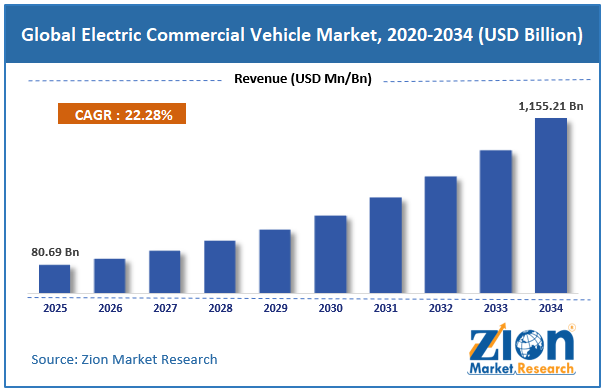
| Market Size in 2025 | Market Forecast in 2034 | CAGR (in %) | Base Year |
|---|---|---|---|
| USD 80.69 Billion | USD 554.36 Billion | 22.28% | 2025 |
Electric Commercial Vehicle Industry Perspective:
What will be the size of the electric commercial vehicle market during the forecast period?
The global electric commercial vehicle market size was valued at approximately USD 80.69 billion in 2025 and is projected to reach around USD 554.36 billion by 2035, growing at a compound annual growth rate of approximately 22.28% between 2026 and 2035.
Key Insights
- As per the analysis shared by our research team, the global electric commercial vehicle market is estimated to grow at a compound annual growth rate of approximately 22.28% during the forecast period from 2026 to 2035.
- In terms of revenue, the global electric commercial vehicle market was valued at approximately USD 80.69 billion in 2025 and is projected to reach USD 554.36 billion by 2035.
- The electric commercial vehicle market is expected to grow strongly due to tightening emission regulations, falling battery prices, growing e-commerce-driven delivery demand, and expanding government support for fleet electrification.
- Based on vehicle type, light commercial vehicles lead the market because they are well suited to urban delivery routes. At the same time, buses and coaches are the fastest-growing segment as cities expand electric public transportation networks.
- Based on propulsion type, battery electric vehicles lead the market due to their lower operating costs and expanding charging infrastructure. In contrast, fuel cell electric vehicles are the fastest-growing segment as hydrogen technology matures for long-haul applications.
- Based on application, goods transportation and logistics lead the market since delivery and freight companies represent the largest share of commercial vehicle use. In contrast, public transportation is the fastest-growing application as cities invest heavily in electric bus fleets.
- Based on end user, logistics and fleet operators account for the largest share given their large-scale vehicle purchasing needs. At the same time, public transit authorities are the fastest-growing end-user group as urban transportation systems modernize.
- Based on region, Asia Pacific leads the global electric commercial vehicle market, driven by strong government support and large-scale manufacturing capacity. At the same time, Europe is the fastest-growing region due to strict emission targets and generous fleet electrification incentives.
Electric Commercial Vehicle Market: Overview
An electric commercial vehicle is a truck, van, bus, or other business vehicle powered by a battery, plug-in hybrid system, or hydrogen fuel cell instead of a conventional petrol or diesel engine. These vehicles support goods delivery, passenger transport, public transit, construction, waste collection, and other commercial activities. Electric commercial vehicles help businesses reduce fuel consumption, lower maintenance expenses, and cut vehicle emissions, making them increasingly suitable for urban and long-distance operations. Advances in battery technology are supporting the electric commercial vehicles market by providing longer driving ranges, faster charging, improved performance, and greater reliability for demanding applications. Governments are also encouraging adoption through purchase incentives, charging infrastructure investments, tax benefits, and stricter emission standards for commercial fleets. The rapid expansion of e-commerce is further increasing demand for electric delivery vans and light trucks, particularly because they perform efficiently in frequent stop-and-go city traffic. As charging networks expand and vehicle costs gradually decline, electric commercial vehicles are becoming more practical for logistics companies, retailers, public transport operators, construction firms, and other businesses seeking cleaner fleets. This transition is also creating opportunities for charging infrastructure providers, fleet management platforms, battery services, and vehicle maintenance solutions.
Overall, these developments are supporting steady expansion of the electric commercial vehicle industry as businesses, governments, and vehicle manufacturers work together to make electrified fleets a practical and cost-effective reality across passenger and freight transportation.
Electric Commercial Vehicle Market: Strategic Perspective
Where is the electric commercial vehicle market heading?
The electric commercial vehicle market is moving toward wider adoption of electric vans, trucks, and buses as battery technology improves, charging networks expand, and operating costs become more attractive for fleet owners. Businesses are increasingly replacing small pilot fleets with larger electric vehicle deployments to reduce fuel costs, meet emission rules, and support cleaner transportation.
Where should businesses invest in the electric commercial vehicle market?
Businesses can invest in fast-charging stations, battery leasing, fleet management software, battery swapping, and financing services that make electric commercial vehicles easier to adopt and operate. Opportunities are also growing in vehicle maintenance, charging management, and retrofitting services, especially for smaller fleet operators with limited budgets.
What will reshape competition in the electric commercial vehicle market?
The electric commercial vehicle market is becoming more competitive, with manufacturers focusing on range, battery life, charging speed, reliability, operating costs, and after-sales service. Strong service networks, efficient batteries, connected technologies, and reliable vehicle performance can help manufacturers attract fleet operators seeking cost-effective long-term transportation solutions.
Electric Commercial Vehicle Market: Development Roadmap 2026 to 2034
What is the projected development roadmap of the electric commercial vehicle market over the forecast period?
The electric commercial vehicle market is progressing through improving battery range and charging speed, expanding public and depot charging infrastructure, broader vehicle model availability across all weight classes, and growing confidence among fleet operators regarding total cost of ownership. The market is expected to grow at a compound annual growth rate of approximately 22.28% over the forecast period, driven by regulatory pressure, falling battery costs, and rising fuel price volatility.
The following roadmap outlines key development phases expected through 2034.
2026 to 2028: Pilot and Early Adoption Phase
- Depot charging expansion: Logistics companies are expected to begin installing dedicated charging stations at their own depots and distribution centers to support small- to medium-sized electric van and truck fleets.
- Government incentive uptake: Businesses are likely to take advantage of purchase subsidies, tax credits, and low emission zone benefits to offset the higher upfront cost of electric commercial vehicles.
- Route suitability testing: Fleet operators are expected to identify short-haul, predictable delivery routes as ideal starting points for electrification before committing to larger-scale rollouts.
2029 to 2032: Scaling and Infrastructure Growth Phase
- Expanded highway charging corridors: Public and private investment is expected to accelerate the buildout of fast-charging stations along major freight routes, supporting medium and heavy-duty electric trucks.
- Broader vehicle range availability: Manufacturers are likely to introduce a wider variety of electric truck and bus models across different weight classes and use cases, giving fleet buyers more choice.
- Total cost of ownership advantage: As battery prices continue falling, electric commercial vehicles are expected to reach cost parity with diesel alternatives across more vehicle categories.
2033 to 2034: Mass Adoption and Integration Phase
- Fleet-wide electrification: Large logistics and transit operators may complete full or near-full transitions to electric power in regions with mature charging infrastructure.
- Hydrogen expansion for heavy freight: Fuel cell electric vehicles could see broader adoption for long-distance, heavy-load applications where battery weight remains a limiting factor.
- Smart fleet integration: Advanced software systems may fully integrate route planning, charging scheduling, and energy cost optimization, making electric fleet operation more efficient than traditional fuel-based management.
Electric Commercial Vehicle Market: Dynamics
Growth Drivers
What factors are driving changing fleet operator priorities in the electric commercial vehicle market?
Fleet operators increasingly choose electric commercial vehicles based on long-term savings rather than the initial purchase price. Unstable fuel prices make lower running costs attractive, especially for delivery and logistics companies with high daily mileage. Lower maintenance needs are another key benefit because electric vehicles have fewer moving parts than traditional diesel vehicles, which can reduce servicing expenses and vehicle downtime. A growing focus on sustainability is also encouraging businesses to shift their fleets toward cleaner transportation, particularly as customers and reporting requirements expect companies to reduce emissions. Smaller fleet owners are gaining confidence as more real-world data shows how electric vehicles perform during regular commercial use. Manufacturers are supporting this transition with flexible financing, leasing plans, and longer battery warranties that reduce upfront costs. Better charging networks are also making daily fleet operations easier. These changes are making electric commercial vehicles a practical choice for logistics, retail, public transport, construction, and other industries seeking lower operating costs and cleaner transportation.
Improved charging technology is creating new opportunities in the electric commercial vehicle market.
The electric commercial vehicle market is benefiting from falling battery cell prices, which have traditionally been a major barrier to wider adoption. As battery production expands globally and improved chemistries deliver higher energy density, electric trucks, vans, and buses are becoming more affordable while offering longer driving ranges. Faster charging technology is also reducing concerns among fleet operators, allowing vehicles to recover useful range in less time than earlier models. At the same time, improvements in charging infrastructure, including high-power depot chargers and expanding public fast-charging networks, are making electric vehicles suitable for more routes and commercial applications. Battery leasing and second-life battery programs are emerging as additional options to reduce upfront costs and improve ownership economics. Better battery management systems are also extending battery life and improving vehicle performance. These combined advances are making fleet electrification more practical for businesses of different sizes. As battery costs continue declining and charging networks expand, more vehicle categories are expected to approach cost parity with diesel models, supporting stronger adoption across logistics, public transportation, municipal services, and other commercial applications during the forecast period.
Restraints
High upfront costs and charging infrastructure gaps are limiting faster growth in the electric commercial vehicle market.
Despite falling battery prices, the electric commercial vehicle industry still faces several barriers to wider adoption. Electric vans, trucks, and buses generally cost more upfront than diesel models, making them harder for small businesses with limited budgets to buy. Charging infrastructure is also uneven, particularly in rural areas and developing markets where reliable high-power chargers may be limited. Range remains another concern for long-haul freight, as heavy loads and long distances require larger batteries and more frequent charging. In some regions, local electricity grids may lack the capacity to support large commercial fleets, requiring expensive upgrades before charging networks can expand. Limited government incentives can further increase the financial burden for fleet operators, who must invest in vehicles, charging equipment, maintenance, and employee training. High financing costs may also slow purchasing decisions for smaller companies. Addressing these challenges will require continued investment in charging infrastructure, stronger financing support, better battery technology, and cooperation between manufacturers, governments, utilities, and fleet operators to make electrification more affordable and practical.
Opportunities
Will expansion of last-mile delivery electrification open new opportunities in the electric commercial vehicle market?
The rapid growth of online shopping is driving strong demand for last-mile delivery services, creating major opportunities for electric light commercial vehicles designed for frequent, short-distance urban routes. Delivery companies are finding that electric vans and small trucks work well in stop-and-go city traffic, where frequent braking can help recover energy and lower noise is valuable in residential areas. Municipal governments are also introducing low-emission zones in city centers, encouraging delivery fleets to switch to electric vehicles to maintain access to restricted urban areas. Another promising opportunity is electrifying specialized vehicles used for waste collection, street cleaning, and other municipal services. These vehicles often follow predictable routes and return to central depots, making regular charging easier and more practical. Partnerships between vehicle manufacturers, charging infrastructure providers, and logistics companies are also creating integrated solutions that simplify fleet electrification and reduce upfront challenges. As e-commerce continues to expand worldwide, last-mile delivery is expected to remain a major growth area, especially in densely populated cities, supported by rising delivery volumes, stricter emission rules, lower operating costs, and growing demand for cleaner urban transportation solutions.
Challenges
How are supply chain constraints and grid capacity affecting the electric commercial vehicle market?
The electric commercial vehicle industry faces several challenges, including battery raw material shortages, limited grid capacity, and the need to rapidly expand charging infrastructure. Key materials such as lithium, cobalt, and nickel can fluctuate in price and face supply risks, increasing production costs and creating uncertainty for manufacturers. Expanding electricity grids to support large commercial fleets also requires major investment, lengthy approvals, and careful planning, which can delay charging infrastructure projects. Heavy-duty and long-haul electric trucks face additional difficulties because large batteries add weight and may not provide enough range for certain freight operations. Workforce training is another concern, as drivers, technicians, and maintenance teams need new skills to operate and service electric vehicles safely. Manufacturers, utilities, governments, charging providers, and fleet operators will need to work together to address these supply chain, infrastructure, and workforce challenges. Improving battery technology, expanding charging networks, strengthening power grids, and developing skilled workers will be essential for supporting wider adoption across commercial transportation in the coming years.
Electric Commercial Vehicle Market: Report Scope
| Report Attributes | Report Details |
|---|---|
| Report Name | Electric Commercial Vehicle Market |
| Market Size in 2025 | USD 80.69 Billion |
| Market Forecast in 2034 | USD 554.36 Billion |
| Growth Rate | CAGR of 22.28% |
| Number of Pages | 227 |
| Key Companies Covered | BYD Company, Tesla, Daimler Truck, Volvo Trucks, Rivian, Ford Motor Company, Volkswagen Commercial Vehicles, Scania, Navistar, Proterra, and others. |
| Segments Covered | By Vehicle Type, By Propulsion Type, By Application, By End User, and By Region |
| Regions Covered | North America, Europe, Asia Pacific (APAC), Latin America, Middle East, and Africa (MEA) |
| Base Year | 2025 |
| Historical Year | 2020 - 2024 |
| Forecast Year | 2026 - 2034 |
| Customization Scope | Avail customized purchase options to meet your exact research needs. Request For Customization |
Electric Commercial Vehicle Market: Segmentation
The global electric commercial vehicle market is segmented by vehicle type, propulsion type, application, end user, and region.
Why do light commercial vehicles lead the electric commercial vehicle market?
Based on vehicle type, the market is classified into light commercial vehicles, medium commercial vehicles, heavy commercial vehicles, and buses and coaches. Light commercial vehicles hold about 45% of the market share, leading because they suit urban delivery and short-haul logistics routes that make up a large portion of daily commercial vehicle use. Buses and coaches hold around 22% market share. This is the fastest-growing segment as cities worldwide expand electric public transportation fleets.
How are battery electric vehicles maintaining their lead in the electric commercial vehicle market?
By propulsion type, the electric commercial vehicle industry is divided into battery electric vehicles, plug-in hybrid electric vehicles, and fuel cell electric vehicles. Battery electric vehicles account for approximately 68% of the global market share, driven by lower operating costs and rapidly expanding charging infrastructure. Fuel cell electric vehicles hold around 12% market share. It is the fastest-growing segment as hydrogen technology becomes more practical for heavy-duty and long-distance freight applications.
Where does goods transportation stand in the electric commercial vehicle market?
Based on application, the market is categorized into goods transportation and logistics, public transportation, municipal and waste management services, and construction and mining operations. Goods transportation and logistics lead with about a 47% share because delivery and freight companies represent the greatest overall demand for commercial vehicles. Public transportation holds around 26% market share. It is growing rapidly as transit authorities invest heavily in electric bus fleets to meet emission reduction targets.
Which end user accounts for the largest share in the electric commercial vehicle market?
Based on end user, the global electric commercial vehicle market is divided into logistics and fleet operators, public transit authorities, e-commerce and retail companies, construction companies, and municipal and government bodies. Logistics and fleet operators account for about 39% of the market, leading due to their large-scale vehicle fleets and consistent daily usage requirements. Public transit authorities hold around 24% market share. This segment is expanding quickly as cities modernize their bus networks with electric alternatives.
Electric Commercial Vehicle Market: Regional Analysis
What factors are strengthening Asia Pacific's position in the electric commercial vehicle market?
Asia Pacific leads the global electric commercial vehicle market, growing at a CAGR of around 15.3% during the forecast period, supported by large-scale vehicle manufacturing, strong government electrification targets, and rising e-commerce delivery demand across major economies. China remains a contributor because of its extensive manufacturing base, established battery supply chain, and long-term government support for electric vehicles across passenger and commercial segments. India and Southeast Asian countries are also witnessing growing demand for electric commercial fleets, particularly electric two- and three-wheelers used for deliveries and small businesses. Investment in electric buses for public transportation is rising as cities seek cleaner, more efficient mobility solutions. Governments across the region are providing purchase incentives, tax benefits, subsidies, and infrastructure support to encourage fleet operators to replace diesel vehicles with electric alternatives. Asia Pacific also benefits from strong electronics and battery manufacturing capabilities, helping manufacturers control production costs and strengthen regional supply chains. Rapid urbanization, expanding e-commerce, rising fuel costs, and growing concerns about air pollution are further supporting adoption. Together, these factors are strengthening demand across logistics, public transport, municipal services, and urban delivery applications, supporting continued regional market growth during the forecast period.
How are strict emission regulations driving growth in the European electric commercial vehicle market?
Europe is witnessing strong growth in the electric commercial vehicle industry, expanding at a CAGR of around 17.8% during the forecast period, supported by strict vehicle emission regulations and government efforts to reduce transportation-related carbon emissions. Countries such as Germany, France, the Netherlands, and the Nordic nations are investing heavily in charging infrastructure while providing incentives to businesses that switch their commercial fleets to electric vehicles. Low-emission and zero-emission zones in major cities are also encouraging delivery and logistics companies to replace diesel vehicles, as restricted access can affect urban operations. European manufacturers are expanding production of electric vans, trucks, and buses, giving fleet operators more options across different vehicle sizes and applications. Public transport authorities are increasing investment in electric bus fleets to support cleaner, more sustainable urban mobility. The region is also strengthening cooperation on charging standards and infrastructure, making electric freight transport more practical across borders. Rising fuel costs, growing environmental awareness, and corporate sustainability targets are accelerating fleet electrification. Improvements in battery technology, faster charging, and longer driving ranges are helping address concerns about electric commercial vehicles. Together, these factors are expected to drive strong adoption across Europe during the forecast period.
Recent Market Developments
- In September 2026, Tesla announced plans to bring its Semi electric truck to Europe, with the heavy-duty model offering up to 550 km of range at a 40-tonne gross weight and the ability to recover about 60% of its range in 30 minutes using Tesla’s Megacharger network.
- In June 2026, Sany shipped its largest single order of 880 electric heavy trucks, highlighting the growing demand for battery-powered commercial vehicles in international markets, particularly across Asia, Africa, and Latin America.
Electric Commercial Vehicle Market: Competitive Analysis
The leading players in the global electric commercial vehicle market are:
- BYD Company
- Tesla
- Daimler Truck
- Volvo Trucks
- Rivian
- Ford Motor Company
- Volkswagen Commercial Vehicles
- Scania
- Navistar
- Proterra
The global electric commercial vehicle market is segmented as follows:
By Vehicle Type
- Light Commercial Vehicles
- Medium Commercial Vehicles
- Heavy Commercial Vehicles
- Buses and Coaches
By Propulsion Type
- Battery Electric Vehicles
- Plug-in Hybrid Electric Vehicles
- Fuel Cell Electric Vehicles
By Application
- Goods Transportation and Logistics
- Public Transportation
- Municipal and Waste Management Services
- Construction and Mining Operations
By End User
- Logistics and Fleet Operators
- Public Transit Authorities
- E-commerce and Retail Companies
- Construction Companies
- Municipal and Government Bodies
By Region
- North America
- The U.S.
- Canada
- Mexico
- Europe
- France
- The UK
- Spain
- Germany
- Italy
- Rest of Europe
- Asia Pacific
- China
- Japan
- India
- Australia
- South Korea
- Rest of Asia Pacific
- The Middle East & Africa
- Saudi Arabia
- UAE
- Egypt
- Kuwait
- South Africa
- Rest of the Middle East & Africa
- Latin America
- Brazil
- Argentina
- Rest of Latin America
Table Of Content
Methodology
FrequentlyAsked Questions
An electric commercial vehicle is a truck, van, bus, or other business vehicle powered by a battery, plug-in hybrid system, or hydrogen fuel cell instead of a conventional petrol or diesel engine. These vehicles are used for goods delivery, passenger transport, public transit, construction, waste collection, and other commercial activities.
The global electric commercial vehicle market is expected to grow due to tightening emission regulations, falling battery costs, expanding charging infrastructure, and rising demand for delivery and logistics services worldwide.
According to research, the global electric commercial vehicle market was valued at approximately USD 80.69 billion in 2025 and is projected to reach approximately USD 554.36 billion by 2035.
The electric commercial vehicle market is expected to grow at a compound annual growth rate of approximately 22.28% from 2026 to 2035.
Asia Pacific is expected to lead the global electric commercial vehicle market throughout the forecast period, driven by large-scale manufacturing capacity, strong government support, and rapidly growing delivery demand.
The major players in the global electric commercial vehicle market include BYD Company, Tesla, Daimler Truck, Volvo Trucks, Rivian, Ford Motor Company, Volkswagen Commercial Vehicles, Scania, Navistar, and Proterra.
The report examines key aspects of the electric commercial vehicle market, including growth drivers, adoption barriers, application opportunities, competitive landscape dynamics, detailed regional market performance, and a comprehensive forward-looking outlook across all major vehicle types, propulsion types, applications, end users, and geographic regions through 2035.
Rising fuel price volatility and government support for clean transportation are expected to support demand in the electric commercial vehicle market. However, inflation and rising battery raw material costs may slow adoption among smaller, budget-constrained fleet operators.
The electric commercial vehicle market offers opportunities in charging infrastructure development, battery leasing programs, fleet management software, and partnerships with logistics companies, municipal governments, and public transit authorities.
Prices in the electric commercial vehicle market vary by vehicle size and battery capacity, with heavy-duty trucks and buses costing significantly more due to larger battery packs. Light commercial vehicles remain comparatively more affordable and are seeing the fastest price parity with diesel alternatives.

List of Contents
Electric Commercial VehicleIndustry Perspective:Key InsightsOverviewStrategic PerspectiveDevelopment Roadmap 2026 to 2034DynamicsReport ScopeSegmentationRegional AnalysisRecent Market DevelopmentsCompetitive AnalysisThe global electric commercial vehicle market is segmented as follows:HappyClients