
Drop Packer Market Size, Share, Trends, Growth and Forecast 2034

Drop Packer Market By Industry Type (Food and Beverage Industry, Pharmaceutical Industry, Apparel Industry and Others), By End-Use (Bottling, Canning and Carton), By Production Capacity (High-Speed Drop Packers and Medium to Low-Speed Drop Packers), By Automation Level (Manual Drop Packers, Semi-Automatic Drop Packers and Fully-Automatic Drop Packers) and By Region - Global and Regional Industry Overview, Market Intelligence, Comprehensive Analysis, Historical Data, and Forecasts 2025 - 2034
| Market Size in 2024 | Market Forecast in 2034 | CAGR (in %) | Base Year |
|---|---|---|---|
| USD 15.8 Billion | USD 25.7 Billion | 5.0% | 2024 |
Drop Packer Industry Perspective:
What will be the size of the global drop packer market during the forecast period?
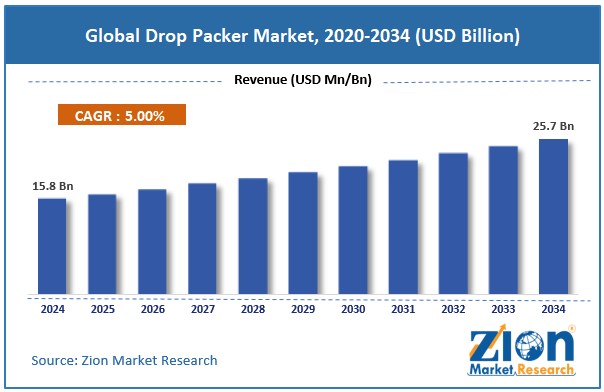
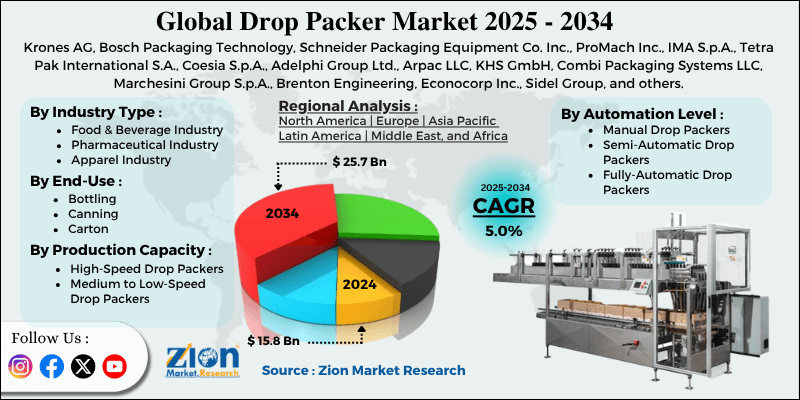
The global drop packer market size was worth around USD 15.8 billion in 2024 and is predicted to grow to around USD 25.7 billion by 2034 with a compound annual growth rate (CAGR) of roughly 5.0% between 2025 and 2034.
Key Insights
- As per the analysis shared by our research analyst, the global drop packer market is estimated to grow annually at a CAGR of around 5.0% over the forecast period (2025-2034).
- In terms of revenue, the global drop packer market size was valued at around USD 15.8 billion in 2024 and is projected to reach USD 25.7 billion by 2034.
- Demand for flexible & versatile packaging solutions is expected to propel the drop packer market over the projected period.
- Based on the Industry type, the food and beverage industry segment dominated with the largest revenue share in 2024.
- Based on the end-use, the bottling segment captures the largest revenue share in 2024.
- Based on the production capacity, the high-speed drop packers segment captures the largest revenue share in 2024.
- Based on the automation level, the semi-automatic drop packers segment captures the largest revenue share in 2024.
- Based on region, the Asia Pacific is expected to dominate the market over the projected period.
Drop Packer Market: Overview
The drop packer is an automatic packaging machine that fills products into cases, cartons, or boxes by dropping them from above in a controlled manner. The devices work by placing a cluster of items, such as bottles, cans, cartons, or pouches, into the open case below, then dropping them into the drop packer. Drop packers are very common in the food, beverage, pharmaceutical, and consumer goods industries, as they require high speed and accuracy. Drop packers are adaptable to packages of various shapes and sizes, with adjustable settings and quick-changeover mechanisms.
Drop packer devices may be semi-automatic or fully automatic. Conveyors, sensors, and even robotic pick-and-place systems may be used by a drop packer device to facilitate proper alignment, prevent product damage, and speed up operation.
Impact of the USA-Israel War on Iran on the Drop Packer Market
The USA–Israel/Iran conflict is adversely affecting the drop packer industry, mainly through supply chain disruptions, higher costs, and industrial uncertainty. The Middle East is a major center for energy production and global trade routes – this has resulted in rising oil and gas prices, logistical constraints, and scarcity of raw materials such as plastic resins and aluminum, which are used in packaging machinery production. These are leading to increased production and transportation costs for drop packer companies, along with delays in equipment installation and delivery. Moreover, the entire packaging industry is affected by supply chain instability in essential raw plastics and packaging inputs.
Drop Packer Market: Dynamics
Growth Drivers
Why does the rising demand for automation in packaging drive the drop packer market?
The acceleration of the automation trend in packaging is likely to drive a parallel evolution in the Drop Packer Market. The ever-increasing demand for fast, effective, and reliable packaging machinery across industries such as food & beverage, healthcare, and consumer durables is driving this growth. More and more companies are automating parts of their packaging line in an attempt to “automate” some processes so they can cut down on labor costs, keep the take-up time down, reduce errors, and save money. This trend, driven by the increasing need for higher productivity while reducing labor costs, is closely linked to the move towards fully automated, integrated systems capable of 24/7 operation with minimal operator presence.
Fast case packing speeds, where empty cases are transported at high speed beneath the nozzle system, and products are accurately placed into the cases, are being installed worldwide. With advances in robotics, sensors, and lighting systems, intelligent controller boards are increasing in speed, flexibility, and adaptability, enabling them to handle a wide variety of products across a range of packaging environments. This shift to automation is improving production efficiency and boosting growth.
Restraints
High initial capital investment hindering the drop packer industry growth
A high initial capital cost is anticipated to be a restraint on the growth of the drop packer market, as the effective cost of deploying an advanced drop packer is high, especially for small and medium enterprises (SMEs). Automated drop packers involve a considerable capital cost for machinery, equipment, and integration with production systems such as conveyors and control systems.
In addition, the organization would be required to provide and train the staff to monitor and control the equipment at the manufacturing level. The high initial investment would appear to be a setback to the adoption of advanced automated drop packing systems, especially in developing markets with cost-sensitive end users.
Opportunities
Why does the growing product portfolio expansion by the key players offer a lucrative opportunity for the drop packer market?
The growing product portfolio expansion by the key players is expected to offer a potential opportunity to the drop packer market growth. For instance, in October 2025, Serpa, a company that supplies the secondary packaging equipment, including cartoners, sleevers, case and tray packers, and robotic palletizers, has introduced a drop packer to its product line. At Pack Expo Las Vegas, the company introduced the DP260 drop packer, one of the DP series case packers that drop or place product into a case.
Designed for efficiency and simplicity, the single-drop DP260 can run at 30 cases per minute (CPM), while the tandem-drop can run up to 60 CPM. This is the first time Serpa, a part of the ProMach family of brands, has moved into the drop packing arena, so the new equipment allows the company to offer a more comprehensive line of end-of-line packaging equipment from filler to stretch wrapper.
Challenges
Why does the availability of alternative packaging methods pose a significant challenge to the drop packer market?
Availability of substitutes poses the greatest threat to the drop packer market, as there are equivalents such as manual packing, robotic case packers, side-load case packers, wraparound packers, or other types of automated packers that manufacturers can use. The essence lies in offering the same functionality at a better price, or in providing a manual or semi-automatic solution that can work on a low-volume basis at a lower investment.
Additionally, even the more versatile robotic solutions, compared with other semi- or manual solutions, might be the most cost-effective way to pack certain products that don't require high-speed operation. Therefore, such applications might work through other methods rather than automating drop packers, thereby hindering their market penetration.
Drop Packer Market: Report Scope
| Report Attributes | Report Details |
|---|---|
| Report Name | Drop Packer Market |
| Market Size in 2024 | USD 15.8 Billion |
| Market Forecast in 2034 | USD 25.7 Bllion |
| Growth Rate | CAGR of 5.0% |
| Number of Pages | 227 |
| Key Companies Covered | Krones AG, Bosch Packaging Technology, Schneider Packaging Equipment Co. Inc., ProMach Inc., IMA S.p.A., Tetra Pak International S.A., Coesia S.p.A., Adelphi Group Ltd., Arpac LLC, KHS GmbH, Combi Packaging Systems LLC, Marchesini Group S.p.A., Brenton Engineering, Econocorp Inc., Sidel Group, and others. |
| Segments Covered | By Industry Type, By End-Use, By Production Capacity, By Automation Level, and By Region |
| Regions Covered | North America, Europe, Asia Pacific (APAC), Latin America, Middle East, and Africa (MEA) |
| Base Year | 2024 |
| Historical Year | 2019 to 2023 |
| Forecast Year | 2025 - 2034 |
| Customization Scope | Avail customized purchase options to meet your exact research needs. Request For Customization |
Drop Packer Market: Segmentation
Industry Type Insights
Why does the food and beverage industry dominate the drop packer market?
The food and beverage industry segment dominated with the largest revenue share in 2024. This growth is driven by the increasing worldwide demand for packaged and processed food products. As consumer lifestyles accelerate, so too do the demands on food packagers for ready-to-eat foods, bottled drinks, canned products, and convenience packaging, with greater pressure on that packaging to operate at higher speeds. Drop packers are an important part of this industry, providing an accurate, high-speed method for loading bottles, cans, cartons, or pouches.
End-Use Insights
Does the bottling capture the largest market share in the drop packer market?
The bottling segment captures the largest revenue share in 2024. This growth is being driven by increasing world-wide consumption of packaged beverages such as water, carbonated soft drinks, juices, dairy, and alcohol-based drinks. Bottling operations demand automated, high-speed, accurate, and consistent packaging equipment to process large volumes of product; consequently, drop packers are a significant component of end-of-line packaging automation.
Drop packers are effective at grouping and placing bottles into cartons with precision and minimal breakage, which is vital to the end-of-line bottling operation. In addition to the increasing popularity of automated bottling lines, the overall savings from reduced operating costs are well-suited to the drop packer market.
Production Capacity Insights
Why the high-speed drop packers capture the largest market share in the drop packer market?
The high-speed drop packers segment captures the largest revenue share in 2024. This growth is mainly driven by the proliferation of faster, more efficient, and larger-scale packaging lines across industries, including food & beverage, pharmaceuticals, and consumer goods. With growing production lines, the emphasis is on using high-speed packaging systems with large capacity to handle larger quantities with accuracy and minimize operational time. The high-speed drop packers, which facilitate faster case packing rates, higher throughput, and accurate product placement, make them most suitable for high-end manufacturing.
Automation Level Insights
How does the semi-automatic drop packers capture the largest market share in the drop packer market?
The semi-automatic drop packers segment captures the largest revenue share in 2024. Their development is mainly motivated by their cost efficiency and compatibility with small- to medium-scale production. Many manufacturers, particularly in underdeveloped countries, prefer semi-automatic systems to drop packers because they cost less and still provide a faster system than manpower.
Regional Insights
Why does the Asia Pacific lead the drop packer market?
The Asia Pacific is expected to dominate the market over the projected period. The main drivers in the Asia Pacific are rapid industrialization and increased manufacturing activity. The increased demand for packaged goods from China, India, Japan, and other emerging countries has driven demand for more efficient, fast packaging solutions, thereby increasing demand for drop packers. The increased organized retail and E-commerce activities have also increased the demand for secondary packaging and faster logistics.
Many Asia Pacific companies are adopting various automation solutions to lower labor costs and increase productivity to meet increased production demands (especially amid higher wages in some manufacturing regions). The government directives for increased industrialization have also increased demand for new production bases and, in turn, for newer packaging solutions.
Drop Packer Market: Competitive Analysis
The global drop packer market is dominated by players like:
- Krones AG
- Bosch Packaging Technology
- Schneider Packaging Equipment Co. Inc.
- ProMach Inc.
- IMA S.p.A.
- Tetra Pak International S.A.
- Coesia S.p.A.
- Adelphi Group Ltd.
- Arpac LLC
- KHS GmbH
- Combi Packaging Systems LLC
- Marchesini Group S.p.A.
- Brenton Engineering
- Econocorp Inc.
- Sidel Group
The global drop packer market is segmented as follows:
By Industry Type
- Food and Beverage Industry
- Pharmaceutical Industry
- Apparel Industry
- Others
By End-Use
- Bottling
- Canning
- Carton
By Production Capacity
- High-Speed Drop Packers
- Medium to Low-Speed Drop Packers
By Automation Level
- Manual Drop Packers
- Semi-Automatic Drop Packers
- Fully-Automatic Drop Packers
By Region
- North America
- The U.S.
- Canada
- Mexico
- Europe
- France
- The UK
- Spain
- Germany
- Italy
- Rest of Europe
- Asia Pacific
- China
- Japan
- India
- Australia
- South Korea
- Rest of Asia Pacific
- The Middle East & Africa
- Saudi Arabia
- UAE
- Egypt
- Kuwait
- South Africa
- Rest of the Middle East & Africa
- Latin America
- Brazil
- Argentina
- Rest of Latin America
Table Of Content
Methodology
FrequentlyAsked Questions
The drop packer is an automatic packaging machine that fills products into cases, cartons, or boxes by dropping them from above in a controlled manner. The devices work by placing a cluster of items, such as bottles, cans, cartons, or pouches, into the open case below, then dropping them into the drop packer.
Key growth drivers for the drop packer market include rising demand for packaging automation, expansion of e-commerce, increasing consumption of packaged goods, and the need for high-speed, cost-efficient production solutions.
Major challenges restraining the growth of the drop packer market include high initial capital investment, complex integration with existing production lines, high maintenance requirements, availability of alternative packaging methods, and economic uncertainty affecting capital expenditure.
Based on the automation level, the semi-automatic drop packers segment is expected to dominate the drop packer market growth during the projected period.
The drop packer market is being shaped by several emerging trends and innovations centered on automation, intelligence, and sustainability. Key developments include the integration of robotics, artificial intelligence (AI), and IoT-enabled smart systems, which enhance precision, enable real-time monitoring, and support predictive maintenance to reduce downtime and improve efficiency.
According to the report, the global drop packer market size was worth around USD 15.8 billion in 2024 and is predicted to grow to around USD 25.7 billion by 2034.
The global drop packer market is expected to grow at a CAGR of 5.0% during the forecast period.
The global drop packer industry growth is expected to be led by the Asia Pacific over the forecast period.
The global drop packer market is dominated by players like Krones AG, Bosch Packaging Technology, Schneider Packaging Equipment Co. Inc., ProMach Inc., IMA S.p.A., Tetra Pak International S.A., Coesia S.p.A., Adelphi Group Ltd., Arpac LLC, KHS GmbH, Combi Packaging Systems LLC, Marchesini Group S.p.A., Brenton Engineering, Econocorp Inc. and Sidel Group among others.
The market report covers the geographical market along with a comprehensive competitive landscape analysis. It also includes cash flow analysis, profit ratio analysis, market basket analysis, market attractiveness analysis, sentiment analysis, PESTLE analysis, trend analysis, SWOT analysis, trade area analysis, demand & supply analysis, Porter’s five forces analysis, and value chain analysis.

HappyClients

