
Diamond Engagement Ring Market Size, Share, Trends, Growth, Forecast 2034

Diamond Engagement Ring Market By Type (Natural Diamonds and Lab-Grown Diamonds), By Setting Type (Halo, Solitaire, Side-Stone, Three-Stone, and Cluster), By Shape (Princess, Round, Cushion, Oval, Emerald, Marquise, and Pear), and By Region - Global and Regional Industry Overview, Market Intelligence, Comprehensive Analysis, Historical Data, and Forecasts 2025 - 2034
| Market Size in 2024 | Market Forecast in 2034 | CAGR (in %) | Base Year |
|---|---|---|---|
| USD 76.8 Billion | USD 134.9 Billion | 5.8% | 2024 |
Diamond Engagement Ring Industry Perspective:
What will be the size of the global diamond engagement ring market during the forecast period?
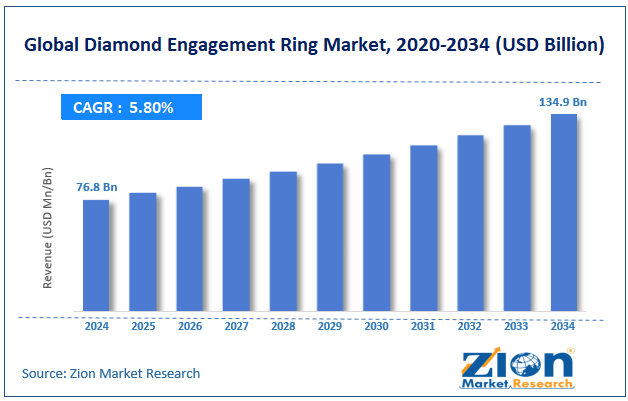
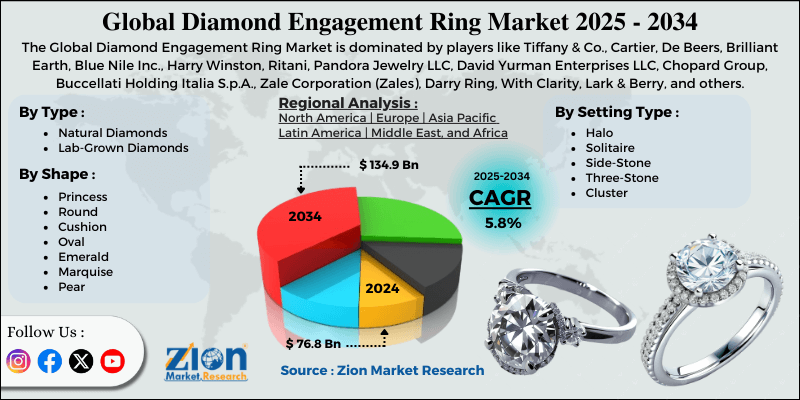
The global diamond engagement ring market size was worth around USD 76.8 billion in 2024 and is predicted to grow to around USD 134.9 billion by 2034, with a compound annual growth rate (CAGR) of roughly 5.8% between 2025 and 2034.
Key Insights
- As per the analysis shared by our research analyst, the global diamond engagement ring market is estimated to grow annually at a CAGR of around 5.8% over the forecast period (2025-2034).
- In terms of revenue, the global diamond engagement ring market size was valued at around USD 76.8 billion in 2024 and is projected to reach USD 134.9 billion by 2034.
- Retail expansion & brand presence are expected to drive the diamond engagement ring market.
- Based on the type, the natural diamonds are expected to capture the largest market share over the analysis period.
- Based on the setting type, solitaire holds the largest market share in 2024.
- Based on the shape, the emerald segment dominated the market in 2024.
- Based on region, North America is expected to dominate the market over the projected period.
Diamond Engagement Ring Market: Overview
A diamond engagement ring is a beautiful piece of jewelry that people normally give to signify their devotion and desire to get married. The main stone in the ring is a diamond. People appreciate diamonds because they are pretty, durable, and symbolize love that lasts forever. Most of the time, they are constructed of gold, white gold, or platinum. Most engagement rings have only one diamond, but some feature halo settings, side stones, or patterns that look like they're from the past. The "4Cs" of a diamond engagement ring are the most common way people judge its quality and value. These are the cut, color, clarity, and carat weight. The diamond engagement ring has gone from a cultural tradition to a luxury item sought by people worldwide. This is because fashions change, people have different tastes, and more people are interested in lab-grown or ethically produced diamonds.
Diamond Engagement Ring Market: Dynamics
Growth Drivers
Why does the rising disposable income & affluence drive the growth of the diamond engagement ring market?
The diamond engagement ring market is growing because people have more money to spend and want to spend it on expensive luxury goods. Young couples are spending more on symbolic, high-end items such as diamond engagement rings as family incomes rise, especially in developing countries like India, China, and Southeast Asia. Customers are more likely to prefer bigger carats, better diamonds (with superior cut, clarity, and color), and branded or unique designs when they have more money to spend.
Also, the growth of the middle class and urban population makes people more likely to buy things they want, such as engagement rings, which are considered a sign of commitment and a way to show off their social status and personal success. This shift toward spending on luxury and premium goods is driving steady expansion in the global industry.
Restraints
Are the growing fluctuations in diamond prices hindering the growth of the diamond engagement ring industry?
Diamond prices that fluctuate a lot can stall the diamond engagement ring market by leaving people unsure and limiting demand and profitability in the sector. Customers may put off buying or buy fewer engagement rings as diamond prices fluctuate. Engagement rings are often expensive things that people choose to buy. Price changes can make it hard for retailers and producers to keep prices stable, manage their stock, and develop marketing or growth plans.
Changes in input costs could cut into profit margins or force prices to rise, making customers who are sensitive to pricing even less likely to buy. This kind of volatility can make people even more afraid to buy big-ticket items like diamond engagement rings in areas where the economy is already shaky, slowing overall market growth.
Opportunities
Will increasing product launches offer a lucrative opportunity for the diamond engagement ring market growth?
The growing product launch is expected to offer a lucrative opportunity to the diamond engagement ring market over the projected period. For instance, in October 2025, De Beers Group announced that Desert Diamonds, the business's first new "beacon" in more than ten years, will be available to consumers. The company will spend more on marketing for this category than it has in more than ten years. A De Beers beacon is a jewelry idea that celebrates natural diamonds. It brings the whole industry together around a single topic and inspires marketing efforts across the board. The introduction demonstrates a distinct change in what customers want.
More people want jewelry that is unique, real, and has personal value. People who buy diamonds have said they prefer ones with earthy tones. These diamonds have a unique style and also show a stronger connection to nature. De Beers' research and creative testing confirmed this trend and showed that a very high percentage of people were interested in buying a desert diamond. More than 90% of people said they wanted to own one and were thinking about buying one.
Challenges
Competition from alternatives poses a major challenge to market growth
The diamond engagement ring market's growth is being held back by competition from other options. A growing number of people are looking at other options that look similar but cost less. The rapid rise of lab-grown diamonds has made this competition even stronger. Synthetic stones are just as brilliant and long-lasting as real diamonds, but they cost less and are considered better for the environment.
Younger people who value uniqueness, individuality, and cost-effectiveness are also increasingly interested in alternative gemstones such as moissanite, sapphires, and other colored stones. This change in what buyers want means there is less demand for diamonds mined conventionally. This puts pressure on natural diamond suppliers and retailers to cut their prices. As a result, companies already in the market have to spend more on branding, certification, transparency in ethical sourcing, and design innovation to maintain their market share. This makes competition from other companies a big barrier to total market expansion.
Diamond Engagement Ring Market: Report Scope
| Report Attributes | Report Details |
|---|---|
| Report Name | Diamond Engagement Ring Market |
| Market Size in 2024 | USD 76.8 Billion |
| Market Forecast in 2034 | USD 134.9 Bllion |
| Growth Rate | CAGR of 5.8% |
| Number of Pages | 223 |
| Key Companies Covered | Tiffany & Co., Cartier, De Beers, Brilliant Earth, Blue Nile Inc., Harry Winston, Ritani, Pandora Jewelry LLC, David Yurman Enterprises LLC, Chopard Group, Buccellati Holding Italia S.p.A., Zale Corporation (Zales), Darry Ring, With Clarity, Lark & Berry, and others. |
| Segments Covered | By Type, By Setting Type, By Shape, and By Region |
| Regions Covered | North America, Europe, Asia Pacific (APAC), Latin America, Middle East, and Africa (MEA) |
| Base Year | 2024 |
| Historical Year | 2019 to 2023 |
| Forecast Year | 2025 - 2034 |
| Customization Scope | Avail customized purchase options to meet your exact research needs. Request For Customization |
Diamond Engagement Ring Market: Segmentation
Type Insights
What factor cause natural diamonds segment to be in a dominating position in the diamond engagement ring market?
The natural diamonds are expected to capture the largest market share over the analysis period. Natural diamonds are still seen as symbols of individuality, lasting value, and everlasting love. This keeps the demand for normally mined stones in engagement rings high. Because they are rare in nature and have been important to cultures for a long time, they make great keepsakes. People often think of them as heirloom-quality gifts, which makes them more likely to pay more for them. Jewelry with high-clarity natural diamonds has been selling more and more over the past few years, especially in classic carat sizes that appeal to traditional buyers looking for luxury and investment-like attributes.
Setting Type Insights
Why does the solitaire segment hold the largest share in the diamond engagement ring industry?
Solitaire holds the largest market share in 2024. A solitaire engagement ring features only one diamond set on a band, which makes the stone look even more beautiful and high-quality. This simple, classic style is still the most popular choice for engagement rings, accounting for a large share of all sales. Trends show that it is still the most popular choice in many areas.
Shape Insights
Why does the emerald capture the largest revenue share in the diamond engagement ring market in 2024?
Emerald segment dominated the market in 2024. The emerald cut's long, sleek shape gives it a look that is both modern and timeless, which appeals to people who don't like the usual round or princess cuts. Couples who want simple yet beautiful engagement rings have chosen it for its smooth contours and understated grace. This aesthetic necessity drives sales higher and causes the category to flourish.
Regional Insights
Why does North America hold the largest share of the diamond engagement ring market?
North America is expected to dominate the diamond engagement ring market over the projected period. High consumer buying power, cultural traditions, and changes in how people shop are usually what drive regional growth. Over the next 10 years, the combined US and Canadian market is expected to grow rapidly. This is because rich people still see engagement rings as luxury items worth the money. This expansion is conceivable because diamond engagement rings mean a lot to people in North America. They are still the most important signs of commitment and marriage.
Average selling prices have increased because clients are willing to pay more for larger stones, stones with more carats, or stones made to order. This indicates that the corporation will make more money, even if the number of units sold changes. The market has also become more enticing as more people buy engagement rings online, more stores are opening, and shoppers are interested in both natural and lab-grown diamonds. This has helped jewelers get more clients and preserve their sales growth in this area.
Diamond Engagement Ring Market: Competitive Analysis
The global diamond engagement ring market is dominated by players like:
- Tiffany & Co.
- Cartier
- De Beers
- Brilliant Earth
- Blue Nile Inc.
- Harry Winston
- Ritani
- Pandora Jewelry LLC
- David Yurman Enterprises LLC
- Chopard Group
- Buccellati Holding Italia S.p.A.
- Zale Corporation (Zales)
- Darry Ring
- With Clarity
- Lark & Berry
The global diamond engagement ring market is segmented as follows:
By Type
- Natural Diamonds
- Lab-Grown Diamonds
By Setting Type
- Halo
- Solitaire
- Side-Stone
- Three-Stone
- Cluster
By Shape
- Princess
- Round
- Cushion
- Oval
- Emerald
- Marquise
- Pear
By Region
- North America
- The U.S.
- Canada
- Europe
- France
- The UK
- Spain
- Germany
- Italy
- Rest of Europe
- Asia Pacific
- China
- Japan
- India
- South Korea
- Southeast Asia
- Rest of Asia Pacific
- Latin America
- Brazil
- Mexico
- Rest of Latin America
- Middle East & Africa
- GCC
- South Africa
- Rest of Middle East & Africa
Table Of Content
Methodology
FrequentlyAsked Questions

HappyClients

