
Decarbonizing Market Size, Share, Growth and Forecast 2034

Decarbonizing Market By Service (Carbon Accounting and Reporting Services, Waste Reduction and Circular Economy Services and Sustainable Transportation Services), By Technology (Renewable Energy Technologies, Energy Efficiency Solutions, Electric Vehicles (EVs), Carbon Removal Technologies and Carbon Capture and Storage (CCS)), By Deployment (On-premises and Cloud), By End-use (Oil & Gas, Agriculture, Energy and Utility, Automotive & Transportation, Government, Aerospace & Defense and Manufacturing) and By Region - Global and Regional Industry Overview, Market Intelligence, Comprehensive Analysis, Historical Data, and Forecasts 2025 - 2034
| Market Size in 2024 | Market Forecast in 2034 | CAGR (in %) | Base Year |
|---|---|---|---|
| USD 1.99 Trillion | USD 6.29 Trillion | 12.2% | 2024 |
Decarbonizing Industry Perspective:
What will be the size of the global decarbonizing market during the forecast period?
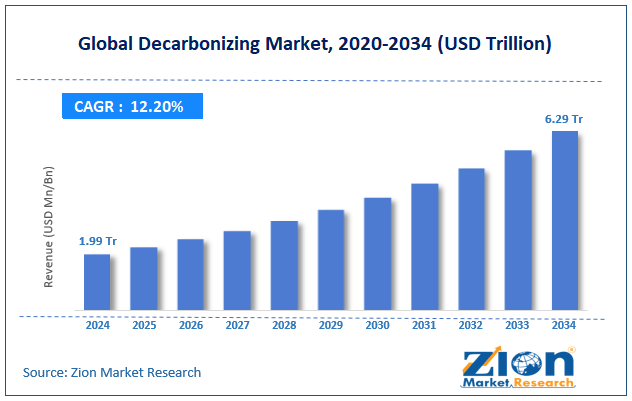
The global decarbonizing market size was worth around USD 1.99 trillion in 2024 and is predicted to grow to around USD 6.29 trillion by 2034 with a compound annual growth rate (CAGR) of roughly 12.2% between 2025 and 2034.
Key Insights
- As per the analysis shared by our research analyst, the global decarbonizing market is estimated to grow annually at a CAGR of around 12.2% over the forecast period (2025-2034).
- In terms of revenue, the global decarbonizing market size was valued at around USD 1.99 trillion in 2024 and is projected to reach USD 6.29 trillion by 2034.
- Rising energy demand & urbanization is expected to propel the decarbonizing market over the projected period.
- Based on the service, the sustainable transportation services segment is expected to capture the largest market share over the projected period.
- Based on the technology, the renewable energy technologies segment captures the largest revenue share in 2024 of over 70%.
- Based on the deployment, the on-premises segment dominates the market in 2024.
- Based on the end-use, the oil & gas segment dominates the market in 2024.
- Based on region, North America captures the largest market share in 2024.
Decarbonizing Market: Overview
Decarbonization is the term used to describe the reduction of emissions of carbon dioxide (CO2) and other greenhouse gases resulting from human activities, especially in the energy, transport, industry, and buildings sectors. The transition from carbon-based to low-carbon or renewable energy sources, including solar, wind, and hydro, is central to decarbonization.
Other technologies include energy efficiency, clean hydrogen, and carbon capture technology, among others. Decarbonization is associated with efforts by the international community, especially within the context of the Paris Agreement, which aims to keep global temperatures within bounds by reducing net emissions to zero in the coming years.
Impact of the USA-Israel War on Iran on the Decarbonizing Market
The current USA-Israel war against Iran has had both positive and negative effects on the decarbonization industry. On the one hand, the serious disruptions to oil and gas supply, especially those that transit via the Strait of Hormuz, have led to higher energy costs and the realization that fossil fuels are not sustainable; as a result, many nations are investing in renewable energy sources and energy security measures. However, the current war has had negative impacts as well, especially on inflation and the use of fossil fuels as an alternative energy source.
Decarbonizing Market: Dynamics
Growth Drivers
How do the government policies & net-zero commitments drive the decarbonizing market?
Government policies and net-zero pledges are among the critical drivers of growth in the decarbonizing industry, characterized by high adoption and clear targets. Within the framework of initiatives like the Paris Agreement, governments across the world have adopted legally binding or voluntary pledges towards addressing climate change through ambitious targets, with about 140–150 nations pursuing or planning for net-zero emissions, accounting for 75%–80% of global greenhouse gas emissions and more than 80% of the world’s gross domestic product (GDP). This is an unprecedented increase since 2018, when fewer than 30 countries had adopted similar pledges.
Notably, key economies like the USA, EU, China, and India have formulated national decarbonization policies that include implementing carbon taxes, renewable energy standards, and massive public funding; for instance, India intends to attain net-zero emissions by 2070 and significantly increase renewable energy production. Such policy frameworks ensure regulatory stability in the long run, facilitate significant climate finance flows, and encourage private-sector engagement, thereby accelerating the adoption of green innovations, such as renewable energy, electric mobility, green hydrogen production, and carbon capture, among others, and promoting growth in the decarbonizing industry.
Restraints
High initial capital investment is hindering the decarbonizing industry growth
The high cost of initial capital investments is one of the main barriers to the growth of the decarbonizing market, as many low-carbon solutions entail expensive upfront capital costs whose payoffs are realized over time. Large-scale investments in solar, offshore wind, and other technologies, such as energy storage systems, smart grids, and innovations (carbon capture, green hydrogen), among others, require substantial initial investments to build the necessary infrastructure and adopt the technology. Many of the investments are much costlier than conventional fossil fuel solutions, creating significant financial challenges for governments and investors, particularly in developing economies. The high cost of capital investments increases risks and the cost of debt, thereby hampering decarbonization efforts.
Opportunities
Why does the growing number of agreements among market players offer a lucrative opportunity for the decarbonizing market?
The rising number of agreements among the key market players are expected to offer a potential opportunity to the decarbonizing market. For instance, in April 2025, Hydro and Nemak have entered into an LOI to produce low-carbon aluminum casting materials for the automotive industry. Decarbonization shall be fast-tracked to aid car manufacturers in meeting their sustainability goals. Decarbonization shall be achieved through the use of more post-consumer scrap metal and modifications to the energy mix, replacing existing fuels with cleaner forms of energy, including natural gas and electric boilers, at the Alunorte alumina plant in Brazil. In the long run, the aim is to develop a foundry alloy aluminum with less than 3.0 kg CO2 per kg of aluminum.
Challenges
How do the technology maturity & scalability issues pose a significant challenge to the decarbonizing market?
The issue of technology readiness and scalability is a significant barrier to the decarbonizing market, as some key low-carbon technologies have not yet matured. For instance, green hydrogen production, CCUS, and energy storage technologies have not yet achieved their full commercial potential, let alone become cost-competitive on a large scale. Despite positive pilot tests of some of the technologies, scaling them up and integrating them into existing infrastructure may prove quite challenging, both technically and economically. This problem is also compounded by the need to adapt these technologies to existing industries to achieve their maximum efficiency. The unpreparedness of the current technology base impedes further progress and limits the rate at which the key industries can adopt low-carbon processes.
Decarbonizing Market: Report Scope
| Report Attributes | Report Details |
|---|---|
| Report Name | Decarbonizing Market |
| Market Size in 2024 | USD 1.99 Trillion |
| Market Forecast in 2034 | USD 6.29 Trllion |
| Growth Rate | CAGR of 12.2% |
| Number of Pages | 228 |
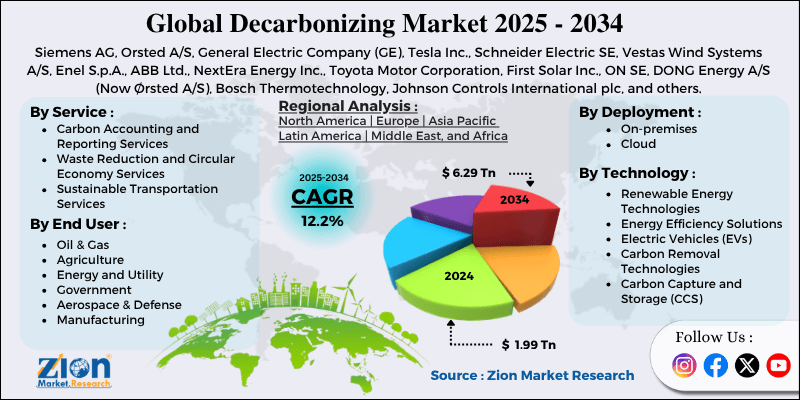
| Key Companies Covered | Siemens AG, Orsted A/S, General Electric Company (GE), Tesla Inc., Schneider Electric SE, Vestas Wind Systems A/S, Enel S.p.A., ABB Ltd., NextEra Energy Inc., Toyota Motor Corporation, First Solar Inc., ON SE, DONG Energy A/S (Now Ørsted A/S), Bosch Thermotechnology, Johnson Controls International plc, and others. |
| Segments Covered | By Service, By Technology, By Deployment, By End-use, and By Region |
| Regions Covered | North America, Europe, Asia Pacific (APAC), Latin America, Middle East, and Africa (MEA) |
| Base Year | 2024 |
| Historical Year | 2019 to 2023 |
| Forecast Year | 2025 - 2034 |
| Customization Scope | Avail customized purchase options to meet your exact research needs. Request For Customization |
Decarbonizing Market: Segmentation
Service Insights
Why does the sustainable transportation services dominate the decarbonizing market?
The sustainable transportation services segment is expected to capture the largest market share over the projected period. Sustainable transportation refers to approaches that prioritize environmental sustainability, reduce carbon footprints, minimize resource consumption, and promote economic success. Sustainability in transportation involves finding ways to address environmental pollution and social challenges arising from existing modes of transport. Additionally, sustainable transportation entails the application of technology to make transportation processes more efficient and minimize pollution from traffic.
Technology Insights
Why does the renewable energy technologies capture the largest market share in the decarbonizing market?
The renewable energy technologies segment captures the largest revenue share in 2024 of over 70%. The number of renewable energy power plants in the region has grown due to the government's strict emission policies. The country’s power sector has been undergoing changes as gas and renewable energy sources have become more prevalent than traditional coal-based power sources. Rising electricity distribution costs, power outages due to grid failures, and incentives offered by the United States government to adopt renewables will encourage consumers to install hydroelectricity systems.
Deployment Insights
Does on-premises segment dominate the decarbonizing market?
The on-premises segment dominates the market in 2024. On-premise deployment in the context of decarbonization involves reducing or eliminating carbon emissions from diverse sources, including factories, power plants, modes of transportation, and buildings, to mitigate global warming. Companies can reduce their reliance on fossil fuels and cut emissions from electricity consumption by generating their own power with renewable energy systems, such as solar and wind.
End-use Insights
How does the oil & gas segment dominate the decarbonizing market?
The oil & gas segment dominates the market in 2024. The process of decarbonization in the energy and utilities industry entails reducing or eliminating carbon dioxide (CO2) and other greenhouse gases emitted in the production and use of energy. Decarbonization is crucial to combating global warming and ensuring that an environmentally friendly energy production system becomes a reality. The first step in the decarbonization process is replacing traditional sources of energy, such as fossil fuels (coal, oil, and natural gas), with alternative sources such as solar, wind, hydro, and geothermal.
Regional Insights
Why does North America lead the decarbonizing market?
North America captures the largest market share in 2024. The industry's growth is driven by increased activity from key players. An example of such an effort was made in June 2023, when the United States Department of Energy, led by the Biden-Harris Administration, invested around USD 30 million to improve sustainability in federal buildings and develop clean energy technology solutions.
Furthermore, another example is the efforts of the North American Climate, Energy, and Environment Partnership, which encouraged countries to embrace sustainability through sustainable policies and the procurement of renewables and electric vehicles where needed. Also, in collaboration with the International Renewable Energy Agency, as part of a long-term global project, Mexico, Canada, and the USA have launched a Trilateral North American effort to help remote indigenous communities access clean energy.
Decarbonizing Market: Competitive Analysis
The global decarbonizing market is dominated by players like:
- Siemens AG
- Orsted A/S
- General Electric Company (GE)
- Tesla Inc.
- Schneider Electric SE
- Vestas Wind Systems A/S
- Enel S.p.A.
- ABB Ltd.
- NextEra Energy Inc.
- Toyota Motor Corporation
- First Solar Inc.
- ON SE
- DONG Energy A/S (Now Ørsted A/S)
- Bosch Thermotechnology
- Johnson Controls International plc
The global decarbonizing market is segmented as follows:
By Service
- Carbon Accounting and Reporting Services
- Waste Reduction and Circular Economy Services
- Sustainable Transportation Services
By Technology
- Renewable Energy Technologies
- Energy Efficiency Solutions
- Electric Vehicles (EVs)
- Carbon Removal Technologies
- Carbon Capture and Storage (CCS)
By Deployment
- On-premises
- Cloud
By End-use
- Oil & Gas
- Agriculture
- Energy and Utility
- Automotive & Transportation
- Government
- Aerospace & Defense
- Manufacturing
By Region
- North America
- The U.S.
- Canada
- Mexico
- Europe
- France
- The UK
- Spain
- Germany
- Italy
- Rest of Europe
- Asia Pacific
- China
- Japan
- India
- Australia
- South Korea
- Rest of Asia Pacific
- The Middle East & Africa
- Saudi Arabia
- UAE
- Egypt
- Kuwait
- South Africa
- Rest of the Middle East & Africa
- Latin America
- Brazil
- Argentina
- Rest of Latin America
Table Of Content
Methodology
FrequentlyAsked Questions
Decarbonization is the term used to describe the reduction of emissions of carbon dioxide (CO2) and other greenhouse gases resulting from human activities, especially in the energy, transport, industry, and buildings sectors.
Key growth drivers of the decarbonization market include strong government policies and net-zero commitments aligned with the Paris Agreement, rapid expansion of renewable energy, electrification of transport and industry, technological advancements, and increasing corporate sustainability (ESG) initiatives.
Major challenges restraining the decarbonization market include high upfront capital costs, immature and hard-to-scale technologies (e.g., green hydrogen and CCUS), infrastructure limitations, policy uncertainty despite frameworks like the Paris Agreement, and supply chain constraints for critical materials.
Based on the end-use, the oil & gas segment is expected to dominate the decarbonizing market growth during the projected period.
Emerging trends shaping the decarbonization market include rapid growth of green hydrogen, advancements in energy storage and smart grids, expansion of carbon capture technologies, electrification of transport and industry, and digital optimization using AI for energy efficiency.
According to the report, the global decarbonizing market size was worth around USD 1.99 trillion in 2024 and is predicted to grow to around USD 6.29 trillion by 2034.
The global decarbonizing market is expected to grow at a CAGR of 12.2% during the forecast period.
The global decarbonizing industry growth is expected to be led by North America over the forecast period.
The global decarbonizing market is dominated by players like Siemens AG, Orsted A/S, General Electric Company (GE), Tesla Inc., Schneider Electric SE, Vestas Wind Systems A/S, Enel S.p.A., ABB Ltd., NextEra Energy Inc., Toyota Motor Corporation, First Solar Inc., ON SE, DONG Energy A/S (Now Ørsted A/S), Bosch Thermotechnology and Johnson Controls International plc among others.
The market report covers the geographical market along with a comprehensive competitive landscape analysis. It also includes cash flow analysis, profit ratio analysis, market basket analysis, market attractiveness analysis, sentiment analysis, PESTLE analysis, trend analysis, SWOT analysis, trade area analysis, demand & supply analysis, Porter’s five forces analysis, and value chain analysis.

HappyClients

