
Global Cycling Tourism Market Size, Share, Growth, Opportunities, and Forecasts 2034

Cycling Tourism Market By Group Type (Groups/Friends, Family, Couples, and Solo), By Booking Mode (Direct, Marketplace Booking, and Travel Agent), By Age Group (18 to 30 Years, 31 to 50 Years, and Above 50 Years), and Region - Global and Regional Industry Overview, Market Intelligence, Comprehensive Analysis, Historical Data, and Forecasts 2026 - 2034
| Market Size in 2025 | Market Forecast in 2034 | CAGR (in %) | Base Year |
|---|---|---|---|
| USD 145.5 Billion | USD 378.2 Billion | 11.2% | 2025 |
Cycling Tourism Industry Perspective:
What will be the size of the global cycling tourism market during the forecast period?
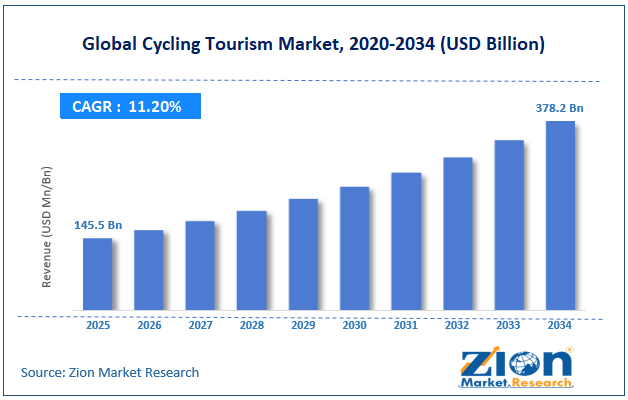
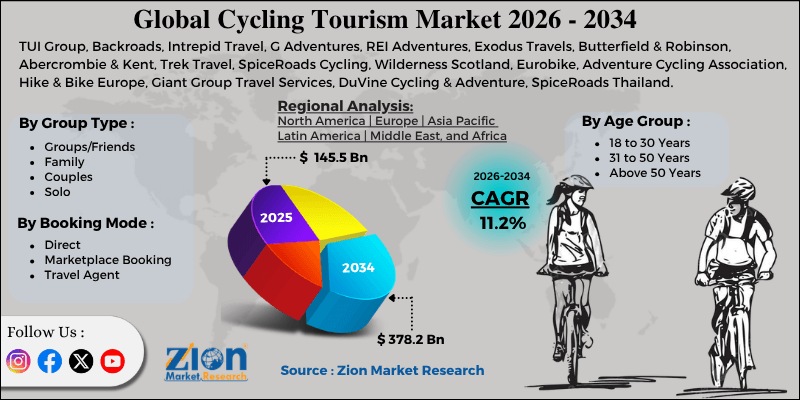
The global cycling tourism market size was worth around USD 145.5 billion in 2025 and is predicted to grow to around USD 378.2 billion by 2034, with a compound annual growth rate (CAGR) of roughly 11.2% between 2026 and 2034.
Key Insights
- As per the analysis shared by our research analyst, the global cycling tourism market is estimated to grow annually at a CAGR of around 11.2% over the forecast period (2026-2034).
- In terms of revenue, the global cycling tourism market size was valued at around USD 145.5 billion in 2025 and is projected to reach USD 378.2 billion by 2034.
- Government support for cycling is expected to propel the cycling tourism market over the projected period.
- Based on the group type, the groups/friends segment dominates the market with a revenue share of 44.7% in 2025.
- Based on the booking mode, the direct segment holds a majority of market share of 64% in 2025.
- Based on the age group, the 31 to 50 years segment holds a majority of market share in 2025 of 48%.
- Based on region, Europe dominates the cycling tourism market with a revenue share of 39.7% in 2025.
Cycling Tourism Market: Overview
The cycling tourism market is a broad sector that includes transportation, tourism, accommodation, and rental companies, as well as tour operators and other entities that serve tourists who prefer to explore the world on bikes. It includes mountain bike, road bike, e-bike, and other types of tourism, as well as bicycle rallies. The market is segmented by cycling-related accommodation, catering, transport, rental, and tour operating, as well as other tourism sectors. The cycling tourism market is growing due to the increasing popularity of alternative and sports travel, as well as the development of the e-bike market.
Impact of the USA-Israel War on Iran on the Cycling Tourism Market
The U.S.-Israel war with Iran may negatively impact the cycling tourism market due to several factors. First, the U.S. and Israel's allies may reduce the number of tourists due to fears for their safety, which may also be impacted by global security concerns. In addition, increased global travel safety concerns may lead to fewer flights operating to some destinations, resulting in limited access to cycling tourism countries. Indeed, the Oxford Economics study estimates that the Middle East visitor numbers could fall by 11-27% in 2026, depending on the conflict scenario. Moreover, there is an increased risk of cancellation of local and international travel, as well as a possible rise in costs due to higher travel, accommodation, insurance, and fuel costs.
Cycling Tourism Market: Dynamics
Growth Drivers
How does the growing demand for sustainable tourism drive the cycling tourism market?
Growing demand for sustainable tourism is driving the development of the U.S. cycling tourism market as federal and local governments support the creation of bicycle infrastructure as a low-carbon, healthy mode of transport. In March 2024, the U.S. Department of Transportation (USDOT) announced funding of up to $44.5 million through the Active Transportation Infrastructure Investment Program (ATIIP) to develop connected bicycle and pedestrian networks and trails. In addition, the government awarded $63 million to 99 communities through the Safe Streets and Roads for All program in 2024. The projects are intended to improve the safety of bicyclists and pedestrians. Recently, in December 2025, USDOT announced the allocation of nearly $982.2 million to 521 projects in 48 states, 18 Tribal communities, and Puerto Rico to make the nation’s infrastructure more transportation-friendly. The USDOT’s initiatives have enhanced the appeal of bicycle use and drawn tourists to the U.S., thereby increasing the demand for cycling tours, bicycle rentals, and trails.
Restraints
Why does the limited cycling infrastructure act as a major restraint to the cycling tourism industry's growth?
Insufficient cycling infrastructure is a significant factor that influences the growth of the cycling tourism sector. Inadequate bike lanes, inappropriate routes, insufficient signage, and a lack of bicycle parking, along with poor maintenance and a lack of charging stations, may hinder the region's development as a destination for cyclists. Cyclists are not willing to share the road with cars, and this is especially critical for long-distance and leisure cycling.
Moreover, the cycling tourism sector suffers from a lack of connections between bike trails and underdeveloped cycling-specific infrastructure. This factor discourages both visiting international cycling tourists and local bike tour operators. As a result, the demand for bicycle transport, including bike rentals, accommodations, catering, and other services, will be lower.
Opportunities
How does the expansion of cycling events offer a lucrative opportunity for the cycling tourism market?
The development of bicycle races, cycling festivals, recreational rides, and long-distance races is an excellent way to attract participants and spectators and benefit from their spending power. According to the Federal Highway Administration (FHWA), bicycle races are classified as planned special events, and the organized events generate economic and tourism benefits for the local community. For instance, government authorities estimate that large-scale planned special events, which usually have over 10,000 participants, have an annual economic impact, attracting 602 million visitors and generating $164 billion in total economic impact and $4.2 billion in government revenue.
the data was collected on all types of planned special events, and not only bicycle races, the tourism and visitor spending power can still be used as an excellent indicator of the potential economic impact of bicycle races in 2025. In other words, the development of bicycle events will result in the growth of demand for hotel accommodation, food, tour services, bicycle rentals, and other tourism-related services.
Challenges
Competition from alternative tourism options poses a significant challenge to the growth of the cycling tourism industry
Competition in the tourism sector is likely to hinder the growth rate of the cycling tourism industry as travelers may choose from a wide variety of alternatives such as hiking, camping, wildlife, adventure tours, road trips, boating, and other outdoor-based activities. The presence of a wide range of substitutes significantly reduces the ability of firms and destination hosts to attract more visitors, especially with the provision of competitive substitutes. According to the US Bureau of Economic Analysis (BEA) research report, for instance, the outdoor recreation economy in the United States was worth $696.7 billion in value added in 2024, which is 2.4 percent of the Gross Domestic Product (GDP). This implies that a substantial proportion of the American economy is devoted to the outdoor recreation sector, making it very difficult to sell travel packages to people interested in hiking, road trips, camping, boating, bicycling, hunting, and other outdoor activities.
As a result, the competition in the tourism sector will require businesses to develop unique routes and hosts to provide distinct cycling events, e-bike activities, entertainment, and other tour plans to attract more visitors and earn more revenue from travelers.
Cycling Tourism Market: Report Scope
| Report Attributes | Report Details |
|---|---|
| Report Name | Cycling Tourism Market |
| Market Size in 2025 | USD 145.5 Billion |
| Market Forecast in 2034 | USD 378.2 Billion |
| Growth Rate | CAGR of 11.2% |
| Number of Pages | 227 |
| Key Companies Covered | TUI Group, Backroads, Intrepid Travel, G Adventures, REI Adventures, Exodus Travels, Butterfield & Robinson, Abercrombie & Kent, Trek Travel, SpiceRoads Cycling, Wilderness Scotland, Eurobike, Adventure Cycling Association, Hike & Bike Europe, Giant Group Travel Services, DuVine Cycling & Adventure, SpiceRoads Thailand, Cycle Tours Global, Discover France, Cycle Europe, and others. |
| Segments Covered | By Group Type, By Booking Mode, By Age Group, and By Region |
| Regions Covered | North America, Europe, Asia Pacific (APAC), Latin America, Middle East, and Africa (MEA) |
| Base Year | 2025 |
| Historical Year | 2020 - 2024 |
| Forecast Year | 2026 - 2034 |
| Customization Scope | Avail customized purchase options to meet your exact research needs. Request For Customization |
Cycling Tourism Market: Segmentation
Group Type Insights
Why does the groups/friends segment hold a prominent position in the cycling tourism market?
The groups/friends segment dominates the cycling tourism market with a revenue share of 44.7% in 2025. The strong growth is attributed to the social and recreational nature of the activity, which enables individuals to interact with friends, gain motivation, and achieve higher levels of safety and comfort during long or challenging rides. Moreover, operators are providing tailored group packages, organized guided tours, accommodation, equipment hire, and group rates, thus making the sport accessible and convenient. In addition, the use of social media to facilitate and promote group adventure travel is encouraging more people to participate in organized group cycling tours with friends, thereby stimulating segment revenue growth.
Booking Mode
How does the direct segment capture the largest share in the cycling tourism market?
The direct segment holds a majority share of the cycling tourism industry, at 64% in 2025. Strong growth will be driven primarily by the increasing use of online booking systems and direct digital platforms, as they enable tourists to contact tour operators, customize their preferences for biking and accommodation, and choose from a variety of options while receiving real-time help and support. Moreover, direct booking helps avoid additional costs associated with distribution channels and facilitates securing preferred rates and unique discounts, thus helping both tourists and operators maximize profits and build relationships. Therefore, the demand for customized and independent travel will drive the growth of the direct booking segment.
Age Group
Does the 31 to 50 years segment capture the largest share in the cycling tourism market?
The 31 to 50 years segment holds a majority of the cycling tourism market share in 2025 of 48%. The main reason is that representatives of this age group have higher disposable income and financial stability, allowing them to afford holidays and excursions. Moreover, people aged 31-50 are characterized by the desire to actively explore the world around them and be as healthy as possible. Given that e-bikes, comfort, and special equipment for cyclists are becoming more popular, it is possible to attract more customers within the specified age range.
Regional Insights
What factors drive the Europe region in the cycling tourism market?
Europe dominates the cycling tourism market with a revenue share of 39.7% in 2025. The growth is attributed to Europe's strong cycling culture, developed cycling infrastructure, the rising popularity of e-bikes, and the number of cycling-related events. In Europe, there are top international races, including the Tour de France, Giro d’Italia, and Vuelta a España, as well as hundreds of professional, amateur, gravel, and mountain-bike races and events. In addition, there is a considerable number of cycling-related tourism events such as the EuroVelo network, and according to the European Cyclists’ Federation, there are about 2.3 billion bike tourism trips in the EU every year that are worth more than 50 billion USD (~44 billion EUR).
Such events attract both local and international visitors and serve to promote the region/image of the country, as well as provide additional services such as accommodation, restaurants, bicycle and tour rentals, and transportation. Thus, the abundance of cycling-related tourism events, as well as the popularity of cycling culture, is positively correlated with such metrics as visitors, image, and revenue, and therefore cycling tourism in Europe is thriving.
Cycling Tourism Market: Competitive Analysis
The global cycling tourism market is dominated by players like:
- TUI Group
- Backroads
- Intrepid Travel
- G Adventures
- REI Adventures
- Exodus Travels
- Butterfield & Robinson
- Abercrombie & Kent
- Trek Travel
- SpiceRoads Cycling
- Wilderness Scotland
- Eurobike
- Adventure Cycling Association
- Hike & Bike Europe
- Giant Group Travel Services
- DuVine Cycling & Adventure
- SpiceRoads Thailand
- Cycle Tours Global
- Discover France
- Cycle Europe
The global cycling tourism market is segmented as follows:
By Group Type
- Groups/Friends
- Family
- Couples
- Solo
By Booking Mode
- Direct
- Marketplace Booking
- Travel Agent
By Age Group
- 18 to 30 Years
- 31 to 50 Years
- Above 50 Years
By Region
- North America
- The U.S.
- Canada
- Mexico
- Europe
- France
- The UK
- Spain
- Germany
- Italy
- Rest of Europe
- Asia Pacific
- China
- Japan
- India
- Australia
- South Korea
- Rest of Asia Pacific
- The Middle East & Africa
- Saudi Arabia
- UAE
- Egypt
- Kuwait
- South Africa
- Rest of the Middle East & Africa
- Latin America
- Brazil
- Argentina
- Rest of Latin America
Table Of Content
Methodology
FrequentlyAsked Questions
The cycling tourism market is a broad sector that includes transportation, tourism, accommodation, and rental companies, as well as tour operators and other entities that serve tourists who prefer to explore the world on bikes.
The key growth drivers for the cycling tourism market include rising demand for sustainable and eco-friendly travel, increasing health and wellness awareness, expansion of cycling infrastructure, growing adoption of e-bikes, and the popularity of adventure and experiential tourism. Digital booking platforms and self-guided cycling tours are also making cycling holidays easier to plan and access. Together, these factors are encouraging more travelers to choose cycling as a low-carbon, active, and immersive way to explore destinations, supporting continued market expansion.
The major challenges restraining the cycling tourism market include limited cycling infrastructure, safety concerns, seasonal and adverse weather conditions, high travel and equipment costs, and inadequate cycling-related facilities in emerging destinations. Poorly connected bike lanes, unsafe roads, limited signage, and insufficient repair, rental, and emergency services can discourage tourists from selecting cycling destinations.
Based on the group type, the groups/friend’s segment is expected to dominate the cycling tourism market growth during the projected period.
The cycling tourism market is being shaped by several emerging trends, including e-bike tourism, AI-powered trip planning, personalized cycling experiences, self-guided tours, digital route-planning tools, and multimodal travel. E-bikes are making cycling holidays accessible to a broader range of travelers by reducing physical barriers, while GPS-enabled navigation and mobile applications are improving route planning, safety, and convenience. AI is increasingly being used to help tourists discover and plan cycling itineraries, reducing the logistical difficulties associated with cycling holidays.
According to the report, the global cycling tourism market size was worth around USD 145.5 billion in 2025 and is predicted to grow to around USD 378.2 billion by 2034.
The global cycling tourism market is expected to grow at a CAGR of 11.2% during the forecast period.
The global cycling tourism industry growth is expected to be led by Europe over the forecast period.
The global cycling tourism market is dominated by players like TUI Group, Backroads, Intrepid Travel, G Adventures, REI Adventures, Exodus Travels, Butterfield & Robinson, Abercrombie & Kent, Trek Travel, SpiceRoads Cycling, Wilderness Scotland, Eurobike, Adventure Cycling Association, Hike & Bike Europe, Giant Group Travel Services, DuVine Cycling & Adventure, SpiceRoads Thailand, Cycle Tours Global, Discover France, and Cycle Europe, among others.
The cycling tourism market report covers the geographical market along with a comprehensive competitive landscape analysis. It also includes cash flow analysis, profit ratio analysis, market basket analysis, market attractiveness analysis, sentiment analysis, PESTLE analysis, trend analysis, SWOT analysis, trade area analysis, demand & supply analysis, Porter’s five forces analysis, and value chain analysis.

HappyClients

