
Global Cultured Dextrose Market Size, Share, Trends by 2034

Cultured Dextrose Market By Form (Powder and Liquid), By Function (Natural Preservative, Flavor Modulation, and pH Control), By Application (Bakery, Dairy, Ready Meals, and Sauces), and By Region - Global and Regional Industry Overview, Market Intelligence, Comprehensive Analysis, Historical Data, and Forecasts 2025 - 2034
| Market Size in 2024 | Market Forecast in 2034 | CAGR (in %) | Base Year |
|---|---|---|---|
| USD 311 Million | USD 562 Million | 6.1% | 2024 |
Cultured Dextrose Industry Prospective:
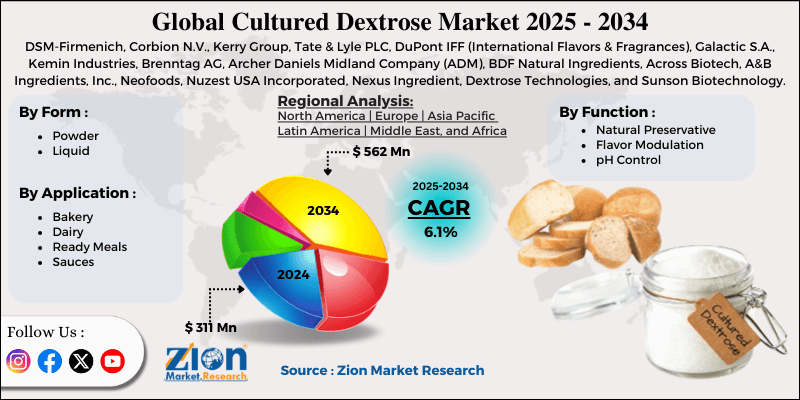
The global cultured dextrose market size was worth around USD 311 million in 2024 and is predicted to grow to around USD 562 million by 2034, with a compound annual growth rate (CAGR) of roughly 6.1% between 2025 and 2034.

Key Insights
- As per the analysis shared by our research analyst, the global cultured dextrose market is estimated to grow annually at a CAGR of around 6.1% over the forecast period (2025-2034).
- In terms of revenue, the global cultured dextrose market size was valued at around USD 311 million in 2024 and is projected to reach USD 562 million by 2034.
- The growing food & beverages sector is expected to drive the cultured dextrose market over the forecast period.
- Based on the form, the powder segment is expected to dominate the market over the projected period.
- Based on the function, the natural preservative segment is expected to capture the largest market share over the projected period.
- Based on the application, the bakery segment is expected to capture the largest market share over the projected period.
- Based on region, North America is expected to dominate the market during the forecast period.
Cultured Dextrose Market: Overview
Fermentation produces cultured dextrose, a type of food additive. To make it, food-grade microorganisms are used to generate dextrose (glucose) in controlled fermentation conditions. During fermentation, organic acids and other metabolites are produced that have antibacterial properties and inhibit the growth of spoilage organisms, such as molds, yeasts, and certain bacteria. Because of this, cultured dextrose is a popular natural preservative and shelf-life extender in the food and drink sectors. Since it allows manufacturers to reduce or eliminate synthetic preservatives while maintaining food safety, freshness, and quality, it is particularly useful in clean-label formulations. People often utilize cultured dextrose in sauces, dressings, baked goods, dairy products, meat and poultry, and processed meals.
Cultured Dextrose Market Dynamics
Growth Drivers
How does the increasing food & beverages sector propel the cultured dextrose industry growth?
The cultured dextrose market is primarily driven by growth in the food and beverage industry. Rapid urbanization, busy schedules, and increased disposable incomes have all led to a big increase in the use of processed, packaged, and ready-to-eat meals. All of these items need to be stored properly to stay safe and last longer. Food manufacturers are rapidly changing their recipes to meet the demand for clean-label, organically preserved meals. This has led to significant demand for fermentation-based ingredients, such as cultured dextrose. As it stops microbes from growing and aligns with natural and label-friendly trends, it's great for bread, dairy, meat, sauces, and convenience foods. The worldwide food and beverage business is growing, especially in developing countries. This indicates that demand for natural preservation solutions, such as cultured dextrose, is expected to continue to grow, supporting long-term market growth.
Restraints
Higher cost versus conventional preservatives is impeding the industry's growth
The high cost of cultured dextrose compared to regular synthetic preservatives is a significant barrier to the sector's expansion. Cultured dextrose is produced through controlled fermentation and incurs higher costs for raw materials, processing, and quality control than chemical preservatives such as sorbates and benzoates. Because of this, food manufacturers, especially those operating in marketplaces where price is important or in areas where they sell many low-margin products, are usually reluctant to use cultured dextrose because it increases the overall production cost. This price difference could make it harder for small and medium-sized firms to adopt the product, and it could also slow its spread in developing countries, where price remains a major factor in buying decisions. Even though it has a clear label and is in a good spot, the higher price is still holding back market growth.
Opportunities
Will technological advancements & fermentation improvements offer a potential opportunity for the cultured dextrose market growth?
Improvements in technology and fermentation will create significant growth opportunities for the cultured dextrose business. Producers can reduce production costs while improving yield, uniformity, and functional performance through ongoing improvements in fermentation technology, including improved microbial strains, optimized fermentation conditions, and greater automation. These changes make cultured dextrose more affordable and useful in a wider range of foods. Also, improvements in downstream processing and formulation technologies enable the use of less antimicrobial agent while maintaining the same effect. This reduces food producers' costs and their sensory effects. As technology improves, it is expected to encourage adoption by eliminating current cost and performance barriers, leading to continued business expansion.
Challenges
How does the competitive pressure from other clean-label preservatives pose a major challenge to cultured dextrose market expansion?
The cultured dextrose sector is struggling to grow due to competition from various clean-label preservatives. Food makers now have many natural preservation options. Vinegar-based preservatives, citrus extracts, rosemary extract, fermented sugar blends, and other bio-preservatives often have similar antibacterial effects. Sometimes, they are cheaper, easier to get, or can be used in other ways. In many circumstances, these alternatives may be easier to add, more familiar to formulators, or better for certain flavor and pH profiles. Because of this, cultured dextrose must compete not only on clean-label status but also on efficacy, sensory attributes, cost, and FDA approval. This intense competition can make it harder to get people to adopt new products, raise prices, and enter new markets, especially in regions where other clean-label preservatives are already well-known and have established supply chains.
Cultured Dextrose Market: Report Scope
| Report Attributes | Report Details |
|---|---|
| Report Name | Cultured Dextrose Market |
| Market Size in 2024 | USD 311 Million |
| Market Forecast in 2034 | USD 562 Million |
| Growth Rate | CAGR of 6.1% |
| Number of Pages | 290 |
| Key Companies Covered | DSM-Firmenich, Corbion N.V., Kerry Group, Tate & Lyle PLC, DuPont IFF (International Flavors & Fragrances), Galactic S.A., Kemin Industries, Brenntag AG, Archer Daniels Midland Company (ADM), BDF Natural Ingredients, Across Biotech, A&B Ingredients, Inc., Neofoods, Nuzest USA Incorporated, Nexus Ingredient, Dextrose Technologies, and Sunson Biotechnology, among others. |
| Segments Covered | By Form, By Function, By Application and By Region |
| Regions Covered | North America, Europe, Asia Pacific (APAC), Latin America,The Middle East and Africa (MEA) |
| Base Year | 2024 |
| Historical Year | 2019 to 2023 |
| Forecast Year | 2025 - 2034 |
| Customization Scope | Avail customized purchase options to meet your exact research needs. Request For Customization |
Cultured Dextrose Market: Segmentation
Form Insights
The powder segment is expected to dominate the market over 70% of revenue share. The food and drink industry is the biggest driver of the market right now, and it's increasingly using it as a natural, clean-label preservative. People want products with fewer artificial chemicals and more natural ones, so producers are adding cultured dextrose powder to a wide range of products, including baked goods, dairy products, sauces, and ready-to-eat meals. Without artificial preservatives, products last longer and stay fresher. As more and more people want clean-label products and processed and convenience foods become more popular around the world, cultured dextrose powder formulations are becoming more popular and profitable.
Function Insights
The natural preservative segment is expected to hold the largest revenue share over the projected period with a 55% of market share. The market is growing as more people seek natural, clean-label food preservation solutions in the booming global food and beverage industry. People are becoming more health-conscious and paying more attention to ingredient lists. As a result, they are choosing products without artificial preservatives. To meet this demand, food manufacturers are using alternatives, such as cultured dextrose, to keep products fresher longer without sacrificing quality or safety. Fermentation makes cultured dextrose, which is thought to be a natural preservative. It aligns well with trends toward clean labels and transparency, making it a strong choice for bread, dairy, processed, and ready-to-eat foods. The cultured dextrose market has seen significant sales growth driven by the trend toward natural preservatives, regulators' focus on food safety, and the ongoing growth of processed and packaged foods worldwide.
Application Insights
The bakery segment is expected to hold the largest revenue share of over 35% in 2024. Its popularity is growing as it is increasingly used as a natural preservative and shelf-life extender in baked goods. Bread, muffins, cakes, and tortillas are especially prone to mold and spoiling, so it's important to store them properly to keep them fresh and of good quality over time. People are increasingly seeking clean-label, naturally preserved foods, and cultured dextrose prevents mold and other spoilage organisms without synthetic preservatives. The appeal of clean labels is especially strong in baking, where precise ingredient lists can sway buying decisions. As food companies modify bread recipes to incorporate more natural ingredients and extend shelf life, cultured dextrose has become increasingly popular, leading to a significant increase in sales in the bakery sector.
Cultured Dextrose Market: Regional Analysis
North America leads the cultured dextrose sector with a market share of 36% in 2024 and is expected to continue the same pattern during the projected period. The main drivers of regional growth are that more individuals are choosing natural, clean-label food ingredients, and cultured dextrose is quickly becoming the most popular natural preservative in the region's mature food and beverage industry. Over the next 10 years, demand for cultured dextrose in the United States, North America's largest single market, is expected to skyrocket. This is because food makers are changing their recipes to eliminate synthetic preservatives, extend product shelf life, and comply with strict food safety rules. More people are becoming aware of clean labels, more food safety regulations are being followed, and companies are continuing to invest in advanced ingredient technologies that make products safer and better. All of these things are helping cultured dextrose sales grow in the bakery, dairy, ready-to-eat, and other processed food segments.
Cultured Dextrose Market: Competitive Analysis
The global cultured dextrose market is dominated by players like -
- DSM-Firmenich
- Corbion N.V.
- Kerry Group
- Tate & Lyle PLC
- DuPont IFF (International Flavors & Fragrances)
- Galactic S.A.
- Kemin Industries
- Brenntag AG
- Archer Daniels Midland Company (ADM)
- BDF Natural Ingredients
- Across Biotech
- A&B Ingredients
- Neofoods
- Nuzest USA Incorporated
- Nexus Ingredient
- Dextrose Technologies
- Sunson Biotechnology
- among others.
The global cultured dextrose market is segmented as follows:
By Form
- Powder
- Liquid
By Function
- Natural Preservative
- Flavor Modulation
- pH Control
By Application
- Bakery
- Dairy
- Ready Meals
- Sauces
By Region
- North America
- The U.S.
- Canada
- Mexico
- Europe
- France
- The UK
- Spain
- Germany
- Italy
- Rest of Europe
- Asia Pacific
- China
- Japan
- India
- Australia
- South Korea
- Rest of Asia Pacific
- The Middle East & Africa
- Saudi Arabia
- UAE
- Egypt
- Kuwait
- South Africa
- Rest of the Middle East & Africa
- Latin America
- Brazil
- Argentina
- Rest of Latin America
Table Of Content
Methodology
FrequentlyAsked Questions
Fermentation produces cultured dextrose, a type of food additive. To make it, food-grade microorganisms are used to generate dextrose (glucose) in controlled fermentation conditions.
The cultured dextrose market is being driven by the rising demand for clean-label and natural ingredients, expansion of the global food & beverages industry, increased focus on food safety and quality, technological advancements in fermentation processes, and others.
Higher cost versus conventional preservatives is hampering the industry's growth.
Based on the function, the natural preservative segment is expected to dominate the cultured dextrose market growth during the projected period.
Consumers increasingly demand products with simple, recognizable ingredients and minimal artificial additives. Cultured dextrose, produced through natural fermentation, aligns with the clean-label movement, prompting manufacturers to adopt it as a preferred natural preservative.
According to the report, the global cultured dextrose market size was worth around USD 311 million in 2024 and is predicted to grow to around USD 562 million by 2034.
The global cultured dextrose market is expected to grow at a CAGR of 6.1% during the forecast period.
The global cultured dextrose industry growth is expected to be led by North America over the forecast period.
The global cultured dextrose market is dominated by players like DSM-Firmenich, Corbion N.V., Kerry Group, Tate & Lyle PLC, DuPont IFF (International Flavors & Fragrances), Galactic S.A., Kemin Industries, Brenntag AG, Archer Daniels Midland Company (ADM), BDF Natural Ingredients, Across Biotech, A&B Ingredients, Inc., Neofoods, Nuzest USA Incorporated, Nexus Ingredient, Dextrose Technologies, and Sunson Biotechnology, among others.
The market report covers the geographical market along with a comprehensive competitive landscape analysis. It also includes cash flow analysis, profit ratio analysis, market basket analysis, market attractiveness analysis, sentiment analysis, PESTLE analysis, trend analysis, SWOT analysis, trade area analysis, demand & supply analysis, Porter’s five forces analysis, and value chain analysis.

HappyClients

