
Bus Seat Market Size, Share, Trends, Growth and Forecast 2032

Bus Seat Market: By Comfort Type (High and Low), By Seat Type (Recliner, Regular Passenger, Integrated Child, Driver, Folding), By Component Type (Frame and Upholstery), Bus Type (Transfer, School, Transit, Coach), and by Region: Global Industry Perspective, Comprehensive Analysis, and Forecast, 2024-2032
| Market Size in 2023 | Market Forecast in 2032 | CAGR (in %) | Base Year |
|---|---|---|---|
| USD 13.16 Billion | USD 21.26 Billion | 5.47% | 2023 |
Bus Seat Market Insights
Zion Market Research has published a report on the global Bus Seat Market, estimating its value at USD 13.16 Billion in 2023, with projections indicating that it will reach USD 21.26 Billion by 2032. The market is expected to expand at a compound annual growth rate (CAGR) of 5.47% over the forecast period 2024-2032.
The report explores the factors fueling market growth, the hitches that could hamper this expansion, and the opportunities that may arise in the Bus Seat industry. Additionally, it offers a detailed analysis of how these elements will affect market demand dynamics and market performance throughout the forecast period.
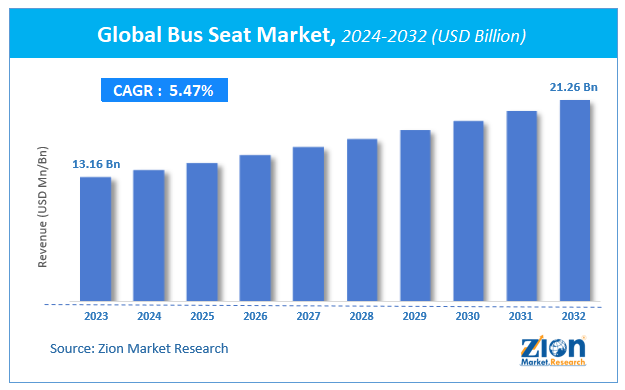
Global Bus Seat Market: Overview
Buses are one of the frequently used means of transportation owing to their high frequency and reliability. As the population around the world is increasing, transportation is of utmost need. The increasing demand for bus seat for coach, school, transfer, and transit buses have raised the opportunities for the bus seat market growth. The school bus and transit types would be the key users of bus seats owing to the increasing need for transportation services in the educational and public domains.
Global Bus Seat Market: Growth Factors
The main factor for the rise of the bus seat market is the increasing need for luxury and comfort in transportation by bus which leads to boosting the production of bus seats for different types of bus services. High population, ample expenditure on transportation by bus by governments, and expansion in private and tourism industries owing to rising expendable income are a few other factors that contribute to the growth of the bus seat market.
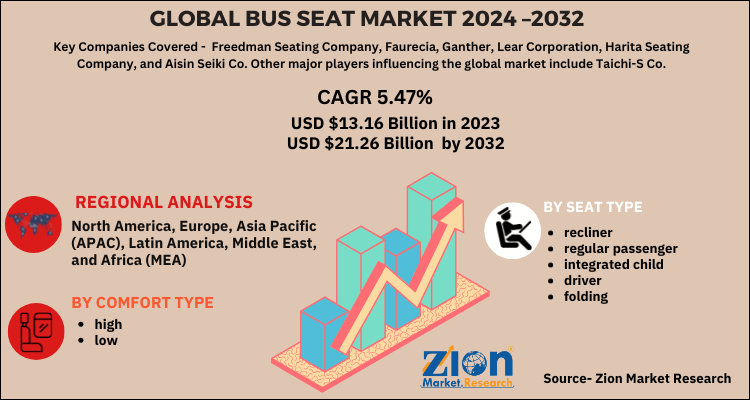
Global Bus Seat Market: Segmentation
The bus seat market can be segmented based on comfort type, seat type, bus type, and geography.
The comfort type segment is further classified as high and low.
The seat type segment of the bus seat market is divided into the recliner, regular passenger, integrated child, driver, and folding.
Recliner seats can be adjusted as per the passenger's needs.
The recliner seats give lumbar support, a self-sufficient footstool, which can bend with an angle of users’ legs for more comfort and weight of the user, and a flexible headrest.
Hence, the demand is high in the market for recliner bus seats. The bus type segment is diversified as transfer, school, transit, and coach.
Bus Seat Market: Report Scope
| Report Attributes | Report Details |
|---|---|
| Report Name | Bus Seat Market |
| Market Size in 2023 | USD 13.16 Billion |
| Market Forecast in 2032 | USD 21.26 Billion |
| Growth Rate | CAGR of 5.47% |
| Number of Pages | 110 |
| Key Companies Covered | Freedman Seating Company, Faurecia, Ganther, Lear Corporation, Harita Seating Company, and Aisin Seiki Co. Other major players influencing the global market include Taichi-S Co., Magna International, Toyota Boshoku Corporation, and NHK Springs |
| Segments Covered | By Type,By End-User And By Region |
| Regions Covered | North America, Europe, Asia Pacific (APAC), Latin America, Middle East, and Africa (MEA) |
| Base Year | 2023 |
| Historical Year | 2018 - 2022 |
| Forecast Year | 2024 - 2032 |
| Customization Scope | Avail customized purchase options to meet your exact research needs. Request For Customization |
The need for buses in schools for convenience and safety reasons for children is anticipated to grow the bus seat market and will remain a trend in the future too.
Geographically, the global bus seat market is segmented as North America, Europe, Asia-Pacific, Latin America, and the Middle East and Africa.
Region-wise, the global market is segregated into North America, Europe, Asia Pacific, Latin America, and Middle East & Africa.
Global Bus Seat Market: Regional Analysis
The Asia-Pacific region is anticipated to grow in the bus seat market owing to the increasing rate of bus transportation services due to the increasing demand for transportation mediums and the high population is an of the key components. The ever-growing population is a major factor contributing to the increasing demand for bus seats in India and China. Hence, the market in the Asia Pacific is assumed to grow fast during the coming period.
Global Bus Seat Market: Competitive Players
The key players in the bus seat market are-
- Freedman Seating Company
- Faurecia
- Ganther
- Lear Corporation
- Harita Seating Company
- Aisin Seiki Co.
- Taichi-S Co.
- Magna International
- Toyota Boshoku Corporation
- NHK Springs
By Region
- North America
- The U.S.
- Canada
- Mexico
- Europe
- France
- The UK
- Spain
- Germany
- Italy
- Rest of Europe
- Asia Pacific
- China
- Japan
- India
- Australia
- South Korea
- Rest of Asia Pacific
- The Middle East & Africa
- Saudi Arabia
- UAE
- Egypt
- Kuwait
- South Africa
- Rest of the Middle East & Africa
- Latin America
- Brazil
- Argentina
- Rest of Latin America
Table Of Content
Methodology
FrequentlyAsked Questions
A bus seat is a passenger seating component designed for buses. It ensures comfort, safety, and durability.
The global Bus Seat market is expected to be driven by the expansion of public transportation, increasing focus on passenger comfort, and rising demand for ergonomic designs. Urbanization and transit investments support market growth.
According to study, the global Bus Seat market size was worth around USD 13.16 Billion in 2023 and is predicted to grow to around USD 21.26 Billion By 2032.
The global Bus Seat market is expected to grow at a Compound Annual Growth Rate (CAGR) of around CAGR 5.47% during the forecast period from 2024-2032.
The global Bus Seat industry is projected to be challenged by Challenges include cost pressure from transport operators, durability requirements, and long replacement cycles.
The Opportunities include public transport investments, demand for ergonomic and lightweight seats, smart seating features, and electric bus adoption will offer significant growth opportunities in the Bus Seat market.
Lightweight and ergonomic seat designs; antimicrobial and fire-retardant materials; smart seating with occupancy and safety sensors are the emerging trends and innovations impacting the Bus Seat market.
The global Bus Seat market is expected to be led by APAC during the forecast period.
Some of the prominent players operating in the global Bus Seat market are; Freedman Seating Company, Faurecia, Ganther, Lear Corporation, Harita Seating Company, and Aisin Seiki Co. Other major players influencing the global market include Taichi-S Co., Magna International, Toyota Boshoku Corporation, and NHK Springs and others.
The report explores crucial aspects of the Bus Seat market, including a detailed discussion of existing growth factors and restraints, while also browsing future growth opportunities and challenges that impact the market.

HappyClients

