
Bleaching Agents Market Size, Share, Trends, Growth and Forecast 2034

Bleaching Agents Market By Form (Liquid and Powder), By Product (Acetone Peroxide, Hydrogen Peroxide, Chlorine Dioxide, Acetone Acid, Azodicarbonamide, and Others), By End-User Industry (Textile, Pulp & Paper, Food & Beverages, Healthcare & Sanitation, Water Treatment, Household Cleaning Products, Leather & Cosmetic Industries,and Others), and By Region - Global and Regional Industry Overview, Market Intelligence, Comprehensive Analysis, Historical Data, and Forecasts 2025 - 2034
| Market Size in 2024 | Market Forecast in 2034 | CAGR (in %) | Base Year |
|---|---|---|---|
| USD 1,064.30 Million | USD 1,545.10 Million | 4.16% | 2024 |
Bleaching Agents Industry Perspective:
What is the anticipated size of the bleaching agents market during the projection period?
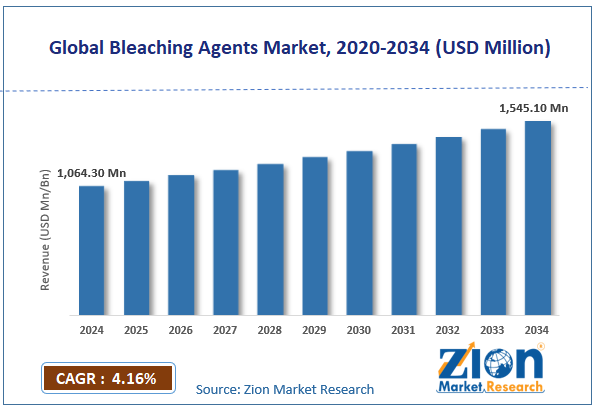
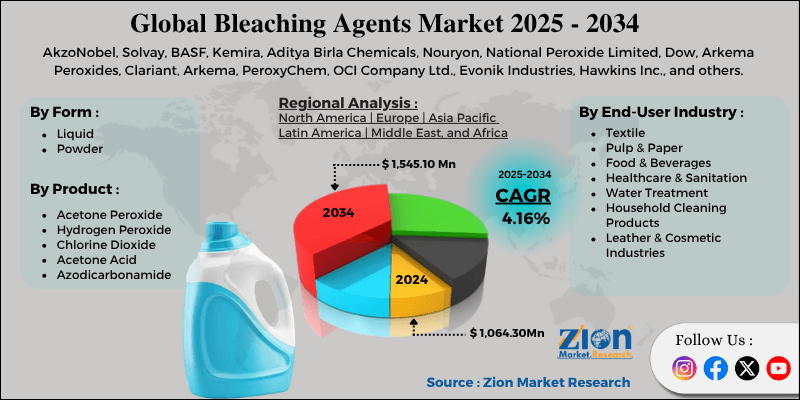
The global bleaching agents market size was worth around USD 1,064.30 million in 2024 and is predicted to grow to around USD 1,545.10 million by 2034 with a compound annual growth rate (CAGR) of roughly 4.16% between 2025 and 2034.
Bleaching Agents Market: Overview
Bleaching agents are materials that whiten or lighten a substrate using a chemical reaction. The bleaching process generally involves a reductive or oxidative process that degrades the color scheme. The process may also involve modification or destruction of chromophoric groups in the substrate. Commonly used bleaching agents are generally classified as peroxygen and chlorine, along with their related compounds such as sodium hypochlorite. Enzymes have emerged as a new class of bleaching agents with applications in the textile and pulp & paper industries.
During the forecast period, demand for bleaching agents is expected to grow due to rising applications in water treatment, increased applications in home laundering, and the introduction of eco-friendly bleaching agents. However, the market may face growth limitations due to safety concerns, environmental impact, and supply chain disruptions.
Key Insights:
- As per the analysis shared by our research analyst, the global bleaching agents market is estimated to grow annually at a CAGR of around 4.16% over the forecast period (2025-2034)
- In terms of revenue, the global bleaching agents market size was valued at around USD 1,064.30 million in 2024 and is projected to reach USD 1,545.10 million by 2034.
- The market is projected to grow at a significant rate due to the rising applications in water treatment.
- Based on the form, the powder segment is growing at a high rate and will continue to dominate the global market, as per industry projections
- Based on the product, the acetone aid segment is anticipated to command the largest market share.
- Based on the end-user industry, the water treatment segment is expected to lead the market growth trends.
- Based on region, the Asia-Pacific is projected to dominate the global market during the forecast period.
Impact of the USA-Israel and Iran war on the Bleaching Agents Market:
The USA-Israel and Iran war has led to an increased cost of bleaching agent production and procurement. According to market research, the global chemical and dye auxiliary sectors are some of the most significantly affected industries due to disruptions in the supply chain. The war is expected to drive demand for alternative sourcing and greater understanding of regional risk exposure, along with opportunities in emerging economies.
Bleaching Agents Market: Dynamics
Growth Drivers
How will applications in water treatment influence demand in the bleaching agents market?
The global bleaching agents market is expected to be driven by the rising applications in water treatment. According to market analysis, water disinfection is one of the largest applications of chlorine-containing bleaching agents. The exceptional effectiveness of bleaching agents in eliminating harmful elements in water bodies improved water safety. Bleaching agents have excellent oxidizing properties, driving end applications. Factors such as growing population, urbanization, industrialization, and public health concerns have encouraged efforts toward large-scale water disinfection projects.
For instance, in February 2026, a new water disinfection plant with a capacity of producing one million litres per day was launched at India’s National Institute of Technology Karnataka (NITK) campus. As per official reports, Europe is expected to spend over EUR 3.6 billion in Per- and Polyfluoroalkyl Substances PFAS) treatment for drinking water across ten European countries by 2036, following the latest EU Drinking Water Directive’s PFAS limits.
Expansion of the textile sector to work in favor of the industry leaders
The textile industry is one of the leading users of bleaching chemicals. These agents form a part of the pre-treatment process of textile products as they are used for removing natural pigments and other impurities before the textile goes for further processing. Accelerated expansion of the textile sector will work in favor of the global bleaching agents market in the coming years. Population growth, the emergence of fast and ultra-fast fashion trends, e-commerce expansion, and other similar factors will encourage demand for textile items during the forecast period.
Restraints
Which safety concerns will limit the expansion of the bleaching agents industry during the projection period?
The global bleaching agents industry is projected to be restricted due to safety concerns. According to industry analysis, bleaching agents used in cosmetic, skincare, and dental care projects can lead to dermatitis, severe skin irritation, and permanent skin discoloration. They can also cause mercury poisoning and tooth sensitivity. Growing awareness about the negative impact of bleaching agents will limit market adoption trends in the coming years.
Opportunities
Green bleaching agents to generate expansion opportunities for the market players
The global bleaching agents market is anticipated to generate growth opportunities due to the rising use of green chemicals. Sustainable and eco-friendly bleaching agents do not pose any threat to the environment or the health of living organisms. It includes the production of chlorine-free, low-toxicity, and biodegradable products. In March 2025, researchers at the Indian Institute of Science (IISc) developed a novel technique of hydrogen peroxide production using zinc-air batteries. The technique produces hydrogen peroxide inside the battery using metal-free carbon and a low-cost catalyst.
Nouryon, a global specialty chemicals company, produces hydrogen peroxide products using low-carbon footprint techniques. Eka® HP Puroxide™, for instance, is produced using fossil-free hydrogen and renewable energy. Furthermore, government regulations discouraging the use of chemical-free bleaching agents across prominent industries such as food & beverages and textiles will drive market investments in the coming years.
Challenges
How will raw material price volatility and dynamic demand challenge the expansion of the bleaching agents industry?
The global bleaching agents industry is projected to be challenged by the raw material price volatility and dynamic demand. Essential raw materials such as energy and caustic soda register high fluctuations in price and volatility. Furthermore, increasing demand for alternative solutions such as ozone treatment and enzymatic procedures will shift revenue for bleaching agents.
Bleaching Agents Market: Report Scope
| Report Attributes | Report Details |
|---|---|
| Report Name | Bleaching Agents Market |
| Market Size in 2024 | USD 1,064.30 Million |
| Market Forecast in 2034 | USD 1,545.10 Million |
| Growth Rate | CAGR of 4.16% |
| Number of Pages | 226 |
| Key Companies Covered | AkzoNobel, Solvay, BASF, Kemira, Aditya Birla Chemicals, Nouryon, National Peroxide Limited, Dow, Arkema Peroxides, Clariant, Arkema, PeroxyChem, OCI Company Ltd., Evonik Industries, Hawkins Inc., and others. |
| Segments Covered | By Form, By Product, By End-User Industry, and By Region |
| Regions Covered | North America, Europe, Asia Pacific (APAC), Latin America, Middle East, and Africa (MEA) |
| Base Year | 2024 |
| Historical Year | 2019 - 2023 |
| Forecast Year | 2025 - 2034 |
| Customization Scope | Avail customized purchase options to meet your exact research needs. Request For Customization |
Bleaching Agents Market: Segmentation
The global bleaching agents market is segmented based on form, product, end-user industry, and region.
Why wi+ll the liquid segment deliver a faster CAGR in the bleaching agents industry revenue during the forecast period?
Based on form, the global market segments are liquid and powder. In 2024, the highest growth was listed in the liquid segment, accounting for 71% of the total revenue. It is expected to continue growing at a CAGR of 6.1% during the forecast period due to higher applications across end-user industries. They offer convenience and faster response as compared to bleaching chemicals in powder form.
Which will be the fastest-growing product segment during the forecast period in the bleaching agents market?
Based on product, the global bleaching agents industry is fragmented into acetone peroxide, hydrogen peroxide, chlorine dioxide, acetic acid, azodicarbonamide, and others. In 2024, the highest revenue was reported in the hydrogen peroxide segment. It contributed up to 51% of the global revenue. During the forecast period, acetone aid is expected to grow at the fastest CAGR of 7.21% due to its eco-friendliness. Strong applications of acetic acid in the food industry will encourage segmental dominance.
Why will the water treatment industry lead the bleaching agents industry in the coming years?
Based on the end-user industry, the global market divisions are textile, pulp & paper, food & beverages, healthcare & sanitation, water treatment, household cleaning products, leather & cosmetic industries, and others. In 2024, the pulp & paper industry was the market leader for bleaching agents, accounting for 32% of the total revenue. In the coming years, the water treatment segment is expected to grow at a CAGR of 7.25% as demand for safe water continues to grow.
Bleaching Agents Market: Regional Analysis
How is Asia-Pacific expected to perform in the bleaching agents market during the projection period?
The global bleaching agents market is expected to be dominated by the Asia-Pacific region. It is also expected to emerge as the fastest-growing region with a CAGR of 6.6% during the forecast period. In 2024, it accounted for 45% of the global revenue. The presence of a robust chemical and dye manufacturing industry across China, India, and South Korea will aid regional expansion. In addition, increasing demand for residential applications, expansion of the regional textile industry, and rapid industrialization will drive regional growth trends.
Why will North America emerge as the second-largest region in the bleaching agents market?
North America will emerge as the second-largest region in the bleaching agents market during the forecast period, growing at a CAGR of 5.1%. In 2024, it accounted for 26.9% of the global revenue. Higher demand for bleaching agents across large-scale water treatment plants, increased development of eco-friendly bleaching agents, and favorable government policies will promote regional growth. Infrastructure development supporting domestic production of chemicals & materials will work in favor of the regional players.
Bleaching Agents Market: Competitive Analysis
The global bleaching agents market is led by players like:
- AkzoNobel
- Solvay
- BASF
- Kemira
- Aditya Birla Chemicals
- Nouryon
- National Peroxide Limited
- Dow
- Arkema Peroxides
- Clariant
- Arkema
- PeroxyChem
- OCI Company Ltd.
- Evonik Industries
- Hawkins Inc.
What are the latest key trends in the bleaching agents market?
Advancements in formulation techniques and procedures
The growing use of advanced manufacturing techniques and formulations for developing highly effective yet low-toxicity bleaching agents is a promising market trend. It allows greater use of bleaching chemicals in industries such as healthcare & sanitation.
Production expansion in novel markets
Bleaching chemical-producing companies are rapidly expanding production lines in new markets to prevent the impact of social-political turmoil. It allows companies to diversify production lines and minimize risks.
The global bleaching agents market is segmented as follows:
By Form
- Liquid
- Powder
By Product
- Acetone Peroxide
- Hydrogen Peroxide
- Chlorine Dioxide
- Acetone Acid
- Azodicarbonamide
- Others
By End-User Industry
- Textile
- Pulp & Paper
- Food & Beverages
- Healthcare & Sanitation
- Water Treatment
- Household Cleaning Products
- Leather & Cosmetic Industries
- Others
By Region
- North America
- The U.S.
- Canada
- Mexico
- Europe
- France
- The UK
- Spain
- Germany
- Italy
- Rest of Europe
- Asia Pacific
- China
- Japan
- India
- Australia
- South Korea
- Rest of Asia Pacific
- The Middle East & Africa
- Saudi Arabia
- UAE
- Egypt
- Kuwait
- South Africa
- Rest of the Middle East & Africa
- Latin America
- Brazil
- Argentina
- Rest of Latin America
Table Of Content
Methodology
FrequentlyAsked Questions
Bleaching agents are materials that whiten or lighten a substrate using a chemical reaction. The bleaching process generally involves a reductive or oxidative process that degrades the color scheme.
The global bleaching agents market is expected to be driven by the rising applications in water treatment.
According to study, the global bleaching agents market size was worth around USD 1,064.30 million in 2024 and is predicted to grow to around USD 1,545.10 million by 2034.
The CAGR value of bleaching agents is expected to be around 4.16% during 2025-2034.
The global bleaching agents industry is projected to be challenged by the raw material price volatility and dynamic demand
Eco-friendly product development, advanced bleaching technologies, and collaborations with healthcare companies are investment or partnership opportunities in the bleaching agents market.
The global bleaching agents market has performed well so far and will offer similar trends in the coming years.
The global bleaching agents market is expected to be dominated by the Asia-Pacific region.
The global bleaching agents market is led by players like AkzoNobel, Solvay, BASF, Kemira, Aditya Birla Chemicals, Nouryon, National Peroxide Limited, Dow, Arkema Peroxides, Clariant, Arkema, PeroxyChem, OCI Company Ltd., Evonik Industries, and Hawkins Inc.
The report explores crucial aspects of the bleaching agents market including detailed discussion of existing growth factors and restraints while also browsing future growth opportunities and challenges that impact the market.

HappyClients

