
Technical Textile Market Size, Share, Trends, Growth and Forecast 2034

Technical Textile Market By Process (Woven, Non-Woven, Knitted, and Others), By Material (High Performance Fiber, Natural Fiber, Synthetic Fiber, Regenerated Fiber, and Others), By Manufacturing (3D Weaving, Thermo-Forming, Hand-Made Elements, Finishing Treatments, and Others), By Application (Oekotech, Geotech, Packtech, Indutech, Agrotech, Protech, Clothtech, Hometech, Meditech, and Others), and By Region - Global and Regional Industry Overview, Market Intelligence, Comprehensive Analysis, Historical Data, and Forecasts 2025 - 2034
| Market Size in 2024 | Market Forecast in 2034 | CAGR (in %) | Base Year |
|---|---|---|---|
| USD 208.74 Billion | USD 338.56 Billion | 5.52% | 2024 |
Technical Textile Industry Perspective:
What is the anticipated size of the global technical textile market during the projection period?
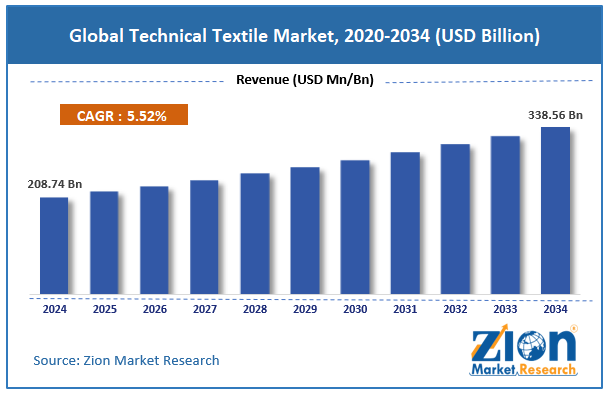
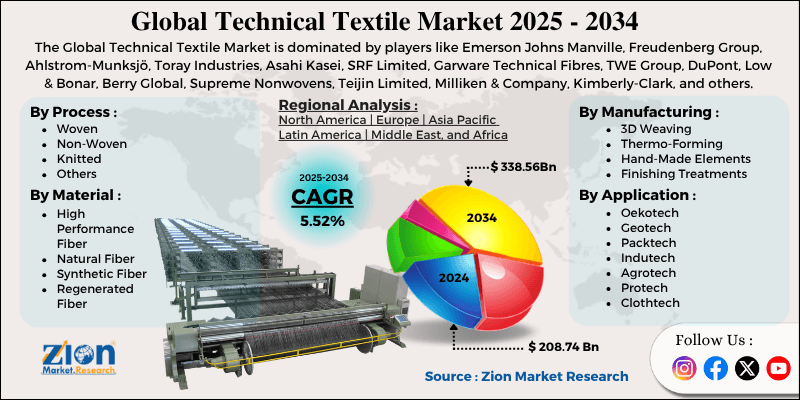
The global technical textile market size was worth around USD 208.74 billion in 2024 and is predicted to grow to around USD 338.56 billion by 2034, with a compound annual growth rate (CAGR) of roughly 5.52% between 2025 and 2034.
Key Insights:
- As per the analysis shared by our research analyst, the global technical textile market is estimated to grow annually at a CAGR of around 5.52% over the forecast period (2025-2034)
- In terms of revenue, the global technical textile market size was valued at around USD 208.74 billion in 2024 and is projected to reach USD 338.56 billion by 2034.
- The technical textile market is projected to grow at a significant rate due to the rising use of the materials in building & construction.
- Based on the process, the woven segment is growing at a high rate and will continue to dominate the global market, as per industry projections
- Based on the material, the Synthetic fiber segment is anticipated to command the largest market share
- Based on the manufacturing, the finishing elements segment is expected to lead the market growth trends
- Based on the application, the Indutech segment is projected to influence revenue in the market
- Based on region, the Asia-Pacific is projected to dominate the global market during the forecast period
Technical Textile Market: Overview
Technical textiles are specially designed products known for their functional properties rather than aesthetic appeal. They are advanced materials with superior physical and technical properties with applications across major industries such as automotive, healthcare, crop protection, and others. Technical textiles can either be used as a standalone component for their technical properties or applied with other textile materials to improve performance. Some of the most common types of technical textiles include agrotech, buildtech, clothtech, hometech, pactech, and oekotech. Each of these segments has a specific application and enjoys considerable demand in the end-user industries. During the forecast period, the technical textile market is expected to witness high growth, driven by rising demand for high-performance materials.
Additionally, growing applications in the space exploration and aviation sectors may further create novel growth opportunities for the industry players. However, the high cost of production, limited skilled labor, and strict regulatory concerns will impact market revenue in the long run.
Technical Textile Market: Dynmics
Growth Drivers
How will the growing applications in the construction industry influence the growth of the technical textile market?
The global technical textile market is expected to be led by the rising use of these materials in the building & construction sectors. According to industry research, technical textiles are sustainable building materials with superior performance. These materials are fire-resistant, cost-effective, and compatible with modern construction requirements. They can be applied in low-temperature and wet conditions as well.
In addition, technical textiles for the construction industry reduce reinforcement demand by improving load capacity, ductility, and damage tolerance. Adding textile waste to geopolymeric binders creates a lightweight, low-cost composite material that offers exceptional mechanical strength. The global construction industry is witnessing rapid investments driven by infrastructure development and residential & commercial construction, driving the use of technical textiles.
Expansion in the automotive sector is expected to work in favor of the industry leaders during the forecast period
The automotive industry is a leading end-user of technical textiles. The fabric and materials are used in manufacturing seat covers, air bags, seat belts, and other interior components. The automotive sector has a high demand for lightweight technical textiles that improve overall vehicle performance. In September 2024, Asahi Kasei launched LASTAN flame-retardant nonwoven fabric. It is designed to enhance electric vehicle (EV) battery safety. This new addition to the global technical textile market provides an ideal solution for thermal runway protection in EV packs.
Restraints
Why will cost barriers affect the technical textile market revenue in the long run?
The global technical textile industry is expected to be restricted due to high cost barriers. Technical textiles are superior fabrics designed using precision manufacturing techniques and advanced raw materials. Technical textile development requires extensive research and skilled expertise. These factors contribute to an increase in the overall technical textile production cost. The average cost of technical textiles is around USD 14100 per ton, limiting the market adoption rate.
Opportunities
Rising demand in the aerospace industry is creating new growth opportunities for the market players
The global technical textile market is projected to experience new growth opportunities due to increasing demand for these materials in the aerospace industry. Lightweight, flame-retardant, and high-performance materials are preferred in the aerospace sector, creating demand for textile innovation.
For instance, the Indian government has launched the National Technical Textile Mission (NTTM) to support the development of specialized firefighting suits with applications in aerospace & aviation, defense, oil & gas, and firefighting emergencies. M/s System 5S Private Ltd has developed an indigenous Specialized Fire Fighting Suit which meets EN 1486 or ISO 15538 standards. The suit is developed using Oxidized Polyacrylonitrile (OPAN) Nonwoven battings, aluminized coated glass fabrics, and FR (Flame Resistant) viscose fabric. Additionally, the rising use of Artificial Intelligence (AI) and Machine Learning (ML) in technical textile production will further aid market expansion. Industry players are leveraging 3D printing and bio-fabrication technologies to deliver advanced technical fabrics.
Challenges
What will be the impact of the lack of skilled force on the technical textile market?
The global technical textile industry is expected to be challenged by the lack of skilled expertise and specialized knowledge. It leads to a high cost of technical textile production and also raises concerns over production viability. In addition, raw material price volatility, supply chain disruptions, and complex regulatory guidelines may affect overall revenue in the industry.
Technical Textile Market: Report Scope
| Report Attributes | Report Details |
|---|---|
| Report Name | Technical Textile Market |
| Market Size in 2024 | USD 208.74 Billion |
| Market Forecast in 2034 | USD 338.56 Bllion |
| Growth Rate | CAGR of 5.52% |
| Number of Pages | 226 |
| Key Companies Covered | Johns Manville, Freudenberg Group, Ahlstrom-Munksjö, Toray Industries, Asahi Kasei, SRF Limited, Garware Technical Fibres, TWE Group, DuPont, Low & Bonar, Berry Global, Supreme Nonwovens, Teijin Limited, Milliken & Company, Kimberly-Clark, and others. |
| Segments Covered | By Process, By Material, By Manufacturing, By Application, and By Region |
| Regions Covered | North America, Europe, Asia Pacific (APAC), Latin America, Middle East, and Africa (MEA) |
| Base Year | 2024 |
| Historical Year | 2019 to 2023 |
| Forecast Year | 2025 - 2034 |
| Customization Scope | Avail customized purchase options to meet your exact research needs. Request For Customization |
Technical Textile Market: Segmentation
The global technical textile market is segmented based on process, material, manufacturing, application, and region.
Which will be the leading process in the technical textile market?
Based on process, the global market segments are woven, non-woven, knitted, and others. In 2024, the highest growth was listed in the woven segment, accounting for 68% of the global revenue. It is expected to generate a CAGR of 5.2% during the forecast period due to the extensive use of woven textiles across major end-user industries such as automotive, aerospace, and aviation. Rising investments across end-user verticals will aid segmental expansion in the future.
What is the projected CAGR for synthetic fiber in the technical textile market for the forecast period?
Based on material, the global industry is fragmented into high-performance fiber, natural fiber, synthetic fiber, regenerated fiber, and others. Synthetic fiber dominated the global market in 2024, accounting for 62.05% of the global revenue. It is projected to grow at a CAGR of 5.67% in the coming years, as synthetic fibers offer higher performance and broader applications across industries.
Why will finishing elements continue to lead the technical textile market in the coming years?
Based on manufacturing, the global technical textile industry is divided into 3D weaving, thermo-forming, hand-made elements, finishing elements, and others. The highest growth rate was listed in the finishing elements segment, accounting for 46% of global revenue. It will continue leading the market with a CAGR of 5.49% in the coming years, as finishing elements are essential to lock the final properties, such as flame resistance and ultraviolet (UV) protection of the material.
How is the Indutech segment expected to perform in the technical textile market during the forecast period?
Based on application, the global market is divided into oekotech, geotech, packtech, indutech, agrotech, protech, clothtech, hometech, meditech, and others. The indutech segment led the market growth in 2024, contributing up to 25% of the global revenue. It will continue leading the market with a CAGR of 5.62% in the coming years, driven by rising applications of the material across the industrial landscape, especially in industrial belts and coated fabrics.
Technical Textile Market: Regional Analysis
Why will Asia-Pacific continue to lead the technical textile market during the forecast period?
The global technical textile market is expected to be led by Asia-Pacific during the forecast period. In 2024, the region accounted for 46% of global revenue and is projected to deliver a CAGR of 6.1% during the forecast period. China, India, and South Korea are among the leading end-users of technical textiles, driven by the rising use of these fabric in construction projects, the aviation industry, and the agricultural sector. Growing government support for the promotion of indigenous production of technical textiles will work in favor of the regional players.
What is the projected CAGR for North America in the technical textile market during the forecast period?
North America is the second-highest market, accounting for 29% of the global revenue in 2024. It is projected to deliver a CAGR of 5.12% during the forecast period, influenced by growing demand and the rising use of smart textiles across industries.
Moreover, growing demand for technical textiles with applications in healthcare and automotive will promote regional expansion in the coming years. However, escalating trade conflicts between the US and other nations may affect regional market revenue.
Technical Textile Market: Competitive Analysis
The global technical textile market is led by players like:
- Johns Manville
- Freudenberg Group
- Ahlstrom-Munksjö
- Toray Industries
- Asahi Kasei
- SRF Limited
- Garware Technical Fibres
- TWE Group
- DuPont
- Low & Bonar
- Berry Global
- Supreme Nonwovens
- Teijin Limited
- Milliken & Company
- Kimberly-Clark
What are the latest key trends in the technical textile market?
Integration with smart technologies
An emerging trend in the technical textile industry is the use of smart technologies such as Internet of Things (IoT)-enabled textiles, wearable electronics, and conductive fibers. These technologies will help elevate fabric performance.
Eco-friendly materials
The growing development of eco-friendly technical textiles will open new growth avenues led by growing sustainability initiatives and regulatory pressures. Biodegradable technical textiles are gaining momentum, alongside fabrics made from recycled materials.
The global technical textile market is segmented as follows:
By Process
- Woven
- Non-Woven
- Knitted
- Others
By Material
- High Performance Fiber
- Natural Fiber
- Synthetic Fiber
- Regenerated Fiber
- Others
By Manufacturing
- 3D Weaving
- Thermo-Forming
- Hand-Made Elements
- Finishing Treatments
- Others
By Application
- Oekotech
- Geotech
- Packtech
- Indutech
- Agrotech
- Protech
- Clothtech
- Hometech
- Meditech
- Others
By Region
- North America
- The U.S.
- Canada
- Mexico
- Europe
- France
- The UK
- Spain
- Germany
- Italy
- Rest of Europe
- Asia Pacific
- China
- Japan
- India
- Australia
- South Korea
- Rest of Asia Pacific
- The Middle East & Africa
- Saudi Arabia
- UAE
- Egypt
- Kuwait
- South Africa
- Rest of the Middle East & Africa
- Latin America
- Brazil
- Argentina
- Rest of Latin America
Table Of Content
Methodology
FrequentlyAsked Questions
Technical textiles are specially designed products known for their functional properties rather than aesthetic appeal.
The global technical textile market is expected to be led by the rising use of the materials in building & construction.
According to study, the global technical textile market size was worth around USD 208.74 billion in 2024 and is predicted to grow to around USD 338.56 billion by 2034.
The CAGR value of the technical textile market is expected to be around 5.52% during 2025-2034.
The global technical textile industry is expected to be challenged by the lack of skilled expertise with specialized knowledge.
Integration with smart technologies and eco-friendly materials is the emerging trend and innovations impacting the technical textile market.
The global technical textile market has performed well so far and will offer similar trends in the coming years.
The global technical textile market is expected to be led by Asia-Pacific during the forecast period.
The global technical textile market is led by players like Johns Manville, Freudenberg Group, Ahlstrom-Munksjö, Toray Industries, Asahi Kasei, SRF Limited, Garware Technical Fibres, TWE Group, DuPont, Low & Bonar, Berry Global, Supreme Nonwovens, Teijin Limited, Milliken & Company, and Kimberly-Clark.
The report explores crucial aspects of the technical textile market, including a detailed discussion of existing growth factors and restraints, while also browsing future growth opportunities and challenges that impact the market.

HappyClients

