
Construction Aggregate Market Size, Share, Value & Trends 2034

Construction Aggregate Market By Type (Crushed Stone, Recycled Aggregates, Sand & Gravels, and Others), By Application (Commercial, Industrial, Residential, and Infrastructure), and By Region - Global and Regional Industry Overview, Market Intelligence, Comprehensive Analysis, Historical Data, and Forecasts 2025 - 2034
| Market Size in 2024 | Market Forecast in 2034 | CAGR (in %) | Base Year |
|---|---|---|---|
| USD 414.56 Billion | USD 770.91 Billion | 6.4% | 2024 |
Construction Aggregate Industry Prospective
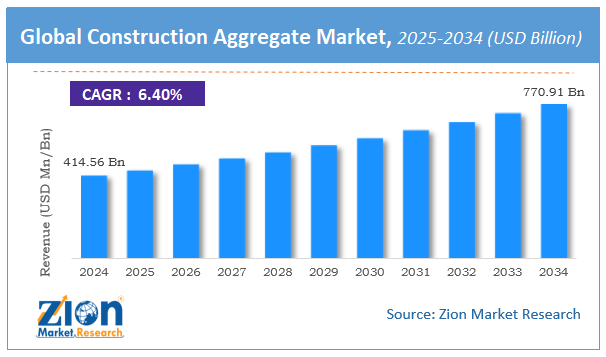
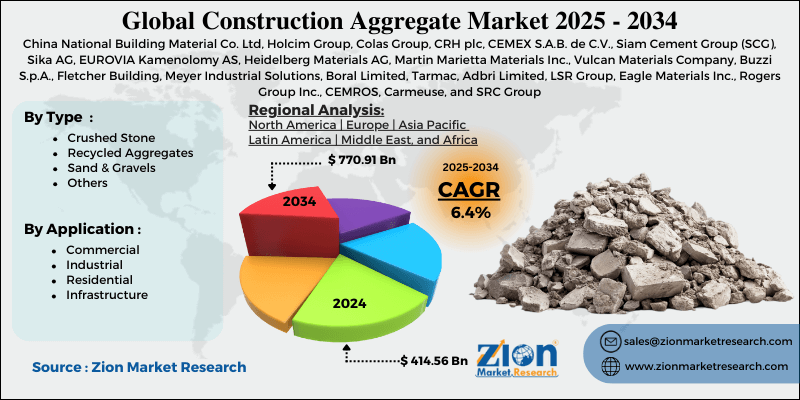
The global construction aggregate market size was worth around USD 414.56 billion in 2024 and is predicted to grow to around USD 770.91 billion by 2034, with a compound annual growth rate (CAGR) of roughly 6.4% between 2025 and 2034.
Key Insights
- As per the analysis shared by our research analyst, the global construction aggregate market is estimated to grow annually at a CAGR of around 6.4% over the forecast period (2025-2034).
- In terms of revenue, the global construction aggregate market size was valued at around USD 414.56 billion in 2024 and is projected to reach USD 770.91 billion by 2034.
- Increasing investment in infrastructure development is expected to drive the construction aggregate market over the forecast period.
- Based on the type, the crushed stone segment is expected to dominate the market over the projected period.
- Based on the application, the residential segment is expected to capture the largest market share over the projected period.
- Based on region, North America is expected to dominate the market during the forecast period.
Construction Aggregate Market: Overview
Crushed stone, river sand, recycled concrete, and slag are among the most commonly used building aggregates. These are big bits that people often use to make things. They are the main ingredients of concrete, asphalt, mortar, and road base, providing buildings and other structures with strength, stability, and a long life. People use construction aggregates in many diverse ways, including in homes and businesses, on highways, bridges, trains, airports, and drainage systems. Aggregates are particularly vital to urban growth, infrastructure development, and industrial activity in both developed and developing countries. This is because they are strong, cheap, and easy to find. Rapid urbanization and industrialization worldwide are positively affecting the construction industry, ultimately driving increased demand for construction materials, including construction aggregates.
Construction Aggregate Market Dynamics
Growth Drivers
Why does rapid urbanization and population growth propel growth in the construction aggregate industry?
The construction aggregate market is driven by rapid urbanization and population growth, which increases demand for housing, transportation networks, and public services. As more people relocate from rural to urban areas and the population grows, cities will need to build many new homes, businesses, highways, bridges, water supply systems, and sewage networks. For these projects, sand, gravel, and crushed stone are crucial raw materials for concrete, asphalt, and basic structures. As the population grows, governments are increasingly likely to spend heavily on urban expansion, smart cities, and affordable housing programs.
This speeds up construction activity. The growing number of people living in cities immediately boosts overall demand, indicating that urbanization and population growth are both essential factors in long-term market growth. For instance, according to the United Nations Report, 68% of the global population lives in urban areas by 2050.
Restraints
How high transportation and logistics costs are impeding the industry's growth?
The market isn't growing as quickly as it should because it's expensive to transport and store aggregates such as sand, gravel, and crushed stone. These materials are huge, heavy, and not worth much. It is much more expensive to transport aggregates over long distances, particularly when they are sourced from quarries far from the work site. Logistics costs are rising due to higher fuel prices, labor costs, tolls, and vehicle maintenance. This makes aggregates more expensive when used. Also, bad roads and traffic bottlenecks in cities can slow the supply chain and make it less efficient. These challenges can make up a significant portion of the final price. This makes it tougher for companies to reduce profit margins and raise construction costs because transportation costs marketplaces to flourish, especially in places with few roads and other infrastructure.
Opportunities
Does the rising partnership offer a potential opportunity for the construction aggregate market growth?
The increasing partnership is expected to offer a potential opportunity for the construction aggregate industry over the forecast period. For instance, in July 2025, TACC Limited, a subsidiary of HEG Limited, signed a Memorandum of Understanding with the National Council for Cement and Building Materials to make high-performance concrete with graphene-based additives. The purpose of the partnership is to make concrete stronger, more durable, and better at its job. It may also help the environment by lowering carbon emissions during construction. TACC's experience with graphene derivatives and NCB's knowledge of concrete technology come together in this partnership. It could transform the construction industry by developing stronger, longer-lasting materials that are more environmentally sustainable.
Challenges
Why does competition from alternative materials pose a major challenge to the construction aggregate market expansion?
In many cases, natural aggregates are being replaced with recycled aggregates, industrial wastes including fly ash and slag, synthetic composites, and lightweight materials. People commonly suggest these options because they are better for the environment, comply with sustainability regulations, and use fewer natural resources. New building methods, such as modular and prefabricated construction, can also reduce the number of standard aggregates required for each project. Governments and builders are using more eco-friendly, cost-effective materials to meet green building standards and reduce carbon emissions. This move makes it more difficult for natural aggregate producers to compete, particularly in areas with stringent environmental regulations and difficult quarrying permit processes. As a result, increased competition from alternative materials may diminish demand for traditional aggregates, exert downward pressure on prices, and threaten long-term industry growth unless manufacturers develop new technologies, increase recycling, and form strategic partnerships.
Construction Aggregate Market : Report Scope
| Report Attributes | Report Details |
|---|---|
| Report Name | Construction Aggregate Market Research Report |
| Market Size in 2024 | USD 414.56 Billion |
| Market Forecast in 2034 | USD 770.91 Billion |
| Growth Rate | CAGR of 6.4% |
| Number of Pages | 220 |
| Key Companies Covered | China National Building Material Co. Ltd, Holcim Group, Colas Group, CRH plc, CEMEX S.A.B. de C.V., Siam Cement Group (SCG), Sika AG, EUROVIA Kamenolomy AS, Heidelberg Materials AG, Martin Marietta Materials Inc., Vulcan Materials Company, Buzzi S.p.A., Fletcher Building, Meyer Industrial Solutions, Boral Limited, Tarmac, Adbri Limited, LSR Group, Eagle Materials Inc., Rogers Group Inc., CEMROS, Carmeuse, and SRC Group |
| Segments Covered | By Type, By Application, and By Region |
| Regions Covered | North America, Europe, Asia Pacific (APAC), Latin America, The Middle East and Africa (MEA) |
| Base Year | 2024 |
| Historical Year | 2019 to 2023 |
| Forecast Year | 2025 - 2034 |
| Customization Scope | Avail customized purchase options to meet your exact research needs. Request For Customization |
Construction Aggregate Market: Segmentation
The global construction aggregate market is segmented based on type, application, and region.
By Type, the crushed stone segment is expected to dominate the market. The market is growing largely because it is widely used in large construction and infrastructure projects. Crushed stone is a significant raw material for the construction of concrete, asphalt, road base, railway ballast, and structural foundations. This necessitates the construction of highways, bridges, airports, dams, and other urban infrastructure. The demand for crushed stone is skyrocketing as governments invest more in transportation networks, smart cities, and public infrastructure, especially in developing countries.
By Application, the residential segment is expected to hold the largest revenue share over the projected period. The segment is growing mostly because house development is becoming more common around the world. The need for new homes, such as apartments, single-family homes, and low-cost housing developments, is expected to increase due to population growth, rapid urbanization, and more people moving to cities. Building a house requires sand, gravel, and crushed stone for concrete, mortar, floors, foundations, and structural frameworks.
Construction Aggregate Market: Regional Analysis
North America is expected to dominate the market growth. Ongoing spending on infrastructure upgrades, housing construction, and business expansion in the area is driving the regional market. The government is spending money to fix up roads, highways, bridges, airports, and public utilities, especially in the US and Canada. This is driving demand for more aggregates, such as crushed stone, sand, and gravel. Also, strong growth in residential housing, fueled by population growth, urban expansion, and the repair of older homes, continues to drive up aggregate spending. The region's established building sector and the growing use of recycled and sustainable aggregates are driving market expansion while still following the rules.
In North America, the US accounts for the largest market share, exceeding 65% over the analysis period. The country's growth is supported by rising investments in infrastructure development, residential housing, and commercial construction. For instance, according to the US Department of the Treasury, President Biden signed the Bipartisan Infrastructure Law (“BIL”) into law. The BIL directs $1.2 trillion in federal funds to transportation, energy, and climate infrastructure projects, most of which are distributed via state and local governments.
Besides, the Asia Pacific is growing at the fastest CAGR over the projected period. Emerging and expanding economies such as China, India, Southeast Asia, and Australia are experiencing market growth driven by rapid urbanization, population growth, and large-scale infrastructure development. The government's huge investments in transportation infrastructure, such as highways, railways, metros, airports, and ports, are increasing demand for aggregates like sand, gravel, and crushed stone. More people are also buying more things because more homes are being built, thanks to homebuyer assistance programs, smart city initiatives, and rising middle-class incomes. The market's growth is also helped by increased foreign direct investment in construction projects and by the construction of more industrial and commercial buildings.
Construction Aggregate Market: Competitive Analysis
The global construction aggregate market is dominated by players like
- China National Building Material Co Ltd
- Holcim Group
- Colas Group
- CRH plc
- CEMEX SAB de C V
- Siam Cement Group (SCG)
- Sika AG
- EUROVIA Kamenolomy AS
- Heidelberg Materials AG
- Martin Marietta Materials Inc
- Vulcan Materials Company
- Buzzi SpA
- Fletcher Building
- Meyer Industrial Solutions
- Boral Limited
- Tarmac
- Adbri Limited
- LSR Group
- Eagle Materials Inc
- Rogers Group Inc
- CEMROS
- Carmeuse
- SRC Group
The global construction aggregate market is segmented as follows:
By Type
- Crushed Stone
- Recycled Aggregates
- Sand & Gravels
- Others
By Application
- Commercial
- Industrial
- Residential
- Infrastructure
By Region
- North America
- The U.S.
- Canada
- Mexico
- Europe
- France
- The UK
- Spain
- Germany
- Italy
- Rest of Europe
- Asia Pacific
- China
- Japan
- India
- Australia
- South Korea
- Rest of Asia Pacific
- The Middle East & Africa
- Saudi Arabia
- UAE
- Egypt
- Kuwait
- South Africa
- Rest of the Middle East & Africa
- Latin America
- Brazil
- Argentina
- Rest of Latin America
Table Of Content
Methodology
FrequentlyAsked Questions

HappyClients

