
Biofoam Market Size, Growth, Global Trends, Forecast 2034

Biofoam Market By Type (Flexible and Rigid), By Raw Material (Sugarcane, Starch, Vegetable Oil & Fat, and Others), By End-User Industry (Furniture & Bedding, Building & Construction, Footwear & Sports Recreational, Packaging, Automotive, and Others), and By Region - Global and Regional Industry Overview, Market Intelligence, Comprehensive Analysis, Historical Data, and Forecasts 2026 - 2034
| Market Size in 2025 | Market Forecast in 2034 | CAGR (in %) | Base Year |
|---|---|---|---|
| USD 1.45 Billion | USD 4.02 Billion | 12.06% | 2025 |
Biofoam Industry Perspective:
What is the anticipated size of the biofoam market during the projection period?
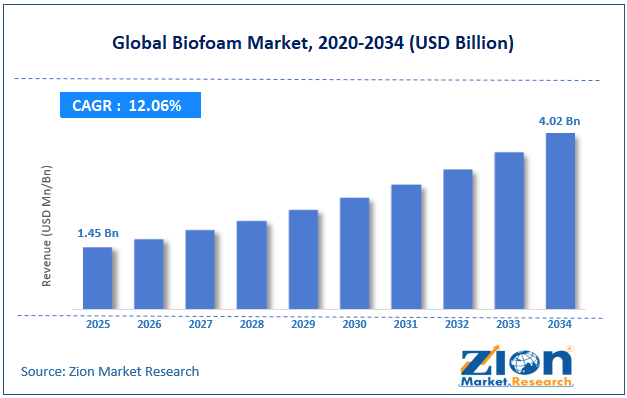
The global biofoam market size was worth around USD 1.45 billion in 2025 and is predicted to grow to around USD 4.02 billion by 2034, with a compound annual growth rate (CAGR) of roughly 12.06% between 2026 and 2034.
Key Insights:
- As per the analysis shared by our research analyst, the global biofoam market is estimated to grow annually at a CAGR of around 12.06% over the forecast period (2026-2034)
- In terms of revenue, the global biofoam market size was valued at around USD 1.45 billion in 2025 and is projected to reach USD 4.02 billion, by 2034.
- The biofoam market is projected to grow at a significant rate due to intensifying regulatory action against petroleum-based products and investments in research & development.
- Based on the type, the flexible segment is growing at a high rate and will continue to dominate the global market as per industry projections.
- Based on the raw material, sugarcane is projected to emerge as the fastest-growing segment due to higher availability of the raw material.
- Based on the end-user industry, in 2025, the furniture & bedding segment emerged as the highest revenue generator. It will continue delivering strong CAGR during the forecast period.
- Based on region, Asia-Pacific is projected to dominate the global market during the forecast period.
Biofoam Market: Overview
Biofoams are foam materials derived from natural sources. Unlike conventional petroleum-based foams, these materials are made from natural, biodegradable materials such as natural oils, soy or whey protein, and plant-derived polymers. According to market analysis, biofoams are seeing accelerated investment as environmental concerns over petroleum products intensify worldwide. Biofoams are commonly used for their insulating properties. During the forecast period, the biofoam market is expected to be driven by rising applications of bioresorbable foam scaffolds in the medical industry. Additionally, growing demand for eco-friendly packaging solutions and rising sales of consumer goods will aid accelerated market growth in the coming years. However, high cost of development, competition from traditional counterparts, and limited awareness may impact market revenue during the projection period.
Impact of the USA-Israel and Iran war on the Biofoam Market:
The USA-Israel and Iran war has increased demand for biofoams. The war has significantly affected the petrochemical supply chain, which has in turn impacted the production and prices of petroleum-based products. The short-term impact of the war is seen in the form of increased transportation costs. However, in the long run, the war is projected to encourage a shift away from petroleum products and toward more eco-friendly alternatives.
Biofoam Market: Dynamics
Growth Drivers
Which government regulations will encourage growth in the biofoam market?
The global biofoam market is expected to benefit from the intensifying regulatory action against petroleum-based products. Governments worldwide are levying heavy taxes or bans on plastic products to curb their environmental impact. According to market analysis, the European Union has applied a direct fuel tax of over 51.9% of the final pump price in recent times. This tax rate results from aggressive policies adopted by the region to fight climate change. Several US states have applied statewide bans on single-use plastics in recent times. As government crackdowns on environmental pollutants intensify, more investment is expected to shift toward eco-friendly goods such as biofoams.
In March 2026, Fibu AB, a Swedish bio-based materials company, was allotted a USD 4.26 million grant through the Klimatklivet initiative. The Swedish Environmental Protection Agency administers the program, confirming the federal government's inclination to encourage the production of bio-based materials.
Why are biofoam market players expected to invest in research & development (R&D) during the forecast period?
Biofoam market players are aggressively investing in R&D to stay ahead of the competition. These innovations are expected to further improve product performance and applications across industries. In November 2025, Storopack, a leading market player, launched FOAMplus® 7008-BIO. It is a range of polyurethane foam made of 83% real bio-based carbon content material in the B-Component. This novel introduction in the global biofoam market has a lower carbon footprint and is made of renewable sources. Market players are experimenting with new materials such as seaweed, starch, agricultural waste, and mycelium to develop high-performance biofoam.
Restraints
High cost of development and limited awareness to affect industry revenue during the projection period
The global biofoam industry is projected to face restrictions due to high development costs and limited acceptance. Biofoams are an emerging class of next-generation materials. Currently, only a limited number of players dominate the industry, resulting in higher production and procurement costs. In addition, limited awareness among end consumers will be a significant growth barrier for industry leaders.
Opportunities
Which healthcare and pharmaceutical applications are biofoam market players exploring for sustained growth?
The global biofoam market companies are exploring different applications of the material in the healthcare and pharmaceutical sectors. For instance, medical care companies are developing bioresorbable foam scaffolds for tissue engineering procedures. These materials are designed to degrade safely in the body without requiring surgical removal. In February 2025, researchers at Colorado State University’s Translational Medicine Institute received a USD 1.5 million grant from the Department of Defense. The investigators are expected to use the funds to develop multifunctional medical foam for on-site wound care for military personnel.
Moreover, research indicates increasing use of biofoam for medical and pharmaceutical packaging. The healthcare industry is one of the largest consumers of plastic packaging. Medical care companies and facilities have shown greater interest in using biofoams for packaging purposes to fight plastic-waste problems.
Challenges
Which are the leading challenges in the biofoam industry?
The global biofoam industry is projected to be challenged by competition from existing petroleum-based foams. The latter benefits from a mature, established market. Petroleum foams are produced and distributed through an existing, robust supply chain that biofoam makers lack. In addition, the absence of standard regulatory protocols, performance limitations, and volatile raw material pricing & availability will affect industry growth in the coming years.
Biofoam Market: Report Scope
| Report Attributes | Report Details |
|---|---|
| Report Name | Biofoam Market |
| Market Size in 2025 | USD 1.45 Billion |
| Market Forecast in 2034 | USD 4.02 Billion |
| Growth Rate | CAGR of 12.06% |
| Number of Pages | 229 |
| Key Companies Covered | Cargill Incorporated, Woodbridge Foam Corporation, Corbion, BASF SE, RAMPF Group, BioFoam Technologies, INOAC Corporation, Sealed Air Corporation, Braskem, Trocellen GmbH, Mitsui Chemicals, Sinomax USA, Stora Enso, and others. |
| Segments Covered | By Type, By Raw Material, By End-User Industry, and By Region |
| Regions Covered | North America, Europe, Asia Pacific (APAC), Latin America, Middle East, and Africa (MEA) |
| Base Year | 2025 |
| Historical Year | 2020 - 2024 |
| Forecast Year | 2026 - 2034 |
| Customization Scope | Avail customized purchase options to meet your exact research needs. Request For Customization |
Biofoam Market: Segmentation
The global biofoam market is segmented based on type, raw material, end-user industry, and region.
Why will the flexible segment lead the biofoam industry revenue during the forecast period?
Based on type, the global market segments are flexible and rigid. In 2025, the highest growth was listed in the flexible segment. It accounted for the largest share of the market and will continue growing at a CAGR of 10.02% during the forecast period. Higher applications of flexible foam in bedding solutions and automotive interiors will drive segmental growth in the coming years.
Which will be the fastest-growing raw material during the forecast period in the biofoam market?
Based on raw material, the global biofoam industry is fragmented into sugarcane, starch, vegetable oil & fat, and others. In 2025, the highest market share was held by the vegetable oil & fat segment. It contributed up to 40.6% of the global revenue. During the forecast period, sugarcane is projected to emerge as the fastest-growing segment due to greater raw material availability. Increasing demand for sustainable alternatives to petroleum-based foam will aid accelerated segmental growth in the coming years.
Which factors drive demand in the furniture & bedding segment in the biofoam industry?
Based on the end-user industry, the global market fragments are furniture & bedding, building & construction, footwear & sports recreational, packaging, automotive, and others. In 2025, the furniture & bedding segment emerged as the highest revenue generator. It will continue delivering strong CAGR during the forecast period. Growing consumer awareness and rising demand for comfortable, bio-based mattresses, chairs, and pillows will fuel segmental revenue during the forecast period.
Biofoam Market: Regional Analysis
Why will Asia-Pacific lead the biofoam market during the forecast period?
The global aerosols paints market is expected to be dominated by Asia-Pacific during the forecast period. In 2025, it accounted for 32.35% of the global revenue and is projected to grow at a CAGR of 12.12% during the forecast period. The presence of key players and an existing consumer base that prefers sustainable materials are the major regional market growth drivers. Additionally, expanding use of biofoams in e-commerce and food packaging will further promote growth across Asia-Pacific.
How is North America expected to perform in the biofoam market during the projection period?
North America is anticipated to deliver a strong CAGR of 11.9% in the global biofoam market during the forecast period. In 2025, it held control over 29.02% of the total market share. Growing demand for sustainable packaging, strict government laws, and applications in the healthcare sector will drive regional growth trends. Moreover, increasing government-backed grants to expand biofoam applications in military medical services will be a key driver of regional growth.
Biofoam Market: Competitive Analysis
The global biofoam market is led by players like:
- Cargill Incorporated
- Woodbridge Foam Corporation
- Corbion
- BASF SE
- RAMPF Group
- BioFoam Technologies
- INOAC Corporation
- Sealed Air Corporation
- Braskem
- Trocellen GmbH
- Mitsui Chemicals
- Sinomax USA
- Stora Enso
What are the latest key trends in the biofoam market?
Applications in sustainable cold chains
Market players are exploring biofoams to establish sustainable cold chains for temperature-sensitive products such as medicinal drugs & vaccinations. Ongoing demand to reduce logistics carbon footprints will support higher market growth during the forecast period.
Use in consumer goods
Biofoams are being investigated as raw materials for consumer goods such as footwear and automotive interiors. Increasing demand for customized consumer goods will open new growth avenues for the industry leaders.
The global biofoam market is segmented as follows:
By Type
- Flexible
- Rigid
By Raw Material
- Sugarcane
- Starch
- Vegetable Oil & Fat
- Others
By End-User Industry
- Furniture & Bedding
- Building & Construction
- Footwear & Sports Recreational
- Packaging
- Automotive
- Others
By Region
- North America
- The U.S.
- Canada
- Mexico
- Europe
- France
- The UK
- Spain
- Germany
- Italy
- Rest of Europe
- Asia Pacific
- China
- Japan
- India
- Australia
- South Korea
- Rest of Asia Pacific
- The Middle East & Africa
- Saudi Arabia
- UAE
- Egypt
- Kuwait
- South Africa
- Rest of the Middle East & Africa
- Latin America
- Brazil
- Argentina
- Rest of Latin America
Table Of Content
Methodology
FrequentlyAsked Questions
Biofoams are foam materials derived from natural sources. Unlike conventional petroleum-based foams, these materials are made from natural, biodegradable materials such as natural oils, soy or whey protein, and plant-derived polymers.
The global biofoam market is expected to benefit from the intensifying regulatory action against petroleum-based products.
According to study, the global biofoam market size was worth around USD 1.45 billion in 2025 and is predicted to grow to around USD 4.02 billion by 2034.
The CAGR value of the biofoam market is expected to be around 12.06% during 2026-2034.
The global biofoam industry is projected to be challenged by competition from existing petroleum-based foams.
Applications in sustainable cold chains and use in consumer goods are the emerging trends and innovations impacting the biofoam market.
The global biofoam market has performed well so far and will offer similar trends in the coming years.
Asia-Pacific will contribute notably towards the biofoam market value.
The global biofoam market is led by players like Cargill Incorporated, Woodbridge Foam Corporation, Corbion, BASF SE, RAMPF Group, BioFoam Technologies, INOAC Corporation, Sealed Air Corporation, Braskem, Trocellen GmbH, Mitsui Chemicals, Sinomax USA, Stora Enso, and others.
The report explores crucial aspects of the biofoam market, including a detailed discussion of existing growth factors and restraints, while also browsing future growth opportunities and challenges that impact the market.

HappyClients

