
Flexible Hybrid Electronics Market Size, Share, Value and Forecast 2034

Flexible Hybrid Electronics Market By Structure Type (Rigid Flex Circuit, Multilayer Flex Circuit, Double Sided Flex Circuit, Single Sided Flex Circuit and Others), By Vertical (Industrial, Consumer Electronics, Automobile Industry, Military and Defense, Aerospace and Others), By Application (Displays, Batteries, Thin-film Photovoltaics, Printed Sensors, OLED Lighting and Others) and By Region - Global and Regional Industry Overview, Market Intelligence, Comprehensive Analysis, Historical Data, and Forecasts 2025 - 2034
| Market Size in 2024 | Market Forecast in 2034 | CAGR (in %) | Base Year |
|---|---|---|---|
| USD 214 Million | USD 695 Million | 12.5% | 2024 |
Flexible Hybrid Electronics Industry Perspective:
What will be the size of the global flexible hybrid electronics market during the forecast period?
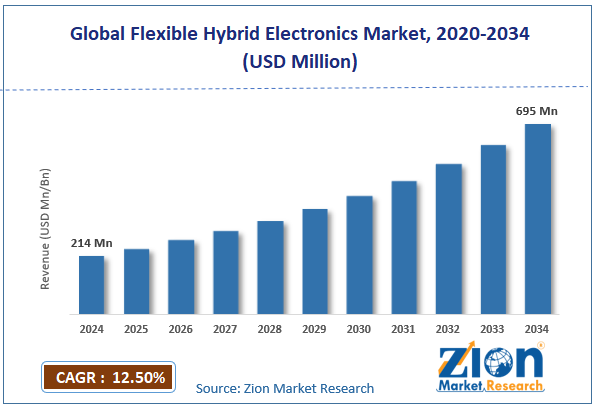
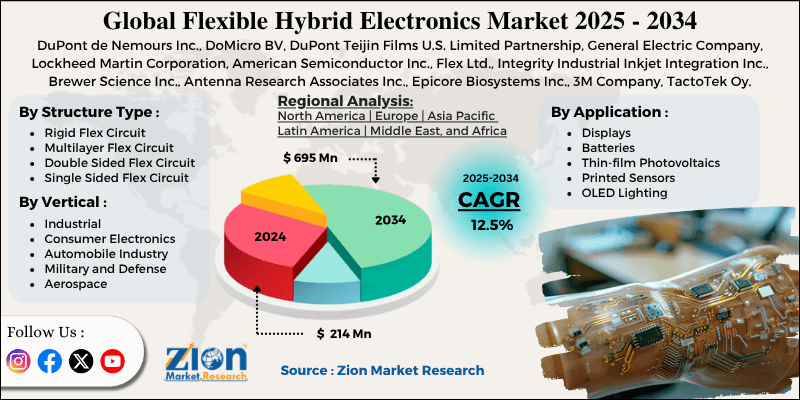
The global flexible hybrid electronics market size was worth around USD 214 million in 2024 and is predicted to grow to around USD 695 million by 2034 with a compound annual growth rate (CAGR) of roughly 12.5% between 2025 and 2034.
Key Insights
- As per the analysis shared by our research analyst, the global flexible hybrid electronics market is estimated to grow annually at a CAGR of around 12.5% over the forecast period (2025-2034).
- In terms of revenue, the global flexible hybrid electronics market size was valued at around USD 214 million in 2024 and is projected to reach USD 695 million by 2034.
- Rise of Internet of Things (IoT) is expected to propel the flexible hybrid electronics market over the projected period.
- Based on the structure type, the rigid flex circuit segment captures the largest market share in 2024.
- Based on the vertical, the consumer electronics segment captures the largest revenue share in 2024 of 31%.
- Based on the application, the displays segment dominates the market in 2024.
- Based on region, North America captures the largest market share in 2024 of 39%.
Flexible Hybrid Electronics Market: Overview
Flexible Hybrid Electronics (FHE) represents a category of electronic systems in which printed components, such as sensors, antennas, and interconnects, on flexible substrates are combined with the traditional semiconductor-based electronics, such as ICs. The concept of FHE enables the development of electronic devices that are light, thin, and flexible enough to fit curved surfaces while performing as well as traditional electronics. Flexible Hybrid Electronics usually employ manufacturing methods like printed electronics and use flexible substrates, such as polymers and plastic films.
Examples of applications for which the technology could be implemented include health monitoring, smart packaging, interior applications in automobiles, and industrial sensors.
Impact of the USA-Israel War on Iran on the Flexible Hybrid Electronics Market
The ongoing 2026 Iran war has negatively impacted the FHE market to a moderate extent through its effects on the global electronics supply chain and increased manufacturing costs. Raw materials that go into printed circuit boards and flexible substrates have been affected by the war in terms of price hikes and shortages, causing costs for PCBs to increase as much as 40 percent and supply shortages to occur. In addition, oil and energy prices have increased, alongside logistical issues such as access to the Strait of Hormuz, driving up manufacturing and logistics costs in the electronic industry. Because FHE is highly dependent on materials and semiconductors, this disrupts manufacturing cycles and slows down growth, but not the long-term demand.
Flexible Hybrid Electronics Market: Dynamics
Growth Drivers
Why does the growing demand for wearable & healthcare devices drive the flexible hybrid electronics market?
The demand for wearables and medical devices is driving development in the FHE industry, where lightweight, thin electronics that match users' body shapes are necessary. Flexible hybrid electronics have enabled the development of unique solutions through wearable gadgets such as smartwatches, body monitors, electronic skins, and continuous-monitoring systems powered by flexible sensors and electronics running powerful microchips. In the medical field, these technological advancements have made it easier to develop machines that continuously monitor patients' health parameters, such as blood pressure, body temperature, heart rate, and glucose levels.
With increased emphasis on preventive medicine due to the aging population and the rise of personal medical devices, wearables and other medical devices have become one of the fastest-growing market segments.
Restraints
How do the high production & material costs hinder the growth of the flexible hybrid electronics industry?
An important limitation acting as a barrier to future market growth prospects is the high cost of production, owing to the nature of the product and its reliance on costly materials, such as flexible polymers, conductive inks, and printed components, which are much more expensive than in other electronics products. The combination of printed flexible electronics along with semiconductor electronics makes it more complicated and expensive to produce such products. Various other factors, such as the lack of economies of scale, further increase the cost of production for these products. It can be safely concluded that, being more expensive than other electronics, the demand for FHE systems would be lessened accordingly.
Opportunities
How does the growing funding offer a lucrative opportunity for the flexible hybrid electronics market?
The increased funding provides an excellent upside opportunity for the FHE industry to enhance the move towards commercialization by adopting technologies developed in laboratories. Increased investment in the development of novel materials, printed electronics, and manufacturing processes ensures continuous advancements in performance and progressive reductions in costs. Increased funding will support the implementation of pilot lines and roll-to-roll manufacturing, allowing the scaling-up of FHE technology deployment.
For instance, in March 2025, NextFlex, a manufacturing innovation institute supported by the Department of Defense (DoD), responsible for the advancement of hybrid electronics, launched project Call 10.0 (PC 10.0), the tenth call for proposals aimed at funding projects that advance hybrid electronics while addressing critical challenges associated with advanced manufacturing.
The expected value of PC 10.0 projects exceeds $10 million (investment by NextFlex and performer cost share). Consequently, the total value of investments in advancing hybrid electronics since NextFlex's establishment exceeds $165 million. Taking advantage of lessons learned from previous projects that have been implemented successfully, the topics of PC 10.0 are defined broadly to ensure that the broadest spectrum of proposers can participate, with particular attention being paid to areas where hybrid electronics can be instrumental in addressing critical U.S. manufacturing challenges and emerging needs for the electronics manufacturing community.
Challenges
Safety concerns & accident risks pose a significant challenge to the flexible hybrid electronics market
A key factor that could impede the advancement of the flexible hybrid electronics market is the lack of standardization and the high design complexity. FHE integrates various electronic components, including flexible printed circuit boards, sensors, and solid-state semiconductor chips, into a single system. While in traditional electronics systems there are recognized design standards, material specifications, and processes, in the case of FHE, none of this exists; therefore, issues like compatibility are major problems. Designers have to tailor-make every product to its specific needs, which increases time, costs, and risks. Moreover, because FHE must perform reliably under mechanical pressure, the design becomes even more complex.
Flexible Hybrid Electronics Market: Report Scope
| Report Attributes | Report Details |
|---|---|
| Report Name | Flexible Hybrid Electronics Market |
| Market Size in 2024 | USD 214 Million |
| Market Forecast in 2034 | USD 695 Million |
| Growth Rate | CAGR of 12.5% |
| Number of Pages | 227 |
| Key Companies Covered | DuPont de Nemours Inc., DoMicro BV, DuPont Teijin Films U.S. Limited Partnership, General Electric Company, Lockheed Martin Corporation, American Semiconductor Inc., Flex Ltd., Integrity Industrial Inkjet Integration Inc., Brewer Science Inc., Antenna Research Associates Inc., Epicore Biosystems Inc., 3M Company, TactoTek Oy, PragmatIC Semiconductor Ltd., Samsung Electronics Co. Ltd., LG Display Co. Ltd., Molex LLC, TE Connectivity Ltd., FlexEnable Limited, Enfucell Oy, Blue Spark Technologies Inc. and Interlink Electronics Inc., and others. |
| Segments Covered | By Structure Type, By Vertical, By Application, and By Region |
| Regions Covered | North America, Europe, Asia Pacific (APAC), Latin America, Middle East, and Africa (MEA) |
| Base Year | 2024 |
| Historical Year | 2019 to 2023 |
| Forecast Year | 2025 - 2034 |
| Customization Scope | Avail customized purchase options to meet your exact research needs. Request For Customization |
Flexible Hybrid Electronics Market: Segmentation
Structure Type Insights
Why does the rigid flex circuit dominate the flexible hybrid electronics market?
The rigid flex circuit segment captures the largest market share in 2024. The expansion in this field is driven by this technology's ability to combine the rigidity of a rigid substrate with the flexibility of a circuit in a single device. The integration results in smaller, lighter, and more durable electronic designs, which makes them an excellent choice for consumer electronics, medical devices, automobiles, and aerospace electronics, among others. With the ever-growing demand for smaller devices, the use of rigid flex circuits will increase.
Vertical Insights
How does the consumer electronics capture the largest market share in the flexible hybrid electronics market?
The consumer electronics segment captures the largest revenue share in 2024 of 31%. The expansion is being driven by increasing demand for small, light, and efficient devices such as smartphones, wearables, bendable screens, and smart home gadgets. FHE allows companies to make their products thinner, stronger, and adaptable by combining flexible circuits and sensors with existing semiconductors. The rapid adoption of novel technologies such as bendable and rollable screens, along with the growing consumer demand for portable, sophisticated devices, is driving growth even further.
Application Insights
Does displays segment dominate the flexible hybrid electronics market?
The displays segment dominates the market in 2024. This trend is driven by the growing use of flexible displays in consumer electronics and automobiles. Flexible hybrid electronics enable lightweight, bendable displays to be combined with high-performance electronic circuitry, facilitating innovations such as foldable phones, rollable displays, and curved dashboard displays. Consumer trends toward immersive display technology, smaller devices, and innovative design formats are driving the adoption of flexible displays.
Regional Insights
Why does North America lead the flexible hybrid electronics market?
North America captures the largest market share in 2024 of 39%. This growth in the region is facilitated by strong investment in advanced electronics, a well-developed semiconductor infrastructure, and solid backing from the government and academia. Companies such as NextFlex play an important part in accelerating innovation and development through R&D collaborations.
In addition, the region benefits from the presence of technology giants such as Apple Inc., Intel Corporation, and 3M Company investing in flexible electronics across consumer products, health care, and automobiles. Moreover, there is a strong need for medical wearables, Internet of Things (IoT) devices, and the next generation of consumer electronics to drive market growth.
Flexible Hybrid Electronics Market: Competitive Analysis
The global flexible hybrid electronics market is dominated by players like;
- DuPont de Nemours Inc.
- DoMicro BV
- DuPont Teijin Films U.S. Limited Partnership
- General Electric Company
- Lockheed Martin Corporation
- American Semiconductor Inc.
- Flex Ltd.
- Integrity Industrial Inkjet Integration Inc.
- Brewer Science Inc.
- Antenna Research Associates Inc.
- Epicore Biosystems Inc.
- 3M Company
- TactoTek Oy
- PragmatIC Semiconductor Ltd.
- Samsung Electronics Co. Ltd.
- LG Display Co. Ltd.
- Molex LLC
- TE Connectivity Ltd.
- FlexEnable Limited
- Enfucell Oy
- Blue Spark Technologies Inc.
- Interlink Electronics Inc.
The global flexible hybrid electronics market is segmented as follows:
By Structure Type
- Rigid Flex Circuit
- Multilayer Flex Circuit
- Double Sided Flex Circuit
- Single Sided Flex Circuit
- Others
By Vertical
- Industrial
- Consumer Electronics
- Automobile Industry
- Military and Defense
- Aerospace
- Others
By Application
- Displays
- Batteries
- Thin-film Photovoltaics
- Printed Sensors
- OLED Lighting
- Others
By Region
- North America
- The U.S.
- Canada
- Mexico
- Europe
- France
- The UK
- Spain
- Germany
- Italy
- Rest of Europe
- Asia Pacific
- China
- Japan
- India
- Australia
- South Korea
- Rest of Asia Pacific
- The Middle East & Africa
- Saudi Arabia
- UAE
- Egypt
- Kuwait
- South Africa
- Rest of the Middle East & Africa
- Latin America
- Brazil
- Argentina
- Rest of Latin America
Table Of Content
Methodology
FrequentlyAsked Questions
Flexible Hybrid Electronics (FHE) represents a category of electronic systems in which printed components, such as sensors, antennas, and interconnects, on flexible substrates are combined with the traditional semiconductor-based electronics, such as ICs.
Key growth drivers for the flexible hybrid electronics market include rising demand for wearable healthcare devices, expansion of IoT applications, need for lightweight and flexible electronics, and continuous advancements in materials and manufacturing technologies.
Major challenges restraining the flexible hybrid electronics market include high production and material costs, design complexity, lack of standardization, reliability concerns, and limited scalability in manufacturing.
Based on the application, the displays segment is expected to dominate the flexible hybrid electronics market growth during the projected period.
Emerging trends in the flexible hybrid electronics market include advancements in flexible materials and conductive inks, adoption of roll-to-roll and 3D printing technologies, growth of foldable displays, and increasing integration with IoT, wearable healthcare, and smart packaging applications.
According to the report, the global flexible hybrid electronics market size was worth around USD 214 million in 2024 and is predicted to grow to around USD 695 million by 2034.
The global flexible hybrid electronics market is expected to grow at a CAGR of 12.5% during the forecast period.
The global flexible hybrid electronics industry growth is expected to be led by North America over the forecast period.
The global flexible hybrid electronics market is dominated by players like DuPont de Nemours, Inc., DoMicro BV, DuPont Teijin Films U.S. Limited Partnership, General Electric Company, Lockheed Martin Corporation, American Semiconductor, Inc., Flex Ltd., Integrity Industrial Inkjet Integration, Inc., Brewer Science, Inc., Antenna Research Associates, Inc., Epicore Biosystems, Inc., 3M Company, TactoTek Oy, PragmatIC Semiconductor Ltd., Samsung Electronics Co., Ltd., LG Display Co., Ltd., Molex, LLC, TE Connectivity Ltd., FlexEnable Limited, Enfucell Oy, Blue Spark Technologies, Inc. and Interlink Electronics, Inc. among others.
The market report covers the geographical market along with a comprehensive competitive landscape analysis. It also includes cash flow analysis, profit ratio analysis, market basket analysis, market attractiveness analysis, sentiment analysis, PESTLE analysis, trend analysis, SWOT analysis, trade area analysis, demand & supply analysis, Porter’s five forces analysis, and value chain analysis.

HappyClients

