
Badminton Racket Market Size, Share, Value and Forecast 2034

Badminton Racket Market By Type (Aluminum Rackets, Carbon Fiber Rackets, Graphite Rackets, Composite Rackets), By Application (Professional Play, Recreational Play, Training and Coaching Institutes, Club Level Play), By Distribution Channel (Online Retail, Sporting Goods Stores, Specialty Badminton Stores, Supermarkets and Hypermarkets), By End User (Men, Women, Juniors, Unisex), and By Region - Global and Regional Industry Overview, Market Intelligence, Comprehensive Analysis, Historical Data, and Forecasts 2026 - 2034
| Market Size in 2025 | Market Forecast in 2034 | CAGR (in %) | Base Year |
|---|---|---|---|
| USD 1.02 Billion | USD 1.85 Billion | 6.90% | 2025 |
Badminton Racket Industry Perspective:
What will be the size of the badminton racket market during the forecast period?
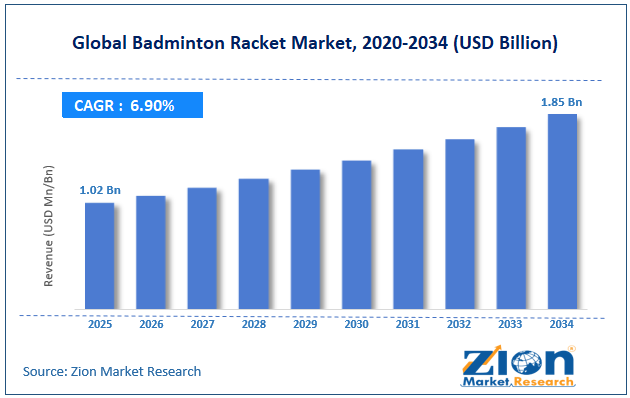
The global badminton racket market size was valued at approximately USD 1.02 billion in 2025 and is projected to reach around USD 1.85 billion by 2034, growing at a compound annual growth rate of approximately 6.90% between 2026 and 2034.
Key Insights
- As per the analysis shared by our research team, the global badminton racket market is estimated to grow at a compound annual growth rate of approximately 6.90% during the forecast period from 2026 to 2034.
- In terms of revenue, the global badminton racket market was valued at approximately USD 1.02 billion in 2025 and is projected to reach USD 1.85 billion by 2034.
- The badminton racket market is expected to grow steadily due to rising participation in recreational and competitive badminton, growing sports tourism, increasing school-level sports programs, and expanding use of advanced racket materials.
- Based on type, carbon fiber rackets lead the market because of their strength and lightweight design, while composite rackets are gaining strong momentum as one of the fastest-growing types due to their affordable pricing and durability for beginners.
- Based on application, recreational play leads the market due to the growing number of casual and fitness-focused players. At the same time, training and coaching institutes are the fastest-growing segment as more academies open across cities and towns.
- Based on distribution channel, online retail leads the market due to convenient price comparison and doorstep delivery, while specialty badminton stores are steadily growing as players seek expert advice and hands-on trials before purchase.
- Based on end user, the unisex category leads the market due to broad appeal across age groups, while the junior segment is growing rapidly as more parents encourage children to take up the sport early.
- Based on region, Asia Pacific leads the global badminton racket market, while Europe is the fastest-growing region due to rising badminton clubs and expanding grassroots sports programs.
Badminton Racket Market: Overview
The badminton racket is a lightweight sporting tool used to hit a shuttlecock across the net during badminton games, practice sessions, and competitions. It has a frame, shaft, handle, grip, and tightly stretched strings that work together to provide power, speed, and control. Modern badminton rackets are mainly made from graphite, carbon fiber, and composite materials, which make them lighter, stronger, and more durable than traditional wooden rackets. Different racket designs suit players based on their skill level, playing style, and performance needs. Lightweight rackets support faster swings and quick movement, while balanced and head-heavy designs can provide greater power during attacking shots. The badminton racket market is growing as the sport gains popularity in schools, sports clubs, fitness centers, and professional tournaments worldwide. Rising interest in fitness and indoor sports is encouraging more people to play badminton for recreation and exercise. Manufacturers are developing improved frames, stronger strings, comfortable grips, and aerodynamic designs to enhance performance. Expanding badminton academies, indoor courts, youth tournaments, and sports programs are also supporting demand. Additionally, online shopping makes it easier for consumers to compare racket specifications, prices, reviews, and brands before purchasing.
The badminton racket industry continues to grow as sports brands, coaching academies, and retail networks work together to bring better-performing and more affordable rackets to players across the globe.
Badminton Racket Market: Strategic Perspective
Where is the badminton racket market heading?
The badminton racket market is expected to focus on rackets that are lighter, stronger, and more comfortable, with improved speed, power, control, and shock absorption for different playing styles. Personalized equipment, advanced string technology, and customizable grips are also expected to help players choose rackets based on their skill level, preferred style, and individual performance needs.
Where should businesses invest in the badminton racket market?
The badminton racket market offers strong investment opportunities in junior and beginner racket lines, e-commerce partnerships, coaching academy tie-ups, and sustainable manufacturing processes. Companies that focus on affordable yet durable rackets, along with easy-to-understand product information for new players, may benefit as more people take up the sport at a grassroots level.
What will reshape competition in the badminton racket market?
The competitive landscape of the badminton racket market is expected to depend on better product technology, professional player endorsements, attractive pricing, and dependable services such as restringing and repairs. Brands that actively participate in local tournaments, academy programs, community activities, and digital marketing can strengthen customer relationships and encourage long-term brand loyalty.
Badminton Racket Market: Technology Roadmap 2026–2034
What is the projected development roadmap of the badminton racket market over the forecast period?
The badminton racket market is advancing through improved frame engineering, more precise weight distribution, expanded use of eco-friendly materials, and growing customization options, making rackets better suited to individual playing styles and skill levels. The market is expected to grow at a compound annual growth rate of approximately 6.90% over the forecast period, driven by rising sports participation, developing manufacturing techniques, and continuous refinement of racket design.
The following roadmap outlines key development phases expected through 2034.
2026–2028: Material Innovation and Accessibility Phase
- Improved frame materials: Manufacturers are expected to introduce lighter and more flexible carbon composites that help players generate more power with less physical effort.
- Affordable performance rackets: Companies are likely to launch mid-range rackets that offer near-professional performance at lower prices, making quality equipment accessible to more players.
- Expansion of online sales channels: E-commerce platforms are expected to play a bigger role in racket distribution, allowing players in smaller towns and rural areas to access a wider variety of products.
2029–2031: Customization and Performance Expansion Phase
- Personalized racket fitting: Brands are expected to offer fitting services that let players choose frame flexibility, grip size, and string tension based on their playing style.
- Smart racket technology: Sensors built into racket handles may begin tracking swing speed, shot power, and stroke patterns, helping players and coaches understand performance in more detail.
- Growth in academy and school partnerships: Racket brands are expected to work more closely with schools and training centers to introduce beginner-friendly rackets designed for young and first-time players.
2032–2034: Sustainable and Data-Driven Equipment Phase
- Eco-conscious manufacturing: Companies are likely to shift toward recyclable frame materials and reduced plastic packaging as environmental awareness grows among sports brands and consumers.
- Advanced performance tracking: Rackets embedded with motion sensors may connect to mobile apps, giving players detailed feedback on technique and helping them improve faster.
- Wider global accessibility: Manufacturing improvements and distribution expansion may bring high-quality rackets to emerging badminton markets in regions where the sport is still developing.
Badminton Racket Market: Dynamics
Growth Drivers
What is driving the expansion of the badminton racket market across recreational and competitive play?
The badminton racket market is growing as more people choose indoor sports for fitness, social interaction, and stress relief. Schools and colleges are adding badminton to physical education programs, introducing children to the sport early. International tournaments, online content, and growing media coverage of badminton players are encouraging new audiences to start playing. Sporting goods brands are also developing rackets for different playing styles, including defensive, all-round, and offensive play, giving consumers more choices. Improvements in grip comfort, racket balance, and vibration control are making equipment easier to handle during longer playing sessions. Expanding badminton clubs and community leagues are creating more opportunities for recreational players to compete and improve their skills. Rising disposable incomes in developing regions are also helping consumers purchase higher-quality sports equipment. In addition, badminton courts in mixed sports complexes are introducing the game to people who already play tennis, squash, and other indoor activities. These trends are increasing badminton participation beyond traditional markets and steadily supporting racket demand across schools, fitness centers, corporate wellness programs, clubs, and residential sports facilities worldwide.
Rising badminton academies are creating fresh opportunities in the badminton racket market.
The badminton racket market is gaining new opportunities as coaching academies and structured training programs expand across cities and smaller towns. These academies often purchase beginner and intermediate rackets in bulk, creating steady demand for manufacturers and sports retailers. Parents enrolling children in badminton classes are also becoming an important customer group, seeking durable, lightweight, and easy-to-use rackets for young players. Online coaching platforms and video tutorials are helping beginners learn proper techniques, encouraging them to upgrade to better-quality equipment as their skills improve. Retailers are responding with starter kits that include rackets, shuttlecocks, grips, and other basic accessories for new players. Manufacturers are also exploring partnerships with residential communities, schools, and corporate offices to develop accessible badminton facilities and attract new users. As more people view badminton as an affordable fitness and recreational activity, rackets are becoming mainstream sports equipment, supporting long-term market growth across organized training centers, schools, communities, workplaces, and casual playing groups.
Restraints
How are pricing and durability concerns affecting the badminton racket market?
The badminton racket market faces challenges from high prices, equipment wear, and varying consumer preferences. Premium carbon fiber rackets can be costly, limiting adoption among casual players and price-sensitive consumers in developing markets. Frequent string breakage and frame damage can increase replacement costs, particularly for beginners who may handle rackets incorrectly. Differences in preferred racket weight, balance, flexibility, and playing style also make it difficult for manufacturers to develop products that satisfy every customer group. Retailers may need knowledgeable staff to explain racket specifications and recommend suitable models, increasing operating expenses. Limited availability of quality sporting goods stores in smaller cities can further restrict access to reliable equipment. Manufacturers can address these concerns by developing affordable product ranges, improving material durability, offering simple product information, and expanding repair and restringing services. These measures can make quality rackets more accessible while improving product value and customer satisfaction across different market segments.
Opportunities
Will broader sports participation create new opportunities in the badminton racket market?
The badminton racket industry is gaining opportunities as badminton becomes increasingly popular as a lifestyle sport across different age groups. Corporate wellness programs are introducing badminton as an enjoyable way for employees to stay active, creating demand for entry-level rackets in office recreational spaces. Retirement communities and senior fitness groups are also adopting badminton as a gentle physical activity, creating opportunities for lightweight, easy-to-swing rackets. Growing interest in mixed doubles and social leagues is encouraging households to purchase multiple rackets for family members and friends. Manufacturers offering sweat-resistant grips, improved head-heavy and head-light balance options, and customizable string tension can benefit from these changing preferences. The inclusion of badminton in multi-sport events and school championships is creating opportunities for bulk institutional sales. Investment in sports tourism, training camps, and badminton-focused holiday programs is also introducing the sport to new audiences. Rising demand for affordable beginner rackets and advanced performance models is expected to support sales across schools, clubs, fitness centers, workplaces, academies, and residential sports communities worldwide, while expanding participation among recreational and competitive players.
Challenges
Counterfeit products and quality inconsistency are creating challenges for the badminton racket market.
The badminton racket market faces counterfeit products, inconsistent manufacturing standards, online authenticity issues, and limited service availability. Fake rackets sold through unauthorized sellers can imitate established brands at lower prices, mislead customers, and weaken consumer confidence. Variations in manufacturing quality can also affect racket strength, balance, string performance, and overall reliability. Online marketplaces may struggle to identify unauthorized listings, requiring stronger seller verification and product authentication systems. Damage during transportation can further affect racket frames and lead to unnecessary returns, especially when packaging does not provide adequate protection. In smaller cities, limited availability of trained technicians can make professional restringing and repair services difficult to access. Manufacturers and retailers can reduce these problems through stronger quality-control procedures, authentication technologies, secure packaging, authorized distribution networks, and wider technician training. Better product verification and dependable after-sales support can strengthen brand credibility, reduce customer complaints, and encourage repeat purchases.
Badminton Racket Market: Report Scope
| Report Attributes | Report Details |
|---|---|
| Report Name | Badminton Racket Market |
| Market Size in 2025 | USD 1.02 Billion |
| Market Forecast in 2034 | USD 1.85 Billion |
| Growth Rate | CAGR of 6.90% |
| Number of Pages | 229 |
| Key Companies Covered | Yonex Corporation, Li-Ning Company, Victor Rackets Industrial Corporation, Babolat, Ashaway Racket Strings, Carlton Sports Company, Apacs Sports, Fleet Sports, Wilson Sporting Goods, Toalson Corporation, and others. |
| Segments Covered | By Type, By Application, By Distribution Channel, By End User, and By Region |
| Regions Covered | North America, Europe, Asia Pacific (APAC), Latin America, Middle East, and Africa (MEA) |
| Base Year | 2025 |
| Historical Year | 2020 - 2024 |
| Forecast Year | 2026 - 2034 |
| Customization Scope | Avail customized purchase options to meet your exact research needs. Request For Customization |
Badminton Racket Market: Segmentation
The global badminton racket market is segmented by type, application, distribution channel, end user, and region.
What makes carbon fiber rackets the dominant type in the badminton racket market?
Based on type, the global badminton racket market is classified into aluminum, carbon fiber, graphite, and composite rackets. Carbon fiber rackets hold about 41% of the market share, leading because of their lightweight strength and popularity among professional and serious recreational players. Composite rackets hold around 22% market share. They are the fastest-growing segment because of their budget-friendly pricing and suitability for beginners and school-level players.
How does the recreational play application maintain its leading position in the badminton racket market?
Based on application, the badminton racket industry is categorized into professional play, recreational play, training and coaching institutes, and club-level play. Recreational play accounts for approximately 39% of the global market share, driven by growing interest in casual fitness activities among families and young adults. Training and coaching institutes hold around 19% market share. It is the fastest-growing segment due to the rising number of academies teaching structured badminton programs to children and adults.
What makes online retail the dominant distribution channel in the badminton racket market?
By distribution channel, the market is segmented into online retail, sporting goods stores, specialty badminton stores, and supermarkets and hypermarkets. Online retail leads with about a 37% share because it offers the convenience of price comparison, reading reviews, and having products delivered directly to the buyer's home. Specialty badminton stores hold around 18% market share. They are growing steadily as players value personalized advice and the ability to test rackets in person before buying.
How does the unisex end-user category shape the demand landscape of the badminton racket market?
Based on end user, the badminton racket market is divided into men, women, juniors, and unisex. The unisex category accounts for about 34% of the market, which makes it the leading segment because many entry-level and mid-range rackets are designed to suit all players regardless of gender. The junior segment holds around 21% market share. This segment is expanding quickly as more parents introduce their children to badminton through school programs and weekend coaching classes.
Badminton Racket Market: Regional Analysis
Why is Asia Pacific leading the global badminton racket market?
Asia Pacific holds a 42.15% global share in the badminton racket market and is expected to maintain its leading position during the forecast period. The region benefits from a deeply established badminton culture, particularly in China, India, Indonesia, Malaysia, and other Southeast Asian countries. Strong participation in amateur badminton creates a broad customer base for racket manufacturers across diverse consumer segments today. Asian players' success in major international tournaments also increases visibility and encourages consumers to buy quality equipment. Government sports initiatives and national training programs support badminton talent development and improve access to organized coaching.
Local manufacturers supply affordable rackets for price-sensitive buyers, while international brands target experienced players with premium models. Rising household incomes are encouraging consumers to upgrade their equipment as their skills improve. Growing sports academies and professional training centers are creating recurring demand from students and competitive players. E-commerce platforms are also making rackets easier to purchase across smaller cities and towns. In addition, strong badminton communities and frequent local competitions encourage regular participation and equipment replacement. These factors are expected to keep Asia Pacific at the forefront of the global market throughout the forecast period.
What makes Europe the fastest-growing region in the badminton racket market?
Europe holds a 24% global share in the badminton racket industry and is expected to remain a major regional market during the forecast period. The region has a well-developed badminton ecosystem supported by established clubs, national federations, indoor facilities, and competitions. Denmark, England, Germany, France, and other European countries contribute strongly to regional demand through active club participation. Growing interest in indoor fitness activities is encouraging adults to play badminton for exercise and recreation. School and university sports programs are also introducing the sport to younger consumers and building long-term participation. European players often demand lightweight, durable, performance-focused rackets, creating opportunities for premium equipment brands.
Retailers and specialty sports stores provide access to racket brands, while online platforms let consumers compare specifications, prices, and reviews before buying. Increasing investment in indoor courts and community sports facilities is making badminton more accessible throughout the region. Social leagues, mixed doubles events, and recreational tournaments are further broadening participation beyond professional players. Sustainability is also becoming more relevant as consumers show greater interest in responsibly produced sports equipment. These trends are expected to support steady demand and strengthen Europe’s position in the global market.
Recent Market Developments
- In March 2026, Yonex launched new badminton racket models including the ARCSABER 7 TOUR, ASTROX 77 TOUR, NANOFLARE 700 TOUR, and NANOFLARE 700 GAME, expanding its lineup with updated designs and multiple playing options.
Badminton Racket Market: Competitive Analysis
The leading players in the global badminton racket market are:
- Yonex Corporation
- Li-Ning Company
- Victor Rackets Industrial Corporation
- Babolat
- Ashaway Racket Strings
- Carlton Sports Company
- Apacs Sports
- Fleet Sports
- Wilson Sporting Goods
- Toalson Corporation
The global badminton racket market is segmented as follows:
By Type
- Aluminum Rackets
- Carbon Fiber Rackets
- Graphite Rackets
- Composite Rackets
By Application
- Professional Play
- Recreational Play
- Training and Coaching Institutes
- Club Level Play
By Distribution Channel
- Online Retail
- Sporting Goods Stores
- Specialty Badminton Stores
- Supermarkets and Hypermarkets
By End User
- Men
- Women
- Juniors
- Unisex
By Region
- North America
- The U.S.
- Canada
- Mexico
- Europe
- France
- The UK
- Spain
- Germany
- Italy
- Rest of Europe
- Asia Pacific
- China
- Japan
- India
- Australia
- South Korea
- Rest of Asia Pacific
- The Middle East & Africa
- Saudi Arabia
- UAE
- Egypt
- Kuwait
- South Africa
- Rest of the Middle East & Africa
- Latin America
- Brazil
- Argentina
- Rest of Latin America
Table Of Content
Methodology
FrequentlyAsked Questions
A badminton racket is a lightweight sporting tool used to hit a shuttlecock across the net during badminton games, practice sessions, and competitions. It has a frame, shaft, handle, grip, and tightly stretched strings that work together to provide power, speed, and control.
The global badminton racket market is expected to grow due to rising participation in recreational and competitive badminton, growing sports infrastructure, increasing school-level sports programs, and expanding use of advanced racket materials worldwide.
According to research, the global badminton racket market was valued at approximately USD 1.02 billion in 2025 and is projected to reach approximately USD 1.85 billion by 2034.
The compound annual growth rate of the badminton racket market is expected to be approximately 6.90% from 2026 to 2034.
Asia Pacific is expected to lead the global badminton racket market throughout the forecast period, driven by strong badminton culture, government sports programs, and widespread participation across the region.
The major players in the global badminton racket market include Yonex Corporation, Li-Ning Company, Victor Rackets Industrial Corporation, Babolat, Ashaway Racket Strings, Carlton Sports Company, Apacs Sports, Fleet Sports, Wilson Sporting Goods, and Toalson Corporation.
The report examines key aspects of the badminton racket market, including research and development drivers, adoption barriers, application opportunities, competitive landscape dynamics, detailed regional market performance analysis, and a comprehensive forward-looking outlook across all major types, applications, distribution channels, end-user segments, and geographic regions through 2034.
Economic growth, inflation, disposable income, and consumer spending will influence the badminton racket market, with higher incomes supporting premium racket purchases. At the same time, rising costs may increase demand for affordable, durable products.
The badminton racket market offers opportunities in advanced materials, manufacturing, e-commerce, sports academies, athlete partnerships, and distribution networks, especially in growing regions where rising participation and sports infrastructure are increasing demand.
The global badminton racket industry value chain includes raw material sourcing, racket design, manufacturing, quality testing, packaging, distribution, marketing, retail sales, and after-sales services such as restringing and repairs.

HappyClients

