
Automotive Silicone Market Size, Share, Growth, Opportunities 2034

Automotive Silicone Market By Type (Elastomers, Resins, Adhesives & Sealants, Gels, and Others), By Application (Electrical Systems, Engine & Drivetrain Systems, Suspension Systems, Interiors & Exteriors, Tires, and Others), and By Region - Global and Regional Industry Overview, Market Intelligence, Comprehensive Analysis, Historical Data, and Forecasts 2025 - 2034
| Market Size in 2024 | Market Forecast in 2034 | CAGR (in %) | Base Year |
|---|---|---|---|
| USD 1290.56 Million | USD 2160.35 Million | 6.60% | 2024 |
Automotive Silicone Industry Perspective:
What will be the global automotive silicone market size during the forecast period?
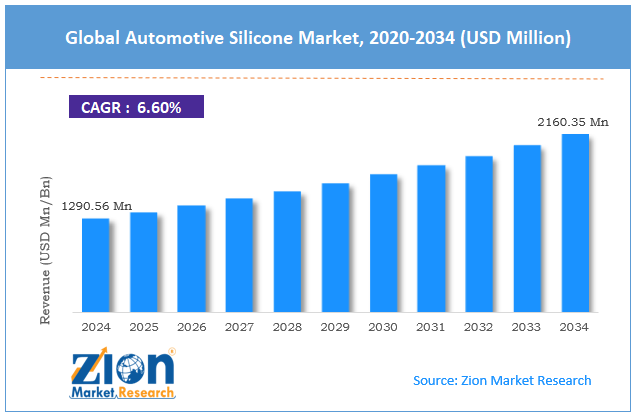
The global automotive silicone market size was worth around USD 1290.56 million in 2024 and is predicted to grow to around USD 2160.35 million by 2034, with a compound annual growth rate (CAGR) of roughly 6.60% between 2025 and 2034.
Key Insights:
- As per the analysis shared by our research analyst, the global automotive silicone market is estimated to grow annually at a CAGR of around 6.60% over the forecast period (2025-2034)
- In terms of revenue, the global automotive silicone market size was valued at around USD 1290.56 million in 2024 and is projected to reach USD 2160.35 million by 2034.
- The global automotive silicone market is projected to grow at a significant rate due to the rising production of EVs and hybrid vehicles.
- Based on type, the elastomers segment is growing at a high rate and will continue to dominate the global market, as per industry projections
- Based on application, the engine & drivetrain systems segment is anticipated to command the largest market share
- Based on region, the Asia-Pacific is projected to dominate the global market during the forecast period
Automotive Silicone Market: Overview
Automotive silicone is widely used and highly versatile in vehicle production and maintenance. It is known for its flexibility, durability, and resistance to high temperatures or pressure. Automotive silicone has significant applications in automobiles, ranging from insulation of electrical systems to enhancing the overall performance of the vehicle. According to industry analysis, automotive silicone is leveraged as flexible connectors and protective barriers in different parts of a vehicle, including exterior and interior components. The demand for automotive silicone is projected to continue growing, driven by multiple factors.
For instance, the growing demand for electric vehicles (EVs) and hybrid automobiles will help fuel market demand in the coming years. Furthermore, applications of automotive silicone in the production of coatings and adhesives may open new avenues for extended growth. Industry players are expected to face growth constraints due to disruptions in the raw material supply chain and competition from alternative materials.
Automotive Silicone Market: Dynamics
Growth Drivers
How will the surging production of electric vehicles affect the growth rate of the automotive silicone market?
The global automotive silicone market is expected to be driven by the rising production of EVs and hybrid vehicles. Automotive silicone is used in the insulation of electronic modules and wiring harnesses. The materials help protect these sensitive components from dust, moisture, and temperature fluctuations.
Thus, automotive silicone is considered highly beneficial in protecting electric or hybrid vehicles from damage. The rising production volume of EVs across the globe will subsequently impact demand for automotive silicone during the projection period. Global EV production volume is expected to reach over 21 million units in 2025. Factors such as increased support from regional governments, rising consumer awareness, and reduced EV production costs will help improve revenue for electric vehicle producers. This will further propel demand for automotive silicone to ensure enhanced vehicle longevity and durability.
Rising focus on ensuring reduced emissions and improvements in fuel efficiency to propel industry revenue
Automotive silicone is helpful in improving fuel efficiency and reducing emissions in several ways. They offer excellent sealing performance by preventing oil or air leaks. This property significantly reduces energy losses while optimizing engine efficiency. Furthermore, since automotive silicone is lightweight, it is useful in manufacturing lightweight vehicle components. According to industry research, reducing automotive weight by 10% can increase fuel efficiency by 6-8%. In addition, regional governments are emphasizing the production of lightweight vehicles to limit carbon emissions.
For instance, in November 2025, the European Labor Authority (ELA) announced the launch of the “Light vehicles. Big changes” campaign. It aims to raise awareness of the new rules that are expected to take effect from 1st July 2026. The changes apply to light commercial vehicles with a maximum permissible mass of 3.5 tonnes, used in international freight transport or cabotage for hire or reward. Such initiatives are expected to work in favor of the global automotive silicone market during the projection period.
Restraints
How will energy-intensive manufacturing processes limit automotive silicone market growth?
The global automotive silicone industry is expected to be restricted due to the involvement of energy-intensive production processes. Automotive silicone manufacturing encompasses the use of higher energy, which subsequently translates to increased harmful emissions. Furthermore, the use of complex and advanced production tools adds to the overall expenses associated with automotive silicone production.
Opportunities
Ongoing advancements in automotive silicone production technology offer new growth opportunities
The global automotive silicone market is expected to generate growth opportunities due to the rising advancements in production methods. These solutions are designed to produce advanced silicone with broader applications and greater durability. In December 2025, OCSiAl, a global leader in nanotechnology and producer of Tuball graphene nanotubes, announced the launch of a new silicone laboratory in Serbia. The brand aims to accelerate production of nanotube-based silicone materials with extensive applications, including use in the automotive sector. The facility is equipped with a complete innovation chain, including pilot production and energy-efficient materials.
In November 2025, Henkel, a prominent multinational company with expertise in sealants, adhesives, and surface treatment solutions, launched two novel silicone potting compounds to address the critical x-in-1 integration challenge faced by electric vehicle producers. The company has designed Loctite SI 5643 and Loctite SI 5637 for use in power-conversion components in EVs, enabling electric vehicle producers to integrate multiple powertrain components into single, compact units to reduce space and weight. Such breakthrough advancements reported in the automotive silicone sector will help reshape the industry growth rate during the forecast period.
Challenges
What challenges will the automotive silicone market face due to a lack of sufficient recycling infrastructure
The global automotive silicone industry is projected to be challenged by the lack of sufficient infrastructure to recycle used silicone. In addition, the absence of end-of-life management solutions can create questions over the sustainability of silicone applications in the automotive sector. The industry also faces tough competition from other alternative materials, such as natural rubbers and thermoplastics.
Automotive Silicone Market: Report Scope
| Report Attributes | Report Details |
|---|---|
| Report Name | Automotive Silicone Market |
| Market Size in 2024 | USD 1290.56 Million |
| Market Forecast in 2034 | USD 2160.35 Million |
| Growth Rate | CAGR of 6.60% |
| Number of Pages | 215 |
| Key Companies Covered | Momentive Performance Materials, Wacker Chemie AG, Evonik Industries AG, Siltech Corporation, Saint-Gobain, ACC Silicones Ltd., KCC Corporation, Dow Inc., Specialty Silicone Products Inc., CHT Group, Shin-Etsu Chemical Co. Ltd., NuSil Technology LLC, Elkem Silicones (Elkem ASA), Rogers Corporation, Henkel AG & Co. KGaA., and others. |
| Segments Covered | By Type, By Application, and By Region |
| Regions Covered | North America, Europe, Asia Pacific (APAC), Latin America, Middle East, and Africa (MEA) |
| Base Year | 2024 |
| Historical Year | 2019 to 2023 |
| Forecast Year | 2025 - 2034 |
| Customization Scope | Avail customized purchase options to meet your exact research needs. Request For Customization |
Automotive Silicone Market: Segmentation
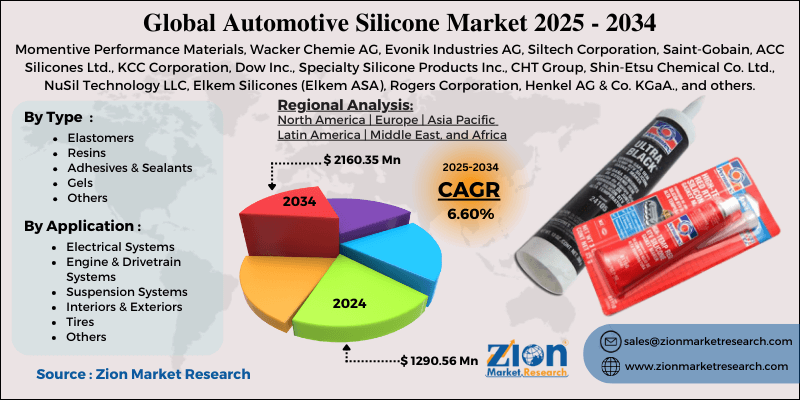
The global automotive silicone market is segmented based on type, application, and region.
Why will the elastomers segment dominate the automotive silicone market?
Based on type, the global market segments are elastomers, resins, adhesives & sealants, gels, and others. In 2024, the highest growth was listed in the elastomers segment due to their growing applications in the production of several critical automotive components such as O-rings, seals, and hoses. Growing applications of elastomers in electric and internal combustion engine (ICE) vehicles will aid higher segmental demand in the future.
What position does the engine and drivetrain systems segment holds in the automotive silicone industry?
Based on application, the global industry is fragmented into electrical systems, engine & drivetrain systems, suspension systems, interiors & exteriors, tires, and others. In 2024, the engine and drivetrain systems segment held the highest market share. The segment's improved revenue is attributable to silicone’s ability to withstand high pressure and temperature. Additionally, surging demand for fuel-efficient vehicles will promote segmental growth during the forecast period.
Automotive Silicone Market: Regional Analysis
Why will Asia-Pacific continue to dominate the automotive silicone market during the projection period?
The global automotive silicone market is expected to be dominated by Asia-Pacific during the forecast period. The region is anticipated to deliver a CAGR of more than 8.5% in the coming years. The regional market will be driven by the rising production of passenger and commercial vehicles. China and India are the regional leaders in terms of EV production.
In addition, the presence of a robust and thriving chemicals & materials sector will help influence regional revenue during the forecast period. Asia-Pacific is expected to record higher sales in the aftermarket segment due to rising demand for cost-effective automotive parts.
At what CAGR is North America anticipated to grow in the automotive silicone industry?
North America is projected to become the second-largest revenue generator in the coming years, with a CAGR of 8.1%. The growing demand for EVs across major North American countries will facilitate improved revenue in North America. Moreover, regional demand for fuel-efficient vehicles is growing at a steady rate, influenced by government policies and consumer awareness. Additionally, North America benefits from a mature automotive market, further accelerating demand for high-performance silicone-based automotive components.
Automotive Silicone Market: Competitive Analysis
The global automotive silicone market is led by players like:
- Momentive Performance Materials
- Wacker Chemie AG
- Evonik Industries AG
- Siltech Corporation
- Saint-Gobain
- ACC Silicones Ltd.
- KCC Corporation
- Dow Inc.
- Specialty Silicone Products Inc.
- CHT Group
- Shin-Etsu Chemical Co. Ltd.
- NuSil Technology LLC
- Elkem Silicones (Elkem ASA)
- Rogers Corporation
- Henkel AG & Co. KGaA.
What are the key trends in the Automotive Silicone Market?
Expansion of luxury vehicles
The expansion of luxury vehicles has driven increased demand for high-performance silicone-based components in the automotive silicone industry. The use of next-generation silicone solutions in interior and exterior parts of automobiles will fuel market expansion in the coming years.
Stringent safety standards
The introduction of strict automobile safety standards worldwide has accelerated applications of cutting-edge silicon-based automotive components. These standards have created demand for silicon solutions that comply with mechanical, chemical, and heat resistance parameters.
The global automotive silicone market is segmented as follows:
By Type
- Elastomers
- Resins
- Adhesives & Sealants
- Gels
- Others
By Application
- Electrical Systems
- Engine & Drivetrain Systems
- Suspension Systems
- Interiors & Exteriors
- Tires
- Others
By Region
- North America
- The U.S.
- Canada
- Europe
- France
- The UK
- Spain
- Germany
- Italy
- Rest of Europe
- Asia Pacific
- China
- Japan
- India
- South Korea
- Southeast Asia
- Rest of Asia Pacific
- Latin America
- Brazil
- Mexico
- Rest of Latin America
- Middle East & Africa
- GCC
- South Africa
- Rest of Middle East & Africa
Table Of Content
Methodology
FrequentlyAsked Questions

HappyClients

