
Global AI SDR Market Size, Share, Trends, Growth and Forecast 2034

AI SDR Market By Component (Software Platforms, Services and Support), By Deployment Mode (Cloud Based Deployment, On Premises Deployment), By Application (Lead Qualification, Outbound Prospecting, Meeting Scheduling, Email Personalization), By End-User (Small and Medium Enterprises, Large Enterprises), and By Region - Global and Regional Industry Overview, Market Intelligence, Comprehensive Analysis, Historical Data, and Forecasts 2026 - 2034
| Market Size in 2025 | Market Forecast in 2034 | CAGR (in %) | Base Year |
|---|---|---|---|
| USD 4.39 Billion | USD 47.10 Billion | 30.17% | 2025 |
AI SDR Market: Industry Perspective
What will be the size of the AI SDR market during the forecast period?
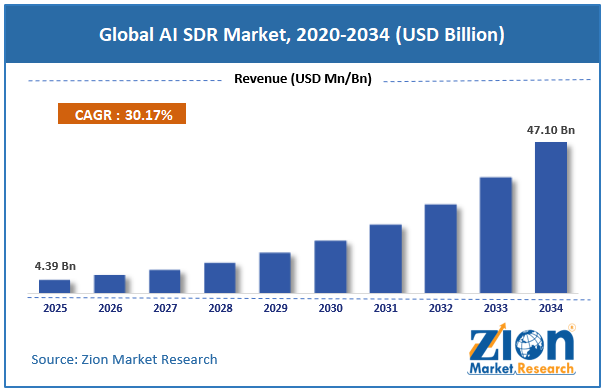
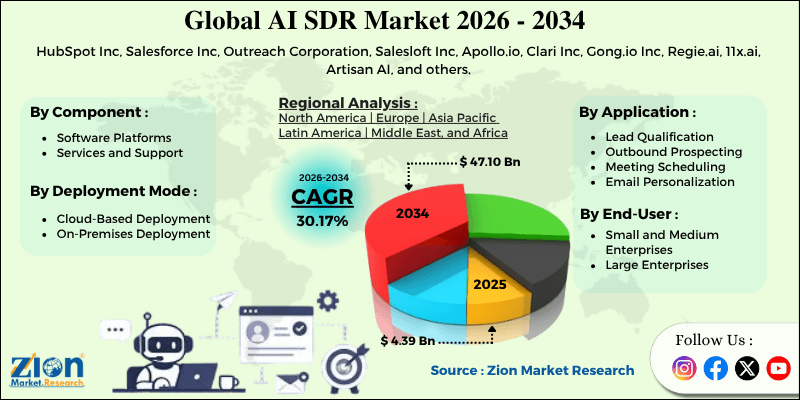
The global AI SDR market size was approximately USD 4.39 billion in 2025 and is projected to reach around USD 47.10 billion by 2034, with a compound annual growth rate of roughly 30.17% between 2026 and 2034.
Key Insights
- As per the analysis shared by our research analyst, the global AI SDR market is estimated to grow annually at a compound annual growth rate of around 30.17% over the forecast period from 2026 to 2034.
- In terms of revenue, the global AI SDR market size was valued at approximately USD 4.39 billion in 2025 and is projected to reach USD 47.10 billion by 2034.
- The AI SDR market is expected to grow steadily, driven by rising demand for sales automation, growing focus on faster lead qualification, expanding adoption among small businesses, and continuous improvements in natural language processing accuracy.
- Based on component, software platforms are expected to lead the market, while services and support are anticipated to grow steadily as demand for training, integration, and ongoing platform optimization rises.
- Based on deployment mode, cloud-based deployment is expected to lead the AI SDR market. In contrast, on-premises deployment is anticipated to grow rapidly, driven by rising concerns around data privacy and internal system control among larger organizations.
- Based on application, lead qualification forms the largest current application area. At the same time, meeting scheduling is expected to grow rapidly during the forecast period as more sales teams look to eliminate manual calendar coordination.
- Based on end-user, large enterprises are expected to lead the market. In contrast, small and medium enterprises are anticipated to grow steadily as affordable AI tools become more accessible to smaller sales teams.
- Based on region, North America is projected to dominate the global AI SDR market during the estimated period, followed by Europe.
AI SDR Market: Overview
An AI SDR (Artificial Intelligence Sales Development Representative) is a software tool that uses AI to automate sales tasks such as identifying potential customers, sending personalized messages, following up with leads, and scheduling meetings. Unlike traditional sales software that mainly stores customer information, an AI SDR actively communicates with prospects and supports the sales process with minimal human involvement. It helps sales teams save time, improve productivity, and ensure that potential customers are not missed during busy periods. By handling repetitive tasks, AI SDRs allow sales professionals to spend more time building relationships and closing deals. They also improve follow-up consistency, helping businesses increase the number of qualified leads that move through the sales pipeline. Most AI SDR platforms use technologies such as artificial intelligence, machine learning, and natural language processing to understand customer behavior, personalize communication, and improve engagement over time. The growing use of AI across businesses, the rising demand for faster, more efficient sales processes, and the need to improve customer outreach are driving growth in the AI SDR market. Increasing pressure on sales teams to achieve higher targets with limited resources is further boosting demand for AI SDR solutions across businesses of all sizes worldwide.
The AI SDR market is growing due to rising adoption of artificial intelligence in sales operations, increasing focus on lead-generation efficiency, and rising demand for scalable outbound prospecting tools.
Impact of the USA-Israel War on Iran on the AI SDR Market
Tensions among the United States, Israel, and Iran could create short-term challenges for the technology supply chain, particularly for cloud computing infrastructure and semiconductor components used inside data centers that support AI SDR platforms across affected trade regions. Some technology providers may experience temporary delays in scaling certain infrastructure resources, which could slow near-term platform expansion timelines. However, steady demand from sales teams and business leaders is expected to keep the AI SDR market on a stable growth path despite short-term regional disruptions.
AI SDR Market: Technology Roadmap 2026–2034
What is the projected development roadmap for the AI SDR market over the forecast period?
The AI SDR market is advancing with more intelligent conversational models, smarter lead-scoring systems, and integration into broader customer relationship management ecosystems. The market is expected to grow at a compound annual growth rate of around 30.17% over the forecast period, supported by rising global demand for automated sales processes and efficient outbound prospecting technology.
The following roadmap outlines key development phases expected through 2034.
2026-2028: Automation Accuracy and Personalization Phase
- Developers are expected to build more accurate, context-aware AI SDR tools that improve message personalization without adding unnecessary complexity for sales teams.
- Adaptive messaging technology is expected to expand, enabling AI SDR platforms to adjust tone and content in real time based on prospect responses rather than following fixed scripts.
- Improved data enrichment and lead scoring designs are expected to extend the usefulness of AI SDR platforms, reducing wasted effort on unqualified leads.
2029-2032: Integrated Sales Intelligence and Workflow Optimization Phase
- Companies are expected to integrate AI SDR operations with wider customer relationship management software to balance outreach volume and lead quality more efficiently.
- Integration between AI SDR systems and marketing automation platforms is expected to grow, giving sales leaders better control over pipeline consistency and revenue forecasting.
- Cloud-connected analytics platforms are expected to help sales managers monitor AI SDR performance across thousands of accounts simultaneously, improving coaching and reducing missed opportunities.
2033-2034: Fully Integrated Autonomous Sales Ecosystem Phase
- AI SDR tools are expected to become part of larger connected revenue ecosystems that integrate prospecting, qualification, and scheduling into a single coordinated system.
- Self-improving conversation models are expected to reduce the need for manual script updates, making long-term sales operations more convenient and less dependent on constant human adjustment.
- Fully automated performance alert systems are expected to notify sales leaders instantly when a campaign underperforms, improving pipeline reliability and revenue predictability.
AI SDR Market: Dynamics
Growth Drivers
Rising adoption of artificial intelligence in sales operations is driving growth in the AI SDR market.
The AI SDR market is growing as more businesses look for smarter ways to reach customers without hiring large sales teams. AI SDR tools can work 24/7, helping companies find potential customers, send personalized messages, follow up with leads, and schedule meetings automatically. This allows sales teams to spend more time talking to interested customers and closing deals rather than performing repetitive tasks. As a result, businesses can improve productivity, generate better-quality leads, and increase sales. More companies are adopting digital sales strategies, creating higher demand for AI SDR tools that are easy to use, scalable, and efficient. These platforms also provide useful reports and insights that help sales managers understand which sales messages and strategies are performing well.
Software companies are continuously improving AI technology to create more natural conversations, faster responses, and better customer engagement. Growing pressure to achieve higher sales targets with smaller teams is further increasing demand for AI SDR solutions. Rising investments in artificial intelligence and sales automation are also creating new growth opportunities, supporting the expansion of the AI SDR industry across businesses of all sizes worldwide.
How is rising investment in enterprise sales technology and outbound prospecting efficiency driving the AI SDR market?
The AI SDR market is growing as more businesses use artificial intelligence to manage increasing numbers of sales leads and potential customers. AI SDR platforms help companies contact prospects, identify the most interested buyers, and keep sales activities running smoothly without adding extra workload for sales teams. Many large businesses are adopting these tools to improve lead management, increase productivity, and streamline their sales process. Software developers are creating AI SDR platforms that are easy to customize and can automatically qualify leads, send personalized messages, and reduce manual work for sales representatives.
Many platforms also include dashboards that track important information such as customer engagement, lead conversions, and sales performance in one place. This helps businesses make better decisions, improve sales results, and reduce time spent on less promising leads. Consulting companies are also helping businesses set up and optimize AI SDR platforms to achieve better results from their investments. Rising investments in artificial intelligence, sales automation, and employee training are further supporting market growth. As companies continue to focus on improving efficiency and increasing sales, demand for the AI SDR market is expected to grow steadily across industries worldwide.
Restraints
High implementation costs and data quality concerns are key challenges in the AI SDR market.
The AI SDR industry faces several challenges that may slow its growth. One of the biggest challenges is the high cost of setting up and customizing AI SDR platforms so they work smoothly with existing sales and marketing systems. These tools also require accurate, well-organized customer data to deliver good results, which many businesses struggle to maintain. Small and medium-sized companies often struggle to afford the technology, training, and ongoing support needed to use AI SDR platforms effectively. Another challenge is making sure AI-generated messages sound natural and personal instead of robotic or repetitive, as poor communication can reduce customer trust.
Businesses must also follow strict data privacy laws and communication regulations, which can increase costs and delay implementation. In addition, regular updates and improvements are needed to keep AI SDR tools accurate and effective as customer expectations change. Although AI SDR platforms help improve sales efficiency and productivity, these cost, technical, and regulatory challenges continue to slow the wider adoption of the AI SDR market across some businesses and industries.
Opportunities
Expanding adoption among small businesses is driving growth in the AI SDR market.
The AI SDR market offers strong growth opportunities as businesses of all sizes look for better ways to increase sales and improve customer outreach. More companies are investing in affordable AI-powered sales tools that help automate lead generation, follow-ups, and meeting scheduling, reducing the need for large sales teams. The growing use of remote and hybrid work is also increasing demand for AI SDR platforms that keep sales activities running smoothly from any location. Countries across the Asia Pacific, Latin America, and the Middle East are rapidly adopting digital sales technologies, creating new opportunities for AI SDR providers. Small and medium-sized businesses are increasingly using AI SDR tools as they become easier to use and more cost-effective.
Software companies are also developing multilingual platforms that help businesses connect with customers in different languages and regions. Improvements in artificial intelligence, workflow automation, customer data integration, and conversational AI are making these tools more accurate, efficient, and accessible. Better cloud-based solutions and easy integration with CRM systems are further encouraging adoption. These developments are expected to drive the long-term growth of the AI SDR market by improving sales productivity, lead quality, customer engagement, and overall business performance across industries worldwide.
Challenges
What challenges does the AI SDR market face in trust and adoption readiness amid rising competition?
The AI SDR market faces several challenges that could slow its growth. One of the biggest challenges is earning the trust of both sales teams and customers, as many people remain unsure about how to interact with AI-powered sales tools. If AI SDR platforms send poor-quality or overly automated messages, they can reduce response rates, harm a company's reputation, and create a negative customer experience. Companies also need to invest in research, testing, and regular updates to ensure these platforms work well across different industries and sales processes.
Another challenge is the shortage of skilled professionals with knowledge of artificial intelligence, sales technology, and data integration. At the same time, strong competition from CRM software providers and new AI startups is forcing companies to offer better products at competitive prices. Rapid changes in AI technology also require continuous innovation and product improvements. These technical, financial, and workforce challenges can increase development costs and delay adoption, especially for small and medium-sized businesses with limited budgets and technical expertise.
AI SDR Market: Report Scope
| Report Attributes | Report Details |
|---|---|
| Report Name | AI SDR Market |
| Market Size in 2025 | USD 4.39 Billion |
| Market Forecast in 2034 | USD 47.10 Billion |
| Growth Rate | CAGR of 30.17% |
| Number of Pages | 230 |
| Key Companies Covered | HubSpot Inc, Salesforce Inc, Outreach Corporation, Salesloft Inc, Apollo.io, Clari Inc, Gong.io Inc, Regie.ai, 11x.ai, Artisan AI, and others. |
| Segments Covered | By Component, By Deployment Mode, By Application,By End-User, and By Region |
| Regions Covered | North America, Europe, Asia Pacific (APAC), Latin America, Middle East, and Africa (MEA) |
| Base Year | 2025 |
| Historical Year | 2020 to 2024 |
| Forecast Year | 2026 - 2034 |
| Customization Scope | Avail customized purchase options to meet your exact research needs. Request For Customization |
AI SDR Market: Segmentation
The global AI SDR market is segmented by component, deployment mode, application, end-user, and region.
What makes software platforms the expected leader in the AI SDR market?
Based on component, the global AI SDR industry is divided into software platforms, services, and support. Software platforms hold about 44% market share, leading due to their scalability, consistent performance, and ability to handle high volumes of prospecting activity without additional staffing. Services and support hold around 25% of the market share. It is one of the fastest-growing segments, driven by increasing demand for implementation guidance and ongoing platform optimization among growing sales teams.
How does the cloud-based deployment segment maintain its leading position in the AI SDR market?
Based on deployment mode, the AI SDR market is segregated into cloud-based and on-premises deployments. The cloud-based deployment segment accounts for about 45% of the global AI SDR market, driven by rising demand for flexible, easy-to-scale sales tools that require minimal internal infrastructure. The on-premises deployment segment holds around 22% of the market share. It is one of the fastest-growing segments, driven by rising concerns among large enterprises about data privacy and internal system control.
What makes lead qualification the leading application for AI SDR platforms?
Based on application, the market is classified into lead qualification, outbound prospecting, meeting scheduling, and email personalization. Lead qualification accounts for about 40% of the market, driven by growing demand among sales teams to focus their time on the most promising prospects. Meeting scheduling holds around 24% of the market share. It is growing rapidly as more sales teams seek to eliminate manual back-and-forth communication in the scheduling process.
How do large enterprises dominate the end-user landscape in the AI SDR market?
Based on end-user, the AI SDR market is categorized into small and medium enterprises and large enterprises. Large enterprises account for about 63% of the market, due to their higher sales volumes and greater budgets for advanced sales technology investments. Small and medium enterprises hold around 37% share. They are growing steadily as demand for affordable, easy-to-implement AI sales tools among smaller sales teams increases.
AI SDR Market: Regional Analysis
What is driving North America's leadership in the AI SDR market?
The North America AI SDR market accounts for around 42% of the global market, making it the largest regional market. This leadership is driven by the region's strong culture of technology adoption, well-developed software industry, and rising demand for efficient sales automation tools. The United States holds the largest market share because of its high concentration of technology companies, well-established venture capital funding, and strong adoption of enterprise software. Canada is also a major contributor, with businesses adopting advanced AI SDR platforms to improve lead qualification, outreach efficiency, and overall sales performance. The growing demand for scalable sales solutions among startups, mid-sized companies, and large enterprises is further increasing the need for intelligent automation tools.
The region is also seeing rising interest in artificial intelligence across every business function, which supports faster adoption of AI SDR technology. Software providers across the region are investing in more intelligent, easy-to-configure platforms that help extend sales team capacity and improve conversion rates. Strong collaboration between technology companies, sales consultants, and enterprise software providers is accelerating innovation and product development. Continuous investments in artificial intelligence research, cloud infrastructure, and sales enablement tools are expected to keep North America at the forefront of the global AI SDR market in the coming years.
What factors are supporting the expansion of the AI SDR market across Europe?
The European AI SDR market accounts for around 29% of the global market, making it the second-largest regional market. Growing digital transformation initiatives, strong data protection standards, and the increasing adoption of artificial intelligence across business functions are driving growth in this region. The United Kingdom leads the regional market due to its advanced technology sector, strong research capabilities, and continuous investment in sales technology. Leading businesses are using advanced AI SDR platforms to improve lead qualification, outreach personalization, and sales team productivity. Germany is also experiencing steady market growth, supported by expanding adoption of enterprise software and the launch of new artificial intelligence tools.
Growing focus on efficient revenue generation and ambitious growth targets is encouraging faster adoption of intelligent sales automation. Software providers are developing flexible, compliant AI SDR platforms to meet evolving data protection and business requirements. Ongoing investments in artificial intelligence research, cloud computing, and sales technology are creating new growth opportunities. These factors are expected to support the long-term expansion of the European AI SDR market while improving sales efficiency, lead quality, and overall business performance.
Recent Market Developments
- In February 2026, Salesforce reported that its AI-driven Agentforce platform had begun contributing significantly to customer support and sales automation following the integration of Informatica, strengthening AI-powered customer data management and enterprise sales automation capabilities.
AI SDR Market: Competitive Analysis
The leading players in the global AI SDR market are;
- HubSpot Inc
- Salesforce Inc
- Outreach Corporation
- Salesloft Inc
- Apollo.io
- Clari Inc
- Gong.io Inc
- Regie.ai
- 11x.ai
- Artisan AI
The global AI SDR market is segmented as follows:
By Component
- Software Platforms
- Services and Support
By Deployment Mode
- Cloud-Based Deployment
- On-Premises Deployment
By Application
- Lead Qualification
- Outbound Prospecting
- Meeting Scheduling
- Email Personalization
By End-User
- Small and Medium Enterprises
- Large Enterprises
By Region
- North America
- The U.S.
- Canada
- Mexico
- Europe
- France
- The UK
- Spain
- Germany
- Italy
- Rest of Europe
- Asia Pacific
- China
- Japan
- India
- Australia
- South Korea
- Rest of Asia Pacific
- The Middle East & Africa
- Saudi Arabia
- UAE
- Egypt
- Kuwait
- South Africa
- Rest of the Middle East & Africa
- Latin America
- Brazil
- Argentina
- Rest of Latin America
Table Of Content
Methodology
FrequentlyAsked Questions
An AI SDR (Artificial Intelligence Sales Development Representative) is a software tool that uses AI to automate sales tasks such as identifying potential customers, sending personalized messages, following up with leads, and scheduling meetings.
The global AI SDR market is expected to grow, driven by rising adoption of artificial intelligence in sales, a growing focus on lead-generation efficiency, expanding adoption among small businesses, and continuous improvements in natural language processing accuracy.
According to research, the global AI SDR market size was valued at around USD 4.39 billion in 2025 and is projected to reach around USD 47.10 billion by 2034.
The compound annual growth rate value of the AI SDR market is expected to be around 30.17% during 2026 to 2034.
North America is expected to lead the global AI SDR market during the forecast period, driven by strong technology adoption, well-developed software infrastructure, and rising consumer demand for sales automation.
The major players in the global AI SDR market include HubSpot Inc, Salesforce Inc, Outreach Corporation, Salesloft Inc, Apollo.io, Clari Inc, Gong.io Inc, Regie.ai, 11x.ai, and Artisan AI.
The report examines key aspects of the AI SDR market, including growth drivers, restraints, emerging opportunities, challenges, a competitive landscape analysis, regional breakdowns, and a detailed future outlook across all major components, deployment modes, applications, and geographies.
The AI SDR market is advancing through adaptive messaging technology, integrated sales intelligence software, cloud-connected analytics platforms, and self-improving conversation models, thereby improving accuracy, efficiency, and sales performance.
The AI SDR market requires stakeholders to invest in intelligent automation technologies, flexible deployment options, advanced analytics systems, strategic partnerships with customer relationship management providers, and continuous product innovation. Expanding platform capabilities, strengthening data security, and investing in research and development can also improve long-term competitiveness.
The AI SDR market is driven by data privacy standards, anti-spam communication regulations, artificial intelligence governance frameworks, and consumer protection policies that promote responsible and transparent automated sales practices.

HappyClients

