
Global Wood Vinegar Market Size, Share, Growth Analysis Report - Forecast 2034

Wood Vinegar Market By Pyrolysis Method (Slow Pyrolysis, Fast Pyrolysis, and Intermediate Pyrolysis), By Application (Agriculture, Animal Feed, Food, Medicinal, Consumer Products, and Others), and By Region - Global and Regional Industry Overview, Market Intelligence, Comprehensive Analysis, Historical Data, and Forecasts 2025 - 2034
| Market Size in 2024 | Market Forecast in 2034 | CAGR (in %) | Base Year |
|---|---|---|---|
| USD 572.1 Million | USD 901.62 Million | 4.8% | 2024 |
Wood Vinegar Market: Industry Perspective
What will be the global wood vinegar market size during the forecast period?
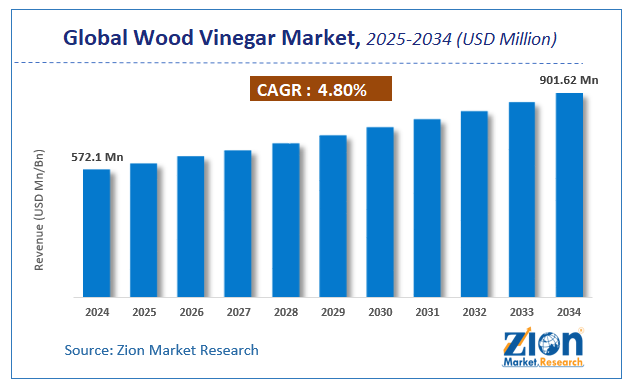
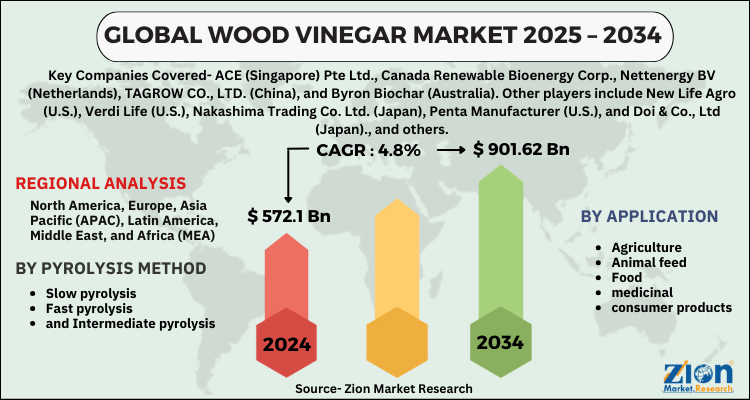
The global wood vinegar market size was worth around USD 572.1 million in 2024 and is predicted to reach around USD 901.62 million by 2034, with a compound annual growth rate (CAGR) of roughly 4.8% between 2025 and 2034.
This report provides a comprehensive analysis of the growth drivers, restraints, and challenges shaping demand across the global wood vinegar market throughout the forecast period, while highlighting high-potential emerging opportunities within the industry.
Key Insights
- As per the analysis shared by our research analyst, the global wood vinegar market is estimated to grow annually at a CAGR of around 4.8% over the forecast period (2025-2034).
- Regarding revenue, the global wood vinegar market size was valued at around USD 572.1 Million in 2024 and is projected to reach USD 901.62 Million by 2034.
- The wood vinegar market is projected to grow at a significant rate due to rising demand in agriculture, as a bio-based pesticide and soil conditioner boosts market expansion.
- Based on pyrolysis method, the slow pyrolysis segment is expected to lead the global market.
- Based on application, the agriculture segment is growing at a high rate and will continue to dominate the global market.
- Based on region, Asia-Pacific is predicted to dominate the global market during the forecast period.
Wood Vinegar Market: Overview
Wood vinegar, also known as pyroligneous acid, is an acid compound formed from wood and other plant materials. Wood vinegar is produced through a destructive distillation process in which wood and plant material are heated at high temperatures with little oxygen. The global wood vinegar market is expanding rapidly and is predicted to grow further throughout the forecast period, driven by rising consumer demand for organic pesticides. In addition, rising government efforts to use bio-based commodities as a replacement for synthetic chemicals are expected to boost market demand for wood vinegar.
Processed food businesses are expanding existing manufacturing units and establishing new plants to increase production of processed foods such as meat and seafood. As a result, demand for liquid smoke/wood vinegar, which is used to provide a distinct flavor to certain processed food products, is predicted to rise. Furthermore, increased use of wood vinegar in industries such as agriculture and food and beverages, lower manufacturing costs than synthetic pesticides, and the growing organic food industry are projected to drive future demand for wood vinegar.
Wood Vinegar Market: Growth Drivers
What factors are primarily accelerating demand in the wood vinegar market?
The growing emphasis on organic farming worldwide is driving the global wood vinegar sector. The growing environmental concern and global demand for organic products are boosting the industry's growth. Additionally, organic farming provides an economic incentive for rural and small-scale farmers because sustainable agricultural practices can dramatically improve production and profitability given available farm size and conditions. Furthermore, because of the economic benefits for farmers, several governments worldwide are spearheading the organic farming movement at the national, regional, and municipal levels. As a result, the adoption of organic farming is predicted to considerably contribute to the expansion of the wood vinegar business.
Wood Vinegar Market: Restraints
What factors are limiting the expansion of the wood vinegar market?
Factors that may limit wood vinegar market growth include the fact that it is made from a variety of organic sources. However, obstacles in sourcing and manufacturing wood vinegar from these similar natural sources may limit repeatable/dependable results, restricting its use across industrial domains. Furthermore, much of the wood required for charcoal production comes from natural forests, leading to forest harvesting. Charcoal manufacturing is a major cause of deforestation around the world. As the standard of living in developed and emerging countries develops, so does the demand for charcoal and its byproducts, such as wood vinegar, for energy production. As a result, governments have issued rules governing the manufacturing and sale of charcoal and its byproducts, reducing overall charcoal output and, in turn, the production of wood vinegar.
Wood Vinegar Market: Opportunities
Where do significant growth opportunities lie for the wood vinegar market?
Expansion of organic agriculture and preference for organic food products create opportunities for wood vinegar as a biopesticide and bio-based fertilizer. Growth in processed foods that use liquid smoke for distinctive flavor supports additional demand in the food sector.
Industrial uses, including sources for acetic acid, tar and creosote production, and wastewater treatment, as well as applications in animal feed, medicinal products, and consumer goods, offer further avenues for market expansion.
Wood Vinegar Market: Challenges
What key challenges confront participants in the wood vinegar market?
Ensuring consistent quality and performance from variable natural feedstocks remains a challenge for producers and industrial users. Regulatory constraints related to forest harvesting and charcoal production can limit raw material availability in some regions.
Balancing production economics with environmental and regulatory requirements is an ongoing consideration for market participants across the value chain.
Wood Vinegar Market: Report Scope
| Report Attributes | Report Details |
|---|---|
| Report Name | Wood Vinegar Market |
| Market Size in 2024 | USD 572.1 Million |
| Market Forecast in 2034 | USD 901.62 Million |
| Growth Rate | CAGR of 4.8% |
| Number of Pages | 225 |
| Key Companies Covered | ACE (Singapore) Pte Ltd., Canada Renewable Bioenergy Corp., Nettenergy BV, TAGROW CO., LTD., Byron Biochar, New Life Agro, Verdi Life, Nakashima Trading Co. Ltd., Penta Manufacturer, Doi & Co., Ltd., and others. |
| Segments Covered | By Pyrolysis Method, By Application, and By Region |
| Regions Covered | North America, Europe, Asia Pacific (APAC), Latin America, The Middle East and Africa (MEA) |
| Base Year | 2024 |
| Historical Year | 2020 - 2023 |
| Forecast Year | 2025 - 2034 |
| Customization Scope | Avail customized purchase options to meet your exact research needs. Request For Customization |
Wood Vinegar Market: Segmentation
The wood vinegar market is segmented by pyrolysis method, application, and region. All the segments of the wood vinegar market have been analyzed based on present and future trends and the market is estimated from 2025 to 2034.
By pyrolysis method, the market is classified into slow pyrolysis, fast pyrolysis, and intermediate pyrolysis. During the forecast period, slow pyrolysis held the largest market share. Slow pyrolysis yields a critical amount of wood vinegar, an aqueous composition containing organic acids. Slow pyrolysis differs from fast pyrolysis in that it uses a slower heating rate, longer vapor residence time, and lower temperature. Slow pyrolysis produces more char, wood vinegar, and other products than fast and intermediate pyrolysis. However, it has lower energy output, takes longer, and produces more pollutants.
By application, the market is classified into agriculture, animal feed, food, medicinal, consumer products, and others (including industrial sources for the production of acetic acid, tar & creosote production, and wastewater treatment). During the projection period, agriculture held the greatest share of this market. It has multifunctional properties and is used as a pesticide and fertilizer. It also helps control damaging insects on crops. It reduces odor and supports composting when combined with manure. Wood vinegar promotes cell growth and acts as a catalyst for creating a variety of enzymes and microorganisms that aid nutrient absorption, photosynthesis, and cell growth. When used as chicken feed additives, charcoal and wood vinegar eliminate microorganisms such as Salmonella, which causes gastrointestinal disorders in poultry. It also improves hen egg-laying performance.
Wood Vinegar Market: Regional Analysis
Why will Asia-Pacific continue to dominate the global market during the projection period?
The Asia-Pacific market is expected to dominate and grow significantly, driven by increased use of organic fertilizer, high output of organic products, and local players operating in several countries, particularly Australia, India, and China. Wood vinegar has paved the way for Asian countries like India, where agriculture accounts for a significant share of GDP, to increase crop yields while maintaining quality. Furthermore, the region's growing preference for organic food products has increased the number of farmers adopting organic farming practices, boosting the market for biopesticides and bio-based fertilizers, such as wood vinegar, in the agricultural sector. As a result, the number of wood vinegar makers has increased across the region to meet growing demand from various industries, particularly food and beverage, agriculture, feed supplements, culinary items, cosmetics, and others.
North America is supported by rising acceptance of convenient and processed foods, increased consumer awareness of food safety, and demand for bio-based agricultural fertilizers, with preference for smoked food products also contributing to regional demand. Europe and other regions continue to develop applications in organic agriculture, food, and industrial uses.
Recent Developments
-
In 2021, Nettenergy BV partnered with the Vermeulen Group during the VOA meeting to execute a joint pilot project focused on converting verge grass and forestry wood waste into biochar, renewable hydrogen, and refined pyroligneous fractions.
Wood Vinegar Market: Competitive Analysis
The global wood vinegar market is dominated by players like:
- ACE (Singapore) Pte Ltd.
- Canada Renewable Bioenergy Corp.
- Nettenergy BV
- TAGROW CO. LTD.
- Byron Biochar
- New Life Agro
- Verdi Life
- Nakashima Trading Co. Ltd.
- Penta Manufacturer
- Doi & Co. Ltd.
Wood Vinegar Market: Key Trends
What are the key trends in the wood vinegar market?
Leadership of slow pyrolysis and agricultural applications
Slow pyrolysis is expected to lead production methods because it yields substantial wood vinegar, while agriculture continues to dominate demand as a bio-based pesticide, fertilizer, and soil conditioner in organic and conventional systems.
Rising focus on organic farming and bio-based inputs
Growing emphasis on organic farming, environmental concerns, and preference for organic products are increasing adoption of wood vinegar as an alternative to synthetic pesticides and supporting expansion in food and related applications.
Segments Covered
The global wood vinegar market is segmented as follows;
By Pyrolysis Method
- Slow Pyrolysis
- Fast Pyrolysis
- Intermediate Pyrolysis
By Application
- Agriculture
- Animal feed
- Food
- Medicinal
- Consumer Products
- Others (including industrial sources for the production of acetic acid tar & creosote production and wastewater treatment)
By Region
- North America
- The U.S.
- Canada
- Mexico
- Europe
- France
- The UK
- Spain
- Germany
- Italy
- Rest of Europe
- Asia Pacific
- China
- Japan
- India
- Australia
- South Korea
- Rest of Asia Pacific
- The Middle East & Africa
- Saudi Arabia
- UAE
- Egypt
- Kuwait
- South Africa
- Rest of the Middle East & Africa
- Latin America
- Brazil
- Argentina
- Rest of Latin America
Table Of Content
Methodology
FrequentlyAsked Questions
Wood vinegar, also known as pyroligneous acid, is an acid compound formed from wood and other plant materials through disruptive distillation with limited oxygen. It is used in agriculture, animal feed, food, medicinal, consumer, and industrial applications.
Key growth drivers include rising demand in agriculture as a bio-based pesticide and soil conditioner, growing emphasis on organic farming, government support for bio-based alternatives to synthetic chemicals, and use in food flavoring and related applications.
The global wood vinegar market was valued at approximately USD 572.1 million in 2024 and is projected to reach around USD 901.62 million by 2034.
The global wood vinegar market is expected to expand at a compound annual growth rate of approximately 4.8% between 2025 and 2034.
Asia-Pacific is predicted to dominate the global market during the forecast period, supported by organic fertilizer use, organic product output, and local producers in countries such as China, India, and Australia.
Major players include ACE (Singapore) Pte Ltd., Canada Renewable Bioenergy Corp., Nettenergy BV, TAGROW CO., LTD., Byron Biochar, New Life Agro, Verdi Life, Nakashima Trading Co. Ltd., Penta Manufacturer, and Doi & Co., Ltd.

HappyClients