
Global Virtual Engine Sound System Market Size, Share, Trends, Growth 2034

Virtual Engine Sound System Market By Type (Simulated Engine Sounds and Enhanced Engine Sounds), By Application (Electric and Hybrid Vehicles, Performance and Sports Cars, Luxury and Premium Vehicles and Commercial and Fleet Vehicles), By Distribution Channel (Original Equipment Manufacturers (OEMs), Automotive Dealerships, Online Retailers, Specialty Automotive Stores and Authorized Service Centers) and By Region - Global and Regional Industry Overview, Market Intelligence, Comprehensive Analysis, Historical Data, and Forecasts 2025 - 2034
| Market Size in 2024 | Market Forecast in 2034 | CAGR (in %) | Base Year |
|---|---|---|---|
| USD 5.6 Billion | USD 11.2 Billion | 7.10% | 2024 |
What is Virtual Engine Sound System Market Size?
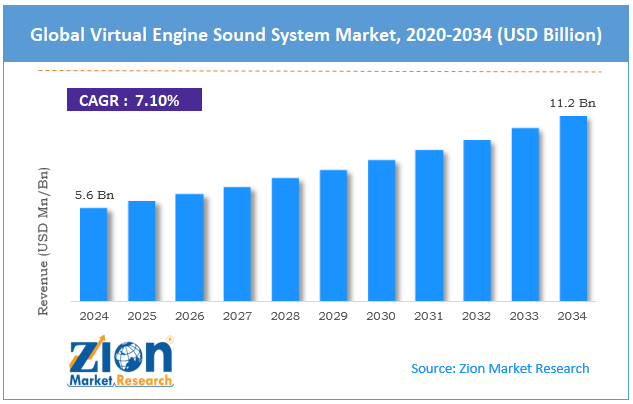
According to Zion Market Research, The global virtual engine sound system market size was worth around USD 5.6 billion in 2024 and is predicted to grow to around USD 11.2 billion by 2034 with a compound annual growth rate (CAGR) of roughly 7.1% between 2025 and 2034. The Virtual Engine Sound System market is primarily driven by the global surge in electric vehicle adoption and stringent government mandates requiring acoustic alerts to ensure pedestrian safety.
 Request Free SampleRequest Free Sample
Key Insights
- As per the analysis shared by our research analyst, the global virtual engine sound system market is estimated to grow annually at a CAGR of around 7.1% over the forecast period (2025-2034).
- In terms of revenue, the global virtual engine sound system market size was valued at around USD 5.6 billion in 2024 and is projected to reach USD 11.2 billion by 2034.
- The increasing government regulation is expected to drive the virtual engine sound system market over the forecast period.
- Based on the type, the simulated engine sounds segment is expected to capture the largest market share over the projected period.
- Based on the application, the electric and hybrid vehicles segment is expected to capture the largest market share over the projected period.
- Based on the distribution channel, the Original Equipment Manufacturers (OEMs) segment is expected to capture the largest market share over the projected period.
- Based on region, North America is expected to dominate the market during the forecast period.
Virtual Engine Sound System Market: Overview
A virtual engine sound system is an electronic system that produces simulated engine sounds for cars, primarily to make electric and hybrid vehicles safer. It makes sounds at low speeds to let others know that the car is there, as these quieter cars don't make the usual engine noise. VESS systems can also be used in high-performance vehicles to enhance the driving experience or create distinct sound profiles. The virtual engine sound system market is growing quickly because of several factors, including the rapid growth of electric and hybrid vehicles, regulatory requirements for the safety of pedestrians and other vulnerable road users, advances in technology and integration, a greater focus on urban mobility, pedestrian safety, and quiet streets, and more. But the fact that regulations vary across places and there is no standardization makes it hard for the industry to grow.
Virtual Engine Sound System Market Dynamics
Growth Drivers
Why rapid growth of EVs & hybrids drives the market growth?
The virtual engine sound system market is growing as more electric vehicles (EVs) and hybrids are produced. This is due to the need for improved pedestrian safety, government regulations, and changing customer expectations for more immersive driving experiences. EVs and hybrids are a lot quieter than regular cars with internal combustion engines (ICEs), especially when they're going slowly. This is dangerous for pedestrians who depend on engine noise to hear things.
In Europe, North America, and Asia, laws require electric and hybrid cars to make fake sounds at moderate speeds to warn pedestrians, especially those who can't see well. Because of this, new cars are being developed with VESS solutions to satisfy these regulations and make the roads safer for everyone.
Restraints
Why does the regulatory fragmentation & lack of standardization hinder market growth
The virtual engine sound system market is not growing as quickly as it could because of regulatory fragmentation and a lack of standardization. This makes it harder to comply with the rules, costs more money, and impedes collaboration across different areas and brands. Producers have to make, test, and certify different versions of VESS to meet local standards when rules vary across regions, such as the EU, North America, and Asia. This makes product development more expensive and time-consuming, which makes it hard for companies to use their resources effectively for region-specific certification and redesigns.
Also, due to variances in standards and policies, VESS solutions are often only available for specific brands or areas. This lack of compatibility makes automakers and end users angry, slows down market acceptance, and may make people less likely to invest in new technology. When switching brands or markets, consumers may also find that product features are not always the same or that they don't work with other products.
Opportunities
How does the technological advancements & integration offer a potential opportunity for the industry growth?
Technological progress and integration are what keep the virtual engine sound system sector going. They enable the creation of more realistic, customizable, and seamlessly connected solutions that meet growing safety, regulatory, and customer experience needs. VESS can now make engine sounds that are both accurate and immersive thanks to improvements in sound synthesis and speaker technology. Manufacturers can now create a wide range of engine sounds, adjust sound levels, and give drivers personalized sound profiles. This improves the overall driving experience and helps brands stand out from other vehicles.
Also, modern VESS can be tightly integrated with the car's electronics, entertainment, and safety systems. This integration enables the sound to adapt to speed, driving conditions, and user preferences, creating a dynamic, responsive sound experience inside and outside the car. Automated updates and compatibility with other smart-car technologies make it easier to use and deliver value over time.
Challenges
Why does the performance limitations & reliability concerns pose a major challenge to market expansion?
Integration difficulties with automotive electronics and NVH (Noise, Vibration, and Harshness) systems are a significant challenge to virtual engine sound system market growth, as they increase engineering costs, lengthen development cycles, and create compatibility issues across vehicle models and platforms. Different manufacturers use different electronic designs and NVH controllers, so sound system vendors have to continually develop and update their products to work with each platform. Because there is no standardization, it is harder for people to adopt new technologies, which slows the time-to-market for new products.
Virtual Engine Sound System Market: Segmentation
 Request Free SampleRequest Free Sample
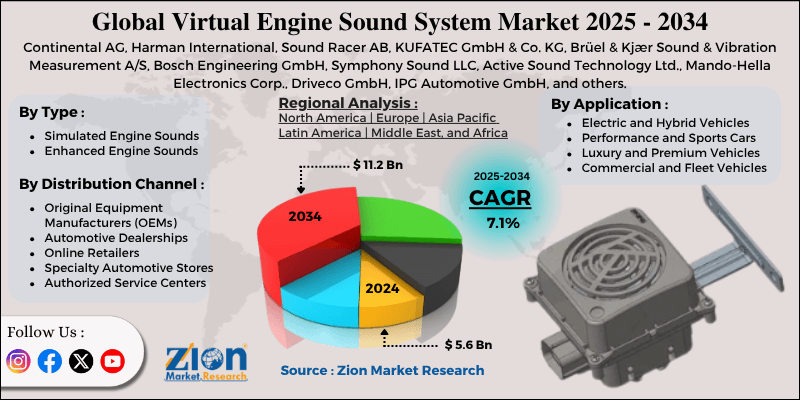
The global virtual engine sound system industry is segmented based on type, application, distribution channel and region. All the segments have been analyzed based on present and future trends and the market is estimated from 2024 to 2032.
Based on the type, the global virtual engine sound system market is bifurcated into simulated engine sounds and enhanced engine sounds. The simulated engine sounds segment is expected to capture the largest market share over the projected period. The rise of EVs and hybrids, which require simulated engine sounds for pedestrian safety and a better driving experience, drives immediate VESS adoption. Also, people want electric and hybrid cars to offer immersive, individualized driving experiences, which prompts automakers to add sophisticated sound systems. This increases demand and market value.
Based on the application, the global virtual engine sound system industry is bifurcated into electric and hybrid vehicles, performance and sports cars, luxury and premium vehicles and commercial and fleet vehicles. The electric and hybrid vehicles segment holds the major market share. Electric and hybrid vehicles operate far more quietly compared to internal combustion engine vehicles, creating the need for artificial sound generation to meet safety regulations and enhance road safety for pedestrians. Thus, driving the market growth.
Based on the distribution channel, the global virtual engine sound system market is bifurcated into Original Equipment Manufacturers (OEMs), automotive dealerships, online retailers, specialty automotive stores and authorized service centers. The Original Equipment Manufacturers (OEMs) segment dominates the market. OEMs are following global guidelines that say electric and hybrid vehicles must have audible warnings or engine noises that seem like they are coming from the real thing. This makes VESS integration an important part of compliance and marketability.
The Regional, this segment includes the current and forecast demand for North America, Europe, Asia Pacific, Latin America,and the Middle East and Africa.
Virtual Engine Sound System Market: Report Scope
| Report Attributes | Report Details |
|---|---|
| Report Name | Virtual Engine Sound System Market |
| Market Size in 2024 | USD 5.6 Billion |
| Market Forecast in 2034 | USD 11.2 Billion |
| Growth Rate | CAGR of 7.1% |
| Number of Pages | 212 |
| Key Companies Covered | Continental AG, Harman International, Sound Racer AB, KUFATEC GmbH & Co. KG, Brüel & Kjær Sound & Vibration Measurement A/S, Bosch Engineering GmbH, Symphony Sound LLC, Active Sound Technology Ltd., Mando-Hella Electronics Corp., Driveco GmbH, IPG Automotive GmbH, and others. |
| Segments Covered | By Type, By Application, By Distribution Channel, and By Region |
| Regions Covered | North America, Europe, Asia Pacific (APAC), Latin America, Middle East, and Africa (MEA) |
| Base Year | 2024 |
| Historical Year | 2019 - 2023 |
| Forecast Year | 2025 - 2034 |
| Customization Scope | Avail customized purchase options to meet your exact research needs. Request For Customization |
Virtual Engine Sound System Market: Regional Analysis
Why does North America dominate the market over the projected period?
North America region is expected to dominate the virtual engine sound system market. Strict regulatory requirements, high adoption of electric and hybrid vehicles, advanced automotive technology infrastructure, and strong consumer demand for premium driving experiences drive the regional expansion of the market.
For instance, according to the International Energy Agency, in the United States, electric car sales increased to 1.6 million in 2024, with the sales share growing to more than 10%. Moreover, the region has a large market for luxury and performance vehicles, where brand identity and immersive driver experiences—including customizable, sophisticated engine sounds—are expected by consumers and used by brands to differentiate.
What are the Recent Developments?
- In July 2023, Maruti Suzuki India introduced the Grand Vitara hybrid SUV equipped with an advanced Virtual Engine Sound System to improve pedestrian safety, incorporating customizable tones that comply with local regulations while enhancing the vehicle's appeal in the growing Indian EV market through seamless integration with its hybrid powertrain.
- In September 2022, BlackBerry partnered with Shanghai Dayin Technology to deploy the "Yin" 2.0 app in Great Wall Motors' vehicles, utilizing BlackBerry QNX acoustics for Virtual Engine Sound System features that provide directional alerts and integrate with infotainment, marking a step toward AI-enhanced sound solutions in Chinese EVs.
- In January 2025, Kia unveiled the EV6 GT with innovative 'Virtual Shift' and engine sound features, simulating gear shifts and engine revs to mimic traditional driving experiences, boosting driver engagement in electric vehicles and highlighting advancements in immersive audio technology for performance-oriented EVs. In April 2020, Volvo collaborated with Harman International on the Polestar 2's Virtual Engine Sound System, introducing the first AVAS-equipped model with tailored pedestrian alerts, setting a benchmark for safety in premium EVs amid rising regulatory pressures.
- In May 2021, Volvo Trucks launched a specialized Virtual Engine Sound System for its electric trucks, featuring distinctive tones to alert pedestrians in urban settings, addressing safety challenges in commercial electrification and supporting fleet operators in complying with EU mandates.
What are the Market Trends?
- Increasing integration of AI and machine learning for personalized sound profiles that adapt to driving conditions and user preferences.
- Growing emphasis on customizable brand-specific sounds to enhance vehicle identity and driver engagement in EVs.
- Expansion of VESS beyond safety to include interior sound enhancement for a more immersive driving experience.
- Rising adoption of directional and multi-speaker systems for precise pedestrian alerts in urban environments.
- Shift toward eco-friendly and energy-efficient designs to minimize battery drain in electric vehicles.
- Collaborations between audio tech firms and automakers for advanced infotainment-VESS fusions.
- Focus on compliance with evolving global regulations, including sound standardization for non-intrusive alerts.
Virtual Engine Sound System Market: Competitive Analysis
The global virtual engine sound system market is dominated by players like:
- Continental AG
- Harman International
- Sound Racer AB
- KUFATEC GmbH & Co. KG
- Brüel & Kjær Sound & Vibration Measurement A/S
- Bosch Engineering GmbH
- Symphony Sound LLC
- Active Sound Technology Ltd.
- Mando-Hella Electronics Corp.
- Driveco GmbH
- IPG Automotive GmbH
The global virtual engine sound system market is segmented as follows:
By Type
- Simulated Engine Sounds
- Enhanced Engine Sounds
By Application
- Electric and Hybrid Vehicles
- Performance and Sports Cars
- Luxury and Premium Vehicles
- Commercial and Fleet Vehicles
By Distribution Channel
- Original Equipment Manufacturers (OEMs)
- Automotive Dealerships
- Online Retailers
- Specialty Automotive Stores
- Authorized Service Centers
By Region
- North America
- The U.S.
- Canada
- Europe
- France
- The UK
- Spain
- Germany
- Italy
- Rest of Europe
- Asia Pacific
- China
- Japan
- India
- South Korea
- Southeast Asia
- Rest of Asia Pacific
- Latin America
- Brazil
- Mexico
- Rest of Latin America
- Middle East & Africa
- GCC
- South Africa
- Rest of Middle East & Africa
Table Of Content
Methodology
FrequentlyAsked Questions
A virtual engine sound system is an electronic system that produces simulated engine sounds for cars, primarily to make electric and hybrid vehicles safer. It makes sounds at low speeds to let others know that the car is there, as these quieter cars don't make the usual engine noise.
The virtual engine sound system market is being driven by several factors such as growing automotive sector, rising emphasis on safety, technological advancements, and others.
Lack of standardization pose a significant challenge to the virtual engine sound system industry's growth.
Based on the application, the electric and hybrid vehicles segment is expected to dominate the virtual engine sound system market growth during the projected period.
The increasing innovation and advancement in technology pose a major impact factor for the virtual engine sound system industry's growth over the projected period.
According to the report, the global virtual engine sound system market size was worth around USD 5.6 billion in 2024 and is predicted to grow to around USD 11.2 billion by 2034.
The global virtual engine sound system market is expected to grow at a CAGR of 7.1% during the forecast period.
The global virtual engine sound system industry growth is expected to be driven by North America region. It is currently the world’s highest revenue-generating market due to the presence of major players and rising demand for EVs.
The global virtual engine sound system market is dominated by players like Continental AG, Harman International, Sound Racer AB, KUFATEC GmbH & Co. KG, Brüel & Kjær Sound & Vibration Measurement A/S, Bosch Engineering GmbH, Symphony Sound LLC, Active Sound Technology Ltd., Mando-Hella Electronics Corp., Driveco GmbH and IPG Automotive GmbH, among others.
The market report covers the geographical market along with a comprehensive competitive landscape analysis. It also includes cash flow analysis, profit ratio analysis, market basket analysis, market attractiveness analysis, sentiment analysis, PESTLE analysis, trend analysis, SWOT analysis, trade area analysis, demand & supply analysis, Porter’s five forces analysis, and value chain analysis.

HappyClients

