
Global Veterinary Regenerative Medicine Market Size, Share, Trends, and Forecast 2034

Veterinary Regenerative Medicine Market By Animal (Small Animals and Large Animals), By Product (Stem Cells, Platelet-Rich Plasma, and Others), By Application (Orthopedics, Trauma/Wound Care, and Others), By End Use (Veterinary Hospitals/Clinics and Veterinary Research Institutes), and Region - Global and Regional Industry Overview, Market Intelligence, Comprehensive Analysis, Historical Data, and Forecasts 2026 - 2034
| Market Size in 2025 | Market Forecast in 2034 | CAGR (in %) | Base Year |
|---|---|---|---|
| USD 1.45 Billion | USD 3.56 Billion | 10.5% | 2025 |
Veterinary Regenerative Medicine Industry Perspective:
What will be the size of the global veterinary regenerative medicine market during the forecast period?
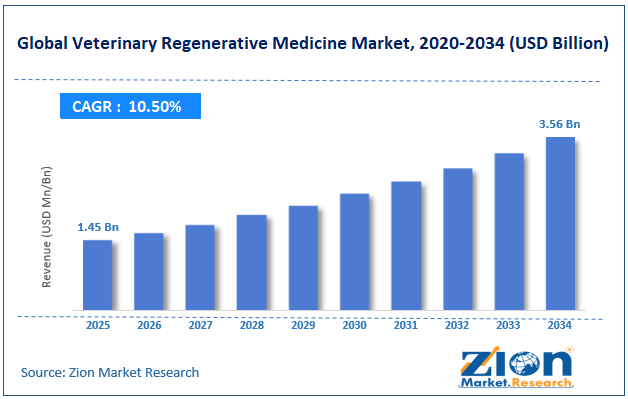
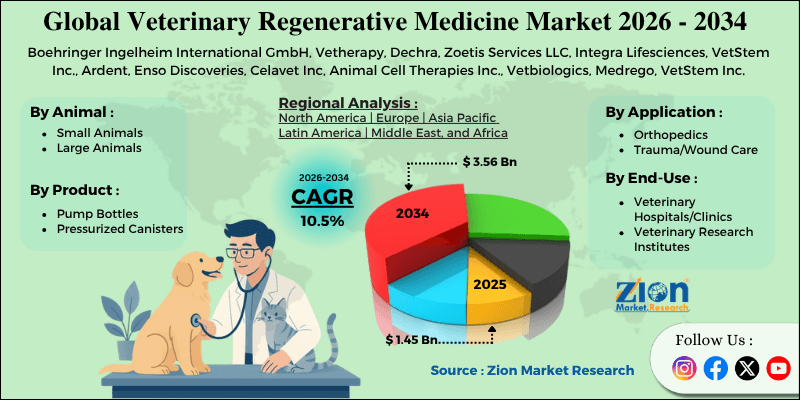
The global veterinary regenerative medicine market size was worth around USD 1.45 billion in 2025 and is predicted to grow to around USD 3.56 billion by 2034, with a compound annual growth rate (CAGR) of roughly 10.5% between 2026 and 2034.
This report provides a comprehensive analysis of the growth drivers, restraints, and challenges shaping demand across the global veterinary regenerative medicine market throughout the forecast period, while highlighting high-potential emerging opportunities within the industry.
Key Insights
- As per the analysis shared by our research analyst, the global veterinary regenerative medicine market is estimated to grow annually at a CAGR of around 10.5% over the forecast period (2026-2034).
- In terms of revenue, the global veterinary regenerative medicine market size was valued at around USD 1.45 billion in 2025 and is projected to reach USD 3.56 billion by 2034.
- Increasing pet healthcare expenditure and the humanization of pets are expected to propel the veterinary regenerative medicine market over the projected period.
- Based on the animal, the small animals segment dominates the market.
- Based on the product, the stem cells segment holds a majority of market share in 2025.
- Based on the application, the orthopedics segment holds a majority of market share in 2025 of 42%.
- Based on the end use, the veterinary hospitals/clinics segment holds the largest market share in 2025.
- Based on region, North America dominates the veterinary regenerative medicine market in 2025 with 38%.
Veterinary Regenerative Medicine Market: Overview
Veterinary regenerative medicine is a division of veterinary medicine that mainly focuses on restoring normal tissues and organs in animals using biological and therapeutic methods. It includes treatments such as regenerative therapies, veterinary stem cells, platelet-rich plasma, tissue engineering, growth factors, and regenerative biomaterials that support tissue repair and help reverse the effects of various diseases and injuries. These treatment modalities can restore function in a wide range of tissues, including muscular, tendinous, ligamentous, articular, and bony tissues. They can promote healing and reduce the inflammatory response after surgery. Veterinary regenerative medicine can improve the quality of life for companion, farm, and athletic animals and minimize the need for invasive or pharmaceutical interventions.
Impact of the USA-Israel War on Iran on the Veterinary Regenerative Medicine Market
The USA-Israel war on Iran is projected to have a mainly negative short-term effect on the veterinary regenerative medicine market in the Middle East due to disrupted transportation, interrupted pharmaceutical supply chains, and restricted access to advanced medical technologies. The military conflict and the Strait of Hormuz blockade will inevitably raise logistical costs for transporting temperature-sensitive and cellular medical materials and equipment, increasing veterinary healthcare expenses. Veterinary institutions and clinics in Iran and the Persian Gulf region may see declining treatment quality and reduced access to critical medical supplies. Yet, in the long run, demand for animal healthcare, tissue-repair treatments, and veterinary regenerative medicine is projected to rise.
Veterinary Regenerative Medicine Market: Dynamics
Growth Drivers
How does the increasing prevalence of chronic, degenerative, and age-related disorders in animals drive the veterinary regenerative medicine market?
A key factor driving the veterinary regenerative medicine market is the rising prevalence of chronic, degenerative, and age-associated disorders in animals. This is primarily because aging animals often require treatment for osteoarthritis and degenerative joint disease, along with tendon, ligament, and other orthopedic disorders. Government-funded United States research studies support this point. For instance, a National Institutes of Health (NIH)- backed Dog Aging Project of 27,542 dogs found that 6.6% had an owner-reported osteoarthritis diagnosis, while 19.2% had a history of orthopedic disease. The study also found that the prevalence of orthopedic conditions increases with age. In contrast, large-breed dogs are particularly prone to orthopedic disease, with diagnoses occurring around age 7.
In addition, the Food and Drug Administration (FDA) has reviewed several studies showing the need for regenerative medicine in veterinary orthopedics. One FDA-reviewed preclinical study focused on canine platelet-rich plasma (PRP). It involved dogs aged 1.6 to 12.7 years, which were treated with intra-articular injections to evaluate the therapy's efficacy and safety. Overall, animals are living longer now, leading to a higher prevalence of chronic, degenerative diseases. These disorders require long-term treatment, including the development of appropriate stem cell therapies, platelet-rich plasma, growth factors, and other treatments to improve tissue-regeneration efficacy.
Restraints
Limited availability of specialized veterinary expertise, laboratory infrastructure, and advanced equipment acts as a major restraint on the growth of the veterinary regenerative medicine industry
The limited availability of specialized veterinary expertise, laboratory infrastructure, and advanced equipment, which are essential for the development of regenerative treatment methods, is a key factor that could restrain the development of the veterinary regenerative medicine market. Regenerative veterinary medicine generally requires veterinary doctors, laboratory technicians, cell-processing experts, and state-of-the-art laboratory infrastructure to isolate, expand, and characterize cells, tissues, or organs, as well as perform cryopreservation and other procedures, which limits adoption of such treatments. For instance, producing mesenchymal stromal cells for veterinary applications requires a safe, sterile environment, sophisticated equipment, stem cell technologists, and cryopreservation capabilities, which increases the overall cost of establishing regenerative medicine services.
Moreover, a key limitation in emerging markets and rural areas is the lack of veterinary hospitals, cell-processing laboratory infrastructure, and related equipment. These factors, along with the absence of appropriate research resources and specific reagents, impede the standardization and development of veterinary stem cell therapeutics, according to research findings. Similarly, the U.S. Government Accountability Office observes that regenerative medicine generally requires an educated workforce trained in laboratory techniques, and that the broader regenerative medicine field has too few laboratory and biomanufacturing technicians.
Opportunities
How does the growing launch of online continuing education (CE) platforms offer a lucrative opportunity for the veterinary regenerative medicine market?
The growing availability of online continuing education (CE) will benefit the veterinary regenerative medicine market by giving veterinarians better access to knowledge on stem cell therapy, PRP, orthobiologics, and related techniques. Virtual platforms offer a convenient way to build the relevant academic competencies needed in this highly specific and continuously evolving area of veterinary medicine. For instance, the American Veterinary Medical Association’s online education platform provides CE for veterinary professionals, while the AAVSB’s RACE program standardizes accreditation for these courses. This opportunity represents a significant advantage for the forecast period because regenerative medicine is complex, and practitioners need to understand indications, contraindications, cell isolation procedures, routes of administration, relevant evidence, and other aspects.
In addition, the veterinary regenerative medicine market opportunity is particularly attractive because online education resources are emerging that offer specialized training in this niche area. For instance, GallantU provides RACE-approved courses on applying stem cells and regenerative medicine, while DVM360 offers CE courses on PRP, PRF, and their application in veterinary medicine. Moreover, the Royal Veterinary College has webinars on stem cells, PRP, and autologous conditioned serum, which are recorded for later viewing.
Challenges
Why do regulatory complexity and lengthy approval processes pose a significant challenge to the growth of the veterinary regenerative medicine industry?
The main hindering force for the development of the veterinary regenerative medicine market is regulatory complexity and a long approval process, as stem-cell therapies, animal cells, tissues, and cell- and tissue-based products (ACTPs) should meet numerous requirements regarding safety, efficacy, manufacturing process, donor eligibility, contamination prevention, labeling, and clinical studies. According to the FDA, most ACTPs are new animal drugs intended to affect an animal’s structure or function and must be approved by the FDA before introduction to the market. The FDA regulates veterinary regenerative medicine products, which can significantly slow development and increase costs because it requires clinical trials to prove the products’ safety and effectiveness and establishes procedures for manufacturing, storing, labeling, packaging, and distributing them under CGMP regulations.
Furthermore, multiple federal agencies, including the FDA and the USDA, may have jurisdiction over ACTP and veterinary biologic development, making it even more challenging.
Veterinary Regenerative Medicine Market: Report Scope
| Report Attributes | Report Details |
|---|---|
| Report Name | Veterinary Regenerative Medicine Market |
| Market Size in 2025 | USD 1.45 Billion |
| Market Forecast in 2034 | USD 3.56 Billion |
| Growth Rate | CAGR of 10.5% |
| Number of Pages | 227 |
| Key Companies Covered | Boehringer Ingelheim International GmbH, Vetherapy, Dechra, Zoetis Services LLC, Integra Lifesciences, VetStem Inc., Ardent, Enso Discoveries, Celavet Inc., Animal Cell Therapies Inc., Vetbiologics, Medrego, VetStem Inc., eQcell Inc., StemcellX, Revatis, Equine Amnio Solutions, Calidi Biotherapeutics Inc., and others. |
| Segments Covered | By Animal, By Product, By Application, By End Use, and By Region |
| Regions Covered | North America, Europe, Asia Pacific (APAC), Latin America, Middle East, and Africa (MEA) |
| Base Year | 2025 |
| Historical Year | 2020 - 2024 |
| Forecast Year | 2026 - 2034 |
| Customization Scope | Avail customized purchase options to meet your exact research needs. Request For Customization |
Veterinary Regenerative Medicine Market: Segmentation
Animal Insights
Why does the small animals segment hold a prominent position in the veterinary regenerative medicine market?
The small animals segment dominates the market. Rising pet ownership, increased spending on advanced therapeutics, and growing awareness of regenerative treatments are key drivers of market growth. The use of platelet-rich plasma, mesenchymal stem cells, and other biologics to treat osteoarthritis, ligament injuries, complex wounds, and other conditions in small animals is increasing. Moreover, pet owners are willing to spend more on novel therapeutics that provide high-quality, non-invasive procedures. Thus, the regenerative veterinary small animal market is rising rapidly due to the growing number of veterinary clinics offering regenerative treatment options for small animals, along with extensive research and development in the field.
Product Insights
How does the stem cells segment capture the largest share in the veterinary regenerative medicine market?
The stem cells segment held the largest market share in 2025. Their ability to repair, regenerate, and restore damaged tissues in companion and large animals is what makes them the growth driver. This therapy has been used to treat osteoarthritis and tendon and ligament injuries. Stem cell procedures are taking over traditional veterinary medicine because they address the root cause of diseases and injuries, not just the symptoms. A combination of emerging clinical evidence, regulatory pathways, and improvements in cryopreserved banked cells and ready-to-use preparations will facilitate adoption of these therapies.
For instance, VetStem, Inc. received funding in April 2025 to advance the FDA conditional approval of StemStat Ortho, an allogeneic stem cell therapy for osteoarthritis in dogs and the first FDA-approved treatment in the $1 billion companion-animal market. Moreover, alliances between biotech companies and veterinary partners are increasing, broadening market reach and increasing the number of innovative products.
Application Insights
Why does the orthopedics segment capture the largest share in the veterinary regenerative medicine market?
The orthopedics segment held a 42% market share in 2025. Growth is primarily driven by the high prevalence of musculoskeletal disorders, including osteoarthritis, ligament injuries, and joint deterioration, in companion animals and elite performance athletic animals. Regenerative treatments, including but not limited to stem cell therapy, Platelet-Rich Plasma (PRP), and Bone Marrow Concentrate, are gaining traction to repair cartilage, promote tissue regeneration, and reduce inflammation. The increase in pet ownership, along with increased orthopedic injuries linked to obesity and demand for minimally invasive, long-term healing treatments, contribute to the segment’s growth.
Additionally, recent advancements in product offerings, such as allogeneic “off-the-shelf” treatments, and the surge in research on veterinary orthopedic treatments fuel market growth. Moreover, continued investment in veterinary orthopedic research and development further supports high adoption of the treatment among clinicians.
End Use Insights
How does the veterinary hospitals/clinics segment capture the largest share in the veterinary regenerative medicine market?
The veterinary hospitals/clinics segment held the largest market share in 2025 because it serves as a major hub for distributing cutting-edge treatments, such as stem cell, PRP, and tissue engineering, due to its wide availability, equipment, and professional personnel, which can provide comprehensive treatment and follow-up care. Moreover, veterinary hospitals play an essential role in the market because of the growing trend toward less invasive treatment methods and the increasing number of pet owners who want to prevent osteoarthritis, injuries, and other degenerative diseases.
Veterinary Regenerative Medicine Market: Regional Insights
What factors drive the North America region in the veterinary regenerative medicine market?
North America held the largest share of the veterinary regenerative medicine market in 2025 at 38%. The region's growth is driven by major players and competitive strategies such as collaborations, product launches, and approvals. For instance, a significant event for the company involved a collaboration with another firm in 2025. Precisely in February, VetStem, Inc. and PetVivo Holdings, Inc. finalized an exclusive license and supply deal. According to its terms, PetVivo received the exclusive right to commercialize VetStem’s PrecisePRP TM Canine and PrecisePRP TM Equine products nationwide. The main advantage of this technology is that it provides a ready-to-use, allogeneic, pooled, freeze-dried PRP (platelet-rich plasma) solution for treating canine and equine joints through intra-articular injection.
Unlike conventional products, these preparations do not require centrifugation of blood obtained from the patient at a veterinary clinic. The companies expect that through this partnership, they will be able to satisfy the growing demand for this product. The joint offering will allow many veterinary clinics to provide regenerative treatments to their patients.
Additionally, the ready-to-use technology will reduce the burden on veterinary professionals, as they will not have to collect blood samples from animals and separate the plasma. As of April 2025, VetStem has already treated more than 40,000 pets in the United States and Canada with cell-based regenerative medicine.
Veterinary Regenerative Medicine Market: Competitive Analysis
The global veterinary regenerative medicine market is dominated by players like:
- Boehringer Ingelheim International GmbH
- Vetherapy
- Dechra
- Zoetis Services LLC
- Integra Lifesciences
- VetStem Inc.
- Ardent
- Enso Discoveries
- Celavet Inc
- Animal Cell Therapies Inc.
- Vetbiologics
- Medrego
- VetStem Inc.
- eQcell Inc.
- StemcellX
- Revatis
- Equine Amnio Solutions
- Calidi Biotherapeutics Inc.
The global veterinary regenerative medicine market is segmented as follows:
By Animal
- Small Animals
- Large Animals
By Product
- Stem Cells
- Platelet-Rich Plasma
- Others
By Application
- Orthopedics
- Trauma/Wound Care
- Others
By End Use
- Veterinary Hospitals/Clinics
- Veterinary Research Institutes
By Region
- North America
- The U.S.
- Canada
- Mexico
- Europe
- France
- The UK
- Spain
- Germany
- Italy
- Rest of Europe
- Asia Pacific
- China
- Japan
- India
- Australia
- South Korea
- Rest of Asia Pacific
- The Middle East & Africa
- Saudi Arabia
- UAE
- Egypt
- Kuwait
- South Africa
- Rest of the Middle East & Africa
- Latin America
- Brazil
- Argentina
- Rest of Latin America
Table Of Content
Methodology
FrequentlyAsked Questions
Veterinary regenerative medicine is a division of veterinary medicine that mainly focuses on restoring normal tissues and organs in animals using biological and therapeutic methods. It includes treatments such as regenerative therapies, veterinary stem cells, platelet-rich plasma, tissue engineering, growth factors, and regenerative biomaterials that support tissue repair and help reverse the effects of various diseases and injuries.
The key growth drivers for the veterinary regenerative medicine market include the rising prevalence of osteoarthritis, chronic and degenerative disorders, and soft-tissue injuries in animals, particularly companion and performance animals.
What are the major challenges restraining the growth of the veterinary regenerative medicine market?
The major challenges restraining the growth of the veterinary regenerative medicine market include the high cost of regenerative therapies, regulatory complexity, limited clinical evidence, lack of standardized treatment protocols, and limited availability of specialized veterinary expertise and laboratory infrastructure. Regenerative products are biologically complex and can vary according to donor source, cell type, manufacturing process, and potency, making consistent product quality and clinical outcomes difficult to achieve.
Based on the application, the orthopedics segment is expected to dominate the veterinary regenerative medicine market growth during the projected period.
Several emerging trends and innovations are reshaping the veterinary regenerative medicine market. One of the most important is the increasing use of mesenchymal stem cells (MSCs) for conditions such as osteoarthritis, tendon and ligament injuries, musculoskeletal disorders, and other degenerative diseases.
According to the report, the global veterinary regenerative medicine market size was worth around USD 1.45 billion in 2025 and is predicted to grow to around USD 3.56 billion by 2034.
The global veterinary regenerative medicine market is expected to grow at a CAGR of 10.5% during the forecast period.
The global veterinary regenerative medicine industry growth is expected to be led by North America over the forecast period.
The global veterinary regenerative medicine market is dominated by players like Boehringer Ingelheim International GmbH, Vetherapy, Dechra, Zoetis Services LLC, Integra Lifesciences, VetStem, Inc., Ardent, Enso Discoveries, Celavet Inc, Animal Cell Therapies, Inc., Vetbiologics, Medrego, VetStem, Inc., eQcell Inc., StemcellX, Revatis, Equine Amnio Solutions, and Calidi Biotherapeutics, Inc., among others.
The veterinary regenerative medicine market report covers the geographical market along with a comprehensive competitive landscape analysis. It also includes cash flow analysis, profit ratio analysis, market basket analysis, market attractiveness analysis, sentiment analysis, PESTLE analysis, trend analysis, SWOT analysis, trade area analysis, demand & supply analysis, Porter’s five forces analysis, and value chain analysis.

HappyClients

