
Veggie Burgers Market Size, Share, Trends, Growth and Forecast 2034

Veggie Burgers Market By Type (Frozen Veggie Burgers, Fresh Veggie Burgers, Chilled Veggie Burgers, and Shelf-Stable Veggie Burgers), By Flavor (Plain Veggie Burgers, Spicy Veggie Burgers, Seasoned Veggie Burgers, Gourmet Veggie Burgers, and Smoked Veggie Burgers), By Ingredients (Soy-Based Veggie Burgers, Lentil-Based Veggie Burgers, Quinoa-Based Veggie Burgers, Chickpea-Based Veggie Burgers, and Black Bean-Based Veggie Burgers), By Distribution Channel (Supermarkets/Hypermarkets, Online Retailers, Convenience Stores, Fast Food Restaurants, and Specialty Health Food Stores), and By Region - Global and Regional Industry Overview, Market Intelligence, Comprehensive Analysis, Historical Data, and Forecasts 2025 - 2034
| Market Size in 2024 | Market Forecast in 2034 | CAGR (in %) | Base Year |
|---|---|---|---|
| USD 27.8 Billion | USD 209.8 Billion | 22.4% | 2024 |
Veggie Burgers Industry Perspective:
What will be the size of the global veggie burgers market during the forecast period?
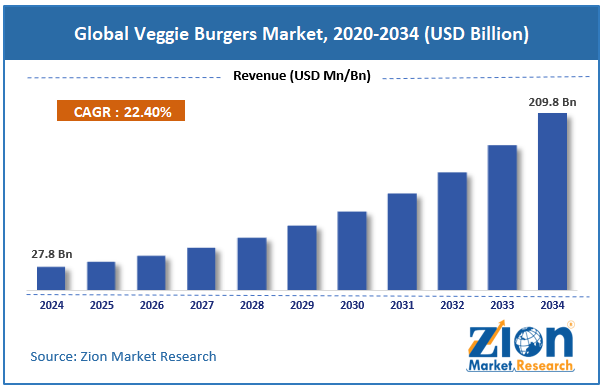
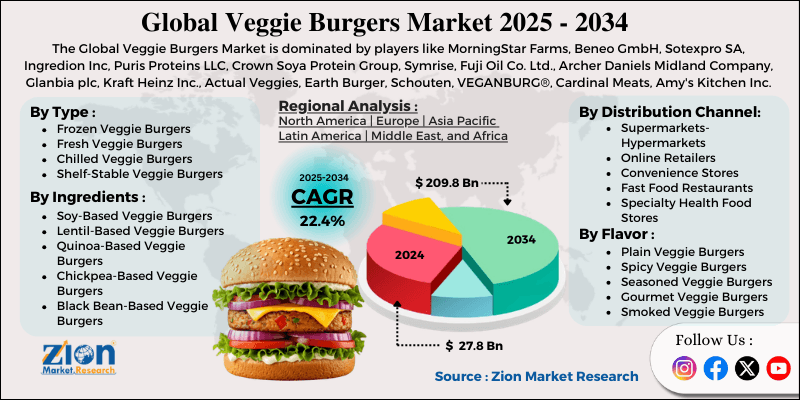
The global veggie burgers market size was worth around USD 27.8 billion in 2024 and is predicted to grow to around USD 209.8 billion by 2034, with a compound annual growth rate (CAGR) of roughly 22.4% between 2025 and 2034.
 Request Free SampleRequest Free Sample
Key Insights
- As per the analysis shared by our research analyst, the global veggie burgers market is estimated to grow annually at a CAGR of around 22.4% over the forecast period (2025-2034).
- In terms of revenue, the global veggie burgers market size was valued at around USD 27.8 billion in 2024 and is projected to reach USD 209.8 billion by 2034.
- Growth of the vegan & flexitarian population is expected to drive the veggie burgers market.
- Based on the type, the frozen veggie burgers are expected to capture the largest market share over the analysis period.
- Based on the flavor, seasoned veggie burgers hold the largest market share in 2024.
- Based on the ingredients, the soy-based veggie burgers segment captures the largest market share of over 30% in 2024.
- Based on the distribution channel, the supermarkets/hypermarkets distribution channel leads the market.
- Based on region, North America holds the largest revenue share of 45% in 2024.
Veggie Burgers Market: Overview
Veggie burgers are made from plant-based ingredients and are supposed to be eaten instead of regular beef burgers. Common ingredients include vegetables, legumes (such as black beans or lentils), grains (such as quinoa or brown rice), nuts, seeds, and plant-based proteins (such as soy or pea protein). These ingredients are mixed with spices and other binders to form a patty that looks, tastes, and feels like a regular beef burger. Veggie burgers can be either vegetarian or vegan, depending on whether they contain eggs or dairy products, which are animal-derived. People who don't consume meat, fish, or dairy but want to eat foods that are better for their health, the environment, or their values. Consumers can get them at grocery stores, restaurants, and other food-serving establishments worldwide.
Veggie Burgers Market: Dynamics
Growth Drivers
Why does the rising health consciousness drive the growth of the veggie burgers market?
As people become more aware of their health, the market grows as they place a higher priority on preventive care, healthy eating, and overall well-being. People are more conscious of lifestyle-related diseases like obesity, heart disease, and diabetes, so they look for food and drink products that are thought to be healthier, have less saturated fat, cholesterol, or sugar, or are high in fiber or plant protein. Because people want cleaner, more natural, and more functional products, businesses are being forced to create and expand their healthier product lines. Fitness trends, digital health information, and wellness-focused lifestyles also encourage people to repeatedly buy the same products and make long-term changes to their diets. Because of this, businesses that connect with health-conscious customers achieve higher sales, greater customer loyalty, and long-term market growth.
Restraints
Concerns over ultra-processed ingredients act as a major restraint to the market growth
Individuals are worried about ultra-processed ingredients because an increasing number of individuals are linking highly processed foods to health issues like obesity, metabolic disorders, and cardiac problems. This is bad for market growth. Many plant-based or alternative products are marketed as healthier options, yet some contain chemicals, stabilizers, artificial flavors, and excessive sodium, making them taste and feel like regular products. People who care about their health and prefer whole, minimally processed meals with clear labeling may think these formulas don't align with the trend toward healthy, natural foods. People who don't trust might not buy again, new customers might find it tougher to accept, and people might be searching for shorter ingredient lists. This slows the veggie burger market growth and puts additional pressure on producers to change what they make.
Opportunities
Does the rising focus on sustainability offer a lucrative opportunity for the veggie burgers market growth?
The veggie burger market is growing rapidly as people become more concerned about the environment and sustainability. As concerns about climate change grow, people are more likely to buy products that align with their environmental attitudes. Compared to making meat the old-fashioned way, producing vegetable burgers uses fewer resources and emits fewer greenhouse gases. Data shows that people who eat a lot of plants can greatly reduce their carbon footprint, which is something that ecologically conscious consumers want. It looks like this adjustment in eating patterns toward more sustainable ones is a permanent change in how people act, not just a trend. Because of this, the market will benefit from the greater focus on sustainability, attracting more people who care about buying ethically.
Challenges
Why does competition from alternatives pose a major challenge to the veggie burger market growth?
Competition from other options makes it hard for the market to grow, as customers have many choices that can fulfill their dietary, nutritional, or lifestyle needs. Many health-conscious people, for example, choose whole-food alternatives such as beans, lentils, tofu, and mushrooms, or homemade meals, over processed plant-based alternatives. These foods are often perceived as more natural and less expensive.
Also, traditional protein sources like poultry, eggs, and dairy are still the most popular since people are used to them, they taste well, and they are cheaper in many countries. The growing number of nutritional options, such as low-carb, high-protein, and functional foods, is further fragmenting consumer demand. This intense competition makes it hard for firms to enter new markets, pressures pricing strategies, and pushes them to constantly develop new ideas to set their products apart and keep customers coming back.
 Request Free SampleRequest Free Sample
Veggie Burgers Market: Report Scope
| Report Attributes | Report Details |
|---|---|
| Report Name | Veggie Burgers Market |
| Market Size in 2024 | USD 27.8 Billion |
| Market Forecast in 2034 | USD 209.8 Bllion |
| Growth Rate | CAGR of 22.4% |
| Number of Pages | 223 |
| Key Companies Covered | MorningStar Farms, Beneo GmbH, Sotexpro SA, Ingredion Inc, Puris Proteins LLC, Crown Soya Protein Group, Symrise, Fuji Oil Co. Ltd., Archer Daniels Midland Company, Glanbia plc, Kraft Heinz Inc., Actual Veggies, Earth Burger, Schouten, VEGANBURG®, Cardinal Meats, Amy's Kitchen Inc., and others. |
| Segments Covered | By Type, By Flavor, By Ingredients, By Distribution Channel, and By Region |
| Regions Covered | North America, Europe, Asia Pacific (APAC), Latin America, Middle East, and Africa (MEA) |
| Base Year | 2024 |
| Historical Year | 2019 to 2023 |
| Forecast Year | 2025 - 2034 |
| Customization Scope | Avail customized purchase options to meet your exact research needs. Request For Customization |
Veggie Burgers Market: Segmentation
Type Insights
What factor causes the frozen veggie burger segment to be in a dominant position in the veggie burger industry?
The frozen veggie burgers are expected to capture the largest market share over the analysis period. The main reasons for growth include convenience, longer shelf life, and more stores that sell the product. People in cities are becoming more interested in ready-to-cook meals that save time and fit their busy lives. This is driving revenue growth in this area. Manufacturers can keep the quality, texture, and flavor of their products while reducing spoilage and logistical problems by using frozen forms. This makes them perfect for distribution in large supermarkets and hypermarkets.
Flavor Insights
Why do seasoned veggie burgers hold the largest share in the veggie burgers market?
Seasoned veggie burgers hold the largest market share in 2024. The number of consumers is growing as more people are seeking plant-based solutions that taste better. As competition intensifies, producers are using stronger seasonings, global spice blends, and unique flavors to make their products taste better and entice people to buy them again. People who care about their health typically look for plant-based foods that taste good. Seasoned versions help get over the flavor problems that come with vegetarian foods.
Ingredients Insights
Why do the soy-based veggie burgers capture the largest revenue share in 2024 in the veggie burger market?
The soy-based veggie burger segment captures the largest market share of over 30% in 2024. Their increase is due to their high protein content, low cost, and long shelf life. Soy protein, especially in the form of textured vegetable protein (TVP) and soy protein isolates, has a texture that is similar to meat and a high amino acid profile. This makes it a popular ingredient for people who want to make burgers that taste like restaurant fare. This market's revenue growth is due to its lower manufacturing costs compared to newer plant proteins. This lets businesses offer items at competitive prices and target consumers who are price-sensitive.
Distribution Channel Insights
Why do the supermarkets/hypermarkets dominate the veggie burgers market?
The supermarkets/hypermarkets distribution channel leads the market. The growth of organized retail chains in cities and suburbs has made more products available, especially in new markets. Retailers are also pushing their own plant-based products, making them more affordable and lowering prices. Supermarkets and hypermarkets remain a major driver of veggie burger market growth, as more and more health-conscious and flexitarian shoppers buy their goods at big stores every week.
Regional Insights
Why does North America hold the largest market share in the veggie burgers market?
North America holds the largest revenue share of 45% in 2024. The area's expansion is being driven by more people caring about their health, more people becoming vegetarians, and a big need for plant-based protein alternatives. Regulatory support for plant-based items and programs that encourage sustainable food sources is making this trend even stronger. The US is the leader in this field, with companies like Beyond Meat and Impossible Foods at the top. Canada also plays a big role, focusing on local production and environmental sustainability. Innovation is a key part of the competitive landscape, with companies often introducing new flavors and formulations to meet customer needs.
Veggie Burgers Market: Competitive Analysis
The global veggie burgers market is dominated by players like;
- MorningStar Farms
- Beneo GmbH
- Sotexpro SA
- Ingredion Inc
- Puris Proteins LLC
- Crown Soya Protein Group
- Symrise
- Fuji Oil Co. Ltd.
- Archer Daniels Midland Company
- Glanbia plc
- Kraft Heinz Inc.
- Actual Veggies
- Earth Burger
- Schouten
- VEGANBURG®
- Cardinal Meats
- Amy's Kitchen Inc.
The global veggie burgers market is segmented as follows:
By Type
- Frozen Veggie Burgers
- Fresh Veggie Burgers
- Chilled Veggie Burgers
- Shelf-Stable Veggie Burgers
By Flavor
- Plain Veggie Burgers
- Spicy Veggie Burgers
- Seasoned Veggie Burgers
- Gourmet Veggie Burgers
- Smoked Veggie Burgers
By Ingredients
- Soy-Based Veggie Burgers
- Lentil-Based Veggie Burgers
- Quinoa-Based Veggie Burgers
- Chickpea-Based Veggie Burgers
- Black Bean-Based Veggie Burgers
By Distribution Channel
- Supermarkets/Hypermarkets
- Online Retailers
- Convenience Stores
- Fast Food Restaurants
- Specialty Health Food Stores
By Region
- North America
- The U.S.
- Canada
- Mexico
- Europe
- France
- The UK
- Spain
- Germany
- Italy
- Rest of Europe
- Asia Pacific
- China
- Japan
- India
- Australia
- South Korea
- Rest of Asia Pacific
- The Middle East & Africa
- Saudi Arabia
- UAE
- Egypt
- Kuwait
- South Africa
- Rest of the Middle East & Africa
- Latin America
- Brazil
- Argentina
- Rest of Latin America
Table Of Content
Methodology
FrequentlyAsked Questions

HappyClients

