
U.S. Intelligent Transportation Systems Market Size, Share, Report 2034

U.S. Intelligent Transportation Systems Market By Component (Hardware, Software and Services), By Type (Advanced Traveler Information System (ATIS), Advanced Traffic Management System (ATMS), Advanced Transportation Pricing System (ATPS), Advanced Public Transportation System (APTS), and Emergency Medical System (EMS)), By Mode of Transport (Roadways, Railways, Waterways, and Airways), By Deployment (On-Premise and Cloud), By Application (Traffic Management, Road Safety and Security, Freight Management, Public Transport, Automotive Telematics, Parking Management, and Others), and By Regional Industry Overview, Market Intelligence, Comprehensive Analysis, Historical Data, and Forecasts 2025 - 2034
| Market Size in 2024 | Market Forecast in 2034 | CAGR (in %) | Base Year |
|---|---|---|---|
| USD 13.2 Billion | USD 29.0 Billion | 8.2% | 2024 |
U.S. Intelligent Transportation Systems Industry Perspective:
What will be the size of the US intelligent transportation systems market during the forecast period?
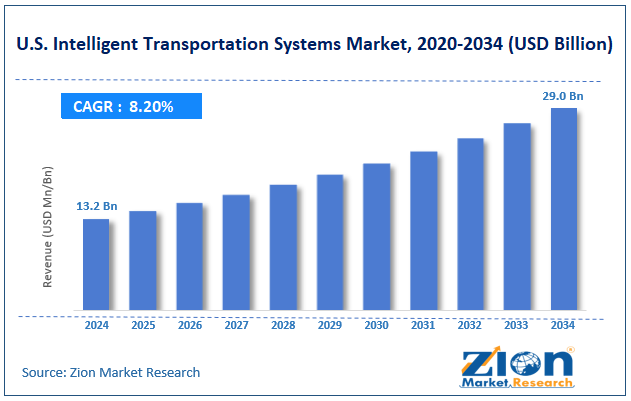
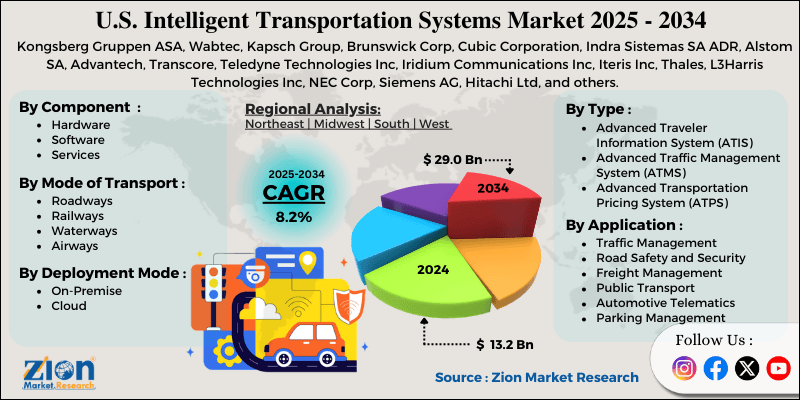
The U.S. intelligent transportation systems market size was worth around USD 13.2 billion in 2024 and is predicted to grow to around USD 29.0 billion by 2034, with a compound annual growth rate (CAGR) of roughly 8.2% between 2025 and 2034.
 Request Free SampleRequest Free SampleRequest Free Sample
Key Insights
- As per the analysis shared by our research analyst, the U.S. intelligent transportation systems market is estimated to grow annually at a CAGR of around 8.2% over the forecast period (2025-2034).
- In terms of revenue, the U.S. intelligent transportation systems market size was valued at around USD 13.2 billion in 2024 and is projected to reach USD 29.0 billion by 2034.
- Smart city & infrastructure modernization initiatives are expected to drive the U.S. intelligent transportation systems market over the forecast period.
- Based on the component, the hardware segment captures the largest revenue share of 45% in 2024.
- Based on the type, the Advanced Traffic Management System (ATMS) segment dominates the market, accounting 35% of the market share.
- Based on the mode of transport, the roadways segment dominates the market, accounting for 48% of revenue.
- Based on the deployment mode, the on-premise segment dominates the market.
- Based on the application, the traffic management segment dominates the market.
U.S. Intelligent Transportation Systems Market: Overview
An intelligent transportation system is an advanced application that uses information and communication technologies to enhance specific transportation infrastructure and vehicles, optimizing safety, efficiency, mobility, and environmental factors. Combining a pool of innovative tools, such as sensors for real-time traffic monitoring, GPS, cameras, wireless communication, data analytics, and automation systems, it collects and distributes transportation data between vehicles or to travel management hosts. ITS enables functions such as traffic signal management, incident detection and management, electronic toll collection, transit monitoring and control, traveler information systems, and V2V and V2I communications. It provides all the necessary real-time information to traffic network operators and travelers and can improve efficiency, reduce congestion and delays, enhance safety and fuel economy, and achieve sustainable, connected transportation.
U.S. Intelligent Transportation Systems Market: Dynamics
Growth Drivers
Why does rapid urbanization & traffic congestion drive the growth of the US intelligent transportation systems market?
Urbanization and the resulting increase in traffic congestion are significant drivers of growth in the US intelligent transportation systems market. The rapid growth of urban centers means more vehicles on roads, increased traffic congestion, longer travel times, and pressure on existing transportation infrastructure and networks. With this increase in overall traffic volumes, there is a growing demand for intelligent traffic management systems to alleviate strain on existing infrastructure. These systems provide a variety of tools for transportation authorities to understand traffic patterns, monitor congested areas, and analyze data to better control and direct traffic. They are therefore extremely important for combating increasing congestion, delays, and travel times in emerging urban areas.
Restraints
High capital & lifecycle costs act as a major restraint for the market development
High capital and lifecycle costs are among the biggest barriers to growth in the U.S. intelligent transportation systems market. Deployment of an ITS infrastructure, whether at the system level or for individual hardware components such as sensors and cameras, communications networks, control centers, and roadside units, requires a significant upfront capital investment as well as high subscription and implementation costs for software platforms and data acquisition and analysis software. These high costs, along with ongoing expenditures and resources for system integration, technology upgrades, training, and security upgrades, increase the system's lifecycle costs and delay project buy-in and deployment, especially for cash-strapped municipal and transportation authorities. This factor limits market growth despite the system's inherent long-term operational and safety benefits.
Opportunities
Does federal & state funding support offer a potential opportunity for the US intelligent transportation systems industry?
The US intelligent transportation systems market can benefit significantly from federal and state funding. With government initiatives focused on transportation modernization, infrastructure upgrades, and smart city development, financial support can help offset the high upfront investment required for transportation deployment projects. Grants, incentives, and direct investments from the federal government and state agencies to support the development and deployment of traffic management systems, C-ITS, data visualization tools, and intelligent mobility solutions stimulate market growth. They also help set standards, encourage innovation, and expedite the widespread application of ITS.
According to the Congrees.gov/Library of Congress, in FY2024, the federal government provided an estimated $1.1 trillion to state and local governments in federal grants, funding a wide range of public policy initiatives such as health care, transportation, income security, education, job training, social services, community development, and environmental protection.
Challenges
How do cybersecurity & privacy risks pose a major challenge to the US intelligent transportation systems market expansion?
Cybersecurity and privacy issues are critical barriers to the U.S. intelligent transportation systems market's growth, as the system relies on highly interconnected digital infrastructure, real-time information sharing, cloud-based platforms, and vehicle-to-infrastructure communication. With the growth in transportation connectivity and interdependence, ITS is more exposed to hacking, a cyberattack that could jeopardize the entire traffic management system by blocking signals, blocking toll collection, or tampering with safety-related functions. ITS platform investment also entails handling a large amount of personal data, thereby raising privacy concerns. Future data breaches, unauthorized access or publication, and the abuse of personal information associated with the use of the ITS platform could erode ITS's credibility and lead to greater regulatory pressure.
Meanwhile, operating ITS systems requires investments in encryption technology, monitoring systems, compliance policies and procedures, and trained personnel, which can multiply operating costs and the lead time for large-scale implementation of the ITS platform.
 Request Free SampleRequest Free SampleRequest Free Sample
U.S. Intelligent Transportation Systems Market: Report Scope
| Report Attributes | Report Details |
|---|---|
| Report Name | U.S. Intelligent Transportation Systems Market |
| Market Size in 2024 | 13.2 Billion |
| Market Forecast in 2034 | 29.0 Billion |
| Growth Rate | CAGR of 8.2% |
| Number of Pages | 223 |
| Key Companies Covered | Kongsberg Gruppen ASA, Wabtec, Kapsch Group, Brunswick Corp, Cubic Corporation, Indra Sistemas SA ADR, Alstom SA, Advantech, Transcore, Teledyne Technologies Inc, Iridium Communications Inc, Iteris Inc, Thales, L3Harris Technologies Inc, NEC Corp, Siemens AG, Hitachi Ltd, and others. |
| Segments Covered | By Component, By Type, By Mode of Transport, By Deployment Mode, By Application, and By Region |
| Regions Covered in U.S. | Northeast, Midwest, South, and West |
| Base Year | 2024 |
| Historical Year | 2019 to 2023 |
| Forecast Year | 2025 - 2034 |
| Customization Scope | Avail customized purchase options to meet your exact research needs. Request For Customization |
U.S. Intelligent Transportation Systems Market: Segmentation
By Component Insights
Why does hardware hold the dominant position in the US intelligent transportation systems market?
The hardware segment captures the largest revenue share of 45% in 2024. This dominance is mainly driven by the increasing requirements for hardware systems that support different parts of such intelligent solutions, such as various sensors, including cameras, and control units, required for the everyday operation of systems. They provide support for vehicle tracking and the smooth operation of traffic, which are basic requirements for any smart city or urban mobility program. With ongoing investments in smart infrastructure equipment, high-performance hardware components will remain in high demand.
By Type Insights
Is the Advanced Traffic Management System (ATMS) growing substantially in the US intelligent transportation systems industry?
The Advanced Traffic Management System (ATMS) segment dominates the market, accounting 35% of the market share. This dominance is mainly due to the need for real-time traffic detection and control to address congestion, delays, and road-safety issues. Real-time traffic management (RTTM) products, such as intelligent traffic lights, CCTV, and dynamic message signs, are essential for controlling traffic flow and responding rapidly to abnormal conditions, thereby supporting smart city initiatives and large-scale infrastructure projects.
By Mode of Transport Insights
Does the roadways segment dominate the US intelligent transportation systems industry?
The roadways segment dominates the market, accounting for 48% of revenue. The growth can be attributed mainly to rising traffic congestion, the increasing number of vehicle owners, and the need to upgrade increasingly outdated transportation infrastructure. The roadways constitute the largest application segment in the U.S. ITS market, as state and federal transportation agencies focus on more self-sufficient advanced traffic management systems, incident detection systems, adaptive signal control systems, electronic toll collection systems, and traveler information systems. In this segment, revenue is also expected to increase largely on the back of upcoming large-scale federal and state government infrastructure funding initiatives, the ever-growing smart city implementation programs, and investments in V2I infrastructure.
By Deployment Mode Insights
Why do on-premises hold the dominant position in the US intelligent transportation systems market?
The on-premise segment dominates the market. This is driven by high demand from federal, state, and municipal transportation organizations prioritizing data control, security, and compliance. On-premises provides ITS software and traffic management systems hosted within transportation organizations' agency-owned data centers, allowing agencies full ownership of operational data, system installation, and cybersecurity standards. Revenue growth here is primarily driven by cybersecurity, data privacy and security regulation, and high-reliability issues in mission-critical roadway operations. Many transportation bodies favor on-premises infrastructure for their core applications, such as traffic signal control, incident management systems, tolling operations, and emergency operations centers, where latency, uptime, and direct control are highly valuable.
By Application Insights
Does traffic management account for the largest share of the US intelligent transportation systems market?
The traffic management segment dominates the market. This growth is due to growing concerns about accident reduction, emergency response optimization, and emissions control, which are encouraging agencies to implement intelligent traffic solutions that enhance situational awareness and decision-making capabilities.
U.S. Intelligent Transportation Systems Market: Competitive Analysis
The U.S. intelligent transportation systems market is dominated by players like:
- Kongsberg Gruppen ASA
- Wabtec
- Kapsch Group
- Brunswick Corp
- Cubic Corporation
- Indra Sistemas SA ADR
- Alstom SA
- Advantech
- Transcore
- Teledyne Technologies Inc
- Iridium Communications Inc
- Iteris Inc
- Thales
- L3Harris Technologies Inc
- NEC Corp
- Siemens AG
- Hitachi Ltd
The U.S. intelligent transportation systems market is segmented as follows:
By Component
- Hardware
- Software
- Services
By Type
- Advanced Traveler Information System (ATIS)
- Advanced Traffic Management System (ATMS)
- Advanced Transportation Pricing System (ATPS)
- Advanced Public Transportation System (APTS)
- Emergency Medical System (EMS)
By Mode of Transport
- Roadways
- Railways
- Waterways
- Airways
By Deployment Mode
- On-Premise
- Cloud
By Application
- Traffic Management
- Road Safety and Security
- Freight Management
- Public Transport
- Automotive Telematics
- Parking Management
- Others
By Region
-
The U.S.
- Northeast
- Midwest
- South
- West
Table Of Content
Methodology
FrequentlyAsked Questions

HappyClients

