
Underground Mining Vehicles Market Size, Share, Growth and Forecast 2034

Underground Mining Vehicles Market By Type (Hydraulic Excavators, Mining Dozers, Underground haulers and Others), By Application (Metal Mining, Mineral Mining and Coal Mining), By Propulsion Type (ICE and Electric) and By Region - Global and Regional Industry Overview, Market Intelligence, Comprehensive Analysis, Historical Data, and Forecasts 2025 - 2034
| Market Size in 2024 | Market Forecast in 2034 | CAGR (in %) | Base Year |
|---|---|---|---|
| USD 195 Billion | USD 343 Billion | 5.8% | 2024 |
Underground Mining Vehicles Industry Perspective:
What will be the size of the global underground mining vehicles market during the forecast period?
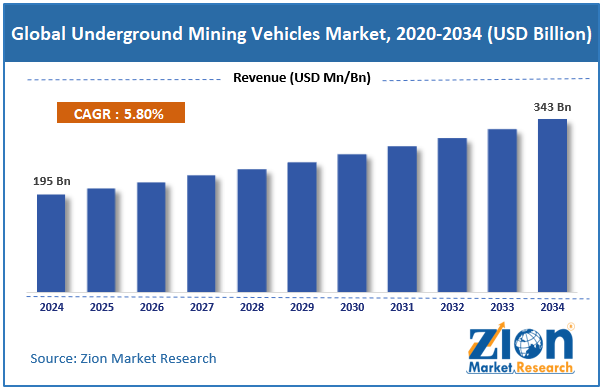
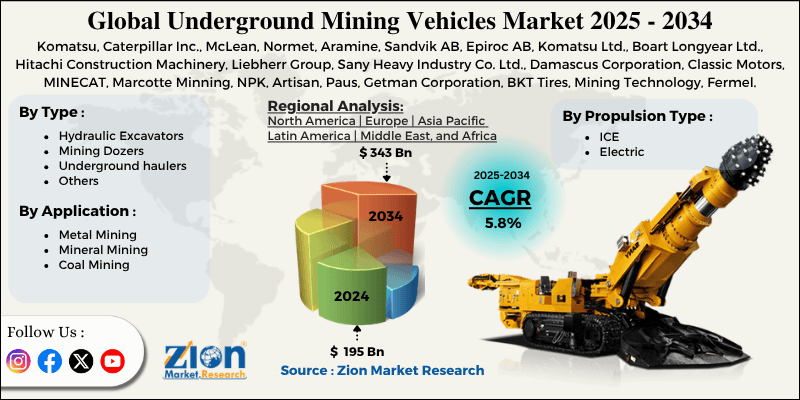
The global underground mining vehicles market size was worth around USD 195 billion in 2024 and is predicted to grow to around USD 343 billion by 2034 with a compound annual growth rate (CAGR) of roughly 5.8% between 2025 and 2034.
Key Insights
- As per the analysis shared by our research analyst, the global underground mining vehicles market is estimated to grow annually at a CAGR of around 5.8% over the forecast period (2025-2034).
- In terms of revenue, the global underground mining vehicles market size was valued at around USD 195 billion in 2024 and is projected to reach USD 343 billion by 2034.
- Infrastructure development and industrialization is expected to propel the underground mining vehicles market over the projected period.
- Based on the type, the hydraulic excavators segment captures the largest market share in 2024.
- Based on the application, the metal mining segment captures the largest revenue share in 2024.
- Based on the propulsion type, the ICE segment dominates the market in 2024.
- Based on region, the Asia Pacific captures the largest market share in 2024.
Underground Mining Vehicles Market: Overview
The phrase “underground mining vehicles” refers to the types of vehicles specifically designed for use in underground mines. The vehicles perform various tasks in underground mining, including drilling, hauling, loading, scaling, and transportation. Underground mining vehicles are small, highly agile, and extremely sturdy because they must operate in difficult conditions characterized by low visibility, rough terrain, and poor ventilation. Some examples of underground mining vehicles include the load-haul-dump (LHD) vehicle, underground mining truck, drill rig, and utility vehicle, all of which have become technologically advanced through features such as automation and electrification.
Impact of the USA-Israel War on Iran on the Underground Mining Vehicles Market
The USA-Israel conflict against Iran has both positive and negative impacts on the Underground Mining Vehicles Market. On the positive side, the ongoing war between the USA, Israel, and Iran has led to a surge in the prices of oil and energy due to disruptions in their supply and blockages through channels such as the Strait of Hormuz. This results in high fuel, production, and transport costs for mining vehicles, limiting market growth. In addition, logistical challenges have led to higher costs for mining vehicle supplies, thereby delaying deliveries of the mining vehicles. On the negative side, geopolitical uncertainty has led to increased investment in strategic minerals and metals.
Underground Mining Vehicles Market: Dynamics
Growth Drivers
Does the rising demand for minerals and metals drive the underground mining vehicles market?
The increase in the demand for minerals and metals will be one of the major factors driving the market growth in the coming years. The mining industry will see an increased demand for materials such as iron ore, copper, lithium, and gold, owing to their extensive use in the construction, automotive, electronics, and renewable energy sectors. With the rising number of infrastructure development projects, urbanization, and the adoption of electric vehicles and renewable energy technologies across the globe, demand for these raw materials will increase. Mining operations are becoming more difficult as surface deposits have become scarce and mines are being exploited deep underground.
Restraints
High capital and operational costs are one of the major restraints that hinder the growth of the underground mining vehicles industry
High capital and operating expenses are among the key limitations affecting the growth of the underground mining vehicles industry. This is because these mining vehicles are expensive to acquire. The high expenses associated with acquiring mining vehicles include not only purchase costs but also maintenance, fuel, spare parts, and labor. These expenses may prove too much for smaller organizations within this industry, limiting their ability to use modern machinery.
Opportunities
How does the expansion of a market player's product division offer a lucrative opportunity for the underground mining vehicles market?
The expansion of a market players product division offers a lucrative opportunity for the underground mining vehicles market. For instance, in February 2025, as the international mining industry gears up to convene in Denver, US and Toronto, Canada in the coming weeks for the SME Denver and PDAC conferences respectively, MacLean Engineering ("MacLean") is proud to announced the formation of a new Surface Mining Vehicles division, leveraging over 50 years of experience in providing purpose-built solutions for the underground mining industry as an OEM and over a decade of EV designs and supporting technologies in North America, Africa, and Australia. MacLean is proud to introduce its first product for the division, the GR8 EV Surface Grader. MacLean has been announced as the first customer of the GR8, joining forces with Fortescue following the MINExpo 2024 conference in Las Vegas to assist Fortescue in achieving its industry-leading Real Zero 2030 decarbonization strategy in its iron ore mines in Western Australia.
Challenges
Why do the infrastructure limitations in developing regions pose a significant challenge to the underground mining vehicles market?
Inadequately developed infrastructure is a primary challenge in the underground mining vehicles market, as these vehicles require robust infrastructure to operate properly and efficiently. The first reason is the availability of an energy source required to provide adequate ventilation, lighting, and even power for electrically operated machines; however, a lack of energy hinders the use of such equipment in underdeveloped economies. Another challenge associated with the improper development of underground infrastructure refers to its negative impact on the mobility of such vehicles. A lack of well-developed underground roads may affect the performance of underground mining machines by slowing them down and wearing them out. Lastly, the lack of underground infrastructure may become an expensive factor when using sophisticated mining vehicles.
Underground Mining Vehicles Market: Report Scope
| Report Attributes | Report Details |
|---|---|
| Report Name | Underground Mining Vehicles Market |
| Market Size in 2024 | USD 195 Billion |
| Market Forecast in 2034 | USD 343 Billion |
| Growth Rate | CAGR of 5.8% |
| Number of Pages | 228 |
| Key Companies Covered | Komatsu, Caterpillar Inc., McLean, Normet, Aramine, Sandvik AB, Epiroc AB, Komatsu Ltd., Boart Longyear Ltd., Hitachi Construction Machinery, Liebherr Group, Sany Heavy Industry Co. Ltd., Damascus Corporation, Classic Motors, MINECAT, Marcotte Minning, NPK, Artisan, Paus, Getman Corporation, BKT Tires, Mining Technology, Fermel, and others. |
| Segments Covered | By Type, By Application, By Propulsion Type, and By Region |
| Regions Covered | North America, Europe, Asia Pacific (APAC), Latin America, Middle East, and Africa (MEA) |
| Base Year | 2024 |
| Historical Year | 2019 to 2023 |
| Forecast Year | 2025 - 2034 |
| Customization Scope | Avail customized purchase options to meet your exact research needs. Request For Customization |
Underground Mining Vehicles Market: Segmentation
Type Insights
Why does the hydraulic excavators dominate the underground mining vehicles market?
The hydraulic excavators segment captures the largest market share in 2024. This development is due to the vital role excavators play in excavation, material handling, and tunneling in confined mine environments. Hydraulic excavators offer the most powerful, accurate performance of any machine; hence, they are the most suitable for such complex tasks in confined areas. The tendency towards deep mining due to the depletion of minerals at the surface has been a contributing factor to the increasing demand for small but efficient hydraulic excavators. Improvements in hydraulics, together with automation and environmentally friendly electrical equipment, have enhanced efficiency while ensuring compliance with environmental and safety standards.
Application Insights
How does the metal mining capture the largest market share in the underground mining vehicles market?
The metal mining segment captures the largest revenue share in 2024. This growth is possible due to increased demand worldwide for metals such as iron ore, copper, gold, nickel, and lithium. These demands arise from phenomena such as industrialization, construction, and the shift to renewable energy and electric cars. In particular, the use of renewable energy and electric cars requires more metals to build the respective systems. With the depletion of readily available mineral reserves, mining companies have had to resort to mining minerals deep underground.
Propulsion Type Insights
Does ICE propulsion type segment dominate the underground mining vehicles market?
The ICE segment dominates the market in 2024. The reasons for this growth include its proven reliability, its ability to provide great power, and its use in mining. The internal combustion engine vehicle is favored for its reliability and long working hours, particularly for the transportation of bulk goods. Moreover, some mining sites, especially those in developing countries, may lack the facilities needed for alternative types of engines. This, along with the affordability of these cars compared to advanced electric models, increases their appeal.
Regional Insights
Why does the Asia Pacific lead the underground mining vehicles market?
The Asia Pacific captures the largest market share in 2024. The development in the region results from rapid industrialization, urbanization, and increased infrastructure development across nations such as China, India, and Australia. The region boasts many minerals, including coal, iron, gold, and rare earths, leading to a rise in mining operations, with more focus on underground mining as surface minerals are fast being exhausted. Government policies that encourage the development of the mining industry and the presence of foreign investment are also boosting market expansion.
Moreover, the rising demand for minerals used in construction and the manufacturing of electronic components and renewable energy technology products is prompting mining companies to consider acquiring modern underground mining vehicles.
Underground Mining Vehicles Market: Competitive Analysis
The global underground mining vehicles market is dominated by players like:
- Komatsu
- Caterpillar Inc.
- McLean
- Normet
- Aramine
- Sandvik AB
- Epiroc AB
- Komatsu Ltd.
- Boart Longyear Ltd.
- Hitachi Construction Machinery
- Liebherr Group
- Sany Heavy Industry Co. Ltd.
- Damascus Corporation
- Classic Motors
- MINECAT
- Marcotte Minning
- NPK
- Artisan
- Paus
- Getman Corporation
- BKT Tires
- Mining Technology
- Fermel
The global underground mining vehicles market is segmented as follows:
By Type
- Hydraulic Excavators
- Mining Dozers
- Underground haulers
- Others
By Application
- Metal Mining
- Mineral Mining
- Coal Mining
By Propulsion Type
- ICE
- Electric
By Region
- North America
- The U.S.
- Canada
- Mexico
- Europe
- France
- The UK
- Spain
- Germany
- Italy
- Rest of Europe
- Asia Pacific
- China
- Japan
- India
- Australia
- South Korea
- Rest of Asia Pacific
- The Middle East & Africa
- Saudi Arabia
- UAE
- Egypt
- Kuwait
- South Africa
- Rest of the Middle East & Africa
- Latin America
- Brazil
- Argentina
- Rest of Latin America
Table Of Content
Methodology
FrequentlyAsked Questions
The phrase “underground mining vehicles” refers to the types of vehicles specifically designed for use in underground mines. The vehicles perform various tasks in underground mining, including drilling, hauling, loading, scaling, and transportation.
The underground mining vehicles market is driven by rising mineral demand, expansion of deep mining activities, infrastructure development, and increasing adoption of automation and electric mining technologies.
The underground mining vehicles market is restrained by high capital and operating costs, infrastructure limitations in developing regions, stringent environmental regulations, and technical challenges in adopting advanced technologies.
Based on the application, the metal mining segment is expected to dominate the underground mining vehicles market growth during the projected period.
Emerging trends in the underground mining vehicles market include rapid adoption of automation, battery-electric and zero-emission vehicles, AI-driven digital fleet management, and smart mining technologies, all aimed at improving safety, efficiency, and sustainability.
According to the report, the global underground mining vehicles market size was worth around USD 195 billion in 2024 and is predicted to grow to around USD 343 billion by 2034.
The global underground mining vehicles market is expected to grow at a CAGR of 5.8% during the forecast period.
The global underground mining vehicles industry growth is expected to be led by the Asia Pacific over the forecast period.
The global underground mining vehicles market is dominated by players like Komatsu, Caterpillar Inc., McLean, Normet, Aramine, Sandvik AB, Epiroc AB, Komatsu Ltd., Boart Longyear Ltd., Hitachi Construction Machinery, Liebherr Group, Sany Heavy Industry Co. Ltd., Damascus Corporation, Classic Motors, MINECAT, Marcotte Minning, NPK, Artisan, Paus, Getman Corporation, BKT Tires, Mining Technology and Fermel among others.
The market report covers the geographical market along with a comprehensive competitive landscape analysis. It also includes cash flow analysis, profit ratio analysis, market basket analysis, market attractiveness analysis, sentiment analysis, PESTLE analysis, trend analysis, SWOT analysis, trade area analysis, demand & supply analysis, Porter’s five forces analysis, and value chain analysis.

HappyClients

