
Telecom Millimeter Wave Technology Market Size, Share, Growth Report 2032

Telecom Millimeter Wave Technology Market By Licensing Nature (Light-Licensed, Fully-Licensed, And Unlicensed Frequency Bands), By Frequency Band Type (E-Band, V-Band, And Other Such Types), By Industry Vertical (Defense, Security Services, Industrial Transportation, Healthcare, Automotive, Telecommunications, And Commercial End-User), Based Product Type (MM Radar And Satellite Communication Systems, Application-Specific Radar, Perimeter & Surveillance Radar, Scanner & Imaging Systems, MM Telecommunication Equipment), By Region - Global And Regional Industry Overview, market Intelligence, Comprehensive Analysis, Historical Data, And Forecasts 2024-2032
| Market Size in 2023 | Market Forecast in 2032 | CAGR (in %) | Base Year |
|---|---|---|---|
| USD 2.16 Billion | USD 40.55 Billion | 38.5% | 2023 |
Description
What is the Market size of the Telecom Millimeter Wave Technology Industry?
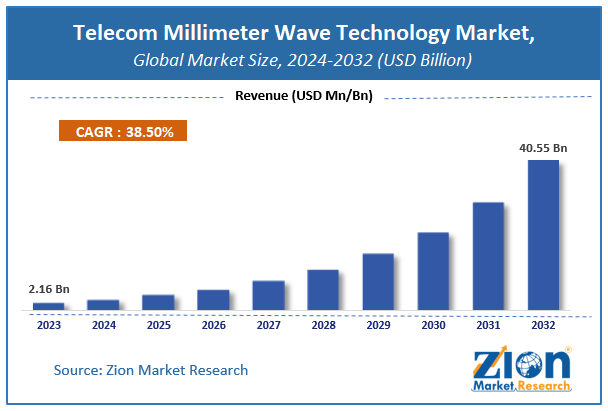
The global telecom millimeter wave technology market size was worth around USD 2.16billion in 2023 and is predicted to grow to around USD 40.55 billion by 2032 with a compound annual growth rate (CAGR) of roughly 38.5% between 2024 and 2032. The study provides historical data from 2018 to 2022 along with a forecast from 2024 to 2032 based on revenue (USD Billion). The report covers a forecast and an analysis of the telecom millimeter wave technology market on a global and regional level.
 Request Free SampleRequest Free Sample
Global Telecom Millimeter Wave Technology Market: Overview
Millimeter Waves Technology is also known as Extremely High Frequency (EHF) waves owing to the operational frequency spectrum. Millimeter waves can proficiently transmit a massive volume of data effectively operating in 30 GHz to 300 GHz. The feature of sending a huge amount of relevant data has allowed the technology to be popular in telecommunication applications.
Global Telecom Millimeter Wave Technology Market: Growth Drivers
The demand for bandwidth-intensive applications is rising especially across consumer electronics, particularly for mobile devices such as wearable electronics and smartphones. The growing deployment rate of these devices has been acting a major stimulant for the global telecom millimeter wave technology market. Furthermore, data-intensive technologies such as high-speed online gaming, media exchange over the internet, video conferencing, and video streaming are likely to enhance the need for high-bandwidth, promoting the need for adoption of the global telecom millimeter wave technology market.
Additionally, the next-generation wireless communication is at its commencement with approaching time. The technological needs of 5G such as cell edge data rate of 100 Mbps 1 msec latency rate, peak data rate i.e. above 10 Gbps, and so on, are the driving the requirement for this technology. The huge amount of adjoining bandwidth available above 24 GHz, improving research & lab trials, upbringing modern innovative approaches such as sub-6 GHz spectrum in the uplink, and using the multimeter wave in the downlink as well as the competitive environment are some of the prominent growth drivers of the global market.
Global Telecom Millimeter Wave Technology Market: Segmentation
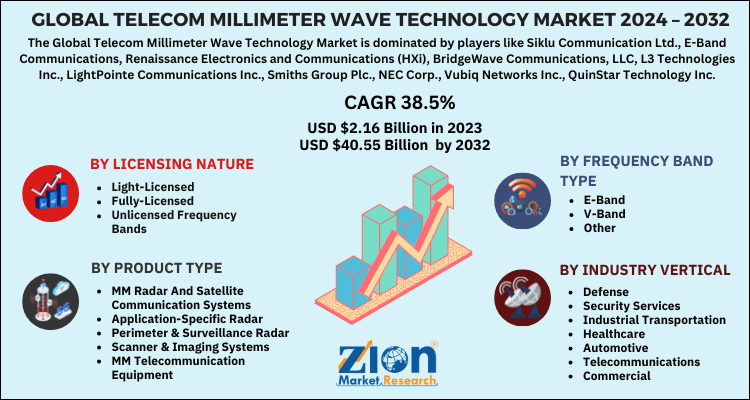
The global telecom millimeter wave technology market is categorized on the basis of licensing nature, frequency band type, product, industry vertical, and region.
By licensing nature, the global telecom millimeter wave technology market is segmented into light-licensed, fully-licensed, and unlicensed frequency bands.
On the basis of the frequency band type, the global market is bifurcated into E-band, V-band, and other such types. Amongst these, E-band frequencies have extensive applicability across the telecom sector.
Based on industry vertical, the global market is bifurcated into defense, security services, industrial transportation, healthcare, automotive, telecommunications, and commercial end-user.
Based upon product type, the global telecom millimeter wave technology market is segregated into MM radar and satellite communication systems, application-specific radar, perimeter & surveillance radar, scanner & imaging systems, MM telecommunication equipment, sub-segments such as macro-cell and small-cell, mobile back-haul equipment as well as enterprise and other networking equipment.
 Request Free SampleRequest Free Sample
Telecom Millimeter Wave Technology Market: Report Scope
| Report Attributes | Report Details |
|---|---|
| Report Name | Telecom Millimeter Wave Technology Market |
| Market Size in 2023 | USD 2.16 Billion |
| Market Forecast in 2032 | USD 40.55 Billion |
| Growth Rate | CAGR of 38.5% |
| Number of Pages | 201 |
| Key Companies Covered | Siklu Communication Ltd., E-Band Communications, Renaissance Electronics and Communications (HXi), BridgeWave Communications, LLC, L3 Technologies Inc., LightPointe Communications Inc., Smiths Group Plc., NEC Corp., Vubiq Networks Inc., QuinStar Technology Inc., ELVA-1 and Wireless Excellence Inc., Proxim Wireless, Keysight Technologies Inc., Siklu Communication Ltd., SAGE Millimeter, Aviat Networks Inc., Smiths Group, Axxcss Wireless Solutions, Eravant, Millimeter Wave Products, and Farran Technology Ltd |
| Segments Covered | By licensing nature, By frequency band type, By product, By industry vertical and By Region |
| Regions Covered | North America, Europe, Asia Pacific (APAC), Latin America, Middle East, and Africa (MEA) |
| Base Year | 2023 |
| Historical Year | 2018 - 2022 |
| Forecast Year | 2024 - 2032 |
| Customization Scope | Avail customized purchase options to meet your exact research needs. Request For Customization |
Global Telecom Millimeter Wave Technology Market: Regional Analysis
North America might represent a considerable chunk of the total global telecom millimeter wave technology market share through 2026. Countries such as Canada and the United States, being early adopters of emerging technologies, have been seeking to establish a robust telecom sector. The tendency of the consumers to adopt highly efficient, advanced technologies is pushing the need for the Carrier Ethernet services particularly across the metro areas. These factors are expected to drive the market in the region.
Asia Pacific is set to observe notable growth throughout the forecast period owing to the trending inclination toward optimum digitalization. Growing installation of modern telecom equipment, accelerated rise in data consumption, and infrastructural development have been anticipated to boost the market share of this region in the near future in the global telecom millimeter wave technology market. The public as well as private investments have been rising in countries such as India and Japan, across the healthcare, military, automotive, and telecommunication applications, further driving regional market growth.
Global Telecom Millimeter Wave Technology Market: Competitive Players
Some of the key players of the global telecom millimeter wave technology market include:
- Siklu Communication Ltd.
- E-Band Communications
- Renaissance Electronics and Communications (HXi)
- BridgeWave Communications LLC
- L3 Technologies Inc.
- LightPointe Communications Inc.
- Smiths Group Plc.
- NEC Corp.
- Vubiq Networks Inc.
- QuinStar Technology Inc.
- ELVA-1 and Wireless Excellence Inc.
- Proxim Wireless
- Keysight Technologies Inc.
- Siklu Communication Ltd.
- SAGE Millimeter
- Aviat Networks Inc.
- Smiths Group
- Axxcss Wireless Solutions
- Eravant
- Millimeter Wave Products
- Farran Technology Ltd.
The major companies have been adopting both inorganic as well as organic strategies of market growth such as contracts, acquisitions, mergers, installations & product launches, partnerships, collaborations, and expansions to strengthen their share in the global market.
The Global Telecom Millimeter Wave Technology Market is segmented as follows:
By Licensing Nature
- Light-Licensed
- Fully-Licensed
- Unlicensed Frequency Bands
By Frequency Band Type
- E-Band
- V-Band
- Other
By Industry Vertical
- Defense
- Security Services
- Industrial Transportation
- Healthcare
- Automotive
- Telecommunications
- Commercial
By Product Type
- MM Radar And Satellite Communication Systems
- Application-Specific Radar
- Perimeter & Surveillance Radar
- Scanner & Imaging Systems
- MM Telecommunication Equipment
By Region
- North America
- The U.S.
- Canada
- Mexico
- Europe
- France
- The UK
- Spain
- Germany
- Italy
- Rest of Europe
- Asia Pacific
- China
- Japan
- India
- Australia
- South Korea
- Rest of Asia Pacific
- The Middle East & Africa
- Saudi Arabia
- UAE
- Egypt
- Kuwait
- South Africa
- Rest of the Middle East & Africa
- Latin America
- Brazil
- Argentina
- Rest of Latin America
What Reports Provides
- Full in-depth analysis of the parent market
- Important changes in market dynamics
- Segmentation details of the market
- Former, on-going, and projected market analysis in terms of volume and value
- Assessment of niche industry developments
- Market share analysis
- Key strategies of major players
- Emerging segments and regional markets
- Testimonials to companies in order to fortify their foothold in the market.
Table Of Content

FrequentlyAsked Questions
Telecom millimeter wave technology uses high-frequency radio waves for data transmission. It enables ultra-fast speeds in 5G and advanced networks.
The global Telecom Millimeter Wave Technology market is expected to be driven by the Driven by rapid deployment of 5G networks, growing demand for high-speed data transmission, and increasing mobile data traffic. Expansion of smart cities and connected devices accelerates adoption.
According to study, the global Telecom Millimeter Wave Technology market size was worth around USD 2.16 Billion in 2023 and is predicted to grow to around USD 40.55 Billion By 2032.
The global Telecom Millimeter Wave Technology market is expected to grow at a Compound Annual Growth Rate (CAGR) of around CAGR 38.5% during the forecast period from 2024-2032.
The global Telecom Millimeter Wave Technology industry is projected to be challenged by Challenges include limited range and line-of-sight constraints, high deployment costs for dense small-cell networks, and device ecosystem readiness.
The Opportunities include ultra-high-speed 5G use cases, fixed wireless access expansion, and growing demand for low-latency connectivity in dense urban and enterprise environments will offer significant growth opportunities in the Telecom Millimeter Wave Technology market.
Expanded mmWave small-cell densification; advanced beamforming and RFIC integration; fixed wireless access and private network use cases are the emerging trends and innovations impacting the Telecom Millimeter Wave Technology market.
The global Telecom Millimeter Wave Technology market is expected to be led by APAC during the forecast period.
Some of the prominent players operating in the global Telecom Millimeter Wave Technology market are; Siklu Communication Ltd., E-Band Communications, Renaissance Electronics and Communications (HXi), BridgeWave Communications, LLC, L3 Technologies Inc., LightPointe Communications Inc., Smiths Group Plc., NEC Corp., Vubiq Networks Inc., QuinStar Technology Inc., ELVA-1 and Wireless Excellence Inc., Proxim Wireless, Keysight Technologies Inc., Siklu Communication Ltd., SAGE Millimeter, Aviat Networks Inc., Smiths Group, Axxcss Wireless Solutions, Eravant, Millimeter Wave Products, and Farran Technology Ltd and others.
The report explores crucial aspects of the Telecom Millimeter Wave Technology market, including a detailed discussion of existing growth factors and restraints, while also browsing future growth opportunities and challenges that impact the market.
HappyClients

