
Global Sports Tourism Market Size, Share, Growth, Trends, and Forecast 2034

Sports Tourism Market By Sports Type (Soccer, Basketball, Cricket, Hockey, Tennis, and Others), By Tourism Type (Active, Nostalgia, and Passive), and Region - Global and Regional Industry Overview, Market Intelligence, Comprehensive Analysis, Historical Data, and Forecasts 2026 - 2034
| Market Size in 2025 | Market Forecast in 2034 | CAGR (in %) | Base Year |
|---|---|---|---|
| USD 687 Billion | USD 1180 Billion | 6.2% | 2025 |
Sports Tourism Industry Perspective:
What will be the size of the global sports tourism market during the forecast period?
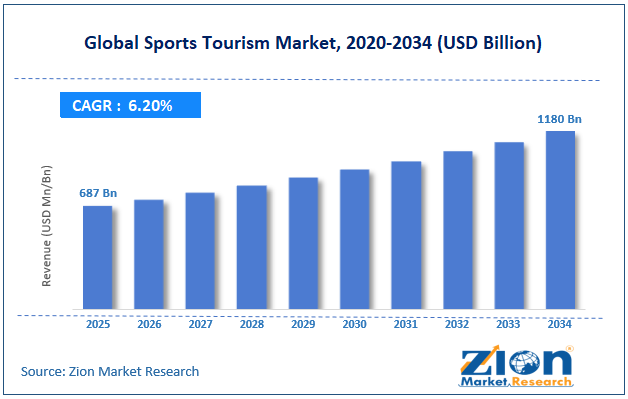
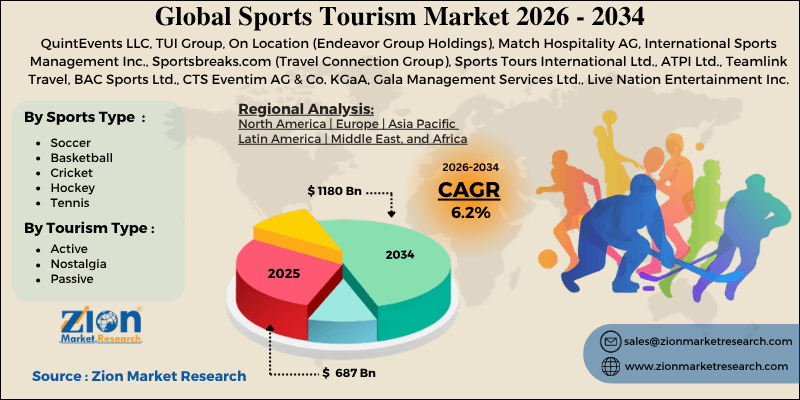
The global sports tourism market size was worth around USD 687 billion in 2025 and is predicted to grow to around USD 1180 billion by 2034, with a compound annual growth rate (CAGR) of roughly 6.2% between 2026 and 2034.
Key Insights
- As per the analysis shared by our research analyst, the global sports tourism market is estimated to grow annually at a CAGR of around 6.2% over the forecast period (2026-2034).
- In terms of revenue, the global sports tourism market size was valued at around USD 687 billion in 2025 and is projected to reach USD 1180 billion by 2034.
- Government investment in sports infrastructure is expected to propel the sports tourism market over the projected period.
- Based on the sports type, the soccer segment dominates the market with a revenue share of 38% in 2025.
- Based on the tourism type, the passive segment holds a majority of market share in 2025 of 44%.
- Based on region, Europe dominates the sports tourism market with a revenue share of 38.5% in 2025.
Sports Tourism Market: Overview
Sports Tourism is defined as traveling to take part in sporting events. Sports tourism can be explained through the act of traveling to take part in or witness international sporting events like the Olympics, FIFA World Cups, cricket championships, and Formula One Grand Prix races, and also participating in outdoor activities like skiing, surfing, cycling, golf, hiking, and other adventure activities. Sports tourism also involves visiting sports museums, stadiums, training grounds, and sites related to famous sports personalities and events.
Impact of the USA-Israel War on Iran on the Sports Tourism Market
The negative impact on the sports tourism industry has been caused by the U.S.-Israel war against Iran, making the region insecure for sports tourism by affecting airline flights to the region and making tourists less willing to take part in sports in the Middle East. Increased flight costs and cancellations have been a major problem for sports tourism, and some sporting events have also been canceled or postponed because of political tension in the region.
Sports Tourism Market: Dynamics
Growth Drivers
How does the growing popularity of international sporting events drive the sports tourism market?
The growing popularity of international sports events fuels the sports tourism market by encouraging fans, athletes, teams, and sports lovers to travel both domestically and abroad, thereby boosting spending on accommodation, transport, restaurants, entertainment, and event tickets. For instance, in 2025, official London Government data shows that more than 1.4 million people attended London's largest women's sporting events, such as the Women's Rugby World Cup, and one match drew a record 81,885 spectators.
In addition, according to the London Government, the six largest sports events hosted in London in 2024 contributed an estimated direct economic impact of about £230 million (around US$294 million). They drew nearly 500 thousand spectators, which proves how international sports events contribute to the increasing interest of fans and contribute to tourism expenditure. In other words, in 2025, the growing popularity and mass media coverage of international sports events contribute to the development of sports tourism in terms of visitor arrivals, length of stay, tourism expenditure, and government investment in sports and tourism infrastructure.
Restraints
Why do the high travel and accommodation costs act as a major restraint on the growth of the sports tourism industry?
Expensive travel and accommodation costs are among the biggest barriers to expanding the sports tourism market because international sporting events require significant spending on flights, hotels, local transport, meals, and game tickets. According to the Sports Events & Tourism Association, in 2025, the sports-tourism industry in the U.S. brought in about US$111.2 billion in traveler spending, including US$16.1 billion on flights, US$19.7 billion on lodging, and US$12.4 billion on local transportation. This shows how dependent sports tourism is on travel-related spending.
For foreign travelers, these costs can rise further during major competitions because of limited hotel capacity and high visitor demand. Government data on tourism expenditures also show that accommodation and transport costs are among the main components of tourism spending. For instance, India's Ministry of Statistics and Program Implementation collects expenditure data on accommodations, transportation, meals, entertainment, and sporting activities via its 2025-26 Domestic Tourism Expenditure Survey. Expensive flights and rooms may keep some budget- and middle-class tourists from visiting such events, leading them to stay home or watch sports competitions on TV.
Opportunities
How does the integration of advanced technology offer a lucrative opportunity for the sports tourism market?
Adopting sophisticated technology offers a major opportunity to grow the sports tourism market by increasing immersion, convenience, personalization, and accessibility for international travelers. Technologies like artificial intelligence (AI), augmented reality (AR), virtual reality (VR), 5G, Internet of Things (IoT), mobile apps, and smart-stadium technology may be applied to boost the entire process of sports tourism experience, including discovery of sporting events, booking tickets, navigating stadiums, and exploring attractions around stadiums.
For instance, AR will give visitors access to real-time stats about players and other stadium content, while VR will enable virtual tours and stadium experiences. Further, AI and data analysis will enable personalized offers based on the sports fans' preferences. The opportunity is especially evident in the Olympic Fan Data Platform, a data collection and analysis platform developed by the International Olympic Committee, which engaged 16 million fans during the Paris 2024 Olympic Games.
Challenges
Limited sports infrastructure in emerging destinations poses a significant challenge to the growth of the sports tourism industry
The shortage of sports infrastructure in emerging destinations is a serious issue for the sports tourism market because many developing destinations lack modern stadiums, sports facilities, training grounds, accommodation, transport, healthcare services, and the digital infrastructure needed to host major sporting events. In its report, the World Bank identifies a lack of proper infrastructure as a key constraint on the tourism industry's competitiveness, noting that improving transport, water and sanitation, waste disposal, and digital infrastructure is necessary to increase visitor growth in emerging destinations. This issue is relevant to sports tourism because major sports events require specific infrastructure and effective connections between airports, hotels, venues, and tourist sites. A recent analysis of sports-tourism competitiveness in developing countries identified insufficient infrastructure and financial constraints as the main barriers to destination development.
Sports Tourism Market: Report Scope
| Report Attributes | Report Details |
|---|---|
| Report Name | Sports Tourism Market |
| Market Size in 2025 | USD 687 Billion |
| Market Forecast in 2034 | USD 1180 Billion |
| Growth Rate | CAGR of 6.2% |
| Number of Pages | 228 |
| Key Companies Covered | QuintEvents LLC, TUI Group, On Location (Endeavor Group Holdings), Match Hospitality AG, International Sports Management Inc., Sportsbreaks.com (Travel Connection Group), Sports Tours International Ltd., ATPI Ltd., Teamlink Travel, BAC Sports Ltd., CTS Eventim AG & Co. KGaA, Gala Management Services Ltd., Live Nation Entertainment Inc., Expedia Group Inc., IMG (Endeavor Group Holdings), Booking Holdings Inc., KNT-CT Holdings Co. Ltd., Sports Travel and Hospitality Group Ltd., Victory Sports Tours, AEG Worldwide (Anschutz Entertainment Group), and others. |
| Segments Covered | By Sports Type, By Tourism Type, and By Region |
| Regions Covered | North America, Europe, Asia Pacific (APAC), Latin America, Middle East, and Africa (MEA) |
| Base Year | 2025 |
| Historical Year | 2020 - 2024 |
| Forecast Year | 2026 - 2034 |
| Customization Scope | Avail customized purchase options to meet your exact research needs. Request For Customization |
Sports Tourism Market: Segmentation
Sports Type Insights
Why does the soccer segment hold a prominent position in the sports tourism market?
The soccer segment dominates the sports tourism market with a revenue share of 38% in 2025. Soccer tourism is growing rapidly as more sports fans prefer experiential travel tied to big matches, famous stadiums, and tournaments. International soccer leagues such as the Premier League, La Liga, and Serie A have successfully built international fan bases through digital media and broadcasting, inspiring fans to travel to attend matches. In addition, major tournaments such as the FIFA World Cup, UEFA Champions League, and regional cups also draw sports fans who prefer to experience the atmosphere at the stadium. Another factor behind the growing trend of soccer-based sports tourism is rising disposable income and easier international travel.
Tourism Type Insights
How does the passive segment capture the largest share in the sports tourism market?
The passive segment holds a 44% share of the sports tourism industry in 2025. Growth is driven by the increasing number of international tourists attending sports events such as the FIFA World Cup, the Olympics, Formula 1, cricket, football, tennis, and many other tournaments. Beyond sports-event ticket sales, passive sports tourism is lucrative for hotels, flights, transport, dining out, and other facilities.
Regional Insights
What factors drive the Europe region in the sports tourism market?
Europe dominates the sports tourism market with a revenue share of 38.5% in 2025. Growth comes from growing interest in major international events, increased participation in adventure activities, and health and fitness activities, along with strong infrastructure in Europe for hosting tournaments, marathons, cycling races, and winter sports. People look for unique holidays, and sports-related holidays offer a combination of competition, enjoyment, and cultural exploration. Also, rising disposable incomes, strong marketing by European tourism agencies, and the popularity of major events like football championships, Formula 1, and ski championships help draw people to holiday in Europe.
Sports Tourism Market: Competitive Analysis
The global sports tourism market is dominated by players like:
- QuintEvents LLC
- TUI Group
- On Location (Endeavor Group Holdings)
- Match Hospitality AG
- International Sports Management Inc.
- Sportsbreaks.com (Travel Connection Group)
- Sports Tours International Ltd.
- ATPI Ltd.
- Teamlink Travel
- BAC Sports Ltd.
- CTS Eventim AG & Co. KGaA
- Gala Management Services Ltd.
- Live Nation Entertainment Inc.
- Expedia Group Inc.
- IMG (Endeavor Group Holdings)
- Booking Holdings Inc.
- KNT-CT Holdings Co. Ltd.
- Sports Travel and Hospitality Group Ltd.
- Victory Sports Tours
- AEG Worldwide (Anschutz Entertainment Group)
The global sports tourism market is segmented as follows:
By Sports Type
- Soccer
- Basketball
- Cricket
- Hockey
- Tennis
- Others
By Tourism Type
- Active
- Nostalgia
- Passive
By Region
- North America
- The U.S.
- Canada
- Mexico
- Europe
- France
- The UK
- Spain
- Germany
- Italy
- Rest of Europe
- Asia Pacific
- China
- Japan
- India
- Australia
- South Korea
- Rest of Asia Pacific
- The Middle East & Africa
- Saudi Arabia
- UAE
- Egypt
- Kuwait
- South Africa
- Rest of the Middle East & Africa
- Latin America
- Brazil
- Argentina
- Rest of Latin America
Table Of Content
Methodology
FrequentlyAsked Questions
Sports Tourism is defined as traveling to take part in sporting events. Sports tourism can be explained as traveling to participate in or witness international sporting events like the Olympics, FIFA World Cups, cricket championships, and Formula One Grand Prix races, as well as participating in outdoor activities like skiing, surfing, cycling, golf, hiking, and other adventure activities.
The key growth drivers for the sports tourism market include the rising popularity of international sporting events, increasing consumer preference for experiential travel, growing participation in adventure and recreational sports, rising disposable incomes, improved air connectivity and sports infrastructure, and the expansion of premium sports hospitality and travel packages. Major tournaments and events attract international spectators and participants, generating spending on accommodation, transportation, food, entertainment, and event tickets.
The major challenges restraining the growth of the sports tourism market include high travel and accommodation costs, limited sports and tourism infrastructure in emerging destinations, security and geopolitical risks, seasonality and weather dependence, overcrowding at major sporting events, visa and travel restrictions, and high event-hosting and operational costs. High airfare, hotel prices, and event-ticket costs can make sports travel unaffordable for price-sensitive consumers. At the same time, inadequate stadiums, transportation, accommodation, and connectivity can prevent emerging destinations from hosting major events.
Based on the sports type, the soccer segment is expected to dominate the sports tourism market growth during the projected period.
The emerging trends and innovations impacting the sports tourism market include the increasing adoption of artificial intelligence (AI), augmented reality (AR), virtual reality (VR), smart stadiums, mobile applications, digital ticketing, and personalized fan experiences. AI provides real-time sports information, personalized content, and digital assistance, while AR and VR create more immersive spectator experiences.
According to the report, the global sports tourism market size was worth around USD 687 billion in 2025 and is predicted to grow to around USD 1180 billion by 2034.
The global sports tourism market is expected to grow at a CAGR of 6.2% during the forecast period.
The global sports tourism industry growth is expected to be led by Europe over the forecast period.
The global sports tourism market is dominated by players like QuintEvents LLC, TUI Group, On Location (Endeavor Group Holdings), Match Hospitality AG, International Sports Management Inc., Sportsbreaks.com (Travel Connection Group), Sports Tours International Ltd., ATPI Ltd., Teamlink Travel, BAC Sports Ltd., CTS Eventim AG & Co. KGaA, Gala Management Services Ltd., Live Nation Entertainment Inc., Expedia Group Inc., IMG (Endeavor Group Holdings), Booking Holdings Inc., KNT-CT Holdings Co., Ltd., Sports Travel and Hospitality Group Ltd., Victory Sports Tours, and AEG Worldwide (Anschutz Entertainment Group), among others.
The sports tourism market report covers the geographical market along with a comprehensive competitive landscape analysis. It also includes cash flow analysis, profit ratio analysis, market basket analysis, market attractiveness analysis, sentiment analysis, PESTLE analysis, trend analysis, SWOT analysis, trade area analysis, demand & supply analysis, Porter’s five forces analysis, and value chain analysis.

HappyClients

