
Smart Hair Brush Market Size, Share, Trends, Growth and Forecast 2034

Smart Hair Brush Market By Product Type (Paddle, Detangling, Round, and Others), By Technology (Wi-Fi Enabled, Sensor-Based, Bluetooth Enabled, and Others), By Application (Personal Use and Professional/Salon Use), By Distribution Channel (Online Stores, Specialty Stores, Supermarkets/Hypermarkets, and Others), By End-User (Men, Children, and Women), and By Region - Global and Regional Industry Overview, Market Intelligence, Comprehensive Analysis, Historical Data, and Forecasts 2026 - 2034
| Market Size in 2025 | Market Forecast in 2034 | CAGR (in %) | Base Year |
|---|---|---|---|
| USD 345 Million | USD 578 Million | 5.9% | 2025 |
Smart Hair Brush Industry Perspective:
What will be the size of the global smart hair brush market during the forecast period?
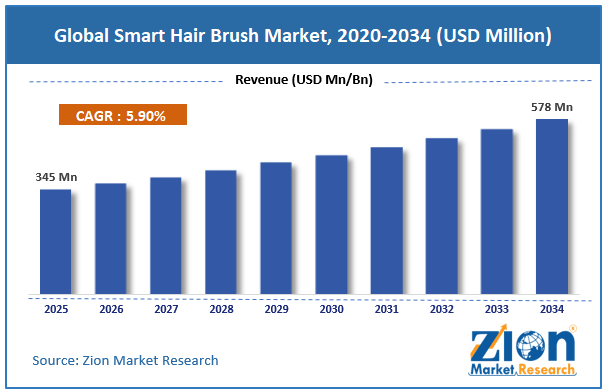
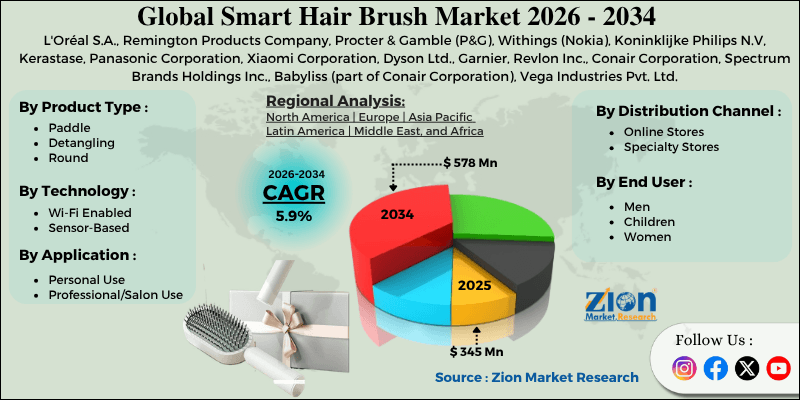
The global smart hair brush market size was worth around USD 345 million in 2025 and is predicted to grow to around USD 578 million by 2034, with a compound annual growth rate (CAGR) of roughly 5.9% between 2026 and 2034.
Smart Hair Brush Market: Overview
A smart hair brush is a sophisticated personal care appliance that brings together all the features of a regular hairbrush, along with sensors, connectivity, and intelligent software that can be used to assess the health of the hair and scalp. A smart hairbrush is meant to help analyze parameters such as hair toughness, hair breakage, brushing patterns, scalp condition, moisture, and external factors. Using a smartphone application, the user receives information about their hair health, along with suggestions for their hair care routine. Smart hair brushes use various types of sensors, including motion sensors, force sensors, microphones, temperature and humidity sensors, and Bluetooth/Wi-Fi connectivity, to determine the brushing technique and detect possible hair damage caused by excessive force or poor brushing techniques. With the help of artificial intelligence (AI) and big data analysis, smart hairbrushes provide users with improved hair care and reduced hair breakage.
Key Insights
- As per the analysis shared by our research analyst, the global smart hair brush market is estimated to grow annually at a CAGR of around 5.9% over the forecast period (2026-2034).
- In terms of revenue, the global smart hair brush market size was valued at around USD 345 million in 2025 and is projected to reach USD 578 million by 2034.
- Increasing demand for personalized beauty and grooming solutions is expected to propel the smart hair brush market over the projected period.
- Based on the product type, the paddle segment held the largest market share of 41% in 2025.
- Based on the technology, the Bluetooth-enabled segment held the largest revenue share of 42% in 2025.
- Based on the application, the personal use segment captures a significant revenue share of 72% in 2025.
- Based on the distribution channel, the online stores segment dominates the industry with a market share of 49% in 2025.
- Based on the end-user, the women segment holds a prominent market share of over 65% in 2025.
- Based on region, the Asia Pacific region held the largest revenue share of 35% in 2025.
Impact of the USA-Israel War on Iran on the Smart Hair Brush Market
USA-Israel tensions regarding Iran had little impact on the global smart hair brush market, as the sector relies heavily on demand from consumer electronics, personal care, and digital health technologies. Nonetheless, the tension has led to supply chain disruptions due to the disruption of semiconductor, sensor, battery, and electronic component manufacturing across the interconnected international supply chain. Additionally, rising energy costs and higher shipping expenses have increased the cost of manufacturing smart beauty care devices. Additionally, economic instability in certain areas of the Middle East has led to a decline in spending on luxury beauty devices in those regions. Despite these challenges, the high demand for products in North America, Europe, and the Asia-Pacific, together with innovations in AI-enabled beauty devices, has enabled the market to remain resilient and continue growing.
Smart Hair Brush Market: Dynamics
Growth Drivers
Why does growing consumer awareness of hair and scalp health drive the smart hair brush market?
Awareness of hair and scalp health among consumers is an important factor influencing the growth of the smart hair brush market, as consumers today tend to adopt preventive measures and use personalized products to ensure they stay protected against any harm related to hair or scalp health, such as hair fall, dandruff, itching, irritation, and breakage. The growing concerns about environmental pollution, stress, hormonal imbalance, and hair damage from heat-styling techniques are encouraging consumers to adopt advanced technology-enabled grooming products that can analyze hair condition and brushing technique. These smart hair brushes, which include AI, sensors, and mobile connectivity, can provide personalized feedback to help users improve their hair care routine.
Restraints
Competition from alternative hair care technologies hampers the growth of the smart hair brush industry
Competing hair care technologies constitute a major constraint on the growth of the smart hair brush market, as many devices on the market today offer more advanced hair and scalp diagnostics than smart hair brushes. For instance, artificial intelligence scalp analyzer, smart mirror, hair analysis application, laser hair growth device, and salon hair and scalp diagnostic tools allow using scalp imaging, follicle analysis, personalized therapy recommendation, hair growth tracking, and other advanced functions that are sometimes more valuable for consumers than simple hair brushing alone. Many people still prefer to use regular hairbrushes, which are inexpensive and easy to use.
Opportunities
How does the rising adoption of AI and connected beauty technologies offer a lucrative opportunity for the smart hair brush market?
The growing use of AI and beauty technology creates a significant opportunity for the smart hair brush market, as consumers are increasingly open to using intelligent personal grooming devices that offer a unique, data-driven experience. The development of artificial intelligence, machine learning, IoT, and sensors enables smart hair brushes to assess hair and skin condition, brush usage, humidity, and other environmental factors with much greater precision. The integration with apps and cloud computing enables tailored hair care recommendations and tracking of changes in hair condition over time. With the growing popularity of personalized beauty products, smart homes, and connected health care, there are many opportunities for manufacturers to create smart hairbrushes with more features and attract new customers.
Challenges
Do limited consumer awareness and adoption pose a significant challenge to the smart hair brush market?
The limited consumer awareness and adoption pose a major obstacle to the smart hair brush market. Many customers are unaware of the benefits of smart hair brushes and see these products more as luxurious grooming tools than as health-oriented gadgets. The advantages of AI-based hair analysis and monitoring, as well as personalized hair care suggestions, are not yet widely known among consumers unfamiliar with connected beauty products.
Apart from this, the higher cost compared to regular hair brushes and professional hair diagnostic services does not allow consumers to make an extra purchase without a guarantee of effectiveness. Thus, consumer education becomes very important for the development of the smart hair brush market.
Smart Hair Brush Market: Report Scope
| Report Attributes | Report Details |
|---|---|
| Report Name | Smart Hair Brush Market |
| Market Size in 2025 | USD 345 Million |
| Market Forecast in 2034 | USD 578 Million |
| Growth Rate | CAGR of 5.9% |
| Number of Pages | 228 |
| Key Companies Covered | L'Oréal S.A., Remington Products Company, Procter & Gamble (P&G), Withings (Nokia), Koninklijke Philips N.V, Kerastase, Panasonic Corporation, Xiaomi Corporation, Dyson Ltd., Garnier, Revlon Inc., Conair Corporation, Spectrum Brands Holdings Inc., Babyliss (part of Conair Corporation), Vega Industries Pvt. Ltd., Shenzhen FLYCO Electrical Appliance Co. Ltd., Helen of Troy Limited, Braun GmbH, Tangle Teezer Ltd., Aveda Corporation, and others. |
| Segments Covered | By Product Type, By Technology, By Application, By Distribution Channel, By End User, and By Region |
| Regions Covered | North America, Europe, Asia Pacific (APAC), Latin America, Middle East, and Africa (MEA) |
| Base Year | 2025 |
| Historical Year | 2020 - 2024 |
| Forecast Year | 2026 - 2034 |
| Customization Scope | Avail customized purchase options to meet your exact research needs. Request For Customization |
Smart Hair Brush Market: Segmentation
Product Type Insights
Why does the paddle segment hold a prominent position in the smart hair brush market?
The paddle segment held the largest share of the smart hairbrush market, at 41%, in 2025. Its popularity stems from its versatility, convenience, and suitability for a wide range of hair types and lengths. Paddle-type smart hair brushes feature large surfaces designed to brush and care for hair without causing harm. Due to the larger surface area, it is easier for manufacturers to obtain additional data on the brushing process, the state of hair and scalp, and the intensity of brushing. In addition, consumers tend to favor paddle-type hair brushes for their convenience, ergonomics, and efficiency when brushing long, thick, and straight hair.
Technology Insights
Why does the Bluetooth-enabled segment capture the largest share in the smart hair brush market?
The Bluetooth-enabled segment held the largest revenue share in the smart hair brush industry at 42% in 2025. The sector's growth is driven by the rising popularity of wireless hair-grooming devices and their compatibility with phones. Bluetooth technology connects the smart hair brush to the smartphone app, allowing users to monitor the condition of their hair and scalp, track their brushing process, get personalized hair care tips, and keep records. Unlike other connectivity methods, Bluetooth technology reduces energy consumption, supports short-range connectivity, enables easy device pairing, and offers a reasonable implementation cost.
Application Insights
Does the personal use segment capture the largest share in the smart hair brush market?
The personal use segment captured a significant revenue share of 72% in the smart hair brush industry in 2025. The growth is fueled by consumers' growing interest in at-home hair care, grooming, and scalp disorder prevention. Growing concerns about hair fall, hair damage, dandruff, and other issues have prompted people to use smart hair tools that provide instant analysis and personalized hair care tips. The increasing popularity of smartphones and mobile applications has made smart hair brushes more attractive, as they can now be used at home to monitor one’s hair condition and brushing activity.
Distribution Channel Insights
Why does the online stores segment capture the largest share of the smart hair brush market?
The online stores segment dominates the smart hair brush industry with a market share of 49% in 2025. The growth is fueled by fast-growing e-commerce sites and consumers' increasing demand for convenient online shopping. E-commerce shops let consumers access a broad range of smart hair brushes from all corners of the globe, enabling comparisons of features, prices, customer reviews, and other specifications before buying. Exclusive online offers, doorstep delivery, and convenient payment methods further enhance the appeal of online shopping.
End User Insights
Does the women segment capture the largest share in the smart hair brush market?
The women segment holds a prominent share of the smart hairbrush market, over 65%, in 2025. The growth is supported by the increased use of premium hair care products, greater awareness of hair and scalp health, and high adoption of personalization technologies in beauty care. Women are willing to spend more on high-tech grooming equipment that enables them to monitor their hair condition, minimize hair breakage, and address problems such as hair loss, dryness, frizz, and a sensitive scalp. The growing role of beauty bloggers, social media, and online beauty platforms in the beauty industry has increased demand for AI-enabled, connected hair care solutions.
Regional Insights
Why does Asia-Pacific lead the global smart hair brush market?
The Asia-Pacific region accounted for the largest revenue share, at 35%, in the smart hairbrush market in 2025. Factors such as urbanization, rising disposable incomes, widespread smartphone use, and consumers' growing interest in smart personal care and connectivity in beauty devices have driven market growth. There is increased demand for AI-powered grooming devices in countries like China, Japan, South Korea, and India, driven by greater awareness of hair and scalp conditions among consumers. The region is known for a highly developed consumer electronics manufacturing ecosystem, along with technological innovations and beauty and electronics firms launching advanced smart grooming devices.
In addition, the rapid growth of online shopping, social media influence, and digital marketing efforts has facilitated greater access and awareness among consumers, and the rise in home beauty treatments and premium hair products is contributing to revenue growth in the Asia Pacific smart hair brush market over the forecast period.
Smart Hair Brush Market: Competitive Analysis
The global smart hair brush market is dominated by players like:
- L'Oréal S.A.
- Remington Products Company
- Procter & Gamble (P&G)
- Withings (Nokia)
- Koninklijke Philips N.V
- Kerastase
- Panasonic Corporation
- Xiaomi Corporation
- Dyson Ltd.
- Garnier
- Revlon Inc.
- Conair Corporation
- Spectrum Brands Holdings Inc.
- Babyliss (part of Conair Corporation)
- Vega Industries Pvt. Ltd.
- Shenzhen FLYCO Electrical Appliance Co. Ltd.
- Helen of Troy Limited
- Braun GmbH
- Tangle Teezer Ltd.
- Aveda Corporation
The global smart hair brush market is segmented as follows:
By Product Type
- Paddle
- Detangling
- Round
- Others
By Technology
- Wi-Fi Enabled
- Sensor-Based
- Bluetooth Enabled
- Others
By Application
- Personal Use
- Professional/Salon Use
By Distribution Channel
- Online Stores
- Specialty Stores
- Supermarkets/Hypermarkets
- Others
By End User
- Men
- Children
- Women
By Region
- North America
- The U.S.
- Canada
- Mexico
- Europe
- France
- The UK
- Spain
- Germany
- Italy
- Rest of Europe
- Asia Pacific
- China
- Japan
- India
- Australia
- South Korea
- Rest of Asia Pacific
- The Middle East & Africa
- Saudi Arabia
- UAE
- Egypt
- Kuwait
- South Africa
- Rest of the Middle East & Africa
- Latin America
- Brazil
- Argentina
- Rest of Latin America
Table Of Content
Methodology
FrequentlyAsked Questions
A smart hair brush is a sophisticated personal care appliance that brings together all the features of a regular hairbrush, along with sensors, connectivity, and intelligent software that can be used to assess the health of the hair and scalp.
The smart hair brush market is primarily driven by growing consumer awareness of hair and scalp health, increasing adoption of AI and connected beauty technologies, and rising demand for personalized grooming solutions. Consumers are increasingly seeking smart devices that provide real-time analysis of hair condition, scalp health, and brushing habits, enabling customized hair care recommendations and preventive care. The widespread use of smartphones and companion mobile applications, coupled with advancements in artificial intelligence (AI), Internet of Things (IoT), and sensor technologies, has significantly enhanced the functionality and appeal of smart hair brushes.
The major challenges restraining the Smart Hair Brush Market include the high cost of smart hair brushes compared to conventional alternatives, limited consumer awareness and adoption, and increasing competition from alternative hair care technologies. Premium pricing, driven by the integration of AI, sensors, Bluetooth connectivity, and companion mobile applications, limits adoption among price-sensitive consumers.
Based on the technology, the Bluetooth-enabled segment is expected to dominate the smart hair brush market growth during the projected period.
The smart hair brush market is being shaped by several emerging trends and innovations, including the integration of artificial intelligence (AI), Internet of Things (IoT), advanced sensors, and cloud connectivity to deliver highly personalized hair care experiences. Manufacturers are introducing smart hair brushes that analyze hair strength, scalp condition, brushing habits, moisture levels, and environmental factors, and provide real-time recommendations through companion mobile applications.
According to the report, the global smart hair brush market size was worth around USD 345 million in 2025 and is predicted to grow to around USD 578 million by 2034.
The global smart hair brush market is expected to grow at a CAGR of 5.9% during the forecast period.
The global smart hair brush industry growth is expected to be led by the Asia Pacific over the forecast period.
The global smart hair brush market is dominated by players like L'Oréal S.A., Remington Products Company, Procter & Gamble (P&G), Withings (Nokia), Koninklijke Philips N.V, Kerastase, Panasonic Corporation, Xiaomi Corporation, Dyson Ltd., Garnier, Revlon Inc., Conair Corporation, Spectrum Brands Holdings, Inc., Babyliss (part of Conair Corporation), Vega Industries Pvt. Ltd., Shenzhen FLYCO Electrical Appliance Co., Ltd., Helen of Troy Limited, Braun GmbH, Tangle Teezer Ltd., and Aveda Corporation, among others.
The smart hair brush market report covers the geographical market along with a comprehensive competitive landscape analysis. It also includes cash flow analysis, profit ratio analysis, market basket analysis, market attractiveness analysis, sentiment analysis, PESTLE analysis, trend analysis, SWOT analysis, trade area analysis, demand & supply analysis, Porter’s five forces analysis, and value chain analysis.

HappyClients

