
Saffron Market Size, Share, Trends, Growth and Forecast 2034

Saffron Market By Grade (Grade I (Above 190), Grade II (150-190), Grade III (110-149), and Grade IV (Less than 110), By Type (Traditional and Organic), By Form (Powder, Liquid/Extract, and Threads), By End Applications (Food & Beverage, Personal Care Products, Cosmetics, Food Supplements, and Others), By Distribution Channel (Business-to-Business (B2B) and Business-to-Customer (B2C)), and By Region - Global and Regional Industry Overview, Market Intelligence, Comprehensive Analysis, Historical Data, and Forecasts 2025 - 2034
| Market Size in 2024 | Market Forecast in 2034 | CAGR (in %) | Base Year |
|---|---|---|---|
| USD 600.3 Million | USD 1,110.70 Million | 6.96% | 2024 |
Saffron Industry Perspective:
What is the anticipated size of the saffron market during the projection period?
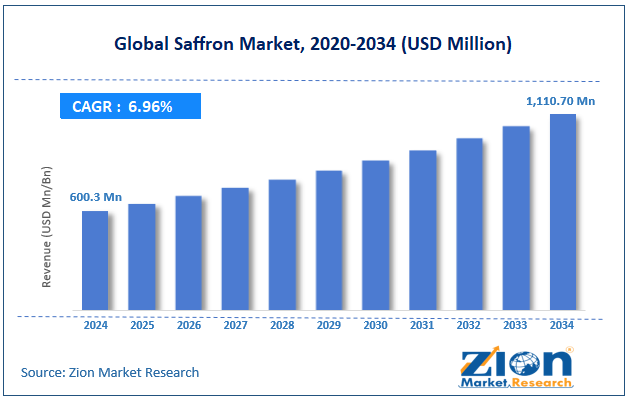
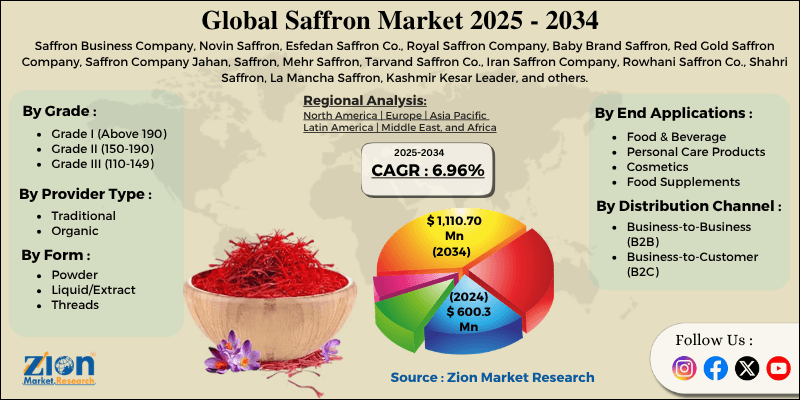
The global saffron market size was worth around USD 600.3 million in 2024 and is predicted to grow to around USD 1,110.70 million by 2034 with a compound annual growth rate (CAGR) of roughly 6.96% between 2025 and 2034.
Saffron Market: Overview
Saffron is the world’s most expensive spice. According to market research, 75,000 crocus flowers are used to produce 1 pound of saffron. The process of harvesting saffron is extremely labor-intensive, which results in a high cost of the spice. Saffron has been used in food and traditional treatments for thousands of years. Saffron is an excellent antioxidant, and hence it is reported to have several health benefits. For instance, saffron consumption can help deal with Alzheimer’s, as per certain reports. However, saffron consumption is also linked to several side effects such as upset stomach, anxiety, and appetite changes. Pregnant women and people with blood pressure issues must refrain from consuming saffron since it may lead to unwanted reactions in the body.
During the forecast period, demand for saffron is projected to grow due to globalization of food globalization trends, increased demand for natural supplements, and ongoing research on the potential health benefits of the spice. The market may register growth limitations due to the high cost of production, known side effects, and supply chain disruptions.
Key Insights:
- As per the analysis shared by our research analyst, the global saffron market is estimated to grow annually at a CAGR of around 6.96% over the forecast period (2025-2034)
- In terms of revenue, the global saffron market size was valued at around USD 600.3 million in 2024 and is projected to reach USD 1,110.70 million by 2034.
- The market is projected to grow at a significant rate due to the driving food globalization trends
- Based on the grade, the Grade I (above 190) segment is growing at a high rate and will continue to dominate the global market, as per industry projections
- Based on the type, the organic segment is anticipated to command the largest market share.
- Based on the form, the threads segment is expected to lead the market growth trends.
- Based on the end applications, the food & beverage segment is projected to influence revenue in the market.
- Based on the distribution channel, the Business-to-Business (B2B) will emerge as the fastest-growing segment.
- Based on region, the Asia-Pacific is projected to dominate the global market during the forecast period.
Impact of the USA-Israel and Iran war on the Saffron Market:
The saffron market is significantly impacted due to the war between the USA, Israel, and Iran. More than 85% of global saffron production takes place in Iran. The war has thus affected saffron production due to infrastructure damage and trade restrictions. Other saffron-producing countries, such as India and Spain, are expected to witness accelerated demand as countries seek new ways to meet consumer needs and requirements.
Saffron Market: Dynamics
Growth Drivers
How are food globalization trends expected to shape the saffron market during the forecast period?
The global saffron market is expected to be driven by food globalization trends. For instance, Asian cuisines, especially Indian, Chinese, and Middle Eastern dishes, are gaining global popularity. Saffron is a key ingredient in several of these cuisines. Global food trends are rapidly evolving, driven by growing international tourism, access to information through digital channels, and social media influence.
Increased applications in the pharmaceutical industry to generate industry revenue
The pharmaceutical industry is emerging as one of the largest end-user sectors for saffron. According to industry analysis, saffron has been traditionally used for its medicinal purposes across centuries. Recent studies have also indicated prominent health benefits of saffron. Medicinal properties of saffron include an antispasmodic and aphrodisiac. Saffron consists of monoterpenes and carotenoids, which are the major contributors to its medicinal properties. In addition, saffron has delivered potential benefits against liver cancer, diabetes, fatty liver, hepatotoxicity, stomach cancer, and other diseases. Growing awareness around medical benefits will help fuel revenue in the global saffron market.
Restraints
Which factors will limit the expansion of the saffron market in the coming years?
The global saffron industry is expected to be restricted due to the high cost of the spice. The average cost of saffron can range between USD 3500 and USD 10,500 per kg, depending on the quality of the spices and their origin. The high cost of saffron is caused by the labor-intensive production procedure and low yield per flower. In addition, at present, a limited number of countries produce large volumes of saffron, further limiting market expansion trends.
Opportunities
Cosmetic sector is to offer renewed growth opportunities to the market leaders
The global saffron market is anticipated to generate growth opportunities due to the rising applications of the spice in the cosmetic sector. According to market research, saffron derivatives are used in cosmetic products for their antioxidative properties. Furthermore, the global skincare and oral care market is witnessing a steady shift toward natural formulations with clean ingredients. This trend is expected to deliver excellent expansion possibilities to saffron producers.
Why will novel farming methods play a crucial role in influencing the saffron market during the forecast period?
Conventional saffron farming methods are cost and labor-intensive. This has resulted in a shift toward novel farming practices such as vertical and technology-driven agricultural methods. As per market research, new farming methods can produce 2 to 3 times more saffron yield than conventional practices. The increasing use of new generation technologies such as hydroponics, controlled environment agriculture (CEA), and climate-controlled indoor farming will shape industry growth trends in the future.
Challenges
Climate-sensitive and seasonal production to challenge market expansion
The global saffron industry is projected to be challenged by climate-sensitive and seasonal production. The quantity and quality of saffron produced depend on appropriate climate conditions. However, growing concerns over global warming and unpredictable weather may impact final production volume and subsequent distribution.
Saffron Market: Report Scope
| Report Attributes | Report Details |
|---|---|
| Report Name | Saffron Market |
| Market Size in 2024 | USD 600.3 Million |
| Market Forecast in 2034 | USD 1,110.70 Million |
| Growth Rate | CAGR of 6.96% |
| Number of Pages | 225 |
| Key Companies Covered | Saffron Business Company, Novin Saffron, Esfedan Saffron Co., Royal Saffron Company, Baby Brand Saffron, Red Gold Saffron Company, Saffron Company Jahan, Saffron, Mehr Saffron, Tarvand Saffron Co., Iran Saffron Company, Rowhani Saffron Co., Shahri Saffron, La Mancha Saffron, Kashmir Kesar Leader, and others. |
| Segments Covered | By Grade, By Type, By Form, By End Applications, By Distribution Channel, and By Region |
| Regions Covered | North America, Europe, Asia Pacific (APAC), Latin America, Middle East, and Africa (MEA) |
| Base Year | 2024 |
| Historical Year | 2019 - 2023 |
| Forecast Year | 2025 - 2034 |
| Customization Scope | Avail customized purchase options to meet your exact research needs. Request For Customization |
Saffron Market: Segmentation
The global saffron market is segmented based on grade, type, form, end applications, distribution channel, and region.
Why will the Grade I (above 190) segment deliver faster CAGR in the saffron industry revenue during the forecast period?
Based on grade, the global market segments are Grade I (above 190), Grade II (150-190), Grade III (110-149), and Grade IV (less than 110). In 2024, the highest growth was listed in the Grade I (above 190) segment. It accounted for 53% of the global revenue and will grow at a CAGR of 8.67% during the forecast period. Increased applications in gourmet food and luxury cosmetic items to aid segmental dominance.
Which will be the fastest-growing type segment during the forecast period in the saffron market?
Based on type, the global market is divided into traditional and organic. In 2024, the market was led by the traditional segment. It contributed nearly 75% of the global revenue. During the forecast period, organic saffron is expected to witness higher demand, growing at a CAGR of 9.22% due to changing consumer preferences and the expansion of novel agricultural practices.
Why will the threads segment continue to lead the saffron industry in the coming years?
Based on form, the global saffron industry is fragmented into powder, liquid/extract, and threads. In 2024, around 46% of the global revenue was contributed by the thread segment. During the forecast period, it is expected to continue leading the market due to increased demand for authentic saffron. The liquid/extract segment will grow at a CAGR of 9.12%, driven by higher applications in the pharmaceutical and cosmetic industries.
What will be the contribution of the food & beverage industry in the saffron market during the projection period?
Based on end applications, the global market fragments are food & beverage, personal care products, cosmetics, food supplements, and others. The food & beverage industry was the leading revenue generator in 2024. It accounted for 56% of the total market share and will grow at a CAGR of 7.92% during the forecast period. Food globalization trends will fuel segmental growth in the coming years.
Which distribution channel will emerge as a leading revenue generator in the saffron market?
Based on the distribution channel, the global industry is divided into Business-to-Business (B2B) and Business-to-Customer (B2C). In 2024, the market will witness the highest growth in the Business-to-Business (B2B) segment. It accounted for 52% of the global revenue and will continue growing at a CAGR of 9.5%. Expansion of e-commerce distribution channels, strategic partnerships, and bulk demand across end-user industries will drive segmental growth trends.
Saffron Market: Regional Analysis
How is Asia-Pacific expected to perform in the saffron market during the projection period?
The global saffron market is expected to be dominated by the Asia-Pacific region. It is also expected to emerge as the fastest-growing region with a CAGR of 7.9.6% during the forecast period. In 2024, it accounted for 42% of the global revenue. India is a leading producer of saffron with an extensive distribution network. In addition, saffron has a long history of being used for its medicinal purposes across Indian and Chinese civilizations. The growing popularity of Asian food, along with increased domestic demand, will encourage regional expansion.
Why will Europe emerge as the second-largest region in the saffron market?
Europe will emerge as the second largest region in the saffron market during the forecast period, growing at a CAGR of 35%. In 2024, it accounted for 7.92% of the global revenue. Spain, Italy, and Greece are the most prominent regional saffron producers. The ongoing efforts toward the integration of advanced technologies in agricultural practices will work in favor of the regional players. Additionally, rising food tourism and higher demand for organic saffron varieties will promote growth across Europe during the forecast period.
Saffron Market: Competitive Analysis
The global saffron market is led by players like:
- Saffron Business Company
- Novin Saffron
- Esfedan Saffron Co.
- Royal Saffron Company
- Baby Brand Saffron
- Red Gold Saffron Company
- Saffron Company Jahan
- Saffron
- Mehr Saffron
- Tarvand Saffron Co.
- Iran Saffron Company
- Rowhani Saffron Co.
- Shahri Saffron
- La Mancha Saffron
- Kashmir Kesar Leader
What are the latest key trends in the saffron market?
Higher demand for nutraceuticals
The growing demand for nutraceuticals is a promising market trend driving saffron application. Antioxidative and other benefits of saffron make it a highly sought-after ingredient for clean nutraceuticals with higher effectiveness.
Premiumization of saffron
Premiumization of saffron due to its applications in luxury cosmetic items and gourmet food has further amplified its perceived value among the end consumers. Increased demand for specialty food items and exclusive personal care products will encourage market expansion in the long run.
The global saffron market is segmented as follows:
By Grade
- Grade I (Above 190)
- Grade II (150-190)
- Grade III (110-149)
- Grade IV (Less than 110)
By Type
- Traditional
- Organic
By Form
- Powder
- Liquid/Extract
- Threads
By End Applications
- Food & Beverage
- Personal Care Products
- Cosmetics
- Food Supplements
- Others
By Distribution Channel
- Business-to-Business (B2B)
- Business-to-Customer (B2C)
By Region
- North America
- The U.S.
- Canada
- Mexico
- Europe
- France
- The UK
- Spain
- Germany
- Italy
- Rest of Europe
- Asia Pacific
- China
- Japan
- India
- Australia
- South Korea
- Rest of Asia Pacific
- The Middle East & Africa
- Saudi Arabia
- UAE
- Egypt
- Kuwait
- South Africa
- Rest of the Middle East & Africa
- Latin America
- Brazil
- Argentina
- Rest of Latin America
Table Of Content
Methodology
FrequentlyAsked Questions
Saffron is the world’s most expensive spice. According to market research, 75,000 crocus flowers are used to produce 1 pound of saffron.
The global saffron market is expected to be driven by food globalization trends.
According to study, the global saffron market size was worth around USD 600.3 million in 2024 and is predicted to grow to around USD 1,110.70 million by 2034.
The CAGR value of saffron market is expected to be around 6.96% during 2025-2034.
The global saffron industry is projected to be challenged by climate sensitive and seasonal production.
Higher demand for nutraceuticals and premiumization of saffron are the emerging trends and innovations impacting the saffron market.
The global saffron market has performed well so far and will offer similar trends in the coming years.
Asia-Pacific will contribute notably towards the saffron market value.
The global saffron market is led by players like Saffron Business Company, Novin Saffron, Esfedan Saffron Co., Royal Saffron Company, Baby Brand Saffron, Red Gold Saffron Company, Saffron Company Jahan, Saffron, Mehr Saffron, Tarvand Saffron Co., Iran Saffron Company, Rowhani Saffron Co., Shahri Saffron, La Mancha Saffron, and Kashmir Kesar Leader.
The report explores crucial aspects of the saffron market including detailed discussion of existing growth factors and restraints while also browsing future growth opportunities and challenges that impact the market.

HappyClients

