
Global Road Freight Transportation Market Size, Share, Value and Forecast 2034

Road Freight Transportation Market By Type (Refrigerated/Reefer, Less-Than-Truckload (LTL), Tanker/Liquid Truckload, Full-Truckload (FTL), Flatbed, Intermodal, Parcel Services, and Others), By Distance (Short Haul, Medium Haul, and Long Haul), By Cargo Type (Hazardous Material, Dry Bulk, Perishable/Pharmaceuticals, Liquid Bulk, Automotive/Heavy Machinery, General Cargo, Electronics/High Value, and Others), By End-User Industry (Construction, Manufacturing & Automotive, Food & Beverage, Healthcare, Chemical & Petrochemical, Retail & E-commerce, Oil & Gas, Mining, and Others), By Fleet Ownership (Dedicated/Captive Fleet, Third Party Logistics, and Spot Market), By Technology (Autonomous/Emerging Technology, Telematics & IoT Enabled, and Non-Digital), By Service Type (Domestic Road Freight and Cross-Border Road Freight), and By Region - Global and Regional Industry Overview, Market Intelligence, Comprehensive Analysis, Historical Data, and Forecasts 2025 - 2034
| Market Size in 2024 | Market Forecast in 2034 | CAGR (in %) | Base Year |
|---|---|---|---|
| USD 3,098.45 Billion | USD 4,897.23 Billion | 5.13% | 2024 |
Road Freight Transportation Market: Industry Perspective
What is the anticipated size of the road freight transportation market during the projection period?
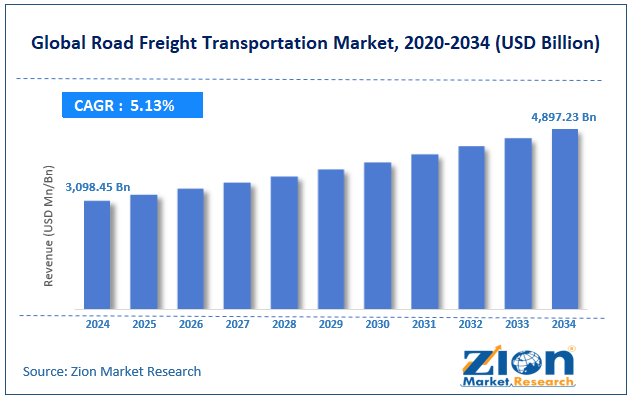
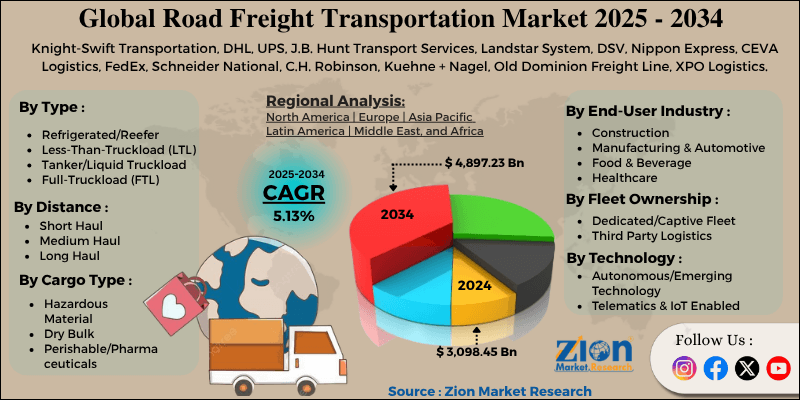
The global road freight transportation market size was worth around USD 3,098.45 billion in 2024 and is predicted to grow to around USD 4,897.23 billion by 2034 with a compound annual growth rate (CAGR) of roughly 5.13% between 2025 and 2034.
Key Insights:
- As per the analysis shared by our research analyst, the global road freight transportation market is estimated to grow annually at a CAGR of around 5.13% over the forecast period (2025-2034)
- In terms of revenue, the global road freight transportation market size was valued at around USD 3,098.45 billion in 2024 and is projected to reach USD 4,897.23 billion by 2034.
- The market is projected to grow at a significant rate due to the increasing investments in road infrastructure worldwide.
- Based on the type, the full-truckload (FTL) segment is growing at a high rate and will continue to dominate the global market, as per industry projections.
- Based on the distance, the short-haul segment is anticipated to command the largest market share.
- Based on the cargo type, the general cargo segment is expected to lead the market growth trends.
- Based on the end-user industry, the retail & e-commerce segment is projected to influence revenue in the market.
- Based on the fleet ownership, the third-party logistics sector will emerge as the fastest-growing segment.
- Based on the technology, the autonomous/emerging technology will deliver the fastest CAGR during the forecast period.
- Based on the service type, the domestic road freight will dominate the market growth trends.
- Based on region, the Asia-Pacific is projected to dominate the global market during the forecast period.
Road Freight Transportation Market: Overview
Road freight transportation refers to the use of motor vehicles such as trucks and lorries to transport commercial goods. Road freight is leveraged to conduct domestic and cross-border transactions of essential and everyday commodities, ranging from hazardous materials to food items. Road freight is one of the leading forms of goods transportation since it allows door-to-door service. In addition, flexibility and reliability delivered by road freight further promotes market adoption across end-user industries. During the forecast period, the expansion of road infrastructure and connectivity will allow extended market growth. Furthermore, e-commerce industries and the use of sustainable transportation modes will add to the industry’s growth trends. However, rising fuel prices and limitations on road freight may restrict market revenue in the long run.
Impact of the USA-Israel war on Iran on the Road Freight Transportation Market
The escalating war between the US, Israel, and Iran, and its subsequent impact on the Strait of Hormuz, has led to extreme fuel price shocks being recorded across the globe. Road transportation costs have increased as service providers add additional fuel charges to the final bill. During the forecast period, the war is expected to aid increased investments in electric vehicles for road-based freight transportation.
Road Freight Transportation Market: Dynamics
Growth Drivers
How will improvements in road infrastructure influence growth in the road freight transportation market?
The global road freight transportation market is expected to benefit from the increasing investments in road infrastructure worldwide. Ongoing construction of highways and expressways connecting remote areas reduces operational cost and ensures faster transit times. In addition, improved connectivity opens up new market groups for commodity producers. The European Commission has recently approved EUR 2.8 billion in funding for 95 transport projects under the Connecting Europe Facility (CEF). Road modernization is a prominent form of modern architecture, thus encouraging freight movement efficiency and reducing traffic congestion.
Expansion of the e-commerce and quick commerce industries works in favor of the industry players
The global e-commerce and quick commerce industries are some of the leading revenue drivers for road freight transportation. Last-mile delivery, which is generally carried out through road-based transport systems, accounts for around 40% to 50% of the total shipping cost. During the forecast period, the e-commerce industry is anticipated to grow at a CAGR of 20%, driven by rising demand for quick commerce solutions and higher use of grocery delivery applications. The global road freight transportation market will continue to benefit as the e-commerce industry reaches new heights in the coming years.
Restraints
Why will fuel price volatility limit the expansion of the road freight transportation market?
The global road freight transportation industry is anticipated to be restricted due to fuel price volatility. Rising geopolitical tension across the Middle East and the ongoing war between Russia and Ukraine have significantly impacted fuel prices and availability. The U.S. national average gas price has reached USD 4 a gallon as of April 2026, marking an increase of over 29.9% since February 2026. Most vehicles used in road freight transportation across the globe are fuel-powered. Fluctuations in gas prices limit market adoption trends.
Opportunities
Use of electric vehicles and sustainable practices to generate growth opportunities during the forecast period
The global road freight transportation market is anticipated to generate growth opportunities due to the adoption of sustainable business practices. For instance, most freight transportation companies are employing electric vehicles to cushion themselves against the challenges of rising fuel costs. Amazon, one of the world’s leading e-commerce companies, employs over 10,000 electric vehicles (EVs) across India alone. Other e-commerce giants have amplified investments in EVs for last-mile delivery. In addition, government pressure to reduce carbon emissions will further encourage the use of new and sustainable methods of freight transportation through roadways, creating opportunities for industry players.
Challenges
How will the technical limitations of road freight transportation challenge market growth during the forecast period?
The global road freight transportation industry is anticipated to be challenged by technical limitations. For instance, road transportation halts during natural calamities and extreme weather. In addition, traffic congestion can disrupt business operations, resulting in diminished profits. Strict regulatory framework and lack of infrastructure will create growth barriers for the industry players during the projection period.
Road Freight Transportation Market: Report Scope
| Report Attributes | Report Details |
|---|---|
| Report Name | Road Freight Transportation Market |
| Market Size in 2024 | USD 3,098.45 Billion |
| Market Forecast in 2034 | USD 4,897.23 Billion |
| Growth Rate | CAGR of 5.13% |
| Number of Pages | 225 |
| Key Companies Covered | Knight-Swift Transportation, DHL, UPS, J.B. Hunt Transport Services, Landstar System, DSV, Nippon Express, CEVA Logistics, FedEx, Schneider National, C.H. Robinson, Kuehne + Nagel, Old Dominion Freight Line, XPO Logistics, DB Schenker, and others. |
| Segments Covered | By Type, By Distance, By Cargo Type, By End-User Industry, By Fleet Ownership, By Technology, By Service Type, and By Region |
| Regions Covered | North America, Europe, Asia Pacific (APAC), Latin America, Middle East, and Africa (MEA) |
| Base Year | 2024 |
| Historical Year | 2019 to 2023 |
| Forecast Year | 2025 - 2034 |
| Customization Scope | Avail customized purchase options to meet your exact research needs. Request For Customization |
Road Freight Transportation Market: Segmentation
The global road freight transportation market is segmented based on type, distance, cargo type, end-user industry, fleet ownership, technology, service type, and region.
Why will the full-truckload segment lead the road freight transportation industry revenue during the forecast period?
Based on type, the global market segments are refrigerated/reefer, less-than-truckload (LTL), tanker/liquid truckload, full-truckload (FTL), flatbed, intermodal, parcel services, and others. In 2024, the full-truckload (FTL) segment dominated more than 50% of the global revenue. It is expected to deliver a CAGR of 4.5% during the forecast period, driven by its applications in bulk deliveries and cost-effectiveness.
Which will be the fastest-growing distance during the forecast period in the road freight transportation market?
Based on distance, the global market is fragmented into short-haul, medium-haul, and long-haul. The highest growth revenue in 2024 was listed in the short-haul segment, accounting for 42% of the global revenue. It will continue dominating the market with a CAGR of 7.1% during the forecast period due to the rising demand for same-day delivery and the quick commerce boom.
Which factors drive demand in the general cargo segment in the road freight transportation industry?
Based on cargo type, the global road freight transportation industry is divided into hazardous material, dry bulk, perishable/pharmaceuticals, liquid bulk, automotive/heavy machinery, general cargo, electronics/high value, and others. In 2024, general cargo emerged as the leading revenue generator, contributing upto 41% of the global revenue. It is projected to deliver a CAGR of 5.24% during the projected period, led by rising demand for essential commodities and food products.
Which end-user industry will contribute notably to the road freight transportation market?
Based on the end-user industry, the global market is fragmented into construction, manufacturing & automotive, food & beverage, healthcare, chemical & petrochemicals, retail & e-commerce, oil & gas, mining, and others. In 2024, the retail & e-commerce industry contributed up to 26% of the global revenue. It is expected to offer a CAGR of 8.12% during the forecast period due to the rapid expansion of online shoppers worldwide.
How is the third-party logistics segment expected to shape the road freight transportation industry during the projection period?
Based on fleet ownership, the global market is segmented into dedicated/captive fleet, third-party logistics, and spot market. In 2024, the highest growth rate was listed in the third-party logistics segment, which accounted for 50.02% of the global revenue. It is projected to grow at 7.27% CAGR as logistics outsourcing offers several operational and financial advantages. Additional third-party logistics providers reduce the risk of non-compliance with the regulatory framework.
Which technology will emerge as the leading revenue generator in the road freight transportation market?
Based on technology, the global market divisions are autonomous/emerging technology, telematics & IoT-enabled, and non-digital. The market was dominated by the non-digital segment in 2024, contributing around 59% of the global revenue. During the forecast period, the autonomous/emerging technology segment is projected to grow at the fastest CAGR of 10% due to higher demand for smart logistics solutions across the transportation industry.
Why will domestic lead the road freight transportation industry during the forecast period?
Based on service type, the global market is divided into domestic road freight and cross-border road freight. In 2025, 75% of the global revenue was listed in the domestic road freight segment. It is expected to grow at 6.12% CAGR during the forecast period due to extensive applications in last-mile delivery and the ongoing expansion of road infrastructure.
Road Freight Transportation Market: Regional Analysis
Why will Asia-Pacific dominate the road freight transportation market during the forecast period?
The global road freight transportation market is anticipated to be dominated by the Asia-Pacific region during the forecast period. In 2024, it accounted for 48% of the global revenue and will grow at a CAGR of 6.12% during the forecast period. Growth in the Asia-Pacific is driven by the presence of a robust and growing e-commerce industry. China and India are some of the leading consumers of the e-commerce and quick commerce markets. In addition, rising demand for consumer goods, large-scale production of consumer electronics, and expansion of road infrastructure will promote regional growth trends in the future.
Which factors will drive demand in North America during the projection period?
North America is the second-highest revenue generator in the global road freight transportation market, accounting for 35% of the total revenue in 2024. It is projected to grow at 5.7% CAGR during the projection period. Strong road infrastructure, a rising e-commerce industry, and a surge in cross-border trade will promote regional growth. Moreover, the expansion of electric fleets by prominent regional e-commerce companies along with strict regulatory guidelines will shape growth trends across North America.
Road Freight Transportation Market: Competitive Analysis
The global road freight transportation market is led by players like:
- Knight-Swift Transportation
- DHL
- UPS
- J.B. Hunt Transport Services
- Landstar System
- DSV
- Nippon Express
- CEVA Logistics
- FedEx
- Schneider National
- C.H. Robinson
- Kuehne + Nagel
- Old Dominion Freight Line
- XPO Logistics
- DB Schenker
What are the latest key trends in the road freight transportation market?
Digitization of freight transportation
The ongoing use of smart technologies such as real-time fleet management tools, advanced driver assistance systems (ADAS), and Global Positioning System (GPS)-based tracking systems is a prominent market growth trend. These technologies will help companies improve business operations and reduce unwarranted costs.
Intermodal transportation
Effective integration of rail, road, and sea transportation under one structure improved cost efficiency, especially for long-haul and cross-border haul. It also reduces dependence on one form of transport, thus promoting risk minimization.
The global road freight transportation market is segmented as follows:
By Type
- Refrigerated/Reefer
- Less-Than-Truckload (LTL)
- Tanker/Liquid Truckload
- Full-Truckload (FTL)
- Flatbed
- Intermodal
- Parcel Services
- Others
By Distance
- Short Haul
- Medium Haul
- Long Haul
By Cargo Type
- Hazardous Material
- Dry Bulk
- Perishable/Pharmaceuticals
- Liquid Bulk
- Automotive/Heavy Machinery
- General Cargo
- Electronics/High Value
- Others
By End-User Industry
- Construction
- Manufacturing & Automotive
- Food & Beverage
- Healthcare
- Chemical & Petrochemical
- Retail & E-commerce
- Oil & Gas
- Mining
- Others
By Fleet Ownership
- Dedicated/Captive Fleet
- Third Party Logistics
- Spot Market
By Technology
- Autonomous/Emerging Technology
- Telematics & IoT Enabled
- Non-Digital
By Service Type
- Domestic Road Freight
- Cross-Border Road Freight
By Region
- North America
- The U.S.
- Canada
- Mexico
- Europe
- France
- The UK
- Spain
- Germany
- Italy
- Rest of Europe
- Asia Pacific
- China
- Japan
- India
- Australia
- South Korea
- Rest of Asia Pacific
- The Middle East & Africa
- Saudi Arabia
- UAE
- Egypt
- Kuwait
- South Africa
- Rest of the Middle East & Africa
- Latin America
- Brazil
- Argentina
- Rest of Latin America
Table Of Content
Methodology
FrequentlyAsked Questions
Road freight transportation refers to the use of motor vehicles such as trucks and lorries to transport commercial goods.
The global road freight transportation market is expected to benefit from the increasing investments in road infrastructure worldwide.
According to study, the global road freight transportation market size was worth around USD 3,098.45 billion in 2024 and is predicted to grow to around USD 4,897.23 billion by 2034.
The CAGR value of the road freight transportation market is expected to be around 5.13% during 2025-2034.
The global road freight transportation industry is anticipated to be challenged by technical limitations.
Digitization of freight transportation and intermodal transportation are the emerging trends and innovations impacting the road freight transportation market.
The global road freight transportation market has performed well so far and will offer similar trends in the coming years.
The global road freight transportation market is anticipated to be dominated by the Asia-Pacific region during the forecast period.
The global road freight transportation market is led by players like Knight-Swift Transportation, DHL, UPS, J.B. Hunt Transport Services, Landstar System, DSV, Nippon Express, CEVA Logistics, FedEx, Schneider National, C.H. Robinson, Kuehne + Nagel, Old Dominion Freight Line, XPO Logistics, and DB Schenker.
The report explores crucial aspects of the road freight transportation market including detailed discussion of existing growth factors and restraints while also browsing future growth opportunities and challenges that impact the market.

HappyClients

