
Private Military Security Services Market Size, Share and Forecast 2034

Private Military Security Services Market By Service Type (Land-Based Security, Specialized Maritime Security and Dual Land-Maritime), By Product (Guard Services, Private Investigation, Armored Transport, Alarm Monitoring and Others), By Application (Commercial, Residential, Government, Industrial and Institutional) and By Region - Global and Regional Industry Overview, Market Intelligence, Comprehensive Analysis, Historical Data, and Forecasts 2026 - 2034
| Market Size in 2025 | Market Forecast in 2034 | CAGR (in %) | Base Year |
|---|---|---|---|
| USD 268 Billion | USD 445 Billion | 5.8% | 2025 |
Private Military Security Services Industry Perspective:
What will be the size of the global private military security services market during the forecast period?
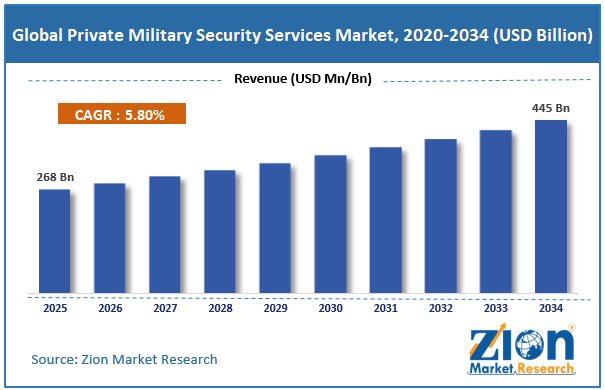
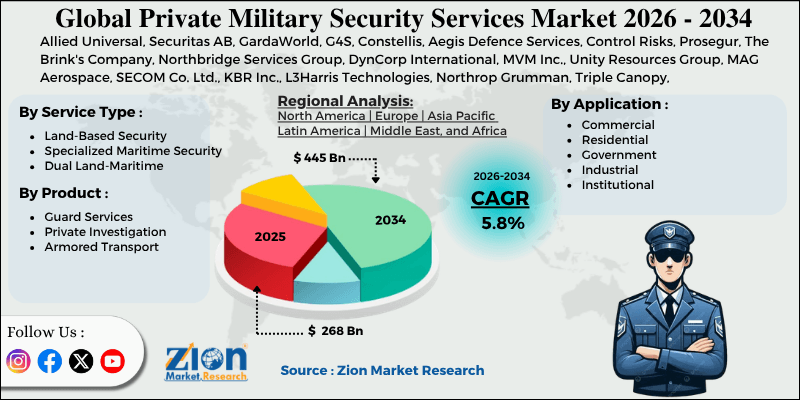
The global private military security services market size was worth around USD 268 billion in 2025 and is predicted to grow to around USD 445 billion by 2034 with a compound annual growth rate (CAGR) of roughly 5.8% between 2026 and 2034.
Key Insights
- As per the analysis shared by our research analyst, the global private military security services market is estimated to grow annually at a CAGR of around 5.8% over the forecast period (2026-2034).
- In terms of revenue, the global private military security services market size was valued at around USD 268 billion in 2025 and is projected to reach USD 445 billion by 2034.
- Technological advancements in security and surveillance are expected to propel the private military security services market over the projected period.
- Based on the service type, the land-based security segment dominates the market.
- Based on the product, the guard services segment held the largest revenue share in 2025.
- Based on the application, the commercial segment held the prominent revenue share in 2025.
- Based on region, North America region holds a prominent market share in 2025.
Private Military Security Services Market: Overview
Private military security services market can be described as the industry that supplies private companies with the provision of unique services in areas such as security, defense, and military activities to governments, defense agencies, international corporations, non-governmental organizations, and operators of critical infrastructure. The range of these services includes the provision of armed and unarmed security services, training, risk assessment, intelligence, convoy escorting, asset security, protection of personnel and valuable objects, maritime security, cybersecurity, logistics, emergency services, and other services. The PMSS market is characterized by a stable development trend due to rising geopolitical tensions, increased terrorism and piracy threats, growing investments in critical infrastructure security, and the outsourcing of security services with greater flexibility and specialization. The development of surveillance technologies, AI, drones, and command-and-control systems is improving service possibilities.
Impact of the USA-Israel War on Iran on the Private Military Security Services Market
The conflict between the USA and Israel with Iran has led to an increase in the need for PMSCs due to an increase in security threats in the region and neighboring regions. Increased concern about missile attacks, maritime dangers in the Red Sea and the Strait of Hormuz, cyberattacks, and the protection of embassies, energy sites, and businesses has led to an increase in government and multinational companies engaging more with PMSCs. The USA-Israel conflict has also led to an increase in the demand for intelligence gathering, convoy protection, critical infrastructure protection, and risk management. However, continued hostilities may result in higher operational costs and insurance costs for PMSCs operating in high-risk regions.
Private Military Security Services Market: Dynamics
Growth Drivers
How does the rising geopolitical tensions and regional conflicts drive the private military security services market?
The rising geopolitical tension, interstate wars, acts of terrorism, and instability within regions are contributing greatly to the growing demand for private military security services around the world. There is a rising trend of contracting security, intelligence gathering, convoy escort, and protection of critical infrastructure in dangerous environments to private military security companies. The Stockholm International Peace Research Institute (SIPRI) reported that global military expenditure in 2025 reached an all-time high of USD 2.887 trillion, marking the 11th consecutive year of increase, with military expenditure outside the US rising by 9.2%.
Additionally, SIPRI noted that the number of interstate armed conflicts rose to six in 2025 from just three in 2024 and included conflicts between Iran-Israel/US. The private military security services market is therefore experiencing sustained growth due to investment in risk management, logistics support, surveillance, and crisis response services, among others.
Restraints
Stringent regulatory and legal compliance requirements hamper the growth of the private military security services industry
Stringent regulatory and legal compliance regulations continue to be major obstacles to the development of the private military security services industry. Companies involved in the provision of private military security services must comply with intricate regulations governing the use of weapons, arms export controls, cross-border operations, human rights, and the use of force, among others. Many nations have put in place elaborate licensing, vetting, and reporting systems, as well as contract approval mechanisms, for private security companies.
At the same time, international documents such as the Montreux document and ICoCA set stringent compliance standards. On the other hand, the government tends to intensify regulation after certain security breaches or conflicts, resulting in high compliance and insurance costs. In addition, differing compliance regulations across nations lead to delays in obtaining approvals, limiting the firm's ability to enter international markets and affecting its profitability, especially for small and medium-sized security companies.
Opportunities
Does the expansion of global business operations in high-risk regions offer a lucrative opportunity for the private military security services market?
The involvement of global companies in politically turbulent, high-risk areas offers significant growth potential for the private military security services market. Large international firms operating in sectors like oil & gas, mining, construction, energy, logistics, telecommunications, and infrastructure are becoming increasingly active in developing their operations in Middle Eastern, African, Latin American, and certain Asian countries, where there are constant dangers of terrorism, civil unrest, piracy, kidnappings, and sabotage. To protect themselves and their property, and to secure their supply chains and other critical locations, they are outsourcing security functions to PMSS firms. There is increased demand for services, including protection (armed/unarmed), escorts, intelligence gathering, risk assessment, crisis management, emergency evacuation, and maritime security. Moreover, due to FDI, border projects, and energy exploration, there is continued growth potential for private security firms to provide security services.
Challenges
How do high operational and personnel costs pose a significant challenge to the growth of the private military security services industry?
The cost of operations and staffing is a significant barrier hindering the expansion of the private military security services industry. The private security agencies have to bear huge costs due to hiring experienced staff, including many with military, special forces, and law enforcement experience, who are paid hefty salaries.
Apart from this, there are considerable expenses involved with regards to the provision of advanced protection equipment, firearms (if allowed), armored vehicles, surveillance devices, drones, communication and cybersecurity technology, insurance coverage, and adherence to strict national and international laws and regulations. Operations in war zones and difficult geographical locations will entail additional costs for hazardous duty allowances, transport and logistics, accommodation, healthcare, and emergency evacuation. Such a high cost of operations may negatively affect profit margins and increase PMSS prices.
Private Military Security Services Market: Report Scope
| Report Attributes | Report Details |
|---|---|
| Report Name | Private Military Security Services Market |
| Market Size in 2025 | USD 268 Billion |
| Market Forecast in 2034 | USD 445 Billion |
| Growth Rate | CAGR of 5.8% |
| Number of Pages | 228 |
| Key Companies Covered | Allied Universal, Securitas AB, GardaWorld, G4S, Constellis, Aegis Defence Services, Control Risks, Prosegur, The Brink's Company, Northbridge Services Group, DynCorp International, MVM Inc., Unity Resources Group, MAG Aerospace, SECOM Co. Ltd., KBR Inc., L3Harris Technologies, Northrop Grumman, Triple Canopy, Olive Group, and others. |
| Segments Covered | By Service Type, By Product, By Application, and By Region |
| Regions Covered | North America, Europe, Asia Pacific (APAC), Latin America, Middle East, and Africa (MEA) |
| Base Year | 2025 |
| Historical Year | 2020 - 2024 |
| Forecast Year | 2026 - 2034 |
| Customization Scope | Avail customized purchase options to meet your exact research needs. Request For Customization |
Private Military Security Services Market: Segmentation
Service Type Insights
Why does the land-based security segment hold a prominent position in the private military security services market?
The land-based security segment dominates the market. The growth is propelled by rising needs to secure critical infrastructure, government offices, military installations, embassies, corporate offices, energy facilities, transportation systems, and manufacturing plants from threats such as terrorism, sabotage, civil disorder, and war. The trend of outsourcing of perimeter security, armed guard service, convoy security, intelligence gathering, access control, and fast deployment of security forces from specialized private military security firms has been growing among governments and multinational companies.
Product Insights
Does the guard services segment capture the largest market share in the private military security services market?
The guard services segment held the largest revenue share in 2025. This is attributed to the growing requirement for real-time on-the-ground security of staff members, vital infrastructures, commercial establishments, government structures, embassies, military bases, and high-valued assets. The rise in geopolitical tension, terrorist activities, civic disturbance, organized crimes, and the extension of corporate activities in risky areas is boosting the requirement for well-trained security guards who can carry out armed and unarmed security services. There is a rising trend among governments, defense agencies, energy firms, logistics providers, and multinational corporations to outsource their guarding activities through private military security service providers.
Application Insights
What factor drives the commercial segment in the private military security services market?
The commercial segment held the prominent revenue share in 2025. The expansion is being fueled by the growing need to protect business interests, people, logistics, and operations from potential threats arising from terrorism, theft, cyber-physical security risks, vandalism, civil unrest, or geopolitical factors. Multinational corporations operating in sectors such as oil and gas, mining, construction, logistics, manufacturing, banking and finance, telecommunications, and other critical infrastructure have increasingly opted to outsource their security to private military companies that can provide business continuity in both stable and unstable environments. Growth in investment in commercial real estate, industry, data centers, ports, airports, and energy production facilities has been another major contributing factor.
Regional Insights
What factors drive North America region in the private military security services market?
North America region holds a prominent market share in 2025. The growth will be fueled by high defense spending, increasing needs for critical infrastructure protection, cyber threats, and the trend towards outsourcing specialized security services among government bodies and commercial organizations. The United States continues to dominate the regional market in terms of strong military readiness, homeland security, diplomatic security, and critical infrastructure resilience investment. Geopolitical tensions, cross-border security issues, and increased partnerships between the public and private sectors have further increased demand for armed guarding, intelligence, risk advisory, convoy protection, and other security services.
In addition, government initiatives aimed at increasing the resilience of energy infrastructure, transportation infrastructure, data centers, ports, and communication infrastructure will generate sustainable demand for PMCs in the region. As reported by the Department of Homeland Security (DHS), the FY2026 budget allocates USD 2.38 billion to CISA (Cybersecurity and Infrastructure Security Agency).
From this amount, USD 302.9 million is allocated to programs for infrastructure security and resilience that aim to protect critical infrastructure in cooperation with public- and private-sector partners. These government investments, combined with high commercial demand for security services, will drive revenue growth in the North American market.
Private Military Security Services Market: Competitive Analysis
The global private military security services market is dominated by players like:
- Allied Universal
- Securitas AB
- GardaWorld
- G4S
- Constellis
- Aegis Defence Services
- Control Risks
- Prosegur
- The Brink's Company
- Northbridge Services Group
- DynCorp International
- MVM Inc.
- Unity Resources Group
- MAG Aerospace
- SECOM Co. Ltd.
- KBR Inc.
- L3Harris Technologies
- Northrop Grumman
- Triple Canopy
- Olive Group
The global private military security services market is segmented as follows:
By Service Type
- Land-Based Security
- Specialized Maritime Security
- Dual Land-Maritime
By Product
- Guard Services
- Private Investigation
- Armored Transport
- Alarm Monitoring
- Others
By Application
- Commercial
- Residential
- Government
- Industrial
- Institutional
By Region
- North America
- The U.S.
- Canada
- Mexico
- Europe
- France
- The UK
- Spain
- Germany
- Italy
- Rest of Europe
- Asia Pacific
- China
- Japan
- India
- Australia
- South Korea
- Rest of Asia Pacific
- The Middle East & Africa
- Saudi Arabia
- UAE
- Egypt
- Kuwait
- South Africa
- Rest of the Middle East & Africa
- Latin America
- Brazil
- Argentina
- Rest of Latin America
Table Of Content
Methodology
FrequentlyAsked Questions
Private military security services market can be described as the industry that supplies private companies with the provision of unique services in areas such as security, defense, and military activities to governments, defense agencies, international corporations, non-governmental organizations, and operators of critical infrastructure.
The private military security services market is primarily driven by rising geopolitical tensions, regional conflicts, and increasing terrorism threats that are boosting demand for specialized security solutions worldwide. Growing protection requirements for critical infrastructure, expanding defense outsourcing by governments, and the expansion of multinational business operations in high-risk regions are further accelerating market growth.
The private military security services market faces several significant challenges, including stringent regulatory and legal compliance requirements governing armed operations, cross-border activities, and the use of force. High operational and personnel costs associated with recruiting skilled professionals, maintaining advanced security technologies, and ensuring regulatory compliance also constrain profitability.
Based on the product, the guard services segment is expected to dominate the private military security services market growth during the projected period.
Emerging trends in the Private Military Security Services market include the growing integration of artificial intelligence (AI), drones, autonomous surveillance systems, biometric access control, IoT-enabled sensors, and advanced command-and-control platforms to enhance threat detection and real-time situational awareness. Security providers are increasingly offering integrated physical and cyber security solutions, predictive risk intelligence, and data-driven security operations through cloud-based monitoring platforms.
According to the report, the global private military security services market size was worth around USD 268 billion in 2025 and is predicted to grow to around USD 445 billion by 2034.
The global private military security services market is expected to grow at a CAGR of 5.8% during the forecast period.
The global private military security services industry growth is expected to be led by North America over the forecast period.
The global private military security services market is dominated by players like Allied Universal, Securitas AB, GardaWorld, G4S, Constellis, Aegis Defence Services, Control Risks, Prosegur, The Brink's Company, Northbridge Services Group, DynCorp International, MVM, Inc., Unity Resources Group, MAG Aerospace, SECOM Co., Ltd., KBR, Inc., L3Harris Technologies, Northrop Grumman, Triple Canopy and Olive Group among others.
The market report covers the geographical market along with a comprehensive competitive landscape analysis. It also includes cash flow analysis, profit ratio analysis, market basket analysis, market attractiveness analysis, sentiment analysis, PESTLE analysis, trend analysis, SWOT analysis, trade area analysis, demand & supply analysis, Porter’s five forces analysis, and value chain analysis.

HappyClients

