PCB And PCBA Market Size, Share, Growth, Opportunities 2034

PCB And PCBA Market By Product Type (Single-Sided, Double-Sided, Multi-Layer, Flexible and Rigid-Flex), By Application (Consumer Electronics, Automotive, Industrial Electronics, Healthcare, Aerospace & Defense and Others) and By Region - Global and Regional Industry Overview, Market Intelligence, Comprehensive Analysis, Historical Data, and Forecasts 2025 - 2034
| Market Size in 2024 | Market Forecast in 2034 | CAGR (in %) | Base Year |
|---|---|---|---|
| USD 69.5 Billion | USD 114.3 Billion | 5.1% | 2024 |
PCB And PCBA Industry Perspective:
What will be the size of the global PCB And PCBA market during the forecast period?
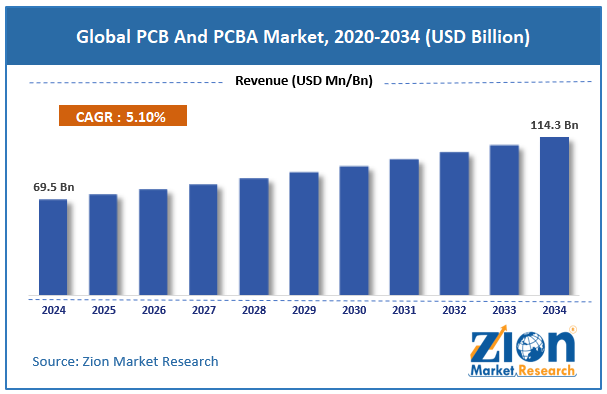
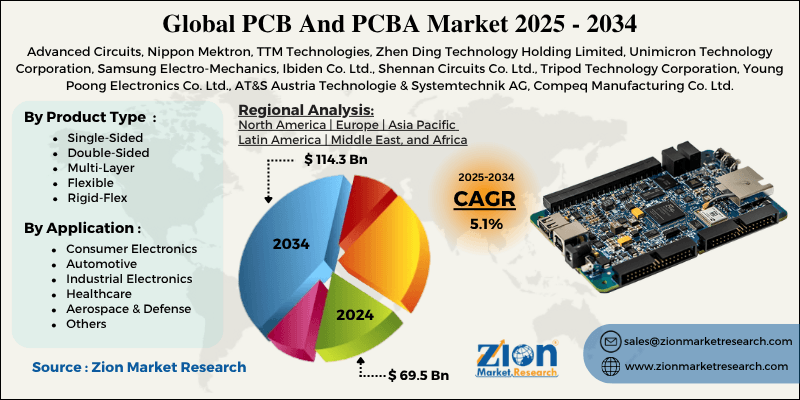
The global PCB And PCBA market size was worth around USD 69.5 billion in 2024 and is predicted to grow to around USD 114.3 billion by 2034 with a compound annual growth rate (CAGR) of roughly 5.1% between 2025 and 2034.
Key Insights
- As per the analysis shared by our research analyst, the global PCB And PCBA market is estimated to grow annually at a CAGR of around 5.1% over the forecast period (2025-2034).
- In terms of revenue, the global PCB And PCBA market size was valued at around USD 69.5 billion in 2024 and is projected to reach USD 114.3 billion by 2034.
- Growing consumer electronics sector is expected to propel the PCB And PCBA market over the projected period.
- Based on the product type, the single-sided segment captures the largest market share in 2024.
- Based on the application, the consumer electronics segment captures the largest revenue share in 2024.
- Based on region, the Asia Pacific accounted for the largest market share of 48% in 2024.
PCB And PCBA Market: Overview
PCB (Printed Circuit Board) and PCBA (Printed Circuit Board Assembly) form the fundamental building blocks of today’s electronics industry. A Printed Circuit Board (PCB) is a board that consists of an insulator, usually fiberglass, and has conductive pathways formed on its surface by etching or printing copper. The PCB provides a base for mounting electronic components, serving as a structure that allows signals to travel within the circuit.
PCBA, on the other hand, is a manufacturing process in which electronic components, including resistors, capacitors, integrated circuits, connectors, and others, are soldered onto the PCB using technologies such as Surface-Mount Technology (SMT) and Through-Hole Assembly. In simple terms, whereas the PCB is just the raw board, PCBA is the actual electronic assembly after all necessary components are mounted.
Impact of the USA-Israel War on Iran on the PCB And PCBA Market
There has been a continuous USA-Israel war against Iran, which is playing an important role in creating an adverse effect on the international PCB and PCBA market due to the disruption of logistics, raw material supply, and increased cost. In particular, the conflict has disrupted global logistics and the movement of goods through the Strait of Hormuz. This has further increased transportation costs and delivery delays for electronic goods. In addition, the increase in energy and oil prices has led to higher operational costs in the manufacturing and assembly of PCBs and PCs, as the manufacturing process requires significant energy use.
On the other hand, the war against Iran has also created a shortage of essential raw materials, such as petrochemicals and helium, required for the manufacturing of PCBs and PCBA. Export embargoes and the destruction of infrastructure in Iran have also led to lengthy production lead times, reduced productivity, and production inefficiencies.
PCB And PCBA Market: Dynamics
Growth Drivers
Why does the rising demand for consumer electronics drive the PCB And PCBA market?
An increasing demand for consumer electronics has been observed as another significant factor contributing to the growth of the PCBs and PCBAs market, as the latter are essential components that form the basis of almost all types of electronics. The use of devices such as smartphones, laptops, tablets, smart TVs, wearables, and even home automation systems require highly advanced printed circuit boards to perform all the necessary functions. With an increasing number of people adopting a digital way of life for work, learning, and entertainment, the manufacturing volumes of devices have increased dramatically, thereby driving up demand for PCB production and assembly.
Furthermore, the need for smaller, multifunctional electronics has driven the need for highly advanced technologies, such as high-density interconnect, flexible circuits, and multi-layer PCBs, to accommodate increasing numbers of components and high performance simultaneously. Another driving factor has been the innovation of new features and capabilities, including the integration of 5G technologies and artificial intelligence.
Restraints
High manufacturing costs & capital investment hamper the industry growth
High manufacturing and capital expenditure are the major factors limiting the development of the PCB and PCBA market. Setting up PCB manufacturing and assembly plants requires substantial investment due to the high cost of equipment such as SMT lines, AOI inspection systems, and precision drilling and etching machines. Moreover, establishing PCB plants requires creating highly controlled working environments along with setting up quality assurance and environmental compliance processes. Apart from that, the industry is associated with high recurring costs, including the procurement of raw materials (copper laminates and special chemicals), electricity consumption, hiring qualified workers, and upgrading manufacturing equipment to keep pace with rapidly evolving technologies, such as HDI and micron-scale circuits. These financial constraints can be quite problematic for small and midsize companies seeking to enter the market.
Another factor affecting PCB and PCBA production is the constantly changing cost of raw materials and the continuous innovations required to meet the ever-changing demands of consumers. Therefore, the industry's capital-intensive nature and high operational costs can negatively impact production and prevent manufacturers from adopting advanced solutions and scaling their operations.
Opportunities
Why do the rising partnership among the key market players offer a lucrative opportunity for the PCB And PCBA market?
The rising partnership among the key market players are expected to offer a potential opportunity to the market growth during the projected period. For instance, in February 2025, NextPCB, one of the largest electronics manufacturing services providers and a Platinum sponsor of KiCad, continues to prove its commitment to advancing open-source electronic design automation through meaningful contributions and initiatives. In particular, unlike other sponsors whose involvement is limited to financial support, NextPCB's efforts go further, including direct development, community nurturing, and KiCad promotion in Asia.
Noteworthy contributions to the core build of KiCad have come from adding two NextPCB engineers to the KiCad core development team, including new features such as the Zone Manager tool and long-awaited ODB++ export functionality that made it into KiCad 9. Moreover, NextPCB's efforts are reflected in their sponsorship of the KiCad Asia conference for two consecutive years, thereby contributing to the growing popularity of KiCad in the Asian market. Such contribution is complemented by Huaqiu KiCad distribution, which increases access for the Chinese user base and aligns with KiCad's mission to become a global software.
Challenges
Why do the stringent quality control & testing requirements pose a significant challenge to the PCB And PCBA market?
The problem with quality control and testing poses great difficulties in the PCB and PCBA market due to the fact that even small defects in the design of circuit boards may result in complete malfunctioning of electronic devices, especially those with high reliability requirements, such as automotive electronics, aerospace systems, medical appliances, or automation devices. Thus, producers must conduct thorough tests, including AOI, x-ray, ICT, and functional tests, to ensure proper functioning and compliance with international standards. Although these practices are absolutely necessary, they prolong the manufacturing process and increase its complexity, thereby increasing costs.
Moreover, ensuring consistent quality becomes more problematic with each successive innovation in PCB design, which usually entails higher component density, multilayer design, and miniaturization, as is the case with HDI. Checking for defects, including microcracks, faulty soldering, etc., requires very sophisticated and costly test equipment and experienced personnel. This not only increases costs but also creates obstacles in the production process.
Finally, in certain industries, specialized regulations governing the manufacturing process also impose constraints on companies operating in the PCB market. For instance, medical or military equipment requires strict control throughout manufacturing, testing, and delivery. Thus, adherence to strict standards poses additional requirements on the producers, adding extra costs and delays to the manufacturing process.
PCB And PCBA Market: Report Scope
| Report Attributes | Report Details |
|---|---|
| Report Name | PCB And PCBA Market |
| Market Size in 2024 | USD 69.5 Billion |
| Market Forecast in 2034 | USD 114.3 Bllion |
| Growth Rate | CAGR of 5.1% |
| Number of Pages | 226 |
| Key Companies Covered | Advanced Circuits, Nippon Mektron, TTM Technologies, Zhen Ding Technology Holding Limited, Unimicron Technology Corporation, Samsung Electro-Mechanics, Ibiden Co. Ltd., Shennan Circuits Co. Ltd., Tripod Technology Corporation, Young Poong Electronics Co. Ltd., AT&S Austria Technologie & Systemtechnik AG, Compeq Manufacturing Co. Ltd., HannStar Board Corporation, Kingboard Holdings Limited, Meiko Electronics Co. Ltd., Daeduck Electronics Co. Ltd., Ellington Electronics Technology Co. Ltd., Shenzhen Kinwong Electronic Co. Ltd., Wus Printed Circuit Co. Ltd., NCAB Group, and others. |
| Segments Covered | By Product Type, By Application, and By Region |
| Regions Covered | North America, Europe, Asia Pacific (APAC), Latin America, Middle East, and Africa (MEA) |
| Base Year | 2024 |
| Historical Year | 2019 to 2023 |
| Forecast Year | 2025 - 2034 |
| Customization Scope | Avail customized purchase options to meet your exact research needs. Request For Customization |
PCB And PCBA Market: Segmentation
Product Type Insights
Why does the single-sided dominate the PCB And PCBA market?
The single-sided segment captures the largest market share in 2024. The growth of these boards is mainly driven by their affordability and widespread use in simpler electronic devices. Single-sided printed circuit boards have conductive elements on only one side of the board. These are widely used in consumer goods such as home appliances, power supplies, LEDs, radio devices, and control circuits. Their simplicity makes them an ideal choice for mass production at lower costs.
Application Insights
Does the consumer electronics application capture the largest market share in the PCB And PCBA market?
The consumer electronics segment captures the largest revenue share in 2024. The increase in demand is driven by the growing number of devices such as smartphones, computers, tablets, smart televisions, wearables, and home automation devices. All these devices require highly advanced PCBs to enable rapid processing and communication, as well as to facilitate small sizes. The global use of digital technologies has greatly increased, driven by rising Internet use, remote work, and disposable incomes, leading to large-scale production of consumer electronic products.
Regional Insights
Why does the Asia Pacific lead the PCB And PCBA market?
The Asia Pacific accounted for the largest market share of 48% in 2024. This growth is driven by the extremely mature electronics manufacturing business and low-cost manufacturing plants. The similar characteristics are observed in countries such as China, Japan, South Korea, and India, which are the bases for PCB manufacturing because of their quality supply chain management, skilled workforce, and manufacturing facilities, supported by the huge demand of consumer electronics, automotive electronics, and industrial electronics areas for sophisticated PCBs/PCBAs industries.
Along with this, commercial adoption of smart home products, wearables, increased urbanization, and disposable income have helped electronics consumption to grow strongly in this region, which is also helped by government programs like ' Make in India’ and other semiconductor/PCB manufacturing programs in the APAC region.
PCB And PCBA Market: Competitive Analysis
The global PCB And PCBA market is dominated by players like:
- Advanced Circuits
- Nippon Mektron
- TTM Technologies
- Zhen Ding Technology Holding Limited
- Unimicron Technology Corporation
- Samsung Electro-Mechanics
- Ibiden Co. Ltd.
- Shennan Circuits Co. Ltd.
- Tripod Technology Corporation
- Young Poong Electronics Co. Ltd.
- AT&S Austria Technologie & Systemtechnik AG
- Compeq Manufacturing Co. Ltd.
- HannStar Board Corporation
- Kingboard Holdings Limited
- Meiko Electronics Co. Ltd.
- Daeduck Electronics Co. Ltd.
- Ellington Electronics Technology Co. Ltd.
- Shenzhen Kinwong Electronic Co. Ltd.
- Wus Printed Circuit Co. Ltd.
- NCAB Group
The global PCB And PCBA market are segmented as follows:
By Product Type
- Single-Sided
- Double-Sided
- Multi-Layer
- Flexible
- Rigid-Flex
By Application
- Consumer Electronics
- Automotive
- Industrial Electronics
- Healthcare
- Aerospace & Defense
- Others
By Region
- North America
- The U.S.
- Canada
- Mexico
- Europe
- France
- The UK
- Spain
- Germany
- Italy
- Rest of Europe
- Asia Pacific
- China
- Japan
- India
- Australia
- South Korea
- Rest of Asia Pacific
- The Middle East & Africa
- Saudi Arabia
- UAE
- Egypt
- Kuwait
- South Africa
- Rest of the Middle East & Africa
- Latin America
- Brazil
- Argentina
- Rest of Latin America
Table Of Content
Methodology
FrequentlyAsked Questions
PCB (Printed Circuit Board) and PCBA (Printed Circuit Board Assembly) form the fundamental building blocks of today’s electronics industry. A Printed Circuit Board (PCB) is a board that consists of an insulator, usually fiberglass, and has conductive pathways formed on its surface by etching or printing copper.
Key growth drivers for the PCB and PCBA market include rising demand for consumer electronics, expansion of electric vehicles and automotive electronics, rapid adoption of IoT and 5G technologies, increasing industrial automation, and ongoing advancements in miniaturized and high-performance circuit designs.
Major challenges restraining the PCB and PCBA market include high manufacturing and capital investment costs, stringent quality control and testing requirements, fluctuations in raw material prices, supply chain disruptions, increasing design complexity due to miniaturization, environmental and regulatory compliance pressures, and intense price competition among global manufacturers.
Based on the application, the consumer electronics segment is expected to dominate the PCB And PCBA market growth during the projected period.
One of the most prominent trends is the shift toward miniaturization and high-density interconnect (HDI) technology, enabling more compact and powerful electronic devices such as smartphones, wearables, and medical equipment. In parallel, the adoption of flexible and rigid-flex PCBs is expanding rapidly, supporting next-generation applications like foldable devices and advanced automotive systems.
According to the report, the global PCB And PCBA market size was worth around USD 69.5 billion in 2024 and is predicted to grow to around USD 114.3 billion by 2034.
The global PCB And PCBA market are expected to grow at a CAGR of 5.1% during the forecast period.
The global PCB And PCBA industry growth is expected to be led by the Asia Pacific over the forecast period.
The global PCB And PCBA market is dominated by players like Advanced Circuits, Nippon Mektron, TTM Technologies, Zhen Ding Technology Holding Limited, Unimicron Technology Corporation, Samsung Electro-Mechanics, Ibiden Co., Ltd., Shennan Circuits Co., Ltd., Tripod Technology Corporation, Young Poong Electronics Co., Ltd., AT&S Austria Technologie & Systemtechnik AG, Compeq Manufacturing Co., Ltd., HannStar Board Corporation, Kingboard Holdings Limited, Meiko Electronics Co., Ltd., Daeduck Electronics Co., Ltd., Ellington Electronics Technology Co., Ltd., Shenzhen Kinwong Electronic Co., Ltd., Wus Printed Circuit Co., Ltd. and NCAB Group among others.
The market report covers the geographical market along with a comprehensive competitive landscape analysis. It also includes cash flow analysis, profit ratio analysis, market basket analysis, market attractiveness analysis, sentiment analysis, PESTLE analysis, trend analysis, SWOT analysis, trade area analysis, demand & supply analysis, Porter’s five forces analysis, and value chain analysis.

HappyClients