
Oil And Gas Downhole Cables Market Size, Share, Value and Forecast 2034

Oil And Gas Downhole Cables Market By Cable Type (Electrical Cables, Fiber Optic Cables, Coaxial Cables), By Material and Design (Temperature Resistance, Corrosion Resistance, Pressure Rating), By Application (Exploration and Drilling, Production and Monitoring, Well Intervention, Completion and Well Integrity), and By Region - Global and Regional Industry Overview, Market Intelligence, Comprehensive Analysis, Historical Data, and Forecasts 2025 - 2034
| Market Size in 2024 | Market Forecast in 2034 | CAGR (in %) | Base Year |
|---|---|---|---|
| USD 2.25 Billion | USD 3.93 Billion | 7.20% | 2024 |
Oil And Gas Downhole Cables Industry Perspective:
What will be the size of the global oil and gas downhole cables market during the forecast period?
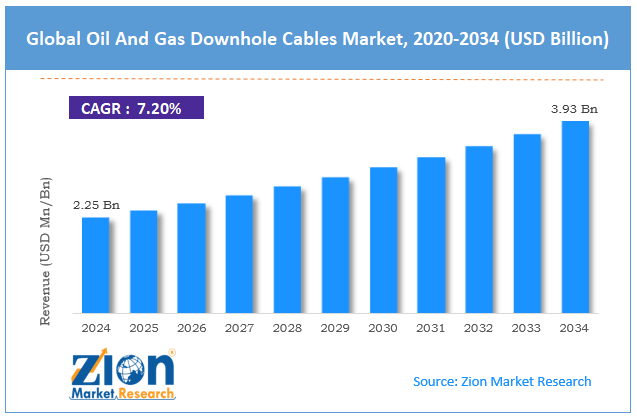
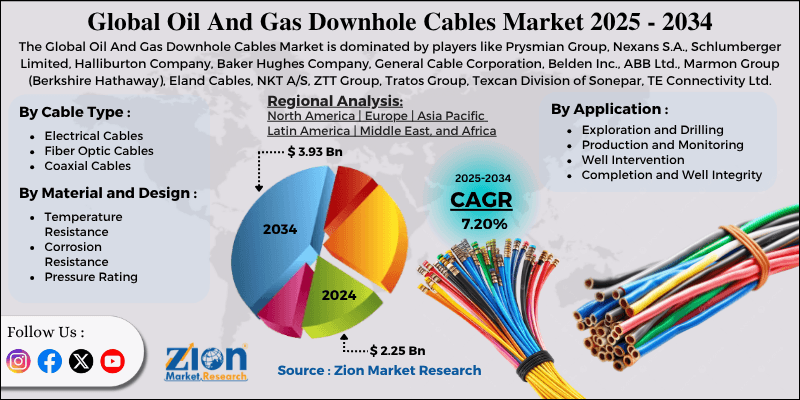
The global oil and gas downhole cables market size was around USD 2.25 billion in 2024 and is projected to reach USD 3.93 billion by 2034, with a compound annual growth rate (CAGR) of roughly 7.20% between 2025 and 2034.
Key Insights:
- As per the analysis shared by our research analyst, the global oil and gas downhole cables market is estimated to grow annually at a CAGR of around 7.20% over the forecast period (2025-2034)
- In terms of revenue, the global oil and gas downhole cables market size was valued at around USD 2.25 billion in 2024 and is projected to reach USD 3.93 billion by 2034.
- The oil and gas downhole cables market is projected to grow significantly, driven by rising demand for deepwater exploration, expansion of unconventional oil and gas projects, and increased oil and gas production in emerging markets.
- Based on cable type, the electrical cables segment is expected to lead the market, while the fiber optic cables segment is expected to grow significantly.
- Based on material and design, the temperature resistance segment is the dominating segment, while the pressure rating segment is projected to witness sizeable revenue over the forecast period.
- Based on application, the production and monitoring segment is expected to lead the market, followed by the exploration and drilling segment.
- By region, North America is projected to dominate the global market during the forecast period, followed by Europe.
Oil And Gas Downhole Cables Market: Overview
Downhole cables in the oil and gas sector are dedicated electrical and fiber-optic cables designed to operate in extreme subsurface conditions, offering communication and power to downhole sensors and tools. They should withstand harsh temperatures, mechanical stress, corrosive fluids, and high pressure while providing reliable data transmission for control and monitoring. The global oil and gas downhole cables market is poised to expand rapidly, driven by the growing demand for subsurface data acquisition, expansion of ultra-deepwater and deepwater projects, and improved drilling automation and digitalization. Real-time monitoring of downhole pressure, drilling dynamics, and temperature is vital for operational efficiency. Downhole cables enable reliable, high-speed data transmission from deep wells. This fuels adoption in appraisal, exploration, and production phases. Offshore drilling in deepwater reservoirs requires stronger, finer, and more electrical connectivity. Downhole cables are vital for power delivery and sensor integration at extreme depths. Growing deepwater investments drive industry demand.
Moreover, the industry shift toward smart wells and automation mandates the use of advanced cable systems. These systems support integrated telemetry, sensors, and control solutions. Digital transformation in oilfield operations drives industry growth.
Despite growth, the global market is constrained by factors such as harsh environment degradation and complex installation processes. Extreme temperatures, corrosive downhole fluids, and pressures accelerate wear. Cable failures may lead to costly downtime and replacement. Environmental challenges restrain performance and increase maintenance pressure. Similarly, deploying long downhole cables during drilling and completion is technically perplexing. Specialized equipment and skilled personnel are required for safe installation. This complexity raises operational costs and time.
Nonetheless, the global oil and gas downhole cables industry stands to benefit from several key opportunities, such as retrofit and upgrade services for aging wells and partnerships with oilfield service providers. Sophisticated fields need advances in monitoring infrastructure. Upgrading old cabling systems to high-performance variants offers a service opportunity. Lifecycle extension projects create recurring revenue streams. Additionally, collaborations with completion and drilling service companies can embed cable systems into bundled offerings. Joint ventures accelerate technology deployment at customer sites. Associations amplify industry reach.
Impact of the USA-Israel war on Iran on the Oil and Gas Downhole Cables Market
The U.S-Israel war with Iran has intensified oil prices but disturbed drilling activities, creating short-term insecurity for the downhole cables sector. Security risks and halted projects hamper immediate demand, though energy diversification and future reconstruction could drive long-term growth. Overall, the market experiences volatility with irregular impacts on operations and investments.
Oil And Gas Downhole Cables Market: Dynamics
Growth Drivers
How is the adoption of enhanced recovery & digital oilfield solutions driving the oil and gas downhole cables market?
Enhanced Oil Recovery (EOR) techniques, comprising thermal recovery and hydraulic fracturing, increase the need for strong downhole connectivity. Downhole cables support complex instrumentation and reservoir surveillance, enhancing extraction efficiency. Integration with analytics platforms and IoT devices improves operational safety and well performance. Digital oil field strategies further amplify demand for cables by enabling remote monitoring and automation. Digitalization and EOR collectively fuel continuous growth in the oil and gas downhole cables market.
How is the oil and gas downhole cables market positively impacted by the need for real-time monitoring & operational efficiency?
Operators increasingly rely on real-time data from downhole cables to monitor well-performance, production efficiency, and reservoir behavior. Continuous transmission of pressure, temperature, and other critical metrics enables predictive maintenance and rapid decision-making. Digital oilfield initiatives are driving greater adoption of high-speed, reliable connectivity. Improved monitoring reduces downtime and operational risks while optimizing extraction. The trend towards data-driven operations highlights the strategic importance of downhole cables. As oilfields become more complex, real-time monitoring remains a vital growth driver.
Restraints
Stringent regulations & environmental compliance hamper the market progress
Stringent safety and environmental regulations for production and drilling activities impose tight standards on material composition, deployment, manufacturing, and decommissioning. Compliance increases production complexity and cost for cable manufacturers. Regulatory delays can slow project approvals, impacting deployment schedules. Environmental scrutiny of offshore and sensitive formations intensifies pressure for restraint. These compliance costs divert resources from innovation.
Opportunities
How are digitalization & smart technologies offering opportunities in the worldwide oil and gas downhole cables market?
Digital transformation in the oil industry, particularly through real-time monitoring, IoT, and predictive analytics, is driving demand for advanced downhole cables with improved data transmission capabilities. Operators increasingly adopt cables-integrated with sensors that can feed continuous well data to analytics platforms. This trend backs predictive maintenance, automation, and efficiency gains. Smart cable solutions differentiate suppliers in a highly competitive market. Digitalization unveils new service layers and recurring revenue streams, thus creating opportunities in the oil and gas downhole cables industry.
Challenges
Competitive pricing pressure restricts the industry development
Intense competition among worldwide cable manufacturers exerts downward pressure on prices, pressing margins. Providers compete on product features, total cost of ownership, and service, leading to commoditization risks. Small players struggle to distinguish themselves against larger incumbents with wider portfolios. Pricing pressure may hamper investment in R&D and innovation. Sustaining profitability in a competitive market is still challenging.
Oil And Gas Downhole Cables Market: Report Scope
| Report Attributes | Report Details |
|---|---|
| Report Name | Oil And Gas Downhole Cables Market |
| Market Size in 2024 | USD 2.25 Billion |
| Market Forecast in 2034 | USD 3.93 Bllion |
| Growth Rate | CAGR of 7.20 |
| Number of Pages | 227 |
| Key Companies Covered | Prysmian Group, Nexans S.A., Schlumberger Limited, Halliburton Company, Baker Hughes Company, General Cable Corporation, Belden Inc., ABB Ltd., Marmon Group (Berkshire Hathaway), Eland Cables, NKT A/S, ZTT Group, Tratos Group, Texcan Division of Sonepar, TE Connectivity Ltd., and others. |
| Segments Covered | By Cable Type, By Material and Design, By Application, and By Region |
| Regions Covered | North America, Europe, Asia Pacific (APAC), Latin America, Middle East, and Africa (MEA) |
| Base Year | 2024 |
| Historical Year | 2019 to 2023 |
| Forecast Year | 2025 - 2034 |
| Customization Scope | Avail customized purchase options to meet your exact research needs. Request For Customization |
Oil And Gas Downhole Cables Market: Segmentation
The global oil and gas downhole cables market is segmented based on cable type, material and design, application, and region.
Why is the Electrical Cables segment projected to dominate the oil and gas downhole cables market?
Based on cable type, the global oil and gas downhole cables industry is divided into electrical cables, fiber optic cables, and coaxial cables. The electrical cables segment registers nearly 60% of the total market share. This is backed by their established track record of reliable performance and power delivery in harsh downhole environments. Electrical cables are the backbone of powering downhole equipment such as logging tools, pumps, and motors, helping maintain the company's dominant market share.
Conversely, the fiber optic cables segment ranks second in the market with a 35% share. This is fueled by surging demand for high-speed data transmission, digital oilfield applications, and other high-speed data applications. Their advanced communication capabilities are increasingly valued in reservoir surveillance and modern drilling operations.
What factors help the Temperature Resistance segment lead the oil and gas downhole cables market?
Based on material and design, the global oil and gas downhole cables market is segmented into temperature resistance, corrosion resistance, and pressure rating. The temperature-resistant downhole cables dominate the industry with nearly 45% share, engineered to operate reliably in harsh conditions of deep wells. Their advanced insulation and sheathing promise data and power transmission under high-temperature stress. This makes them crucial for production, drilling, and monitoring in extreme subsurface environments.
Nonetheless, the pressure rating segment holds the second position with 35% market share, specifically designed to withstand high hydrostatic pressures in ultra-deep wells and deepwater environments. Their strong construction prevents failure or collapse under intense pressure, promising operational safety. They are broadly used in high-pressure oilfield operations where reliability is important.
What are the key reasons for the leadership of the Production and Monitoring segment in the oil and gas downhole cables market?
Based on application, the global market is segmented into exploration and drilling, production and monitoring, well intervention, and completion and well integrity. The production and monitoring segment dominates with approximately 35% market share, as downhole cables enable real-time power transmission to optimize reservoir performance. They allow continuous monitoring of temperature, pressure, and flow in wells. This promises operational efficiency and supports decision-making in mature and new fields.
However, the exploration and drilling segment ranks second at 30%, using downhole cables for measurement-while-drilling, real-time data acquisition, and logging. They connect downhole tools to surface systems for accurate drilling control. Their crucial role in enhancing drilling efficiency makes this the leading segment after production and monitoring.
Oil And Gas Downhole Cables Market: Regional Analysis
Why is North America outperforming other regions in the global Oil and Gas Downhole Cables market?
North America is anticipated to retain its leading role in the global oil and gas downhole cables market, with a 5.1% CAGR, driven by high offshore and onshore drilling activity, adoption of advanced oilfield technologies, and well modernization and retrofit projects. North America, mainly Canada and the United States, holds extensive onshore shale and offshore oilfields. Continuous exploration and production projects demand reliable downhole cable systems to support real-time monitoring and power delivery. This high drilling activity fuels strong regional industry adoption.
Moreover, operators in North America are early adopters of digital oilfield solutions, automated drilling systems, and smart wells. Downhole cables are integral to these technologies for data transmission and equipment control. Technological readiness drives industry dominance in North America. Furthermore, several mature oilfields require upgrades to their existing infrastructure to improve safety and efficiency. Installing advanced, temperature-resistant, pressure-rated downhole cables in older wells enhances monitoring capabilities and longevity. These advancement efforts are a major driver of growth.
Why does Europe rank second in the global Oil and Gas Downhole Cables Market?
Europe ranks as the second-largest region in the global oil and gas downhole cables industry, with a 7.1% CAGR, driven by mature offshore oilfields, focus on digital oilfield technologies, and strict environmental and safety regulations. Europe, especially the North Sea region, holds long-established offshore oil and gas operations. These sophisticated fields require advanced downhole cable systems to improve monitoring, maintenance, and production optimization. The need to extend field life fuels steady demand.
Moreover, European operators prioritize smart wells, automated drilling solutions, and real-time reservoir monitoring. Downhole cables offer essential connectivity for these digital oilfield initiatives. Technology adoption accelerates industry growth. Additionally, stringent European regulations command continuous monitoring of emissions, well integrity, and safety parameters. Downtime cables allow enforcement to encourage broader deployment of cables.
Oil And Gas Downhole Cables Market: Competitive Analysis
The leading players in the global oil and gas downhole cables market are:
- Prysmian Group
- Nexans S.A.
- Schlumberger Limited
- Halliburton Company
- Baker Hughes Company
- General Cable Corporation
- Belden Inc.
- ABB Ltd.
- Marmon Group (Berkshire Hathaway)
- Eland Cables
- NKT A/S
- ZTT Group
- Tratos Group
- Texcan Division of Sonepar
- TE Connectivity Ltd.
What are the key trends in the global Oil and Gas Downhole Cables Market?
Hybrid Cable Systems (Electrical + Fiber Optic):
There is a rising adoption of hybrid cables that combine power delivery with high-speed fiber-optic communication in a single assembly. These integrated solutions reduce deployment complexity and improve data throughout. They are actively preferred for complex drilling and monitoring applications.
Retrofitting and upgrading aging infrastructure:
Mature oilfields worldwide are prioritizing upgrades to existing well infrastructure, including the installation of advanced downhole cables to improve safety and monitoring. Retrofitting augments production efficiency and extends well life. This trend creates recurring demand beyond new drilling projects.
The global oil and gas downhole cables market is segmented as follows:
By Cable Type
- Electrical Cables
- Fiber Optic Cables
- Coaxial Cables
By Material and Design
- Temperature Resistance
- Corrosion Resistance
- Pressure Rating
By Application
- Exploration and Drilling
- Production and Monitoring
- Well Intervention
- Completion and Well Integrity
By Region
- North America
- The U.S.
- Canada
- Mexico
- Europe
- France
- The UK
- Spain
- Germany
- Italy
- Rest of Europe
- Asia Pacific
- China
- Japan
- India
- Australia
- South Korea
- Rest of Asia Pacific
- The Middle East & Africa
- Saudi Arabia
- UAE
- Egypt
- Kuwait
- South Africa
- Rest of the Middle East & Africa
- Latin America
- Brazil
- Argentina
- Rest of Latin America
Table Of Content
Methodology
FrequentlyAsked Questions
Downhole cables in the oil and gas sector are dedicated electrical and fiber-optic cables designed to operate in extreme subsurface conditions, offering communication and power to downhole sensors and tools. They should withstand harsh temperatures, mechanical stress, corrosive fluids, and high pressure while providing reliable data transmission for control and monitoring.
The global oil and gas downhole cables market is projected to grow due to increasing offshore drilling activities, technological advancements in cable materials, and the expansion of oilfield automation and monitoring systems.
According to study, the global oil and gas downhole cables market size was around USD 2.25 billion in 2024 and is expected to grow to around USD 3.93 billion by 2034.
The CAGR value of the oil and gas downhole cables market is expected to be around 7.20% during 2025-2034.
Technological advancements are enhancing data transmission, downhole cable durability, and integration with smart wells, driving reliability and efficiency in oilfield operations.
Key opportunities include strategic investments and partnerships between cable manufacturers, technology firms, and oilfield service providers to co develop advanced, integrated downhole cable solutions and expand into emerging exploration and retrofit markets.
North America is expected to lead the global oil and gas downhole cables market during the forecast period.
The key players profiled in the global oil and gas downhole cables market include Prysmian Group, Nexans S.A., Schlumberger Limited, Halliburton Company, Baker Hughes Company, General Cable Corporation, Belden Inc., ABB Ltd., Marmon Group (Berkshire Hathaway), Eland Cables, NKT A/S, ZTT Group, Tratos Group, Texcan Division of Sonepar, and TE Connectivity Ltd.
Stakeholders should focus on digital integration, strategic partnerships, innovation, and customized high-performance solutions to maintain a competitive edge in the downhole cables market.
The report examines key aspects of the oil and gas downhole cables market, including a detailed analysis of current growth factors and restraints, as well as future growth opportunities and challenges that will affect the market.

HappyClients

