
Iron Ore Market Size, Trend, Growth, Industry Analysis 2034

Iron Ore Market By Type (Fines, Pellets, Lumps, and Others), By End-Use (Steel Industry and Others), and By Region - Global and Regional Industry Overview, Market Intelligence, Comprehensive Analysis, Historical Data, and Forecasts 2025 - 2034
| Market Size in 2024 | Market Forecast in 2034 | CAGR (in %) | Base Year |
|---|---|---|---|
| USD 274 Billion | USD 413 Billion | 4.2% | 2024 |
Iron Ore Industry Perspective:
What will be the size of the global iron ore market during the forecast period?
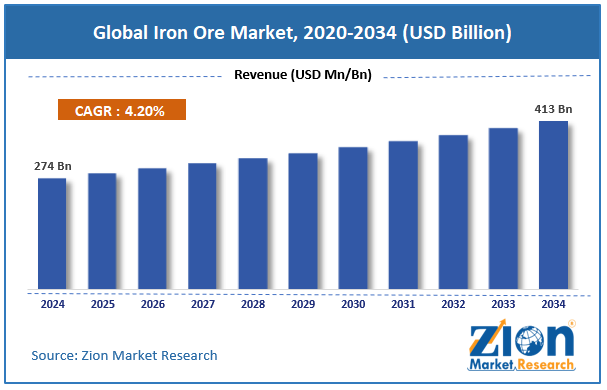
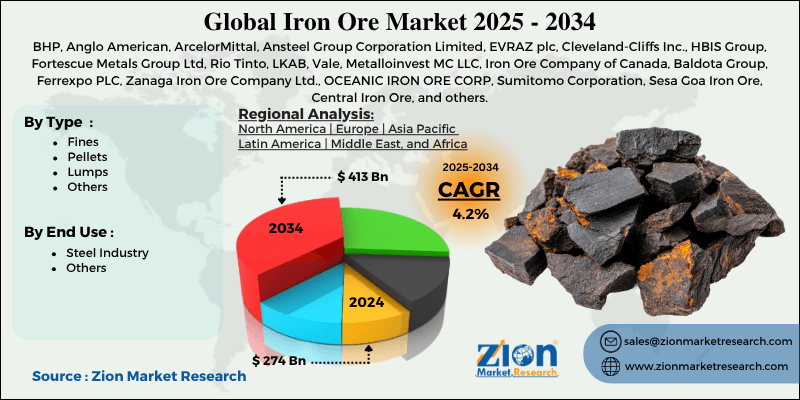
The global iron ore market size was worth around USD 274 billion in 2024 and is predicted to grow to around USD 413 billion by 2034, with a compound annual growth rate (CAGR) of roughly 4.2% between 2025 and 2034.
Key Insights
- As per the analysis shared by our research analyst, the global iron ore market is estimated to grow annually at a CAGR of around 4.2% over the forecast period (2025-2034).
- In terms of revenue, the global iron ore market size was valued at around USD 274 billion in 2024 and is projected to reach USD 413 billion by 2034.
- Increasing demand from the steel industry is expected to propel the iron ore market over the projected period.
- Based on the type, the pellets segment dominated the market in 2024 with a revenue share of over 55%.
- Based on the end use, the steel industry segment holds the prominent market share in 2024.
- Based on region, the Asia Pacific dominated the market in 2024 with the largest revenue share of 70%.
Iron Ore Market: Overview
Iron ore is a natural mineral or rock from which the element iron can be extracted and refined. It is a vital component in the production of both metallic iron and steel, which are among the most important raw materials for the world's economy. The world’s main quantity of iron ore is converted into steel, mainly in blast furnaces and direct reduction technology. Different types of iron ore (such as hematite, magnetite, goethite, limonite, siderite, and others) occur on Earth and have varying chemical properties. Iron ore is used for infrastructure and housing, automotive and machinery manufacturing, and other industries. The growth of the iron ore market is primarily driven by rising global demand for steel, as iron ore is the primary raw material in steel production. The ever-rising construction activity, the booming automotive and machinery industries in developing economies, and the government's infrastructure and industrial investments are responsible for the recent significant growth in the steel market.
However, price fluctuations and strict regulations on mining activities negatively affect the iron ore market. Global steel demand growth influences iron ore prices throughout the unstable period. Production planning becomes difficult for mines as a result. Moreover, growing environmental concerns and high costs of mining and transportation constrain industry growth.
Iron Ore Market: Dynamics
Growth Drivers
How does the increasing demand from the steel industry drive the expansion of the iron ore market?
Demand from the steel industry is directly related to the growth of the iron ore market, as iron ore is the primary raw material for steel production. About 95–98% of the world's iron ore is used for steel production in blast furnaces, combined with basic oxygen furnaces or direct reduction processes; the resulting pig iron is then processed into steel. With the increasing economic development, the major incremental markets are the infrastructure, construction, transportation, energy, and heavy machinery in the form of structural parts, pipes, rails, vehicles, and industrial machinery, which, through expansion, drive the steel companies to increase their capacity utilization. These increases are forcing them to increase their iron ore consumption.
The continuous growth in the urban population and the infrastructure development in developing countries like China, India, Indonesia, Malaysia, Philippines, and other southeast Asia countries like Thailand, Vietnam, South Korea, Taiwan and Singapore is further fueling the demand of steel as governments and private developers are developing new highways, bridges, rail networks, ports, residential area and industrial complexes which are pushing the steel companies to increase their capacity and demand for iron ore, consequently forcing the suppliers to ramp up mine capacity and also find new reserves and also charter more ships in order to meet the increasing demand. Growing manufacturing industries such as automobiles, ships, and other machinery also increase demand for steel and, in turn, for iron ore.
For instance, the vast scope of steel manufacturing is reflected in the World Steel Association's estimate. It states that the estimated world crude steel production in 2023 was 1.89 billion tonnes.
Restraints
Why does the price volatility of iron ore impede the iron ore industry growth?
Volatility in iron ore prices hinders the industry's development by fostering instability, discouraging both steel companies and iron ore producers. For iron ore producers, decreasing prices coupled with the current global steel demand pattern and global supply balance, weak producer prices, would mean lower cash flows from operations and hence lower earnings compared to the time necessary to develop a project such as new exploration, mine development and capacity expansion or upgrades, which may take years and millions of dollars in investment to develop.
However, during the expansion period, if steel prices and raw material requirements remain constant, prices, earnings, and sales of iron ore producers may be affected, impacting their profitability and, in turn, industry development.For instance, sourced from relevant commodity statistics from Trading Economics, the benchmark iron ore spot price stood at approximately $103.5/mt in March 2026. The spot price during this period reflects short-term market fluctuations driven by prospective demand and supply.
Opportunities
How does the growth in the automotive and manufacturing industries offer a potential opportunity for the iron ore market?
Growth in the automotive and manufacturing industries offers attractive opportunities for the iron ore industry, as both are large consumers of steel. Iron ore is the raw material used in almost all steel manufacturing. The automotive industry extensively employs steel in the manufacturing of vehicle parts such as body shells, chassis, engines, and safety systems.
As consumer demand for automobiles, driven by urbanization, continues to grow, this will result in increased demand for steel (and, hence, for iron ore). The manufacturing industry also relies heavily on steel for the production of machinery, industrial equipment, domestic appliances, and heavy engineering products. The advancement of manufacturing infrastructure in emerging markets will further drive up steel demand and, consequently, iron ore demand, as these industries require large quantities of steel for product manufacturing.
For instance, according to the International Energy Agency, global EV sales topped 17 million in 2024, up more than 25% year-on-year. This also helps increase demand for the metals used in vehicle manufacturing and broader industrial production.
Challenges
Stringent environmental regulations pose a significant challenge to the iron ore market
Heavy environmental regulations pose a challenge for the iron ore industry, as its operations and exploration activities can cause land degradation, deforestation, and water and air pollution. To minimize and mitigate the impact, government agencies in several countries have implemented stringent pollution regulations and restrictions on mining rights, waste disposal, land renewal and reforestation, and carbon emissions.
Compliance with these regulatory controls can lead to increased spending on pollution control technology, monitoring equipment, and sustainable mining practices, as well as an increase in production costs. Restrictions imposed by regulation may also delay project approvals, limit exploration activities or expansions in environmentally sensitive zones, and slow down exploration activities in new areas. Due to more restrictive controls, the cost of compliance will increase, posing a challenge for the industry.
Iron Ore Market: Report Scope
| Report Attributes | Report Details |
|---|---|
| Report Name | Iron Ore Market |
| Market Size in 2024 | USD 274 Billion |
| Market Forecast in 2034 | USD 413 Bllion |
| Growth Rate | CAGR of 4.2% |
| Number of Pages | 224 |
| Key Companies Covered | BHP, Anglo American, ArcelorMittal, Ansteel Group Corporation Limited, EVRAZ plc, Cleveland-Cliffs Inc., HBIS Group, Fortescue Metals Group Ltd, Rio Tinto, LKAB, Vale, Metalloinvest MC LLC, Iron Ore Company of Canada, Baldota Group, Ferrexpo PLC, Zanaga Iron Ore Company Ltd., OCEANIC IRON ORE CORP, Sumitomo Corporation, Sesa Goa Iron Ore, Central Iron Ore, and others. |
| Segments Covered | By Type, By End Use, and By Region |
| Regions Covered | North America, Europe, Asia Pacific (APAC), Latin America, Middle East, and Africa (MEA) |
| Base Year | 2024 |
| Historical Year | 2019 to 2023 |
| Forecast Year | 2025 - 2034 |
| Customization Scope | Avail customized purchase options to meet your exact research needs. Request For Customization |
Iron Ore Market: Segmentation
Type Insights
Do pellets hold a dominant position in the iron ore market?
The pellets segment dominated the market in 2024 with a revenue share of over 55%. In terms of segment performance, revenue is expected to increase in the pellet segment due to its higher iron content, higher manufacturing efficiency, and lower ecological impact compared to other forms of iron ore. Iron ore pellets are produced from fine iron ore concentrates, which are converted into small green balls and then fired in an indurating furnace to produce hard, large, porous ‘green’ pellets suitable for use in a blast furnace or direct reduction process.
Although steelmakers used pellets only to a limited extent in the past, today they favor them for the productivity gains, lower energy consumption, and lower emissions they provide. Furthermore, the growing adoption of DRI technology and the increasing demand for premium raw materials among steel producers are likely to boost revenues in the pellet segment of the iron ore market.
End Use Insights
Why is the steel industry segment growing at a significant rate in the Iron Ore market?
The steel industry segment held the prominent market share in 2024. The segment's growth stems from worldwide demand for steel, driven by a wide range of industries. Iron ore is the primary raw material used to produce steel, both by the blast-furnace and direct-reduction methods. With the development of infrastructure, residential and non-residential buildings, roads and transport networks, and industries, steel consumption worldwide is growing rapidly. The growing automotive, machinery, shipbuilding, and manufacturing industries have also driven steady demand for the product. The increase in demand for steel enables steel manufacturers to increase their iron ore supply, resulting in steady revenue growth for the segment.
Regional Insights
Why does the Asia Pacific lead the iron ore market?
The Asia Pacific dominated the market in 2024 with the largest revenue share of 70%. This upward trend is primarily attributed to the strength of Asia Pacific economies’ industrial bases, rapid urban growth, and their development as international steel industry hubs. Many of these leading steel-consuming nations are also leading steel-producing nations, with China, for instance, accounting for a significant share of the world's steel output, driven by large-scale urban infrastructure projects, residential and commercial growth, and heavy industrial manufacturing. Continued urban expansion across the Asia Pacific will lead to increased government allocations for infrastructure such as ports, railways, bridges, cities, and power and energy facilities, all of which tend to require vast quantities of steel (and therefore iron ore) for new construction.
Also, the rapid expansion of the Asia Pacific manufacturing sector, particularly in machinery, automobiles, and shipbuilding, has further bolstered steel consumption. Countries including China, Japan, and South Korea are the world's leading suppliers of automobiles and ships, both of which use steel as their primary raw material. Conversely, India and other emerging economies across the region are actively expanding their industrial and manufacturing sectors as part of their long-term development plans.
Additionally, infrastructure projects and manufacturing enhancement initiatives, such as industrial corridor visions, are hotly pursued by these countries and tend to increase steel requirements. As steel production increases, so too will the demand for iron ore, highlighting the Asia Pacific region's emerging strength in the iron ore industry. Also, the operation of many of the world’s major iron ore mines in the Asia Pacific region, such as Australia, helps sustain the continent's competitive advantage globally.
Iron Ore Market: Competitive Analysis
The global iron ore market is dominated by players like:
- BHP
- Anglo American
- ArcelorMittal
- Ansteel Group Corporation Limited
- EVRAZ plc
- Cleveland-Cliffs Inc.
- HBIS Group
- Fortescue Metals Group Ltd
- Rio Tinto
- LKAB
- Vale
- Metalloinvest MC LLC
- Iron Ore Company of Canada
- Baldota Group
- Ferrexpo PLC
- Zanaga Iron Ore Company Ltd.
- OCEANIC IRON ORE CORP
- Sumitomo Corporation
- Sesa Goa Iron Ore
- Central Iron Ore
The global iron ore market is segmented as follows:
By Type
- Fines
- Pellets
- Lumps
- Others
By End Use
- Steel Industry
- Others
By Region
- North America
- The U.S.
- Canada
- Mexico
- Europe
- France
- The UK
- Spain
- Germany
- Italy
- Rest of Europe
- Asia Pacific
- China
- Japan
- India
- Australia
- South Korea
- Rest of Asia Pacific
- The Middle East & Africa
- Saudi Arabia
- UAE
- Egypt
- Kuwait
- South Africa
- Rest of the Middle East & Africa
- Latin America
- Brazil
- Argentina
- Rest of Latin America
Table Of Content
Methodology
FrequentlyAsked Questions

HappyClients

