
Global Hydrogen Compressor Market Size, Share, Value and Forecast 2034

Hydrogen Compressor Market By Technology (Single-stage and Multistage), By Type (Oil-based and Oil-free), By End-user Industry (Chemical, Oil and Gas, and Others), and By Region - Global and Regional Industry Overview, Market Intelligence, Comprehensive Analysis, Historical Data, and Forecasts 2026 - 2034
| Market Size in 2025 | Market Forecast in 2034 | CAGR (in %) | Base Year |
|---|---|---|---|
| USD 1.1 Billion | USD 1.8 Billion | 5.9% | 2025 |
Hydrogen Compressor Industry Perspective:
What will be the size of the global hydrogen compressor market during the forecast period?
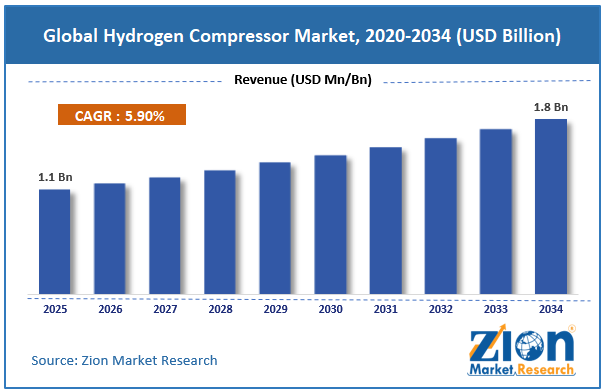
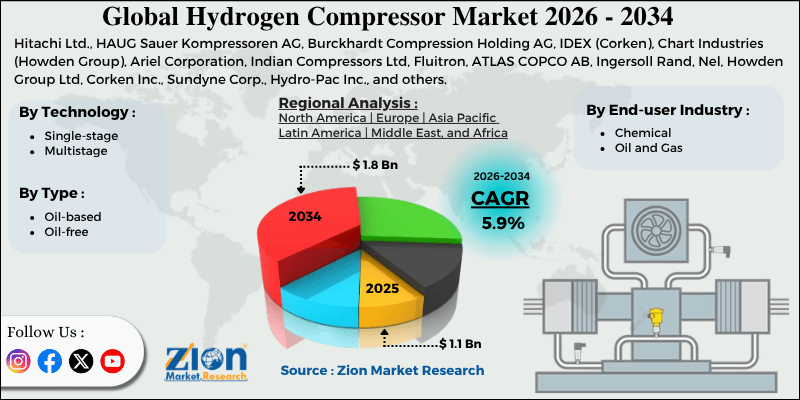
The global hydrogen compressor market size was worth around USD 1.1 billion in 2025 and is predicted to grow to around USD 1.8 billion by 2034, with a compound annual growth rate (CAGR) of roughly 5.9% between 2026 and 2034.
Key Insights
- As per the analysis shared by our research analyst, the global hydrogen compressor market is estimated to grow annually at a CAGR of around 5.9% over the forecast period (2026-2034).
- In terms of revenue, the global hydrogen compressor market size was valued at around USD 1.1 billion in 2025 and is projected to reach USD 1.8 billion by 2034.
- Expansion of hydrogen refueling stations and fuel cell mobility is expected to propel the hydrogen compressor market over the projected period.
- Based on the technology, the single-stage segment held the largest revenue share in 2025.
- Based on the type, the oil-based segment held the largest revenue share in 2025 of 68%.
- Based on the end-user industry, the chemical segment captures a prominent revenue share of 44% in 2025.
- Based on region, the Asia Pacific dominates the hydrogen compressor market.
Hydrogen Compressor Market: Overview
A hydrogen compressor is a specialized machine that compresses hydrogen gas so it can be stored or transported for later use or for use in different hydrogen-related processes. Compared to regular gas compressors, which are designed to handle the relatively heavy molecules of natural gas or air, hydrogen compressors require more sophisticated designs to safely handle the gas’s low molecular weight, its high tendency to leak, and its ability to weaken metals. Depending on the needed pressure and the desired application, hydrogen gas can be compressed using reciprocating devices, diaphragms, ionic liquid pistons, electrochemical compressors, or centrifugal devices. Hydrogen compressors are an essential part of the entire hydrogen economy, including production facilities, hydrogen fuel stations for fuel cell cars, gas transmission networks, petrochemical plants, and energy storage facilities. This equipment is designed to deliver high efficiency, prevent leaks, ensure safe operation, and allow the storage and transport of hydrogen at pressures ranging from a few bar to over 1,000 bar.
Impact of the USA-Israel War on Iran on the Hydrogen Compressor Market
The USA-Israel conflict over Iran has brought both positive and negative effects on the hydrogen compressor market. Geopolitical tensions create unfavorable conditions for the global supply chain, cause fuel prices to spike, and increase the prices of imported goods, including compressors and related equipment essential for the production process.
However, as nations seek to reduce their energy risks and ensure strategic reserves, investments in the hydrogen economy and alternative fuel production, including its compression, are growing. Thus, the effect of the conflict on the compression market is complicated, with some factors pushing growth and others holding it back. Overall, the geopolitical situation is unlikely to have a significant negative impact on the development of the hydrogen compressor market in the long run.
Hydrogen Compressor Market: Dynamics
Growth Drivers
How does the growing investments in the hydrogen economy and clean energy infrastructure drive the hydrogen compressor market?
Growing investments in the hydrogen economy and the clean energy sector are likely to propel the hydrogen compressor market. Governments worldwide are allocating substantial funds to develop infrastructure for producing, storing, transporting, and refueling hydrogen, requiring compressors to meet these needs. According to the International Energy Agency (IEA), capital expenditures on low-emission hydrogen initiatives rose to USD 4.3 billion in 2024, surging by 80% over the previous year. It is projected to almost double to USD 8 billion in 2025 as more projects secure final investment decisions.
Further, the IEA reports that governments have pledged public funding worth USD 41 billion in support of the hydrogen sector in the wake of recent policy changes. Of this amount, nearly 25% has been allocated to projects, and 66 nations have formulated national hydrogen strategies to hasten the adoption of hydrogen energy.
Government-led initiatives are expected to boost demand for hydrogen compressors. For instance, the U.S. Department of Energy has set aside USD 750 million for 52 clean hydrogen projects spanning 24 states. Besides this, USD 7 billion has been directed toward the Regional Clean Hydrogen Hubs Program to establish a network of clean hydrogen hubs across the U.S. Similarly, India’s National Green Hydrogen Mission, with a budgetary allocation of about USD 2.3 billion, aims to achieve annual production of 5 million metric tons of green hydrogen by 2030. The aforementioned programs are likely to augment the demand for hydrogen compressors as they facilitate the production, storage, and distribution of hydrogen, among other applications.
Restraints
High capital and maintenance costs hamper the growth of the hydrogen compressor industry
High capital and maintenance costs associated with the equipment are a crucial aspect hindering the growth of the hydrogen compressor market. Hydrogen compressors are significantly more expensive than ordinary gas compressors due to the special considerations required in their design to ensure safe operation while handling the unique characteristics of hydrogen. Some of the properties of hydrogen gas include being light, having high diffusivity, and embrittlement characteristics, leading to the need for hydrogen-specific equipment.
As a result, there is an increased need for advanced technologies such as high-quality stainless-steel and nickel alloys, state-of-the-art sealing mechanisms, and other equipment that leads to higher capitalization costs. Moreover, high-pressure compressors require regular maintenance and replacement of certain parts such as diaphragms, valves, bearings, and seals to sustain optimal performance.
The high costs associated with the compressors make them unaffordable in some cases, especially for small-scale hydrogen production and refueling stations, as they can constitute a significant portion of the overall investment. Apart from rising acquisition costs, recent trends indicate that metal prices, inflation, and labor costs have also risen, increasing expenditures on compressor maintenance. Thus, investors in the hydrogen industry are more willing to reconsider their proposals until the investment schemes are economically feasible or supported by government subsidies.
Opportunities
Why does the launch of innovative technology create a lucrative opportunity for the hydrogen compressor market?
Innovative developments in hydrogen compression technologies are driving the hydrogen compressor market by improving compressor performance and overcoming significant technical barriers associated with hydrogen handling. Electrochemical, ionic liquid piston, metal hydride, and oil-free diaphragm compressors can offer higher energy efficiency, reduced hydrogen leakage, lower maintenance costs, and improved reliability and safety over traditional reciprocating compressors in a range of hydrogen applications. As a result, the cost of ownership of hydrogen compressors is projected to decrease.
For instance, in September 2025, UK-based Net Zero Technology innovator CATAGEN officially launched its ClimaHtech Compressor technology at Gastech 2025 in Milan, marking a major leap forward in hydrogen compression innovation. The launch includes both static and mobile compressor models, engineered to transform energy efficiency, cost, and reliability across hydrogen refueling and distribution applications.
Challenges
How do the limited hydrogen infrastructure and uncertain project economics pose a significant challenge to the growth of the hydrogen compressor industry?
Limited hydrogen infrastructure and uncertain project economics hinder the development of the hydrogen compressor market. At present, despite growing worldwide interest in hydrogen, the current state of the hydrogen economy is uneven in different parts of the world. The production of hydrogen, its storage, transmission, and use in various modes of transportation are under development. This indicates that demand for hydrogen compressors in the short and medium term is limited to only a few countries with the necessary infrastructure. In addition, the development of large-scale hydrogen facilities requires significant investment, time for implementation, and favorable conditions, which also limits the adoption of hydrogen compressors.
At the same time, project economics is another factor suppressing the development of the hydrogen compressor market. The costs associated with producing green hydrogen are significantly higher than those of conventional hydrogen production. Such costs include electricity, electrolyzers, and supporting infrastructure. In most cases, governments have to provide subsidies, budgetary allocations, tax benefits, or long-term purchase agreements to make hydrogen production investments economically viable.
However, unpredictable hydrogen demand, legislative, financial, and political conditions, and the need for long-term commitments reduce the attractiveness of such projects for investors and developers. The lack of hydrogen infrastructure, its storage, and transport facilities also casts doubt on the cost-effectiveness of implementing such projects. Thus, these factors inhibit the development of hydrogen infrastructure and the corresponding need for compressors, limiting worldwide hydrogen compressor market growth.
Hydrogen Compressor Market: Report Scope
| Report Attributes | Report Details |
|---|---|
| Report Name | Hydrogen Compressor Market |
| Market Size in 2025 | USD 1.1 Billion |
| Market Forecast in 2034 | USD 1.8 Billion |
| Growth Rate | CAGR of 5.9% |
| Number of Pages | 227 |
| Key Companies Covered | Hitachi Ltd., HAUG Sauer Kompressoren AG, Burckhardt Compression Holding AG, IDEX (Corken), Chart Industries (Howden Group), Ariel Corporation, Indian Compressors Ltd, Fluitron, ATLAS COPCO AB, Ingersoll Rand, Nel, Howden Group Ltd, Corken Inc., Sundyne Corp., Hydro-Pac Inc., and others. |
| Segments Covered | By Technology, By Type, By End-user Industry, and By Region |
| Regions Covered | North America, Europe, Asia Pacific (APAC), Latin America, Middle East, and Africa (MEA) |
| Base Year | 2025 |
| Historical Year | 2020 to 2024 |
| Forecast Year | 2026 - 2034 |
| Customization Scope | Avail customized purchase options to meet your exact research needs. Request For Customization |
Hydrogen Compressor Market: Segmentation
Technology Insights
Why does the single-stage segment hold a prominent position in the hydrogen compressor market?
The single-stage segment held the largest revenue share of the hydrogen compressor industry in 2025. The growth is attributed to its cost-effectiveness, simple design, and applicability in low- to medium-pressure hydrogen compression. Single-stage hydrogen compressors are widely adopted in hydrogen production plants, laboratories, pilot green hydrogen projects, chemical processing facilities, and other industrial gas processing and handling applications where high discharge pressures are not required. The compressors have a lower capital investment, reduced footprint, and can be easily installed.
Type Insights
Does the oil-based segment capture the largest share in the hydrogen compressor market?
The oil-based segment held the largest revenue share of the hydrogen compressor market in 2025 of 68%. The growth is due to their high compression ratio, excellent performance, and cost-effectiveness in heavy-duty industries. Oil-based hydrogen compressors use oil to minimize energy consumption, reduce heat generation, and prevent wear and tear, making them suitable for heavy-duty applications. Similarly, they are used in oil refining, petrochemicals, ammonia and methanol production, gas manufacturing, and conventional hydrogen production plants because they can produce hydrogen with low oil content that can be removed using downstream purification processes.
End-user Industry Insights
How does the chemical segment capture the largest share in the hydrogen compressor market?
The chemical segment captures a prominent revenue share of the hydrogen compressor market of 44% in 2025. The rising need for hydrogen as a precursor in the production of ammonia, methanol, hydrogen peroxide, and other chemical compounds drives the growth. In this context, hydrogen compressors play a critical role in chemical processing facilities, where they facilitate the compression and circulation of hydrogen gas during synthesis, purification, storage, and other processes. Therefore, with the growing emphasis on fertilizers, specialty chemicals, and low-carbon production of chemical substances, manufacturers are capitalizing on the potential of hydrogen compressors to optimize their performance and cut emissions.
Regional Insights
What factors drive the Asia Pacific region in the hydrogen compressor market?
The Asia Pacific dominates the hydrogen compressor market. The region's revenue growth is driven by surging investments in hydrogen infrastructure, rising green hydrogen production, and government support for clean energy and industrial decarbonization. Countries in the Asia Pacific region, including China, Japan, South Korea, India, and Australia, are making continuous efforts to develop national hydrogen strategies, build electrolyzer capacity, establish hydrogen refueling networks, and produce and store clean hydrogen on a large scale. These factors are boosting the demand for hydrogen compressors for hydrogen production, transportation, storage, and dispensing across the Asia Pacific region.
The growing need for hydrogen arises from the large-scale chemical manufacturing, petroleum refining, steel production, and electronics sectors in the region. Moreover, the adoption of fuel cell electric vehicles, including buses and trucks, and the rising utilization of renewable energy sources are creating ample growth opportunities for high-pressure hydrogen compressors.
In addition, government support for developing hydrogen transportation infrastructure, including public-private partnerships and investments, will contribute significantly to rising demand for compressors. Finally, continuous technological improvement, expanding hydrogen infrastructure, and the intensifying need for decarbonization make the Asia Pacific region the largest market for hydrogen compressors.
Hydrogen Compressor Market: Competitive Analysis
The global hydrogen compressor market is dominated by players like:
- Hitachi Ltd.
- HAUG Sauer Kompressoren AG
- Burckhardt Compression Holding AG
- IDEX (Corken)
- Chart Industries (Howden Group)
- Ariel Corporation
- Indian Compressors Ltd
- Fluitron
- ATLAS COPCO AB
- Ingersoll Rand
- Nel
- Howden Group Ltd
- Corken Inc.
- Sundyne Corp.
- Hydro-Pac Inc.
The global hydrogen compressor market is segmented as follows:
By Technology
- Single-stage
- Multistage
By Type
- Oil-based
- Oil-free
By End-user Industry
- Chemical
- Oil and Gas
- Others
By Region
- North America
- The U.S.
- Canada
- Mexico
- Europe
- France
- The UK
- Spain
- Germany
- Italy
- Rest of Europe
- Asia Pacific
- China
- Japan
- India
- Australia
- South Korea
- Rest of Asia Pacific
- The Middle East & Africa
- Saudi Arabia
- UAE
- Egypt
- Kuwait
- South Africa
- Rest of the Middle East & Africa
- Latin America
- Brazil
- Argentina
- Rest of Latin America
Table Of Content
Methodology
FrequentlyAsked Questions
A hydrogen compressor is a specialized machine that compresses hydrogen gas so it can be stored or transported for later use or for use in different hydrogen-related processes.
The key growth drivers for the hydrogen compressor market include rising investments in the global hydrogen economy, expanding green and blue hydrogen production, and increasing deployment of hydrogen infrastructure such as storage facilities, pipelines, and refueling stations. Growing adoption of fuel cell electric vehicles (FCEVs), stricter carbon reduction policies, and industrial decarbonization across the chemical, refining, steel, and power sectors are further boosting demand for hydrogen compression systems.
The major challenges restraining the hydrogen compressor market include high capital and maintenance costs, technical complexities associated with handling hydrogen, and the limited availability of hydrogen infrastructure in many regions. Hydrogen's small molecular size and tendency to cause material embrittlement require specialized materials, advanced sealing technologies, and rigorous safety measures, increasing equipment costs.
Based on the technology, the single-stage segment is expected to dominate the hydrogen compressor market growth during the projected period.
Emerging trends and innovations impacting the hydrogen compressor market include the development of oil-free diaphragm, electrochemical, ionic liquid piston, and metal hydride compressor technologies that offer higher efficiency, lower leakage, and reduced maintenance requirements. Manufacturers are also integrating IoT-enabled monitoring, AI-based predictive maintenance, and smart control systems to improve reliability and optimize performance.
According to the report, the global hydrogen compressor market size was worth around USD 1.1 billion in 2025 and is predicted to grow to around USD 1.8 billion by 2034.
The global hydrogen compressor market is expected to grow at a CAGR of 5.9% during the forecast period.
The global hydrogen compressor industry growth is expected to be led by the Asia Pacific over the forecast period.
The global hydrogen compressor market is dominated by players like Hitachi, Ltd., HAUG Sauer Kompressoren AG, Burckhardt Compression Holding AG, IDEX (Corken), Chart Industries (Howden Group), Ariel Corporation, Indian Compressors Ltd, Fluitron, ATLAS COPCO AB, Ingersoll Rand, Nel, Howden Group Ltd, Corken Inc., Sundyne Corp., and Hydro-Pac Inc., among others.
The hydrogen compressor market report covers the geographical market along with a comprehensive competitive landscape analysis. It also includes cash flow analysis, profit ratio analysis, market basket analysis, market attractiveness analysis, sentiment analysis, PESTLE analysis, trend analysis, SWOT analysis, trade area analysis, demand & supply analysis, Porter’s five forces analysis, and value chain analysis.

HappyClients

