
Health Intelligent Virtual Assistant Market Size, Share, Report 2034

Health Intelligent Virtual Assistant Market By Technology (Voice (Speech Recognition), Text-to-Speech, Multimodal and Emotion-AI Interfaces, and Text-based/NLP), By Product (Chatbots, Mobile App-based Assistants, Smart Speakers, Kiosk and Bedside Terminals, and Wearable/Edge Devices), By Application (Symptom Checking and Medical Information, Mental-health and Well-being Coaching, Appointment and Queue Scheduling, Medication and Care-plan Reminders, Patient Triage and Management and Billing, Claims and Admin Support), By End-User (Healthcare Providers (Hospitals and Clinics), Healthcare Payers and TPAs, Patients and Caregivers, Life-Sciences and Pharma Companies, and Telehealth/Digital-health Platforms), and By Region - Global and Regional Industry Overview, Market Intelligence, Comprehensive Analysis, Historical Data, and Forecasts 2026 - 2034
| Market Size in 2025 | Market Forecast in 2034 | CAGR (in %) | Base Year |
|---|---|---|---|
| USD 4.5 Billion | USD 28.0 Billion | 22.5% | 2025 |
Health Intelligent Virtual Assistant Industry Perspective:
What will be the size of the global health intelligent virtual assistant market during the forecast period?
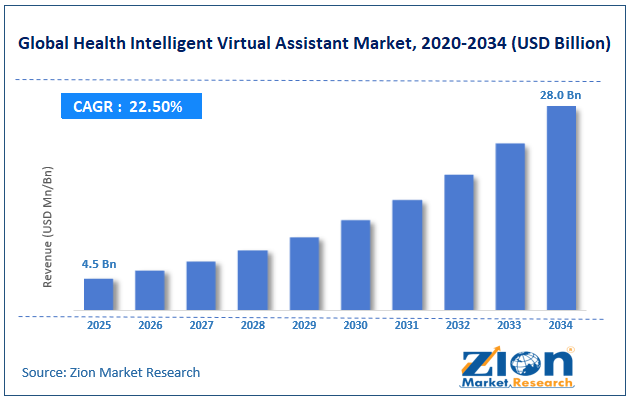
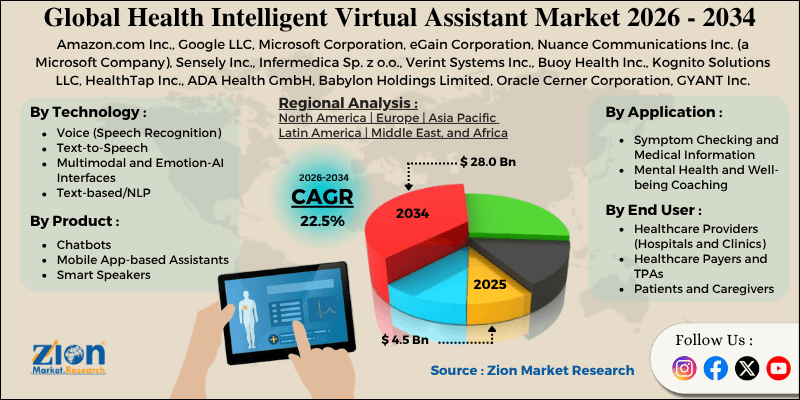
The global health intelligent virtual assistant market size was worth around USD 4.5 billion in 2025 and is predicted to grow to around USD 28.0 billion by 2034, with a compound annual growth rate (CAGR) of roughly 22.5% between 2026 and 2034.
Health Intelligent Virtual Assistant Market: Overview
A health intelligent virtual assistant refers to AI-based software that uses NLP, ML, speech recognition, and generative AI to interact with patients, caregivers, and healthcare practitioners via text and voice. This software automates healthcare-related tasks such as scheduling appointments, symptom analysis, medication reminders for patients, patient triage, patient education, remote patient monitoring, and administration-related activities, among others. By integrating with EHR systems and other telehealth technologies, intelligent virtual healthcare assistants help improve patient engagement, simplify clinical procedures, reduce administrative workload, and provide round-the-clock personalized healthcare services.
Key Insights
- As per the analysis shared by our research analyst, the global health intelligent virtual assistant market is estimated to grow annually at a CAGR of around 22.5% over the forecast period (2026-2034).
- In terms of revenue, the global health intelligent virtual assistant market size was valued at around USD 4.5 billion in 2025 and is projected to reach USD 28.0 billion by 2035.
- Increasing demand for personalized healthcare and patient-centric care delivery is expected to propel the health intelligent virtual assistant market over the projected period.
- Based on the technology, the voice (speech recognition) segment holds a significant market share in 2025 of 44%.
- Based on the product, the chatbots segment held the largest revenue share in 2025 of over 55%.
- Based on the application, the symptom checking and medical information held the prominent revenue share of 36% in 2025.
- Based on the end-user, the healthcare providers (hospitals and clinics) segment captures a significant revenue share of 53% in 2025.
- Based on region, the North America region holds a prominent market share in 2025 of 42%.
Impact of the USA-Israel War on Iran on the Health Intelligent Virtual Assistant Market
The war between the USA, Israel, and Iran is anticipated to bring mixed results on the health intelligent virtual assistant market. Firstly, the disruption caused by military activities hampers the development and adoption of AI-assisted virtual assistants, as healthcare infrastructure, internet connectivity, cloud computing, and hospital operations are disrupted, thereby delaying their adoption. Besides, healthcare institutions might allocate their budgets not to the introduction of new technologies but to providing emergency services and building critical infrastructure.
Secondly, the mentioned events heighten the threat of cyberattacks and underscore the importance of protecting patient data and the AI system itself. At the same time, the war increases interest in intelligent virtual assistants by demonstrating the necessity of providing remote healthcare, mental health services, and telemedicine, as well as AI-driven engagement, in situations where access to healthcare facilities is limited. Healthcare institutions and governments are investing in the development of reliable digital healthcare infrastructure and AI systems to provide essential services in emergency situations.
Thus, although regional adoption will slow, the global health intelligent virtual assistant market will continue to grow due to increased investments in AI-assisted healthcare.
Health Intelligent Virtual Assistant Market: Dynamics
Growth Drivers
How does the rising adoption of AI-powered patient engagement and virtual care solutions drive the health intelligent virtual assistant market?
Increased use of AI-powered patient engagement and virtual care tools is a key driver of the health intelligent virtual assistant market, as healthcare facilities seek to expand treatment accessibility, reduce unnecessary bureaucracy, and improve the quality of care. AI-powered virtual assistants provide 24/7 patient assistance, automated appointment booking, medication reminders, symptom checks, and post-discharge follow-ups, and integrate with telehealth platforms and EHRs. Data from government sources show that the digital transformation is ongoing. Statistics from the U.S. Department of Health and Human Services (HHS) show that 95% of HRSA-funded health centers provided primary care via telehealth in 2024, and 25% of Medicare fee-for-service beneficiaries received at least one telehealth service in 2024.
Moreover, CMS promotes AI technology innovations for over 150 million Americans who use Medicare, Medicaid, and CHIP services, and has launched programs in 2025 that encourage the use of conversational AI assistants for symptom checking, care navigation, and appointment booking as part of a patient-centered digital health ecosystem. Government-supported digital health initiatives represent a growing trend in the HIVA market.
Restraints
Why does the data privacy and cybersecurity concerns act as a major restraint to the growth of the health intelligent virtual assistant industry?
Security and privacy issues continue to pose considerable challenges to the health intelligent virtual assistant market. These intelligent AI solutions handle extremely sensitive health-related data and information from patients, such as EHRs, medical condition histories, diagnostic information, and insurance information. Cybercrime has become a major issue in the healthcare industry, with attacks including ransomware, phishing, and data breaches. The issue of security and confidentiality of patient information poses an obstacle to the adoption of AI solutions. It is also because these platforms need to comply with strict regulations such as HIPAA in the USA, GDPR in Europe, and many other national healthcare regulations. According to the Office for Civil Rights at HHS in the United States, there have been 725 large data breaches in the US involving over 275 million people in 2024. This means that cybersecurity threats continue to be a challenge to the adoption of the technology.
Opportunities
Do the increasing product launches offer a lucrative opportunity for the health intelligent virtual assistant market?
The growing product launch is expected to offer a potential opportunity to the health intelligent virtual assistant market over the projected period. For instance, in July 2026, the global information technology company FPT launched MediSight, an AI-driven framework that helps the healthcare sector, medical device manufacturers, and pharmaceutical companies transform digitally, improve regulatory compliance, and gain meaningful insights from healthcare data. This framework consists of autonomous AI digital workers, applications for the healthcare sector, and AI-enabled engineering capabilities that simplify clinical, operational, and regulatory workflows and accelerate data-driven decision-making.
Created using the FleziPT AI-first ecosystem of FPT and following the principles of CASAN, the framework the company uses to advance from experimenting with AI to the operational phase, MediSight enables healthcare and life sciences organizations to implement AI solutions across care delivery, business operations, and compliance. Using AI agents, industry-specific accelerators, and AI-enabled engineering capabilities, the framework transforms healthcare data into structured intelligence.
Challenges
Concerns over liability and accountability for AI-generated healthcare advice and clinical decision support pose a significant challenge to the health intelligent virtual assistant industry's growth
Issues concerning the liability and accountability of healthcare advice and clinical decision support delivered by artificial intelligence technology are among the main barriers to the development of the health intelligent virtual assistant market. The use of AI-enabled virtual assistants for diagnosis, drug prescription, patient triage, and guidance is growing, but the risk of misdiagnosis, incorrect recommendations, or delays in medical care due to inaccurate patient data is real. Determining the party responsible for those issues remains a difficult task that limits the implementation of such technology in the healthcare sector.
Moreover, the emergence of regulations concerning the use of AI in the healthcare industry means companies have to ensure that their systems provide transparent, understandable, and validated results and remain under human control. Healthcare organizations hesitate to adopt AI because they want to avoid potential issues and remain compliant with healthcare regulations.
Health Intelligent Virtual Assistant Market: Report Scope
| Report Attributes | Report Details |
|---|---|
| Report Name | Health Intelligent Virtual Assistant Market |
| Market Size in 2025 | USD 4.5 Billion |
| Market Forecast in 2034 | USD 28.0 Billion |
| Growth Rate | CAGR of 22.5% |
| Number of Pages | 227 |
| Key Companies Covered | Amazon.com Inc., Google LLC, Microsoft Corporation, eGain Corporation, Nuance Communications Inc. (a Microsoft Company), Sensely Inc., Infermedica Sp. z o.o., Verint Systems Inc., Buoy Health Inc., Kognito Solutions LLC, HealthTap Inc., ADA Health GmbH, Babylon Holdings Limited, Oracle Cerner Corporation, GYANT Inc., Lifelink Systems Inc., Syllable Corporation, Saykara Inc., Infosys Limited, Tata Consultancy Services Limited, Olive AI Inc., Epic Systems Corporation, Wysa Ltd., and others. |
| Segments Covered | By Technology, By Product, By Application, By End User, and By Region |
| Regions Covered | North America, Europe, Asia Pacific (APAC), Latin America, Middle East, and Africa (MEA) |
| Base Year | 2025 |
| Historical Year | 2020 - 2024 |
| Forecast Year | 2026 - 2034 |
| Customization Scope | Avail customized purchase options to meet your exact research needs. Request For Customization |
Health Intelligent Virtual Assistant Market: Segmentation
Technology Insights
Why does the voice (speech recognition) segment hold a prominent position in the health intelligent virtual assistant market?
The voice (speech recognition) segment holds a significant share of the health intelligent virtual assistant industry in 2025, of 44%. This growth is attributable to the increase in the demand for natural and effective communication channels between patients and healthcare professionals. Voice-enabled virtual assistants integrate ASR, NLP, and generative AI technologies to support appointment scheduling, symptom assessment, medication reminders, clinical documentation, patient triage, and searching for patient health information. Healthcare professionals are integrating voice assistants into their workflows to save time on documentation and dedicate more time to patient care. In turn, patients, particularly seniors and those with visual or physical disabilities, can use voice interactions, which become more convenient and accessible for them. The growing popularity of telehealth solutions, remote monitoring solutions, smart speakers, and mobile voice-enabled apps, combined with advancements in multilingual speech recognition and ambient clinical intelligence, drives rapid revenue growth in this market sector.
Product Insights
Does the chatbots segment capture the largest share in the health intelligent virtual assistant market?
The chatbots segment held the largest revenue share of the health intelligent virtual assistant market in 2025, of over 55%. This growth will be fueled by the increasing use of AI-based chatbot technology to engage patients, assess symptoms, schedule appointments, send medication reminders, educate patients, and provide follow-up services after treatment. Healthcare professionals and insurance companies are increasingly using virtual assistants powered by chatbots for 24/7 healthcare services, reducing administrative burden, improving patient satisfaction levels, and reducing operational expenses. With advancements in generative AI, NLP, and LLMs, the capability of chatbots has greatly improved, enabling highly personalized, context-aware, and multilingual healthcare chatbot conversations. The fast-growing trend of telemedicine, digital health platforms, and remote patient monitoring technologies is driving the growth of AI healthcare chatbots even faster.
The market for AI healthcare chatbots will also grow due to the launch of new products in 2025. In January 2025, Tempus AI launched "olivia" – an AI-based personal health concierge app where patients can connect their health records from over 1,000 health systems, get AI-based answers to their medical record queries, and receive personalized summaries.
Application Insights
What factor drives the symptom checking and medical information segment in the health intelligent virtual assistant market?
The symptom-checking and medical information segment accounted for the largest revenue share of the health intelligent virtual assistant industry of 36% in 2025. The expansion will be fueled by the growing need for fast, convenient, and AI-based health checks. Smart virtual assistants based on AI technology, NLP, ML, and generative AI allow individuals to check their symptoms, get evidence-based health advice, determine the right level of care, and seek trusted health advice from anywhere using smartphones, websites, or telehealth portals. An increasing number of chronic diseases, rising healthcare costs, and greater patient demand for self-service digital health apps are contributing to this trend.
End-User Insights
What factor drives the healthcare providers (hospitals and clinics) segment in the health intelligent virtual assistant market?
The healthcare providers (hospitals and clinics) segment captures a significant revenue share of the health intelligent virtual assistant market, of 53% in 2025. This growth is attributed to the rapid digital transformation in healthcare services, along with the increased use of AI-based applications to improve efficiency and patient health outcomes. Various hospitals and clinics have started using intelligent virtual assistants to schedule appointments, triage patients, check symptoms, send medication reminders, follow up on patient discharges, document patient visits, answer inquiries about the billing process, and provide patient education. Increased numbers of patients visiting hospitals and clinics, rising incidence of chronic illnesses among patients, and a shortage of healthcare professionals are among the other factors contributing to the growth of this market.
Regional Insights
What factors drive the North America region in the health intelligent virtual assistant market?
The North America region holds a prominent share of the health intelligent virtual assistant market in 2025, of 42%. Market development will be stimulated by the presence of advanced IT systems in the region's healthcare sector, high penetration of AI technologies, widespread use of telehealth services, and active government participation in the digitalization of healthcare services. In the United States and Canada, healthcare organizations actively use virtual assistants based on AI for appointment scheduling, symptom evaluation, patient triage, medication management, clinical documentation, and patient communication remotely.
Besides, the region is marked by high adoption of electronic health records (EHRs) and cloud-based healthcare services, as well as significant investment in generative AI technologies, which help healthcare organizations increase efficiency and deliver patient-centered care.
Government initiatives in 2025 will play a positive role in market expansion. For example, according to the US Department of Health and Human Services (HHS), 95% of health centers funded by the HRSA provided primary care using telehealth in 2024, and 25% of fee-for-service beneficiaries under Medicare used at least one telehealth service in 2024, which speaks to the further development of digital health solutions in 2025.
Moreover, HHS has announced that Medicare telehealth flexibilities will remain in effect until December 31, 2027, meaning patients will be able to receive telehealth services from home, and various providers will offer virtual healthcare. Thus, federal policies described above, along with AI healthcare solutions, will encourage the adoption of Health Intelligent Virtual Assistants in North America.
Health Intelligent Virtual Assistant Market: Competitive Analysis
The global health intelligent virtual assistant market is dominated by players like:
- Amazon.com Inc.
- Google LLC
- Microsoft Corporation
- eGain Corporation
- Nuance Communications Inc. (a Microsoft Company)
- Sensely Inc.
- Infermedica Sp. z o.o.
- Verint Systems Inc.
- Buoy Health Inc.
- Kognito Solutions LLC
- HealthTap Inc.
- ADA Health GmbH
- Babylon Holdings Limited
- Oracle Cerner Corporation
- GYANT Inc.
- Lifelink Systems Inc.
- Syllable Corporation
- Saykara Inc.
- Infosys Limited
- Tata Consultancy Services Limited
- Olive AI Inc.
- Epic Systems Corporation
- Wysa Ltd.
The global health intelligent virtual assistant market is segmented as follows:
By Technology
- Voice (Speech Recognition)
- Text-to-Speech
- Multimodal and Emotion-AI Interfaces
- Text-based/NLP
By Product
- Chatbots
- Mobile App-based Assistants
- Smart Speakers
- Kiosk and Bedside Terminals
- Wearable/Edge Devices
By Application
- Symptom Checking and Medical Information
- Mental Health and Well-being Coaching
- Appointment and Queue Scheduling
- Medication and Care-plan Reminders
- Patient Triage and Management and Billing
- Claims and Admin Support
By End User
- Healthcare Providers (Hospitals and Clinics)
- Healthcare Payers and TPAs
- Patients and Caregivers
- Life-Sciences and Pharma Companies
- Telehealth/Digital-health Platforms
By Region
- North America
- The U.S.
- Canada
- Mexico
- Europe
- France
- The UK
- Spain
- Germany
- Italy
- Rest of Europe
- Asia Pacific
- China
- Japan
- India
- Australia
- South Korea
- Rest of Asia Pacific
- The Middle East & Africa
- Saudi Arabia
- UAE
- Egypt
- Kuwait
- South Africa
- Rest of the Middle East & Africa
- Latin America
- Brazil
- Argentina
- Rest of Latin America
Table Of Content
Methodology
FrequentlyAsked Questions
A health intelligent virtual assistant refers to AI-based software that uses NLP, ML, speech recognition, and generative AI to interact with patients, caregivers, and healthcare practitioners via text and voice. This software automates healthcare-related tasks such as scheduling appointments, symptom analysis, medication reminders for patients, patient triage, patient education, remote patient monitoring, and administration-related activities, among others.
The health intelligent virtual assistant market is primarily driven by the growing adoption of artificial intelligence (AI), natural language processing (NLP), and generative AI in healthcare, increasing demand for personalized patient engagement, and the rapid expansion of telemedicine and remote patient monitoring services. Rising healthcare costs, workforce shortages, and the need to automate administrative tasks such as appointment scheduling, symptom checking, medication reminders, and clinical documentation are accelerating adoption.
The health intelligent virtual assistant market faces several challenges, including data privacy and cybersecurity risks, stringent healthcare regulations, and concerns over the accuracy and reliability of AI-generated medical advice. Integration with legacy healthcare IT systems and electronic health records (EHRs) can be complex and costly, while the lack of interoperability and skilled AI professionals further limits adoption.
Based on the technology, the voice recognition segment is expected to dominate the health intelligent virtual assistant market growth during the projected period.
The health intelligent virtual assistant market is being shaped by rapid advancements in generative AI, large language models (LLMs), natural language processing (NLP), and voice recognition technologies, enabling more personalized and context-aware patient interactions. Emerging trends include integrating virtual assistants with electronic health records (EHRs), telemedicine platforms, wearable devices, and remote patient monitoring systems to deliver continuous, data-driven care. Healthcare organizations are also adopting multilingual AI assistants, ambient clinical documentation, predictive analytics, and AI-powered symptom checkers to improve clinical efficiency and patient engagement.
According to the report, the global health intelligent virtual assistant market size was worth around USD 4.5 billion in 2025 and is predicted to grow to around USD 28.0 billion by 2034.
The global health intelligent virtual assistant market is expected to grow at a CAGR of 22.5% during the forecast period.
The global health intelligent virtual assistant industry growth is expected to be led by North America over the forecast period.
The global health intelligent virtual assistant market is dominated by players like Amazon.com, Inc., Google LLC, Microsoft Corporation, eGain Corporation, Nuance Communications, Inc. (a Microsoft Company), Sensely, Inc., Infermedica Sp. z o.o., Verint Systems Inc., Buoy Health, Inc., Kognito Solutions, LLC, HealthTap, Inc., ADA Health GmbH, Babylon Holdings Limited, Oracle Cerner Corporation, GYANT, Inc., Lifelink Systems, Inc., Syllable Corporation, Saykara, Inc., Infosys Limited, Tata Consultancy Services Limited, Olive AI, Inc., Epic Systems Corporation, and Wysa Ltd., among others.
The health intelligent virtual assistant market report covers the geographical market along with a comprehensive competitive landscape analysis. It also includes cash flow analysis, profit ratio analysis, market basket analysis, market attractiveness analysis, sentiment analysis, PESTLE analysis, trend analysis, SWOT analysis, trade area analysis, demand & supply analysis, Porter’s five forces analysis, and value chain analysis.

HappyClients

