
Green Silica Market Size, Share, Growth, Opportunities 2034

Green Silica Market By Product Type (Precipitated Silica, Fumed Silica, Silica Gel, and Colloidal Silica), By Application (Tire and Rubber Manufacturing, Personal Care and Cosmetics, Food and Beverages, Agriculture, and Paints & Coatings), By End-User (Tire Manufacturers, Cosmetics and Personal Care Companies, Food Processing Companies, Agricultural Input Producers, and Paint & Coating Manufacturers), By Distribution Channel (Direct Sales, Specialty Chemical Distributors, Online Chemical Platforms, and Retail Stores), and By Region - Global and Regional Industry Overview, Market Intelligence, Comprehensive Analysis, Historical Data, and Forecasts 2025 - 2034
| Market Size in 2024 | Market Forecast in 2034 | CAGR (in %) | Base Year |
|---|---|---|---|
| USD 290.07 Million | USD 563.63 Million | 7.65% | 2024 |
Green Silica Industry Perspective:
What will be the size of the green silica market during the forecast period?
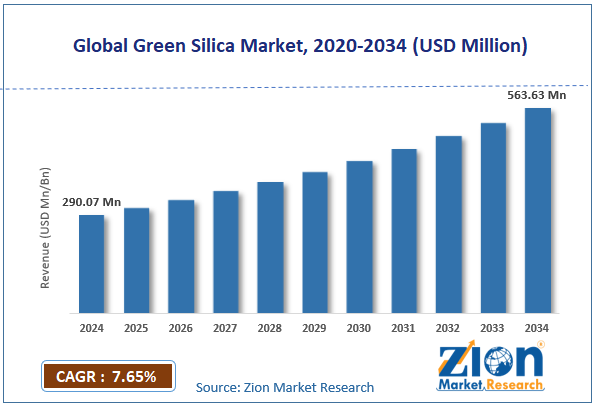
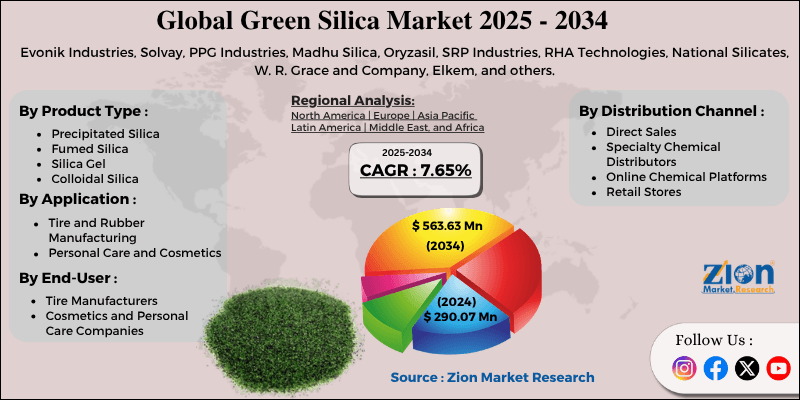
The global green silica market size was worth approximately USD 290.07 million in 2024 and is projected to grow to around USD 563.63 million by 2034, with a compound annual growth rate of roughly 7.65% between 2025 and 2034.
 Request Free SampleRequest Free SampleRequest Free Sample
Green Silica Market: Overview
Green silica is a sustainable form of silicon dioxide derived from eco-friendly sources such as rice husk ash, sugarcane waste, and other agricultural byproducts. It is produced using cleaner processes than traditional silica, helping reduce carbon emissions and turning waste into a useful industrial material. Silica is widely used across industries such as tire manufacturing, personal care, food, paints, coatings, agriculture, and pharmaceuticals. In tires, green silica improves fuel efficiency and grip, while in cosmetics and food products, it acts as a thickening and anti-caking agent. Rice husk ash is one of the most important raw materials, especially in regions like Asia and Africa, where rice production is high.
Converting agricultural waste into high-purity silica helps reduce environmental pollution and adds economic value. The growing focus on sustainability, clean-label products, and eco-friendly manufacturing is driving demand for green silica across industries, making it an important material for supporting both industrial performance and environmental responsibility. The green silica market is driven by sustainability trends, demand for eco-friendly materials, and growing use across industrial applications.
Key Insights
- As per the analysis shared by our research analyst, the global green silica market is estimated to grow annually at a compound annual growth rate of around 7.65% over the forecast period from 2025 to 2034.
- In terms of revenue, the global green silica market size was valued at approximately USD 290.07 million in 2024 and is projected to reach USD 563.63 million by 2034.
- The green silica market is expected to grow steadily, driven by rising demand for sustainable raw materials, increasing adoption in high-performance tire compounds, growing consumer preference for natural personal care ingredients, and expanding food industry interest in clean-label additives.
- Based on product type, the precipitated silica segment is expected to lead the overall green silica market, while the colloidal silica segment is anticipated to grow at a notably fast pace as semiconductor and precision coating applications expand.
- Based on application, the tire and rubber manufacturing segment is expected to lead the green silica market, while the personal care and cosmetics segment is anticipated to grow rapidly, driven by consumer demand for natural and sustainable beauty products.
- Based on end-user, the tire manufacturers segment is the largest current end-user group, while the food processing companies segment is anticipated to grow most rapidly during the forecast period as clean-label ingredient trends gain momentum globally.
- Based on distribution channel, the specialty chemical distributors segment is expected to lead the green silica market, while online chemical platforms are anticipated to grow steadily as digital procurement becomes more common among industrial buyers.
- Based on region, Asia Pacific is projected to dominate the global green silica market during the estimated period, followed by Europe.
Impact of the USA-Israel War on Iran on the Green Silica Market
The ongoing tensions among the United States, Israel, and Iran are expected to influence the green silica market, encouraging stronger supply chain planning and cost management strategies. Fluctuations in global energy prices and disruptions in chemical supply logistics may create short-term cost pressures, but they also open opportunities for localized sourcing and process optimization. Potential challenges in shipping routes, such as the Strait of Hormuz, may affect freight costs, though manufacturers are likely to respond with diversified supply chains and efficient operations to maintain steady growth and market stability.
Green Silica Market: Technology Roadmap 2025–2034
What is the projected development roadmap of the green silica market over the forecast period?
The green silica market is advancing through improved biomass processing, higher purity, broader applications, and stronger environmental validation tools. The market is expected to grow at a compound annual growth rate of around 7.65% over the forecast period, driven by regulatory support for sustainable materials and growing industrial commitment to reducing carbon emissions.
The following roadmap outlines key development phases expected through 2034.
2025–2027: Process Optimization and Feedstock Diversification Phase
- Manufacturers will improve rice husk ash processing to increase silica yield and purity, helping products compete with traditional silica in demanding industries.
- Research into biomass sources such as bamboo ash, wheat straw, and corn cob ash will expand, creating increased raw material options for green silica production.
- Surface treatment methods are expected to become more common, enabling green silica to be used in tires, cosmetics, and food products.
2028–2031: Scale-Up and Market Penetration Phase
- Large-scale production facilities will be set up across Southeast Asia, South Asia, and Africa, since these regions are largely driven by abundant agricultural waste and growing industrial demand.
- Standard certifications and environmental labels will develop, making it easier for industries to trust and adopt green silica in regulated markets.
- Partnerships between silica producers and tire companies will grow, focusing on better materials for high-performance and electric vehicle tires.
2032–2034: Circular Economy Integration and Advanced Applications Phase
- Closed-loop production systems will be widely adopted to reuse water, energy, and chemicals, reducing waste and improving overall manufacturing efficiency.
- High-purity green silica suitable for electronics and semiconductor applications will become commercially available, opening new revenue opportunities for advanced industries.
- AI-driven systems will increasingly manage production processes, helping improve consistency, reduce energy use, and meet strict quality and performance standards.
Green Silica Market: Dynamics
Growth Drivers
What is driving the green silica market growth amid rising sustainability and high-performance material demand?
The green silica market is growing as industries focus on sustainability and high-performance materials. One of the biggest drivers is the tire industry, where green silica helps improve fuel efficiency by reducing rolling resistance, making vehicles consume less fuel and produce fewer emissions. Strict fuel-efficiency rules across regions like North America, Europe, and Asia are encouraging tire manufacturers to use eco-friendly materials, such as green silica. Its plant-based origin also helps companies reduce the environmental impact of their supply chains.
Another important driver comes from consumer goods, especially personal care and cosmetics. Growing awareness of natural, safe ingredients is pushing brands to use materials derived from renewable sources. Green silica, made from rice husk and other agricultural waste, fits well into this demand. It is widely used in toothpaste, powders, and skincare products for its texture and performance benefits. The growing preference for sustainable products and cleaner labels is driving steady demand for green silica across multiple industries.
Sustainability policies and corporate commitments are accelerating the adoption of green silica across industries.
The green silica industry is growing due to government support, sustainability rules, and rising demand from the food industry. Many governments, especially in Europe, are promoting eco-friendly materials through carbon pricing, green procurement policies, and circular-economy initiatives. These measures encourage companies to shift toward sustainable inputs, such as green silica, which is made from agricultural waste and requires less energy than traditional silica production. Using green silica also helps companies reduce emissions and meet environmental goals, making it attractive for businesses focused on sustainability.
Green silica is also used as an anti-caking agent in powdered foods, spices, and food processing. Growing preference for natural and plant-based ingredients is pushing food companies to choose materials derived from renewable sources. Consumers are also becoming more aware of product ingredients, driving demand for cleaner, more sustainable options. These trends are supporting the steady growth of the green silica market across multiple industries.
Restraints
Production consistency challenges and raw material supply variability are key obstacles in the green silica market.
The green silica market faces several restraints that may slow its growth across different industries. One major challenge is the variation in raw materials, as agricultural waste like rice husk ash can differ in quality depending on region, farming conditions, and processing methods, making it difficult to maintain consistent product standards. Industries such as tires and electronics require uniform quality standards, which puts pressure on manufacturers. Strong competition from conventional silica producers is another restraint, as they offer large-scale production, stable supply, and competitive pricing due to established operations.
Convincing companies to shift to green silica requires time, testing, and added costs. Limited awareness and unclear regulations in some regions also slow adoption, as businesses prefer materials with proven performance and clear approval standards. These factors create challenges in scaling production, maintaining quality, and building trust, affecting the overall growth of the green silica market.
Opportunities
How are the electric vehicle adoption and clean-label food trends creating new opportunities in the green silica market?
The green silica industry has strong growth opportunities across fast-growing industries driven by sustainability and performance needs. One major opportunity lies in the electric vehicle sector, where tires require greater strength, lower rolling resistance, and improved grip, making green silica a suitable material for advanced tire designs. As electric vehicle sales increase globally, demand for such materials is expected to rise. The personal care and cosmetics industry also offers significant potential, as brands shift toward natural, eco-friendly ingredients. Green silica, made from agricultural waste, fits well into clean-label products and can replace traditional silica without major changes in production.
Government policies promoting circular economy practices are further supporting market growth. Countries in Europe and Asia are encouraging the use of waste-based materials through incentives and regulations. Green silica producers that can show clear sustainability benefits and reliable supply are likely to gain strong market positions, making it an important material for future industrial and consumer applications.
Challenges
What challenges does the green silica market face in scaling production and competing effectively against conventional silica on price?
The green silica market faces several challenges that can slow its long-term growth. Scaling production from small facilities to large industrial levels is difficult, as converting agricultural waste into high-purity silica requires controlled processes and consistent quality. Managing variations in raw materials while keeping production costs competitive adds further pressure. Pricing is another major challenge, since conventional silica is produced at a large scale and is often cheaper, making it hard for green silica to compete in price-sensitive markets. Many industrial buyers are cautious about switching unless cost differences reduce over time.
Building trust with customers is also a key issue, especially in industries such as tires and electronics, where strict quality standards must be consistently met. New suppliers need time to prove reliability and maintain steady performance over long periods. These challenges make it harder for producers to scale operations, compete on price, and gain wider acceptance in the global green silica market.
 Request Free SampleRequest Free SampleRequest Free Sample
Green Silica Market: Report Scope
| Report Attributes | Report Details |
|---|---|
| Report Name | Green Silica Market |
| Market Size in 2024 | USD 290.07 Million |
| Market Forecast in 2034 | USD 563.63 Million |
| Growth Rate | CAGR of 7.65% |
| Number of Pages | 225 |
| Key Companies Covered | Evonik Industries, Solvay, PPG Industries, Madhu Silica, Oryzasil, SRP Industries, RHA Technologies, National Silicates, W. R. Grace and Company, Elkem, and others. |
| Segments Covered | By Product Type, By Application, By End-User, By Distribution Channel, and By Region |
| Regions Covered | North America, Europe, Asia Pacific (APAC), Latin America, Middle East, and Africa (MEA) |
| Base Year | 2024 |
| Historical Year | 2019 - 2023 |
| Forecast Year | 2025 - 2034 |
| Customization Scope | Avail customized purchase options to meet your exact research needs. Request For Customization |
Green Silica Market: Segmentation
What makes the precipitated silica segment the expected leader in the broader green silica market?
Based on product type, the global market is segregated into precipitated silica, fumed silica, silica gel, and colloidal silica. The precipitated silica segment holds about 55% of the green silica market, driven by its wide use and easy integration across industries, including tire reinforcement, personal care, and food processing. The colloidal silica segment holds around 12% share. It is the fastest-growing, driven by increasing demand from semiconductor manufacturers and precision-coating applications that require very fine, highly uniform silica particles.
How does the tire and rubber manufacturing application segment maintain its leading position in the green silica market?
Based on application, the green silica industry is segmented into tire and rubber manufacturing, personal care and cosmetics, food and beverages, agriculture, and paints and coatings. The tire and rubber manufacturing segment accounts for approximately 48% of the global green silica market share, driven by silica's role in improving tire fuel efficiency and grip performance. The personal care and cosmetics segment holds around 18% share. It is growing rapidly as beauty brands accelerate the transition to naturally derived, sustainably sourced ingredients in their product formulations.
What makes the tire manufacturers segment lead the green silica end-user market?
Based on end-user, the market is divided into tire manufacturers, cosmetics and personal care companies, food processing companies, agricultural input producers, and paint and coating manufacturers. The tire manufacturers segment leads with about 46% share, driven by high silica use, sustainability, and fuel efficiency needs. The food processing companies segment holds around 14% share. It is growing quickly as clean-label trends push food makers toward naturally derived silica-based additives.
How do specialty chemical distributors dominate the distribution landscape of the green silica market?
Based on distribution channel, the green silica market is classified into direct sales, specialty chemical distributors, online chemical platforms, and retail stores. The specialty chemical distributors segment accounts for about 46% of the market, as buyers prefer distributors that offer technical support, local stock, regulatory compliance, and easy sourcing of multiple specialty chemicals. The online chemical platforms segment holds around 9% share. It is growing steadily as chemical procurement increasingly moves toward digital channels, particularly for repeat purchases of well-characterized materials.
Green Silica Market: Regional Analysis
How is Asia Pacific shaping global demand for the green silica market?
The green silica market is led by Asia Pacific and is expected to grow significantly at a CAGR of around 6.8% during the forecast period, driven by strong industrial expansion and abundant agricultural resources across the region. Asia Pacific holds a leading position due to the large availability of raw materials such as rice husk ash, which is widely generated in countries like China, India, and other Southeast Asian nations. These countries produce large volumes of rice, providing a steady, low-cost biomass supply for green silica production. Strong growth in tire manufacturing, automotive production, and the consumer goods industry is increasing demand for sustainable materials. Tire manufacturers across the region are adopting green silica to improve fuel efficiency and meet stricter emission standards. Expanding personal care and cosmetics markets are also contributing to rising consumption, as brands focus on natural and eco-friendly ingredients.
Government support for waste utilization and sustainable manufacturing is further encouraging production and adoption. Increasing exports of green silica from the Asia Pacific to Europe and North America are strengthening its global position. Growing industrialization, rising environmental awareness, and strong supply chain advantages continue to make the Asia Pacific the dominant region in the green silica market. Increasing investments in biomass processing facilities and better supply chain networks are further strengthening regional production capacity. Rising collaboration between manufacturers and end-use industries is also helping expand applications and improve product quality.
What factors help Europe sustain its strong position in the green silica market?
Europe is the second-largest region in the green silica market, growing steadily at a CAGR of around 5.2%, driven by strong environmental regulations and the adoption of sustainable materials across industries. Countries such as Germany, France, and the United Kingdom are leading consumers due to their well-established automotive, chemical, and consumer goods sectors. Strict environmental policies in the region encourage companies to reduce carbon emissions and use materials derived from renewable sources, thereby supporting demand for green silica. Tire manufacturers in Europe are actively using green silica to improve performance and meet fuel efficiency standards set by regulatory bodies. The region also has a strong personal care and cosmetics industry, where companies prefer plant-based ingredients to meet consumer demand for clean-label products.
Food and beverage companies are adopting green silica as a natural anti-caking agent, further supporting market growth. Advanced research and development activities are helping improve product quality and expand applications. Strong awareness about sustainability, combined with regulatory support and technological innovation, continues to position Europe as a key region in the global green silica market. The growing focus on circular economy practices is encouraging wider adoption of waste-based materials, such as green silica, across industries.
Recent Market Developments
- In April 2026, Evonik Industries showcased its latest sustainable silica and advanced material solutions at CHINAPLAS 2026, highlighting innovations focused on the circular economy and energy-efficient applications.
Green Silica Market: Competitive Analysis
The leading players in the global green silica market include;
- Evonik Industries
- Solvay
- PPG Industries
- Madhu Silica
- Oryzasil
- SRP Industries
- RHA Technologies
- National Silicates
- W. R. Grace and Company
- Elkem
The global green silica market is segmented as follows:
By Product Type
- Precipitated Silica
- Fumed Silica
- Silica Gel
- Colloidal Silica
By Application
- Tire and Rubber Manufacturing
- Personal Care and Cosmetics
- Food and Beverages
- Agriculture
- Paints & Coatings
By End-User
- Tire Manufacturers
- Cosmetics and Personal Care Companies
- Food Processing Companies
- Agricultural Input Producers
- Paint & Coating Manufacturers
By Distribution Channel
- Direct Sales
- Specialty Chemical Distributors
- Online Chemical Platforms
- Retail Stores
By Region
- North America
- The U.S.
- Canada
- Mexico
- Europe
- France
- The UK
- Spain
- Germany
- Italy
- Rest of Europe
- Asia Pacific
- China
- Japan
- India
- Australia
- South Korea
- Rest of Asia Pacific
- The Middle East & Africa
- Saudi Arabia
- UAE
- Egypt
- Kuwait
- South Africa
- Rest of the Middle East & Africa
- Latin America
- Brazil
- Argentina
- Rest of Latin America
Table Of Content
Methodology
FrequentlyAsked Questions
Green silica is a sustainable form of silicon dioxide derived from eco-friendly sources such as rice husk ash, sugarcane waste, and other agricultural byproducts. It is produced using cleaner processes than traditional silica, helping reduce carbon emissions and turning waste into a useful industrial material.
The global green silica market is expected to grow, driven by tightening fuel efficiency regulations that push tire manufacturers toward high-performance silica, rising consumer demand for natural personal care ingredients, expanding clean-label trends in the food industry, circular economy policies in major markets, and the ongoing growth of electric vehicle production that requires advanced tire materials.
According to a study, the global green silica market size was worth around USD 290.07 million in 2024 and is predicted to grow to around USD 563.63 million by 2034.
The compound annual growth rate value of the green silica market is expected to be around 7.65% during 2025–2034.
Asia Pacific is expected to lead the global green silica market during the forecast period, driven by abundant rice husk feedstock availability, large domestic tire and personal care industries, strong government support for circular economy development, and rapidly growing electric vehicle production, which is increasing demand for high-performance sustainable tire materials.
The major players in the global green silica market include Evonik Industries, Solvay, PPG Industries, Madhu Silica, Oryzasil, SRP Industries, RHA Technologies, National Silicates, W. R. Grace and Company, and Elkem.
The report examines growth drivers, market restraints, emerging opportunities, competitive landscape analysis, regional breakdowns, and a detailed forecast across all major product types, applications, end-users, and geographic regions through 2034.
The green silica market is evolving toward sustainable materials, clean-label products, and high-performance uses, as industries and consumers increasingly prefer eco-friendly, bio-based, and low-carbon solutions.
The green silica market value chain includes the collection of agricultural waste, conversion into ash, silica extraction and purification, product development, distribution through suppliers, and final use in tires, personal care, food, and industrial applications.
The green silica market offers opportunities in biomass sourcing partnerships, processing technology investments, and collaborations with tire and personal care companies, driven by sustainability demand and expanding industrial applications.

HappyClients

