
Green Shipping Market Size, Share, Trends, Growth and Forecast 2034

Green Shipping Market By Ship Type (Container Ships, Offshore Support Vessels, Bulk Carriers, Naval and Government Vessels, Tankers, Inland and Short Sea Vessels, and Ferries and Passenger Vessels (Including Cruise Ships)), By End User (Commercial Shipping Lines, Port Authorities and Terminals, Passenger Transport Authorities, Offshore and Energy Operators, and Defense and Coast Guard), By Application (Newbuild and Retrofit and Conversion), and By Region - Global and Regional Industry Overview, Market Intelligence, Comprehensive Analysis, Historical Data, and Forecasts 2026 - 2034
| Market Size in 2025 | Market Forecast in 2034 | CAGR (in %) | Base Year |
|---|---|---|---|
| USD 24.6 Billion | USD 105 Billion | 17.5% | 2025 |
Green Shipping Industry Perspective:
What will be the size of the global green shipping market during the forecast period?
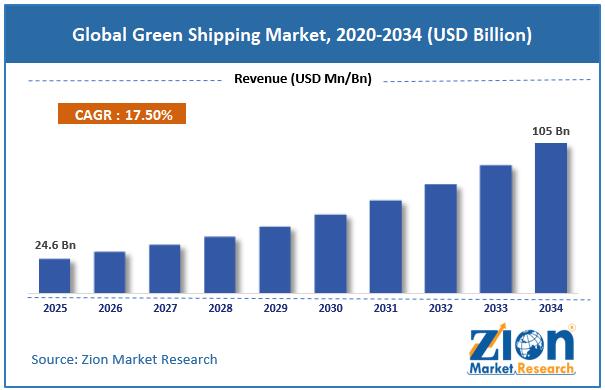
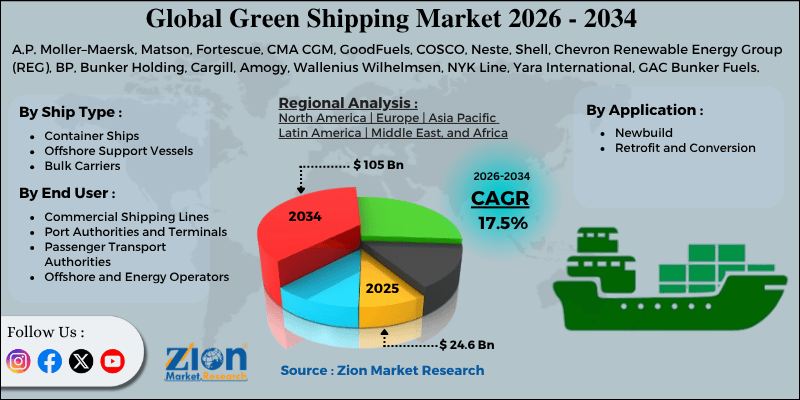
The global green shipping market size was worth around USD 24.6 billion in 2025 and is predicted to grow to around USD 105 billion by 2034, with a compound annual growth rate (CAGR) of roughly 17.5% between 2026 and 2034.
Green Shipping Market: Overview
Green shipping is the implementation of environmentally friendly practices, technologies, and methods in maritime shipping, aimed at ensuring the efficient, environmentally friendly transportation of cargo with minimal impact on the environment. This concept implies reducing emissions of greenhouse gases (GHGs), air and water pollution, and waste by using cleaner fuels, energy-efficient ships, alternative engines, digital routing, and international environmental regulations. Moreover, green shipping methods such as slow steaming, shore power use, ballast water management, and renewable energy sources can be implemented.
Key Insights
- As per the analysis shared by our research analyst, the global green shipping market is estimated to grow annually at a CAGR of around 17.5% over the forecast period (2026-2034).
- In terms of revenue, the global green shipping market size was valued at around USD 24.6 billion in 2025 and is projected to reach USD 105 billion by 2034.
- Rising adoption of alternative and low-carbon marine fuels is expected to propel the green shipping market over the projected period.
- Based on the ship type, the container ships segment held the largest market share in 2025.
- Based on the end user, commercial shipping lines have a significant presence in the green shipping market.
- Based on the application, the newbuild segment is forecast to record a sharp rise in revenues in the green shipping market.
- Based on region, Europe captures the largest market share in the green shipping market.
Impact of the USA-Israel War on Iran on the Green Shipping Market
In the case of the USA-Israel war against Iran, the effect of such conflicts on the development of the green shipping market has been both positive and negative. Short-term negative effects can be seen in the disruption of important maritime transportation lines due to military operations between countries, in this case, the Strait of Hormuz. Such disruptions led to increased fuel expenses and insurance premiums for the ships. Furthermore, attacks on the commercial fleet and uncertainty about navigation conditions have slowed the industry's growth and its sustainability efforts.
Green Shipping Market: Dynamics
Growth Drivers
How do the stringent environmental regulations and decarbonization targets drive the green shipping market?
Stringent environmental laws and decarbonization mandates are among the most powerful drivers of the green shipping industry, as they impose mandatory requirements to reduce emissions rather than voluntary sustainability practices. Government regulations and requirements from international organizations require ship owners to optimize vessel performance, reduce greenhouse gas (GHG) emissions, and switch to environmentally friendly fuel types. To comply with those regulations without facing financial repercussions and maintaining the right to operate on international routes, shipping firms invest in building alternative fuel vessels, energy-efficient engines, CO2 capture technology, voyage optimization using advanced IT solutions, wind-assisted propulsion technology, shore power facilities, and low-carbon maritime fuel types, including green methanol, ammonia, hydrogen, and biofuels. Mandatory regulatory measures stimulate fleet modernization and increase demand for green shipping technologies and solutions.
Such an approach is supported by government policies and goals. According to the International Maritime Organization (IMO), the 2023 GHG Strategy should help the organization to achieve net-zero GHG emissions from international shipping in 2050 or earlier. To reach the goal, some intermediate steps have been established. Thus, by 2030, the IMO should reduce total annual emissions by at least 20%, with a target of 30% considered achievable.
By 2040, the IMO should cut GHG emissions by at least 70% (aiming to reduce them up to 80% compared with 2008). The organization also aims to reduce carbon intensity by 40% by 2030. The IMO should introduce zero- or near-zero-emission fuels and technologies that will comprise at least 5%, but preferably 10%, of international shipping's energy consumption by 2030. Since 1 January 2023, IMO has made it compulsory for existing vessels to comply with EEXI and CII indices.
Restraints
High capital investment and fleet modernization costs hamper the growth of the green shipping industry
Expensive capital investments and ship modernization are significant constraints on the growth of the green shipping sector, as the transition from traditional to environmentally friendly ships requires substantial capital. Ships have to be replaced with ships that feature advanced technology, such as a dual-fuel engine propulsion system and alternative fuel propulsion, which involves retrofitting the fleet with advanced technology, including the air lubrication system, wind-assist propulsion system, battery hybrid system, exhaust gas cleaning system, and the ability to store and handle the new types of fuel, including green methanol, ammonia, and hydrogen. Apart from investing in ships, there is a need to invest in personnel training and digital monitoring systems.
Opportunities
How do the increasing investments in green ports and maritime infrastructure offer a lucrative opportunity for the green shipping market?
The growing investments in green ports and infrastructure represent an important growth opportunity for the green shipping industry, as they create the environment required to enable low- and zero-emission shipping. Governments and private investors are investing heavily in shore power (cold ironing) infrastructure, alternative fuel bunkering for green methanol, ammonia, hydrogen, and liquefied natural gas (LNG), electrification of cargo-handling machinery, renewable energy systems, and smart port infrastructure development. These investments will enable vessels to reduce emissions when docked, increase access to cleaner fuels, shorten turnaround time, and meet growing environmental regulatory requirements. The more ports that can accommodate green vessels, the more shipping companies will be confident in investing in alternative-fuel vessels.
This growth opportunity is being fueled by government investments. The European Union is investing billions of euros in alternative fuels infrastructure through its Alternative Fuels Infrastructure Facility (AFIF), which is part of the Connecting Europe Facility (CEF).
Challenges
How does the limited availability of alternative fuel infrastructure pose a significant challenge to the green shipping market?
Inadequate infrastructure for alternative fuels poses a significant challenge to the development of green shipping, limiting the widespread adoption of eco-friendly fuels such as green methanol, ammonia, hydrogen, and biofuels. Even though shipping organizations have been allocating more resources to acquiring ships that can run on alternative fuels, most ports globally lack the required bunkering, transportation, storage, and safety facilities to supply the fuels. The absence of an extensive refueling network leaves ship owners uncertain about fuel availability during ship transits between countries. This makes it hard for them to use alternative fuel ships.
Green Shipping Market: Report Scope
| Report Attributes | Report Details |
|---|---|
| Report Name | Green Shipping Market |
| Market Size in 2025 | USD 24.6 Billion |
| Market Forecast in 2034 | USD 105 Billion |
| Growth Rate | CAGR of 17.5% |
| Number of Pages | 226 |
| Key Companies Covered | A.P. Moller–Maersk, Matson, Fortescue, CMA CGM, GoodFuels, COSCO, Neste, Shell, Chevron Renewable Energy Group (REG), BP, Bunker Holding, Cargill, Amogy, Wallenius Wilhelmsen, NYK Line, Yara International, GAC Bunker Fuels, Eco Marine Power, Freightera Logistics, ABB, and others. |
| Segments Covered | By Ship Type, By End User, By Application, and By Region |
| Regions Covered | North America, Europe, Asia Pacific (APAC), Latin America, Middle East, and Africa (MEA) |
| Base Year | 2025 |
| Historical Year | 2020 - 2024 |
| Forecast Year | 2026 - 2034 |
| Customization Scope | Avail customized purchase options to meet your exact research needs. Request For Customization |
Green Shipping Market: Segmentation
Ship Type Insights
Why does the container ship segment hold a prominent position in the green shipping market?
The container ships segment held the largest share in the green shipping industry in 2025. This growth is supported by global container shipping growth, environmental regulations, and the shipping industry’s commitment to decarbonizing its operations. The segment is forecast to see revenue growth as major container shipping operators increase investments in dual- and alternative-fuel ships running on green methanol, LNG, biofuel, and, eventually, green ammonia. Container ships sail on predictable routes and dock at large seaports with shore power and alternative fuel bunkering facilities, making them good examples of early adopters of green shipping technologies.
End User Insights
Why does the commercial shipping lines segment capture the largest market share in the green shipping market?
Commercial shipping lines have a significant presence in the green shipping market and are forecast to grow rapidly in revenue as shipping companies move toward low-carbon, energy-efficient operations. Commercial shipping lines include container ships, bulk carriers, tankers, and general cargo vessels that are investing significantly in modernizing their fleets to meet strict environmental standards and customer demands. Commercial shipping lines are turning to alternative marine fuels such as green methanol, LNG, biofuels, as well as green ammonia and hydrogen in the future. They are incorporating energy-saving technologies such as air lubrication, wind assistance, waste heat recovery systems, and AI voyage optimization.
Application Insights
Does the newbuild segment capture the largest market share in the green shipping market?
The newbuild segment is forecast to record a sharp rise in revenues in the green shipping market due to increasing investment from shippers in next-generation ships that help comply with strict environmental laws and achieve future carbon-reduction objectives. Instead of retrofitting old vessels, many shipping firms are choosing to order newbuild ships with advanced fuel systems that can run on green methanol, liquefied natural gas (LNG), ammonia-ready fuels, hydrogen, and other green energy sources. The ships have been designed to feature innovative technologies for energy savings, including efficient hull design, air lubrication technology, a wind propulsion system, hybrid battery systems, a waste heat recovery system, and a digital performance monitoring system.
Regional Insights
Why does Europe lead the green shipping market?
The continent of Europe is poised to drive revenue growth in the green shipping market through its strict environmental regulations, robust decarbonization strategies, and significant investment in sustainable shipping infrastructure. Europe has become a leader in green shipping through policies such as the EU Emissions Trading System for shipping, the FuelEU Maritime Regulation, and the European Green Deal, among others, that motivate shipowners to reduce greenhouse gas emissions and use green fuels in their vessels. These policies have hastened investments in alternative fuel vessels that use fuels like green methanol, liquefied natural gas (LNG), biofuel, and ammonia, among other things, while at the same time promoting.
Green Shipping Market: Competitive Analysis
The global green shipping market is dominated by players like:
- A.P. Moller–Maersk
- Matson
- Fortescue
- CMA CGM
- GoodFuels
- COSCO
- Neste
- Shell
- Chevron Renewable Energy Group (REG)
- BP
- Bunker Holding
- Cargill
- Amogy
- Wallenius Wilhelmsen
- NYK Line
- Yara International
- GAC Bunker Fuels
- Eco Marine Power
- Freightera Logistics
- ABB
The global green shipping market is segmented as follows:
By Ship Type
- Container Ships
- Offshore Support Vessels
- Bulk Carriers
- Naval and Government Vessels
- Tankers
- Inland and Short Sea Vessels
- Ferries and Passenger Vessels (Including Cruise Ships)
By End User
- Commercial Shipping Lines
- Port Authorities and Terminals
- Passenger Transport Authorities
- Offshore and Energy Operators
- Defense and Coast Guard
By Application
- Newbuild
- Retrofit and Conversion
By Region
- North America
- The U.S.
- Canada
- Mexico
- Europe
- France
- The UK
- Spain
- Germany
- Italy
- Rest of Europe
- Asia Pacific
- China
- Japan
- India
- Australia
- South Korea
- Rest of Asia Pacific
- The Middle East & Africa
- Saudi Arabia
- UAE
- Egypt
- Kuwait
- South Africa
- Rest of the Middle East & Africa
- Latin America
- Brazil
- Argentina
- Rest of Latin America
Table Of Content
Methodology
FrequentlyAsked Questions
Green shipping is the implementation of environmentally friendly practices, technologies, and methods in maritime shipping, aimed at ensuring the efficient, environmentally friendly transportation of cargo with minimal impact on the environment.
The green shipping market is primarily driven by stringent environmental regulations and global decarbonization targets, increasing adoption of alternative marine fuels such as green methanol, ammonia, hydrogen, and biofuels, and rising demand for sustainable maritime logistics from cargo owners and multinational corporations.
The green shipping market faces several major challenges, including the high capital cost of fleet modernization, limited availability of alternative fuel bunkering infrastructure, and the high cost and uncertain supply of low-carbon marine fuels such as green methanol, ammonia, and hydrogen.
Based on the application, the newbuild segment is expected to dominate the green shipping market growth during the projected period.
Emerging trends and innovations in the green shipping market include the rapid adoption of alternative marine fuels such as green methanol, ammonia, hydrogen, biofuels, and liquefied natural gas (LNG), along with the development of dual-fuel and zero-emission vessels.
According to the report, the global green shipping market size was worth around USD 24.6 billion in 2025 and is predicted to grow to around USD 105 billion by 2034.
The global green shipping market is expected to grow at a CAGR of 17.5% during the forecast period.
The global green shipping industry growth is expected to be led by Europe over the forecast period.
The global green shipping market is dominated by players like A.P. Moller–Maersk, Matson, Fortescue, CMA CGM, GoodFuels, COSCO, Neste, Shell, Chevron Renewable Energy Group (REG), BP, Bunker Holding, Cargill, Amogy, Wallenius Wilhelmsen, NYK Line, Yara International, GAC Bunker Fuels, Eco Marine Power, Freightera Logistics, and ABB, among others.
The green shipping market report covers the geographical market along with a comprehensive competitive landscape analysis. It also includes cash flow analysis, profit ratio analysis, market basket analysis, market attractiveness analysis, sentiment analysis, PESTLE analysis, trend analysis, SWOT analysis, trade area analysis, demand & supply analysis, Porter’s five forces analysis, and value chain analysis.

HappyClients

